
Part I: Life in Stations – Hegel's Life and Work—Stations of a Path of Thought – Part I: Life in Stations – Full Text
hegel.net/en/hegel-leben-teil1-volltext-1.htm
This is a preliminary version. Feedback and reports of errors are welcome: feedback+en.hegelnet+hegel-leben-teil1@reflexivitypress.com.
Hegel twice wrote down for himself how he had become what he was: in a curriculum vitae he composed in Jena in 1804 for an application, and in a letter to Schelling of 2 November 1800, which contains the sentence that the “ideal of youth” had to “transform itself into a form of reflection, into a system at the same time.” (DE: „zur Reflexionsform, in ein System zugleich verwandeln“)[1] Everything else about his first thirty years we know from others: from letters, from official records of the Württemberg church and of the Bernese and Frankfurt authorities, from album leaves, from recollections that fellow pupils and fellow students often set down decades later, and from the biography that Karl Rosenkranz wrote in 1844 from the family’s papers, some of whose sources are lost (Ch. 12.2).
For these years the sources are so thin that every account must fill the gaps, and it does so in two ways. It infers what can be concluded from evidence, for example from a passport that a journey took place about which Hegel never wrote. Or it interprets, by inferring from what is known about Hegel’s friends and his surroundings to Hegel himself. The two great accounts that this part follows do this to very different degrees. Walter Jaeschke in the Hegel-Handbuch keeps closely to the testimonies and expressly warns against “collages embellished like a novel” (DE: „romanhaft ausgeschmückte[n] Kollagen“) in which one adds up the reports about all of Hegel’s friends and assures us that “the friends” thought thus.[2] Klaus Vieweg’s biography of 2019, by contrast, draws precisely on this milieu and portrays the young Hegel as a member of a network of republicans between Stuttgart, Tübingen, Bern, Frankfurt, and Paris; it also contains a few expressly narrative scenes whose details, by Vieweg’s own account, are documented, “only they did not all take place on one day.” (DE: „nur fanden sie nicht alle an einem Tag statt“)[3] This part sets both readings side by side where they diverge. Among the other recent biographies, that of Horst Althaus (1992) is the first; Jürgen Kaube’s Hegels Welt (2020) places Hegel vividly in the political, scientific, and social world of his time. Both are drawn upon where they offer a detail or an interpretation that can be confirmed against the sources.[4] What is documented by a testimony stands in the text without a mark; what is inferred is described as inferred; an interpretation that goes beyond the testimonies stands in a paragraph marked Reading. or is attributed to its author. A testimony, admittedly, at first proves only that someone reported something; for this reason we say whether a document speaks from the time itself, is a contemporary report, or is a recollection from later years, where that makes a difference for credibility.
Chapter 1: Stuttgart (1770–1788) — Gymnasium and Enlightenment
On Hegel’s childhood there are essentially two sources: a letter that his sister Christiane wrote to the widow after his death, with a few note slips, and the diary that the fifteen- and sixteen-year-old kept between June 1785 and January 1787. In addition there are school essays, excerpts that Rosenkranz still saw, and some records.
1.1 Origins
Georg Wilhelm Friedrich Hegel was born in Stuttgart on 27 August 1770, the eldest son of the ducal revenue-office secretary Georg Ludwig Hegel (1733–1799) and Maria Magdalena Louisa, née Fromm (1741–1783), who came from a Stuttgart family of jurists. In the family he was called Wilhelm. Of the children three survived: Wilhelm, his sister Christiane Luise (1773–1832), and his brother Georg Ludwig (1776–1812), who became an officer and did not return from the Russian campaign.[5] The family belonged to the “Ehrbarkeit,” the Württemberg upper class of officials and clergy from which most of the country’s pastors and professors came.

Hegel’s mother and father
The mother, Christiane reports, was “for the time a woman of education” (DE: „für die damalige Zeit eine Frau von Bildung“); she taught the five-year-old the first Latin declension. In 1783 there was “bilious dysentery and bilious fever” in Stuttgart, which struck the father, the mother, Wilhelm, and his sister: “of the first three one did not know which would die first; our good mother became the victim.” (DE: „von den 3 Ersten wußte man nicht, welches zuerst sterben würde; unsere gute Mutter wurde das Opfer“) Wilhelm was so ill “that he already had the croup and everyone doubted his recovery.” (DE: „daß er schon die Bräune hatte und jedermann an seinem Aufkommen zweifelte“)[6] He did not forget the day of her death. On 20 September 1825 he wrote his sister from Berlin a letter of a single sentence: “Today is the anniversary of the death of our mother, which I always keep in memory.” (DE: „Heute ist der Jahrestag des Todes unserer Mutter, den ich immer im Gedächtnis behalte.“)[7]

Hegel’s birth house in Stuttgart, today hosting a Hegel museum
1.2 School
At three years old Wilhelm entered the German school, an elementary school for reading, writing, arithmetic, and catechism, and at five, as his sister remembered, the “Latin School”; he already knew the first Latin declension from his mother. In Stuttgart the Latin school was the lower division of the Gymnasium illustre, the old Pädagogium: in the five lower classes a preceptor, as class teacher, gave all the instruction, above all in Latin, as in the Latin schools of the provincial towns elsewhere. In the two upper classes, which Hegel attended from 1784, subject professors taught in a manner already like lectures; they prepared pupils for the university. When Hegel entered the lowest class cannot be said exactly. Rosenkranz gives his seventh year; Hegel himself recalled having come to his teacher Löffler in the autumn of 1777, which according to the school records can only have been 1778.[8] According to Christiane’s report he was “from the 10th year until the 18th” (DE: „vom 10ten Jahr an bis ins 18te“) the first of his division and received a prize every year. When he was about eight years old his teacher Johann Jakob Löffler gave him the eighteen volumes of Eschenburg’s translation of Shakespeare, “with the remark: You do not understand them yet, but you will soon learn to understand them” (DE: „mit dem Beisatz: Du verstehst sie jetzt noch nicht, aber Du wirst sie bald verstehen lernen“); first, his sister recalls, “The Merry Wives of Windsor” (DE: „die lustigen Weiber von Windsor“) spoke to him. At ten his father sent him to Karl August Friedrich Duttenhofer, a young mathematics teacher at the Karlsschule and a fellow student of Schiller, who taught him geometry and some astronomy and took him with other pupils “to field surveying” outside the city.[9] The instruction and Hegel’s own reading went far beyond the curriculum. According to his own later report he had “the Wolffian logic by heart from his fourteenth year, the definitions of the idea clara from his twelfth.” (DE: „die Wolffsche Logik schon von seinem vierzehnten, die Definitionen der idea clara schon von seinem zwölften Jahr völlig inne“)[10]
DE: „als Knabe von 3. Jahren wurde er in die deutsche u. im 5ten Jahr in die Lateinischeschule geschickt, in welchem Alter er schon die erste Declination und die dahin gehörigen lateinischen Wörter kannte, die ihn unsere sel. Mutter lehrte“
The diary that Hegel kept from 26 June 1785 to 7 January 1787, partly in German, partly in Latin, is rather a chronicle of his education than a diary in the later sense: it records reading, teachers, conversations, excerpts. The first entry concerns a sermon on the Augsburg Confession of 1530, through which his “historical knowledge” had been increased; when Hegel, as rector of the Berlin University, delivered the festival address on 25 June 1830 for the three hundredth anniversary of this day (Ch. 22.3), forty-five years lay between. On the following day he noted: “No world history has pleased me better than Schröck’s” (DE: „Noch keine Weltgeschichte hat mir besser gefallen als Schröks“); his “principal attention” was “the languages, and indeed really the Greek and Latin.” (DE: „die Sprachen, und zwar wirklich die Griechische und Lateinische“) Contemporary politics appears in the diary once, with the news that peasants, “accursed people,” had “thrown all the windows of the castle at Scharnhausen in on the duke.” (DE: „dem Herzog alle Fenster in dem Schloß zu Scharnhausen eingeworfen“)[11] Rosenkranz still knew of a system of ordering that Hegel set up as a pupil and kept for a long time: whatever seemed to him noteworthy he wrote on a single sheet under a rubric and a keyword and arranged the sheets alphabetically.[12] In the spring of 1785, at fourteen years old, Hegel began almost simultaneously to make extracts, to keep a notebook of definitions, and to write a diary. From June 1785 his earliest surviving letter also dates, to a schoolfriend named Haug, to whom he reports observations on insects and an epigram of Kästner’s on Kepler.[13]
The teachers whom Hegel names were men of the Enlightenment: at the Gymnasium the mathematician and physicist Philipp Heinrich Hopf and the theologian Heinrich David Cleß, with whom the pupil went walking; outside the school the philosopher Jakob Friedrich Abel, professor at the Hohe Karlsschule and there Schiller’s teacher. According to Abel’s own recollection he met in the Hegel household with Hopf and “several young people to whom I assigned essays and corrected them.” (DE: „mehreren jungen Leuten zusammen, denen ich Aufsäze auf gab u. corrigierte“) Hegel noted in July 1785 that Abel and Hopf had visited “our societies” and gone walking with them; Christiane counted both among the early patrons of her brother, Rosenkranz among the teachers whom Hegel accompanied on walks or who visited the paternal house. That Abel taught the pupil is attested only by his late autobiography. In the Hegel literature this Stuttgart role of Abel’s has long been overlooked; it was first duly appreciated by Alexandra Birkert in Hegels Schwester. Hegel was confirmed by Georg Friedrich Griesinger, the later prelate. What Hegel excerpted was late Enlightenment: Feder’s Neuer Emil, Sulzer, Garve, Campe, Zimmermann’s book on solitude, Nicolai’s travel account, Mendelssohn’s Phädon and his essay on the question of what enlightenment is. Kant he first encountered in the last school summer in two reviews of the Allgemeine Literatur-Zeitung that he excerpted: on Ulrich’s Eleutheriologie, hence on the question of freedom, and on Rehberg’s writing on the relationship of metaphysics and religion.[14] The treatises of the Gymnasium student bear the same tone. The essay “Ueber die Religion der Griechen und Römer” of 10 August 1787 sees in the adherents of the old popular religion “people without enlightenment, with a lively imagination,” (DE: „Menschen ohne Aufklärung, mit einer lebhaften Einbildungskraft“) who fall victim to cunning priests, and finds the same in his contemporaries: “The rabble of all peoples ascribes sensory and human properties to the deity and believes in arbitrary rewards and punishments.” (DE: „Der Pöbel aller Völker schreibt der Gottheit sinnliche und menschliche Eigenschaften zu und glaubt an willkührliche Belohnungen und Bestrafungen.“)[15] On 25 September 1788 Hegel spoke at the Gymnasium’s farewell ceremony as the last of the graduates who, according to the program, had to speak on the Turkish Empire; he was assigned the state of the sciences among the Turks, and he closed with the thanks of the departing. The contrast served the praise of a prince who was convinced of the “general and widespread usefulness of the sciences,” (DE: „allgemeinen und ausgebreiteten Nutzen der Wissenschaften“) and of a school that educates “for the state members useful and suited to its needs.” (DE: „dem Staat für seine Bedürfnisse brauchbare und nützliche Mitglieder“) His written work was praised, his delivery, as earlier, criticized.[16]
With Abel Hegel had the same teacher as Schiller, though not in school but as a private teacher and patron; in Tübingen Abel then became his academic teacher. Abel had taught philosophy at the Karlsschule and been there “teacher and friend of Schiller” (DE: „Lehrer und Freund Schillers“); Schiller dedicated Fiesko to him. In 1790 Abel went as professor of philosophy to Tübingen, where he met his former pupil again; theses of Abel’s against Reinhold underlay the magister disputation of 1792, in which Hegel took part as opponent. The influence of the teacher declined in Tübingen, and in 1795 Hegel suspected to Schelling that a reviewer who “truly showed no depth” (DE: „wahrlich keinen Tiefsinn gezeigt“) would “probably be Abel.” (DE: „wohl Abel sein“)[17] Schiller’s works accompanied Hegel from his school days. Rosenkranz still knew of an analysis of Fiesko that is lost; Christiane, by his report, loved in her poems “like her brother, the Schillerian tone” (DE: „wie ihr Bruder, den Schiller’schen Ton“); in one of the historical fragments that Rosenkranz printed, Hegel contrasts the Homeric world with the “newer human world,” in which one sees, “next to Amalie’s heavenly pure soul, Schufterle roast children over the fire,” (DE: „neben Amaliens himmlischer reiner Seele, Schufterle Kinder am Feuer braten“) an image from The Robbers, whose motto “In tyrannos!” Stäudlin wrote in Hegel’s album in 1793 (Ch. 2.3).[18]
1.3 The Stuttgart Circle
How far Hegel as a pupil was already drawn into the political conversations of his city is disputed. The diary is silent on it. Vieweg, by contrast, describes a circle of young people to which Hegel belonged and which represented “youthful ideals of freedom”: the poet Gotthold Friedrich Stäudlin, who tried to continue Schubart’s banned Chronik; Georg Kerner, who co-founded a political club at the Karlsschule and later lived in Paris as an adherent of the Girondists; schoolmates such as Jakob Friedrich Märklin and Christian Friedrich Autenrieth, who moved with Hegel to the Stift; and besides them the sisters and female friends, among them Christiane Hegel. Abel and Hopf, Vieweg writes, “probably regularly” met with young people in the “house of the Hegels” (DE: „wohl regelmäßig im ‚Haus der Hegels‘“); both were members of the Illuminati order, Abel from 1783 head of the Stuttgart group.[19]
Reading. The evidence for this circle consists of album leaves, letters of third parties, and later recollections; for Hegel himself they attest acquaintances, not a conviction. That he was friends with Stäudlin is shown by the latter’s letter of 14 December 1793 to Bern (Ch. 2.4); a closeness to the family is contemporaneously documented already from the school years: Christian Friedrich Stäudlin, a younger brother of the poet, was Hegel’s schoolmate in the sixth class, and the diary names him in June 1785 among the pupils of a loose society against which the professors warned the Primi;[20] for a friendship with Kerner there is no such testimony of Hegel’s or Kerner’s. That the Gymnasium student shared the republican hopes of these friends is an obvious conjecture, but a conjecture. Jaeschke stresses the opposite: the surviving texts of the pupil breathe “the spirit of a somewhat dry late Enlightenment,” (DE: „den Geist der etwas trockenen Spätaufklärung“) and of the great philosophical works of these years, Kant’s Critique of Pure Reason or Jacobi’s little book on Spinoza, “no echo” (DE: „kein Echo“) is found in them.[21] Both findings do not exclude one another. The seventeen-year-old who held up enlightenment against the popular faith of all times was a child of the same Enlightenment from which in Stuttgart the first adherents of the Revolution also came.
How a Württemberger of Hegel’s background studied was prescribed. Whoever passed the Landexamen could be admitted as a stipendiary to the Tübingen Stift and became a pastor; Hegel sat the Landexamen for the first time in September 1780; in 1783 he was absent ill.[22] Before admission he and his father signed a deed of obligation: he would direct himself “solely to theologiam” (DE: „allein auf die Theologiam“) in order to serve the duke in church or school; if he later refused service, he would have to repay the costs, “for each year, for board alone, sixty gulden.” (DE: „für jedes Jahr, allein vor die Kost, Sechzig Gulden“)[23] In October 1788 he went to Tübingen.
Chapter 2: Tübingen (1788–1793) — Stift, Friends, Revolution
The five Tübingen years are those about which the most is told and the least transmitted. From Hegel himself there survive from them four required sermons, a few fragments, and an album; what else is known stands in records of the Stift and in recollections that were in part written down fifty years later.[24] These very years have become famous through the names of his fellow students, Hölderlin and Schelling, and through the French Revolution, which fell in their middle.
2.1 The Stift
On 21 October 1788 Hegel was admitted by ducal order to the “Stift,” the stipendium theologicum in the former Augustinian monastery on the Neckar.[25] There the stipendiaries lived under a monastic order: common prayer in the morning, lectures, meals with reading, fixed hours for going out, supervision by repetents, a “famulus” who reported infractions, and detention as punishment. Karl Friedrich Reinhard, who had left the Stift some years before Hegel and later became a French diplomat, described the contrast between “the free, almost wanton way of thinking … and the extremely slavish way of treatment to which one is subjected” (DE: „der freyen, beynahe ausgelassenen Denkungsart […] und der höchst sclavischen Behandlungsart, der man unterworfen ist“) so sharply that it let “the thinker foresee a revolution.” (DE: „den Denker eine Revolution ahnden“)[26] Hegel himself landed in detention in 1791 for unauthorized absence; according to Rosenkranz, he and friends had stayed in the evening with a comrade until provision was made for his homecoming.[27]

The Tübinger “Stift” (hegel.net photo)
The course of study began with two years of philosophy at the arts faculty. Already six weeks after matriculation, on 3 December 1788, the new students received the dignity of Baccalaureus, and Hegel, as primus of the Stuttgart “promotion,” had to give the speech of thanks, which is not preserved. Philosophy was taught at that time by the late Enlightener August Friedrich Bök and by Johann Friedrich Flatt, who engaged critically with Kant; Flatt’s lecture on empirical psychology had an after-effect in Hegel’s Bernese manuscript on psychology (Ch. 13.2).[28] On 22 September 1790 Hegel received the Magister degree. For it he defended, together with Hölderlin, Fink, and Autenrieth, a dissertation written by Bök, De limite officiorum humanorum seposita animi immortalitate; that Rosenkranz took it for Hegel’s own work was a misunderstanding of the Magister program. From Hegel himself came two specimina of this year, on “the judgment of common sense on objectivity and subjectivity of representations” (DE: „das Urtheil des gemeinen Menschenverstands über Objectivitaet und Subjectivitaet der Vorstellungen“) and on “the study of the history of philosophy” (DE: „das Studium der Geschichte der Philosophie“); both are lost.[29]
On 22 November 1790 Hegel enrolled in the theological faculty. Here taught Gottlob Christian Storr, head of the Tübingen supranaturalist school, Chancellor Johann Friedrich Le Bret, and, from 1792, also Flatt. Hegel could, as Christoph Theodor Schwab reports, “not stand” Storr’s doctrine of faith, and according to Christiane he wanted “as Magister still to study law.” (DE: „als Magister noch die Rechte studieren“) His friend Christian Philipp Friedrich Leutwein named as obstacle “his father’s opposition”; the change would have required leaving the Stift and repaying the costs.[30] In 1791 Hegel was away for several months on a cure in Stuttgart because of a persistent fever, and again at the beginning of 1793. His four practice sermons of 1792/93 are required pieces. In June 1793 he defended with Hölderlin and seven others a dissertation by Le Bret on the misfortunes of the Württemberg church after the Reformation and completed the course of study as fourth of his promotion.[31]
The fourth rank occupied Hegel’s fellow students. Leutwein wrote decades later that Hegel had been set back behind Märklin in the promotion, for which his “ingenious conduct” and his irregular attendance at lectures had provided the pretext; that had left “a lasting wound in his heart” (DE: „eine bleibende Wunde in seinem Herzen“) and been “the secret spring of the change” (DE: „der geheime Ressort der Veränderung“) that went on in him after the years of study.[32] Whether one follows Leutwein in this depends on how much one trusts a report that explains a philosophical career from a slight. What is certain is that the Stift’s final certificate recorded Hegel’s strengths and weaknesses: “Studia theologica non neglexit”, “Philologiae non ignarus”, and “philosophiae multam operam impendit”, he had worked much on philosophy. In the Stuttgart testimonial book of the consistory this became “nullam operam”, no effort; a later hand noted in the margin: “lege: multam secundum testimonia Tubingensia” (read: much, according to the Tübingen testimonials). From the false reading Rudolf Haym inferred in 1857 that Hegel’s teachers had certified him to be “an idiot in philosophy” (DE: „ein Idiot in der Philosophie“).[33]
2.2 Friends
In the recollections of his fellow students Hegel is an agreeable companion, over wine and at Tarock, clumsy at dancing, but devoted to girls. In 1791 he courted Auguste Hegelmaier, the daughter of a deceased professor of theology, whom many sought; in the album stands “Vive A!” His fellow student Georg Friedrich Fallot drew him there as a stooped old man on crutches: “God stand by the old man.” (DE: „Gott stehe dem alten Mann bey“) The nickname “the old man” stuck to him; Hölderlin alluded to it as late as 1796.[34] As his closest friend Rosenkranz names Johann Christian Friedrich Fink, “Hegel’s most faithful comrade” (DE: „Hegel’s treuesten Camaraden“); but Fink was also a main source of his report. Further friends were Leutwein, Fallot, Märklin, and the primus of the cohort, Carl Christoph Renz, whom Hegel held to be an excellent connoisseur of Kant.[35]

THE OLD MAN (Hegel’s Stammbuch - Universitätsbibliothek Stadt Tübingen) A page from Hegel’s album at the Tübingen Stift, where with a message by classmate Georg Friedrich Fallot: “May God help the old man; Vive A!”.
With Hölderlin and Schelling, who later became famous, Hegel lived from 1790 in the same room. This circumstance has fed the notion of a “constellation of three” that hatched the philosophy of German idealism in the Stift; Vieweg speaks of the “divine triangle” that “inhabited the most extraordinary student room of all times.”[36] Jaeschke counters with what Hölderlin wrote to his sister about the room: “Seven of my cohort are in it. […] And the few others are also fine people, among them Breier and Schelling” – thus at least ten students. A particularly close bond among the three cannot be read from the sources of the Tübingen period; Hölderlin’s closest friends were Neuffer and Magenau, and Schelling’s son reports that his father’s friendship with Hegel related “more to their scientific mode of thinking” than “to the sociable, to which Hegel went elsewhere.”[37] Only the letters of the years 1794 and 1795 show what united the three. Hölderlin reminds Hegel that they parted “with the watchword – Kingdom of God! from one another,” and Hegel writes to Schelling: “Reason and freedom remain our watchword, and our point of union the invisible church.”[38]
What Hegel read in Tübingen, the witnesses report differently. Leutwein, who was close with him for four years, wrote: “His hero was Jean Jacques Rousseau, in whose Emile, Contrat social, Confessions” (DE: „Sein Held war Jean Jacques Rousseau, in dessen Emil, Contrat social, Confessions“); metaphysics was not his thing, “in Tübingen even Father Kant was not well known to him,” (DE: „in Tübingen war ihm nicht einmal Vater Kant recht bekannt“) he was an “eclectic” and “still roamed cavalierly in the realm of knowledge.” (DE: „schweifte noch im Reiche des Wissens cavalieremente herum“) Leutwein had also noticed a special delight of Hegel’s in the Book of Job, “because of the unruly natural language he found in it.” (DE: „wegen der ungeregelten Natursprache, die er darin antraf“) Schwab, by contrast, reports that Hegel studied “Kant” eagerly. Jaeschke holds Leutwein’s report more reliable, since Hegel’s Bernese letters do not suggest an intensive study of Kant in Tübingen.[39] Vieweg weights things differently: Hegel acquired in Tübingen an “immense knowledge” from Plato to Kant and Reinhold and became familiar, through Flatt’s skeptical objections to Kant and Reinhold, with ancient skepticism, which became important for his later dialectic; the “cavalierly” fits as little as the charge of eclecticism.[40]
2.3 The Revolution in the Stift
That the French Revolution was received enthusiastically in the Stift is well attested, and by the authorities themselves. A visitation in 1791 found “behavior contrary to subordination” in a large part of the stipendiaries; the ephorus Schnurrer admitted in 1793 that the young people were “for the most part infected by the freedom-vertigo” (DE: „großenteils von dem FreyheitsSchwindel angesteckt“); a ducal rescript of 13 August 1793 called the mood “extremely democratic.” (DE: „äußerst democratisch“)[41] Rosenkranz reports: “A political club formed in the Stift. One kept the French newspapers.” (DE: „Es bildete sich im Stift ein politischer Clubb. Man hielt die Französischen Zeitungen.“) Pinkard names as founder of the club Christian Ludwig Wetzel, who had brought the text of the Marseillaise from Strasbourg and was expelled from the Stift as a democrata in May 1793; Schelling was interrogated by the Duke during the visitation, Hegel was not.[42] Hegel’s album from these years contains entries by friends that leave no doubt where they stood. The theology student André Billing of Colmar wrote in it that a government of angels would govern itself democratically, Heinrich Knapp “Fatherland and freedom!”, Stäudlin “In tyrannos!”, the motto of Schiller’s Robbers, with the name of Ulrich von Hutten below.[43] The events in France were known at close hand to the stipendiaries from French-speaking Mömpelgard (Montbéliard) on the border with France; through them the Revolution worked especially directly into the Stift. They lived in a room of their own, and an official report complained that they brought about “nothing good through their degenerate sense of freedom.” (DE: „durch ihren ungearteten Freiheitssinn nichts Gutes“) With two of them, Fallot and Georg Ludwig Bernard, and with their compatriot Frédéric Jeanmaire, Hegel was, according to Vieweg, closely acquainted; Bernard wrote in an album “Vive la liberté française.”[44]
For Hegel himself, by contrast, there is, as Jaeschke says, “not a single contemporary statement by or about Hegel on his position at that time toward the Revolution and the currents that arose in its wake — unlike for instance with Hölderlin.”[45] What one reads about Hegel as friend of the Revolution comes from later tales, and the best known is invented. Albert Schwegler, who in 1839 asked in the Stift for recollections, reported that Hegel had been “the most enthusiastic orator of freedom and equality,” (DE: „der begeistertste Redner der Freiheit und Gleichheit“) and that one Sunday, “a beautiful clear spring morning,” (DE: „ein schöner klarer Frühlingsmorgen“) Hegel and Schelling with a few friends went to a meadow near Tübingen and raised a freedom tree. Rosenkranz printed that in 1844 and called it himself “mythical traditions” that were “on the whole not incorrect.” (DE: „im Ganzen nicht unrichtig“)[46] Since Schwegler’s source, Leutwein’s report, is known, the freedom tree is, according to Jaeschke, “to be rejected as a product of his myth-making power.” (DE: „Produkt seiner mythopoietischen Kraft zu verwerfen“) Another report places such a festival on 14 July 1793, the anniversary of the storming of the Bastille; by then Hegel was no longer in Tübingen.[47] Vieweg and Pinkard too consider the story unattested.[48] Horst Althaus had still told it as fact in 1992.[49]
Reading. Vieweg makes from the testimonies about the milieu a statement about Hegel: He was “despite his often cautious acting one of the central figures of the student adherents of the Revolution in Württemberg,” (DE: „ungeachtet seines oft vorsichtigen Agierens eine der Zentralfiguren der studentischen Revolutionsanhänger in Württemberg“) with sympathies for the Girondists, probably a spokesman of the club and member of the “Unsinnskollegium,” whose membership an album entry by Griesinger of 1 January 1793 attests.[50] Pinkard formulates more cautiously that Hegel was a member of the club. Domenico Losurdo reads the texts themselves politically: When the young Hegel set a “folk religion” on the Greek model against the Christian religion of the private person, one hears in it the echo of the national festivals Robespierre introduced in France.[51] Jaeschke warns against such generalizations already in the plural “the Stiftler,” which assumes the students had one opinion in politics and theology.[52] This book keeps to the distinction: What is attested is that Hegel lived among friends of the Revolution, was friends with them, and that they wrote their watchwords in his album; his own position on the Revolution first becomes graspable in the Bernese letters (Ch. 3.2). The report that in later years he drank on 14 July to the storming of the Bastille is, by contrast, attested by a contemporary (Ch. 12.5).
2.4 Conclusion and the Way to Bern
On 10 July 1793 Hegel left Tübingen, as the ephorus Schnurrer wrote to a colleague, “under the pretext of a cure” (DE: „unter dem Vorwande einer Cur“); his “long stay at home, where he himself perhaps counts for more than the father, might be no proper preparation for the not exactly unconstrained life of a private tutor.”[53] In the Stuttgart summer months Hegel probably wrote the so-called Tübingen Fragment “Religion is one of the most important concerns,” (DE: „Religion ist eine der wichtigsten Angelegenheiten“) which presupposes Kant’s just-published writing on religion (Ch. 13.1). According to Rosenkranz he walked much that summer with Stäudlin; Stäudlin later wrote to him in Bern of the hours they spent together.[54]
The post in Bern came about through several hands, as Hans Strahm has reconstructed from Bernese letters. The Bernese patrician Carl Friedrich von Steiger sought a house tutor and had a Tübingen Magister recommended via the writing master David von Rütte, who turned out to be little suited. A Stuttgarter named Hauff, then in Tübingen, proposed Hegel instead on 10 July 1793. The landlord of the inn “Zum goldenen Ochsen” in Stuttgart, Johannes Brodhag, made inquiries and reported on 28 July that his informants had “given M. Hegel the best testimony that he is an upright man, and very good as a private tutor for young gentlemen” (DE: „dem H.M: Hegel das Beste zeugnis gegeben, daß er ein rechtschaffener Mensch seye, u. sehr guth vor Junge Herren als Hofmeister Tauge“). Brodhag’s inn had been visited years before by the young Schiller; Pinkard remarks that the landlord later became famous in the Schiller biographies.[55] Hegel hesitated; he doubted whether the offered “15 Louisd’or will suffice for meeting the necessary needs” (DE: „15 Louisd’or zur Bestreitung der notwendigen Bedürfnisse hinreichend sein werde“), and he told Brodhag of a Stuttgart Magister who, as a private tutor not far from Geneva, received 25. On 11 September Hegel accepted.[56]
What made him hesitate is not entirely clear. He needed permission to take the final examination before the Stuttgart consistory early, and perhaps he was waiting for a second post that Stäudlin wanted to arrange for him through Schiller, a private-tutor position with Charlotte von Kalb in Waltershausen. On 20 September Stäudlin wrote to Schiller that Hegel was “already engaged as private tutor to Bern” (DE: „bereits als Hofmeister nach Bern engagiert“) and had drawn his friend Hölderlin’s attention to the post with Frau von Kalb. Hölderlin accepted it and wrote to Hegel a year later: “Were our friendship not, you would have to be a little annoyed that you ceded your good fortune to me.” (DE: „Wäre unsere Freundschaft nicht, Du müßtest ein wenig ärgerlich sein, daß Du Dein gutes Schicksal mir abtratest.“) Why Hegel preferred Bern, whether because of the republic, the proximity to France, or for a third reason, can, according to Jaeschke, “no longer be made out.” (DE: „nicht mehr zu erkennen“)[57] Vieweg enumerates a series of possible reasons, from the image of Switzerland as land of freedom in Rousseau, Stäudlin, and Meiners to the prospect of working as publicist or educator of the people; he remarks himself that many of these hopes were disappointed.[58]
On 19 September at eight in the morning Hegel was examined, on 20 September he had passed the examination “to satisfaction.” The consistory permitted him the post “on condition that he practice preaching diligently, in which he is still very lacking, and immediately follow any call to his fatherland” (DE: „unter der Bedingung, daß er sich fleißig im Predigen übe, woran es ihm noch sehr fehle, und jedem Ruf in sein Vaterland sogleich Folge leiste“); he should “mindful of his chief determination not neglect the study of theology.” (DE: „seiner Hauptbestimmung eingedenk das Studium der Theologie nicht vernachlässigen“)[59] Eleven years later Hegel wrote in his Jena curriculum vitae that he had chosen the private-tutor positions because they left him time “to follow the course of the science that I had made the determination of my life.” (DE: „den Gang der Wissenschaft zu verfolgen, die ich zur Bestimmung meines Lebens gemacht hatte“)[60] The “evening of farewell,” 9 October 1793, he celebrated in the circle of his Stuttgart friends; the album entries of these days are by Tübingen and Stuttgart friends of the Revolution, by Billing, Griesinger, Christoph Heinrich Pfaff, and a Greek student of the Karlsschule. Probably on 10 October he traveled to Bern.[61] Christiane noted later: “Autumn 1793 Switzerland, over 3 years; came back turned in on himself, only in the familiar circle merry.” (DE: „Herbst 1793 Schweiz, über 3 Jahre; kam in sich gekehrt zurück, nur im traulichen Zirkel fidel.“)[62]
Chapter 3: Bern (1793–1796) — Private Tutor and Reader
Hegel’s Bernese years are the loneliest of his life and at the same time those in which he wrote his first larger manuscripts. About his life in the Steiger household little is known, about his thoughts more, because he wrote them to Schelling and Hölderlin.
3.1 In the Steiger House
Carl Friedrich von Steiger, captain and former bailiff at Erlach, belonged to one of the leading patrician families of the Republic of Bern. Whether his line, the Steiger von Tschugg, stood at a distance from the Bernese government is disputed. Hans Strahm thought it had withdrawn from politics since Carl Friedrich’s father had lost in the struggle for the office of Schultheiß; Martin Bondeli counters that Carl Friedrich was more strongly entangled in Bernese politics than father and older brother and embodied “more clearly the type of the politically and militarily trained patrician.” (DE: „deutlicher den Typus des politisch und militärisch geschulten Patriziers“)[63] The family spent the winter in its house at Junkerngasse 51 in Bern, the summer on the estate at Tschugg near Erlach, between the lakes of Biel and Neuchâtel. The Bernese passport that Hegel received in May 1795 calls him “Gouverneur des enfants de notre cher et féal Citoyen Steiguer de Tschougg,” tutor of the children of our dear and faithful citizen Steiger von Tschugg.[64] Hegel had two children to teach, the eight-year-old Maria Catharina at the start of his service and the six-year-old Friedrich Rudolf; expected were knowledge “in the Reformed religion, in languages, especially in the French writers, on natural history, history, geography, and arithmetic,” (DE: „in der reformierten Religion, in den Sprachen, besonders in den französischen Schriftstellern, über Naturgeschichte, Geschichte, Geographie und Arithmetik“) further “good conduct and knowledge of music.” (DE: „gute Conduite und Kenntnisse in der Musik“) The only surviving letter of Hegel to his employer, of 9 July 1795, shows that in the latter’s absence he also supervised the work on the estate, for instance in the gravel pit; such written reports were expected in the Steiger household from the higher employees when the master of the house was away.[65] Hegel was among these. Steiger wrote to his wife on 25 October 1795: “Donnes moi de tes nouvelles, ce que vous faites, vous, nos enfants et Melle Rönner et Mr Hégel, j’espère que vous vous rassemblés le Soir pour que les enfants ne soyent pas abandonnés aux Domestiques. Mr Hégel est-il contant d’eux?” (Give me news, what you are doing, you, our children, and Mademoiselle Rönner and Monsieur Hegel; I hope you gather in the evening so the children are not left to the servants. Is Monsieur Hegel content with them?) Otherwise Hegel appears in the family letters mostly where errands are discussed, for instance when he was to procure “gazettes” for the master of the house; Steiger’s sisters occasionally had greetings passed to Monsieur “Héguel.”[66] A conflict is not recorded. Only a letter of Steiger’s brother Johann Rudolf of 7 November 1796, from the weeks of Hegel’s departure, shows an ill humor: “Je suis fâche du désagrément que le Sieur Hegel t’as causé. Je sais ce que valent les têtes du Wurtemberg, d’ailleurs la mauvaise tête est un apanage de la bêtise et il faudrait pas être souabe pour ne pas l’être” (I am sorry for the annoyance that Herr Hegel caused you. I know what the heads of Württemberg are worth; besides, stubbornness is a prerogative of stupidity, and one would have to not be a Swabian not to have it). In what the annoyance consisted is not known, for Steiger’s letter to his brother is lost.[67]

Tschugg bei Erlach (Aquarel of around 1820) The estate of the von Steiger family, where Hegel taught as a tutor for their children
Hegel soon complained of loneliness. His “too heterogeneous and often interrupted occupation” (DE: „zu heterogene und oft unterbrochene Beschäftigung“) let him “get to nothing proper,” (DE: „zu nichts Rechtem kommen“) he wrote to Schelling on Christmas Eve 1794, and in August 1795: “You cannot believe how good it does me, in my solitude, to hear something from time to time from you and my other friends.” (DE: „Du kannst nicht glauben, wie wohl es mir tut, in meiner Einsamkeit von Dir und meinen andern Freunden von Zeit zu Zeit etwas zu hören.“) He missed the “distance from the scenes of literary activity” (DE: „Entfernung von den Schauplätzen literarischer Tätigkeit“) and the “use of a library.” (DE: „Gebrauch einer Bibliothek“)[68] The library at Tschugg was rich. Its handwritten catalog in the Tschugg archive lists nearly 2000 titles in about 3500 volumes, mostly literature of the French and English Enlightenment, natural and state law from Machiavelli to Rousseau, the Encyclopedists, much history, a collection of Revolution writings of the years 1789 to 1793, and newspapers up to the Gazette de Berne of 1789 to 1797; Hegel read there Montesquieu, Hume, Gibbon, Thucydides. Kant and recent German philosophy were wholly absent, and with them the writings by which the debate his friends were conducting in Tübingen and Jena could be followed.[69] Of his company in Bern little is known: the artist Johann Valentin Sonnenschein from Stuttgart, in whose family one played “clavier,” sang “especially Schillerian songs,” (DE: „besonders Schiller’sche Lieder“) and amused oneself “with a round of Boston” (DE: „an einer Partie Boston“) and who wrote to him in Frankfurt on 13 November 1797: “Joy, beautiful spark of the gods! is sung often enough in your memory,” (DE: „Freude, schöner Götterfunken! wird oft genug zu Ihrem Andenken gesungen“) and the Tübingen fellow student Mögling, who was likewise a private tutor nearby and frequented the Steiger house.[70] Sonnenschein had taught academic drawing since 1792 at the Politisches Institut of the Bernese academy, at which the Kantians Johannes Samuel Ith and Philipp Albert Stapfer taught philosophy and philology; the institute lay on the Herrengasse, a few hundred meters from the Junkerngasse. Whether Hegel knew Ith or Stapfer is not documented. Jaeschke assumes he had no contact with Stapfer’s circle; Vieweg considers an acquaintance possible, and Bondeli and Linneweber-Lammerskitten consider it very probable but admit that “to this day proofs” are lacking.[71]
Reading. The picture of the isolated private tutor has been contested in Swiss scholarship. Hans Strahm pointed to the library at Tschugg, Ludwig Hasler and above all Martin Bondeli to the intellectual life of Bern. There Fichte had stayed some days at the end of October 1793, about the time of Hegel’s arrival, and demonstrably visited the Danish poet Jens Baggesen and the Kantian Ith; Baggesen, who through his marriage to a granddaughter of Albrecht von Haller was connected with Bern and stayed in the city several times until the beginning of 1795, led the debate there on Fichte’s Wissenschaftslehre, and after 1795 young Bernese like Johann Rudolf Steck went to Jena to hear Fichte. Bondeli concludes that Hegel could have found in Baggesen someone who “can inform him on the latest philosophical efforts of Reinhold and Fichte most exactly and relatively early — from mid-1794” (DE: „über die neuesten philosophischen Bemühungen Reinholds und Fichtes genauestens und verhältnismäßig früh – ab Mitte 1794 – informieren kann“); his reserve toward the new speculation was not ignorance but “resolute skepticism,” in which he met Baggesen. Hegel’s approaches were “in their basic conception and also in many of their details related” (DE: „in seinem Grundkonzept und auch in vielen seiner Details verwandt“) to Bernese Kantianism.[72] Jaeschke counters that the question remains open “how far Hegel’s position enabled him to take part in this life” (DE: „wieweit Hegels Stellung es ihm ermöglicht hat, an diesem Leben teilzunehmen“); the names that fall in the friends’ letters, Baggesen and Emilie von Berlepsch, Hegel never mentions in the surviving letters.[73] What Bondeli documents is proximity: the paths, the books, the persons, Hölderlin’s question about Baggesen. A meeting of Hegel with Baggesen, Ith, or Stapfer he does not document, and he says so himself. Between the two findings lies what Hegel’s own complaints say: that he lacked not company but the conversations in which at that time in Jena and Tübingen philosophy was being driven further.
3.2 Bernese Politics
Bern was a republic, but an oligarchy of a few families, and it was split over the French Revolution into a “war party” around the Schultheiß Niklaus Friedrich Steiger and a “neutralist or peace party” friendly toward France under Frisching. Hegel described the elections to the Great Council in April 1795 thus: All intrigues at princely courts through cousins and kinswomen were “nothing against the combinations that are made here.” (DE: „nichts gegen die Kombinationen, die hier gemacht werden“)[74] He collected material on the Bernese constitution and the tax system that later went into his notes to the translation of Jean-Jacques Cart’s letters, an indictment of Bernese rule over the Vaud (Ch. 14.1). According to Rosenkranz Hegel was then occupied with “practical designs”; only so can it be explained “that Hegel worked through the financial constitution of Bern down to the smallest detail, down to the highway toll etc.” (DE: „daß Hegel die Finanzverfassung Berns bis in das kleinste Detail, bis zum Chausséegeld u. s. w. hin, durcharbeitete“); a written financial constitution did not, however, exist in Bern, the state finances were secret, and Hegel will, as Bondeli says, have kept to the overviews in Christoph Meiners’s Briefe über die Schweiz and Johann Georg Heinzmann’s Beschreibung der Stadt und Republik Bern.[75] Vieweg also sees in Bern the origin of Hegel’s later polemic against Carl Ludwig von Haller, the spokesman of the Restoration, who was then active as commission secretary of the Bernese government; Hegel could observe him “from close up.” (DE: „aus nächster Nähe beobachten“) That the two knew each other is not documented.[76]
His position on the Revolution becomes graspable for the first time in the Bernese letters, and doubly. On Christmas Eve 1794 Hegel reported to Schelling that he had spoken with Konrad Engelbert Oelsner, the “author of the letters in Archenholz’s Minerva well known to you,” (DE: „Verfasser der Dir wohl bekannten Briefe in Archenholz’ Minerva“) a supporter of the Girondists who had fled the Jacobins; the trial of Jean-Baptiste Carrier, who had had thousands drowned in Nantes, revealed “the whole infamy of the Robespierrots.” (DE: „die ganze Schändlichkeit der Robespierroten“)[77] In April 1795 he wrote: “I believe there is no better sign of the times than this, that humanity is presented as so worthy of respect in itself; it is a proof that the nimbus around the heads of the oppressors and gods of the earth is vanishing. The philosophers prove this dignity, the peoples will learn to feel it”; and: “Religion and politics have played under one blanket, the former has taught what despotism wanted, contempt for the human race.” (DE: „Religion und Politik haben unter einer Decke gespielt, jene hat gelehrt, was der Despotismus wollte, Verachtung des Menschengeschlechts“)[78] Assent to the ideals of the Revolution and horror at its course remained connected for Hegel; still in the Berlin lectures on aesthetics he described how the “beautiful morning of freedom turned into a dreadful, bloody, freedom-murdering day.” (DE: „schöne Morgen der Freiheit sich in einen greuelvollen, blutigen, freiheitsmordenden Tag verwandelte“)[79]
DE: „Ich glaube, es ist kein besseres Zeichen der Zeit als dieses, daß die Menschheit an sich selbst so achtungswert dargestellt wird; es ist ein Beweis, daß der Nimbus um die Häupter der Unterdrücker und Götter der Erde verschwindet. Die Philosophen beweisen diese Würde, die Völker werden sie fühlen lernen“
Reading. Jacques D’Hondt in Hegel secret (1968) made from the encounter with Oelsner a thesis about Hegel’s whole Bernese surroundings. Oelsner, expelled from Zurich and soon also from Bern, was a man who “compromet tous ceux qui l’accueillent et se lient avec lui” (compromises all who receive him and associate with him), and Hegel’s word “by chance” probably conceals that he met Oelsner at mutual friends. A few kilometers from Tschugg, in Neuchâtel, a circle gathered around Madame de Charrière with Therese Forster, Ludwig Ferdinand Huber, and Benjamin Constant; Steiger frequented the Sévery family, who were friends with Constant, and the Danish poet Baggesen, according to D’Hondt in search of the last Illuminati, came to Switzerland in 1794. Hegel must have known of these neighbors: “Il lui était très facile soit d’aller leur faire visite, soit de se tenir très précisément au courant de leur activité” (It was very easy for him either to visit them or to keep himself very exactly abreast of their activity).[80] D’Hondt explains Hegel’s silence about all this with a caution he says he learned from the journal Minerva, whose contributors concealed their sources. The procedure is the one Jaeschke warns against: From the proximity of persons connections are inferred, and the absence of testimonies counts as a sign of secrecy. What D’Hondt documents is the neighborhood of the persons, not Hegel’s dealings with them; a letter, a meeting, or an album entry that would tie Hegel to the Neuchâtel circle he does not cite. Bondeli, who follows D’Hondt far in the matter, reads his finds as “possibilities, traces” that showed that Hegel “temporarily maintained contacts with conspiratorial, revolution-inspired circles” (DE: „geheimbündlerischen, revolutionär inspirierten Zirkeln zeitweilig Kontakte pflegt“); a “deeper, familiar relation to Freemasonry” (DE: „tieferen, vertrauten Bezug zur Freimaurerei“) he holds “rather excluded.” He refers to a Bernese fragment in which Hegel says of Socrates that he founded no “guild” “that would have been distinguished like the masons by hammer and trowel.” (DE: „die wie die Maurer an Hammer und Kelle wären zu unterscheiden gewesen“)[81]
3.3 Correspondence and Work
The correspondence with friends began late, with Hölderlin’s letter of 10 July 1794 and Hegel’s first letter to Schelling of Christmas Eve 1794. In it a gradient shows. Schelling had already read and answered Fichte’s Wissenschaftslehre, declared himself a Spinozist in February 1795 and spoke of the absolute I; Hegel in April first resolved to study the Wissenschaftslehre “in the summer,” (DE: „auf den Sommer zu studieren“) said not a word about Spinoza, and held the new attempts at foundation to be more theoretically than practically important.[82] On 16 April 1795 he wrote the sentence in which his expectation of that time is summed up: “From the Kantian system and its highest perfection I expect a revolution in Germany” (DE: „Vom Kantischen System und dessen höchster Vollendung erwarte ich eine Revolution in Deutschland“) (Ch. 13.2). He himself was working on other things. In Bern he wrote the retelling of the Gospels that Rosenkranz called Das Leben Jesu, from 9 May to 24 July 1795, and from November 1795 the writing on the positivity of the Christian religion, the question of how from a doctrine of freedom a religion of statutes could arise (Ch. 13.2). None of these texts did he show publicly. Vieweg conjectures they would have triggered a “storm of indignation”; Hegel had “wisely” kept them to himself.[83]

(Staatsbibliothek Preußischer Kulturbesitz, Berlin)
The Bernese years were interrupted by two journeys. Of the first one knows hardly more than the date. On 15 May 1795 the Bernese chancery issued Hegel a passport for a journey to Geneva, on 23 May he received on the return a gate certificate; Rosenkranz knew the “excursion to Geneva” but “nothing more specific,” and Hegel himself mentions the journey nowhere.[84] In January 1796 Schelling wrote to him that Christoph August Klett, a former Stiftler who was private tutor in the Vaud, had said “that he had made a small journey with you.” (DE: „daß er eine kleine Reise mit Dir gemacht habe“)[85] Vieweg connects the journey with Rousseau, whose books had been burned in Geneva in 1762, and conjectures that Hegel learned through Klett of the situation of the Vaud and of Cart’s writing.[86] The second journey Hegel undertook from 25 to 31 July 1796 with three Saxon private tutors through the Bernese Oberland. His detailed report, which Rosenkranz printed in the appendix of the biography, describes waterfalls, glaciers, and the living conditions of the mountain inhabitants and, in view of the barren nature, rejects the physico-theology according to which nature had arranged everything for the benefit of man (Ch. 13.2).[87] In August 1796 Hegel wrote at Tschugg the poem “Eleusis,” “To Hölderlin,” in expectation of seeing the friend again.[88]
3.4 Crisis and the Road to Frankfurt
Several testimonies speak of a psychic change in the last Bernese months. Schelling wrote to Hegel on 20 June 1796 that he seemed to be “in a state of irresolution and – after your last letter to me – even dejection that is wholly unworthy of you. Fie! a man of your powers must never let this irresolution arise in himself.”[89] Hölderlin found on 20 November that Hegel’s situation had robbed him “a little of the well-known ever-cheerful mind.” (DE: „ein wenig um den wohlbekannten immerheitern Sinn gebracht“) Hegel himself wrote to Windischmann in 1810 that he had “suffered from this hypochondria a couple of years to the point of exhaustion” (DE: „an dieser Hypochondrie ein paar Jahre bis zur Entkräftung gelitten“); every person probably has such a “turning point in life, the nocturnal point of the contraction of his essence.” (DE: „Wendungspunkt im Leben, den nächtlichen Punkt der Kontraktion seines Wesens“)[90] Jaeschke relates this retrospect to the Bernese period; so does Vieweg, who names as causes the disappointment over the Terror, the Bernese oligarchy, the failure of folk religion as a program, and loneliness.[91] Hegel then considered a repetent’s post in Tübingen; Hölderlin advised against it, the Stift smelled to him “through all of Württemberg and the Palatinate down like a bier in which all kinds of vermin already stir.” (DE: „durch ganz Württemberg und die Pfalz herunter mich an wie eine Bahre, worin schon allerlei Gewürm sich regt“)[92]
Hölderlin, who had been since early 1796 a private tutor in the household of the Frankfurt banker Gontard, had already in the autumn of 1795 sought a position for Hegel in Frankfurt.[93] “At the beginning of summer” 1796 he wrote to him of a tutor’s position in the house of the wine merchant Johann Noë Gogel; on 24 October he could report that it was ready for him: Hegel would “have to educate first two good boys, of nine to ten years,” (DE: „zwei gute Jungen zunächst zu bilden haben, von neun bis zehn Jahren“) would live “throughout unconstrained” in the house, “which is not unimportant, occupy a room of his own,” (DE: „was nicht unwichtig ist, ein eigenes Zimmer bewohnen“) and he would “hardly” get less than 400 gulden. Bondeli reads this enumeration as a silent contrast to the conditions at Steiger’s.[94] Schelling had at the same time sought a post for him in Jena or Weimar but learned that Hegel preferred Frankfurt.[95] Hegel agreed and wrote in November that he could leave the Bernese post only “toward the end of the year.” (DE: „gegen das Ende des Jahrs“) In the same letter he wrote what a tutor can do: to fill the pupils’ heads “with words and concepts usually succeeds, but on the more essential matter of the formation of character a tutor will be able to have only little influence if the spirit of the parents does not harmonize with his efforts.”[96] He spent the turn of the year with his father and sister in Stuttgart. There he met Nanette Endel, a friend of Christiane’s who was then living in the father’s house; thirty years later she recalled in a poem that he had read aloud “In des 96er Jahres letzter Stunde” from the novel Agnes von Lilien: “We let sleep and dream go, / Hardly dared to breathe, / Eye and ear hung on his mouth.” (DE: „Wir ließen Schlaf und Traum, / Wagten zu atmen kaum, / Aug und Ohr hing an seinem Munde.“)[97] On 10 January 1797 the Consistory approved the move to Frankfurt; on the same day Hölderlin wrote that Hegel had already arrived.[98]
Chapter 4: Frankfurt (1797–1800) — Hölderlin and Württemberg Politics
The Frankfurt years are the most fruitful for Hegel’s thought before Jena: Here arose the manuscripts on the spirit of Christianity, the so-called system fragment, the beginning of the writing on the constitution of Germany, and a commentary on political economy. About the life in which they arose there are still fewer testimonies than for Bern, and the much-discussed friendship with Hölderlin is almost silent in Hegel’s own papers.
4.1 In the Gogel House
Johann Noë Gogel was a wine merchant and banker, later a senator of the imperial city; his house “Zur goldenen Kette” stood on the Roßmarkt. Hölderlin had described the family to Hegel: “unpretentious, unconstrained, reasonable people,” who despite their wealth “still for the most part live to themselves”; Hegel would “have to educate first two good boys, of nine to ten years,” occupy a room of his own, receive 400 gulden salary and travel expenses, and “drink very good Rhine wine or French wine at table.”[99] The boys were nephews of the head of the house who had grown up in his house after their father’s death.[100] After a few weeks Hegel confirmed to Nanette Endel: “the tone in our house is equally far from stiffness and from idle, spiritless and heartless conversations; what is done and said comes from friendship and cheerfulness.”[101]
Reading. D’Hondt has shown that Hegel’s employer belonged to a family of Freemasons. Johann Noë Gogel’s father Johann Peter Gogel (1729–1782) was master of the chair of the Frankfurt lodge “Zur Einigkeit” and from 1766 provincial grand master for the Upper Rhenish and the Franconian circles; the brother Johann David, the father of Hegel’s charges, was treasurer of the provincial lodge, and Johann Noë himself was elected to it on 5 December 1801.[102] D’Hondt infers further that Hegel published the translation of Cart’s letters in 1798 “not without Gogel’s consent,” (DE: „nicht ohne die Zustimmung Gogels“) that Gogel probably prompted it and procured the publisher, and that all of Hegel’s Frankfurt acquaintances who are known were Freemasons. For the lodge membership of the Gogels D’Hondt cites the printed annals of the lodge; for the inferences about Hegel there is no testimony. That Hegel himself belonged to a lodge D’Hondt too does not assert.
From Frankfurt, apart from the letter to Schelling of November 1800, only letters of Hegel’s to Nanette Endel survive. They deal with the continuation of Agnes von Lilien, with balls to which he is “very well disposed,” with the comedy, which he attends at least once a week, with the Magic Flute and Don Juan, for which he is “very eager on account of the music.” (DE: „der Musik wegen sehr begierig“) But they also contain sentences about life in the city: he often flees to nature, this “faithful mother,” “in order to fall out again with her with the people with whom I live in peace” (DE: „um bei ihr mich mit den Menschen, mit denen ich in Frieden lebe, wieder zu entzweien“); and: “Since you no longer urge me to piety, it is quite over with that; I only ever pass by the churches.” (DE: „Seit Sie mich nicht mehr zur Frömmigkeit anhalten, ist es ganz aus damit; ich komme an den Kirchen immer nur vorbei.“) [103] He had sociable contact with Wilhelm Friedrich Hufnagel, the senior of the Frankfurt clergy, whose wife was a daughter of Hegel’s godfather; from Jena in 1801 he thanked him for “shoes, tea, money, sausages.” (DE: „Schuhe, Tee, Geld, Würste“)[104] Rosenkranz tells that Hegel kept a poodle “as a genuine Faust” (DE: „als ein ächter Faust“) and described its “necessity” in verse, and that according to book bills he still saw, Hegel had bought in Frankfurt above all Schelling’s writings and Greek classics: “He must have studied Plato and Sextus Empiricus especially much.” (DE: „Besonders muß er den Platon und Sextus Empirikus viel studirt haben.“)[105] From Frankfurt also comes a note that Rosenkranz transmits: “Inclination to card playing is a principal trait in the character of our time.” (DE: „Neigung zum Kartenspiel ist ein Hauptzug im Charakter unserer Zeit.“) Hegel traced it to the “passionate, restless mood of spirit” (DE: „leidenschaftliche, unruhige Stimmung des Geistes“) that characterizes the age, and found in the game, however much it exercises understanding and power of judgment, “not a spark of an ingredient of reason.” (DE: „kein Funken eines Ingrediens von Vernunft“) He nonetheless played all his life, in Tübingen Tarock, in Berlin L’Hombre and Whist (Ch. 2.2, 10.3).[106] In Frankfurt Hegel also experienced how Goethe’s Hermann und Dorothea was received, which appeared as a pocket book for the year 1798. Even in Berlin he told Varnhagen of it: whoever had not experienced it could form “no conception of it,” (DE: „keine Vorstellung davon machen“) “how mightily it had affected people, how patriotically and conciliatorily it had attuned their minds.” (DE: „wie mächtig dasselbe auf die Menschen gewirkt, wie vaterländisch und versöhnlich es die Gemüter gestimmt habe“)[107]
4.2 Hölderlin and the “League of Spirits”
In scholarship on the Frankfurt Hegel a circle of friends stands at the center that, after a phrase of Sinclair’s, is called the “Bund der Geister” (league of spirits): Hölderlin, his friend Isaak von Sinclair, who was in the service of the Landgrave of Hessen-Homburg, the philosopher Jakob Zwilling, and Hegel. In it, according to the widespread account, the thoughts on union, love, and life arose with which Hegel went beyond Kant and Fichte, and perhaps also the sheet that is called the “Oldest System-Program of German Idealism” (DE: „Älteste Systemprogramm des deutschen Idealismus“) (Ch. 13.3).
Jaeschke has pointed to a striking finding: None of the surviving testimonies from Hegel’s circle touches this league. In the surviving letters of Sinclair and Zwilling Hegel is not mentioned, Hegel’s letters to Sinclair are destroyed, and of Hegel’s reading of Hyperion one knows only that he owned a copy.[108] What there is are sentences of Hölderlin’s about Hegel. To Neuffer he wrote on 16 February 1797: “Hegel’s company is very beneficial to me. I love the calm men of understanding, because one can orient oneself so well with them when one does not rightly know in what case one finds oneself with oneself and the world.” And already in November 1796 to Hegel: “You have been so often my mentor when my mood made me a stupid boy, and will have to be so often still.” (DE: „Du bist so manchmal mein Mentor gewesen, wenn mein Gemüt zum dummen Jungen mich machte, und wirst’s noch manchmal sein müssen.“)[109] The fullest testimony is thirty years younger. Princess Marianne of Prussia, née Hessen-Homburg, wrote in her diary in 1830 after a lunch with Hegel that she had addressed him about Sinclair: “then he spoke of him, of Bonamés, of his wanderings with him on our mountains, named each by name — then he began on Hölderlin, who is lost to the world — on his book Hyperion.”[110] Hegel himself asked Sinclair in 1810: “Greet for me also the high Feldberg and Alkin, toward which I so often and so gladly looked across from unhappy Frankfurt, because I knew you at their foot.”[111] In his writings Hegel names Hölderlin only once, in the heading of the poem “Eleusis. An Hölderlin” of August 1796; in the letters and in the reports of contemporaries the friend, by contrast, appears often.[112]
DE: „Hegels Umgang ist sehr wohlthätig für mich. Ich liebe die ruhigen Verstandesmenschen, weil man sich so gut bei ihnen orientiren kann, wenn man nicht recht weiß, in welchem Falle man mit sich und der Welt begriffen ist.“
Reading. Vieweg makes the league the core of his Frankfurt chapter. He reconstructs from the writings of Hölderlin, Sinclair, and Zwilling the thoughts to which Hegel’s Frankfurt manuscripts respond, and tells in an invented scene a conversation of the friends in winter 1797. The “Oldest System-Program,” whose authorship he holds unresolved, “could be a joint work of three Homburg sorcerers.” (DE: „könnte ein gemeinschaftliches Werk dreier Homburger Hexenmeister sein“)[113] Jaeschke does not deny that the circle had “great significance” for Hegel’s thought; he denies that one knows from the sources which.[114] Whoever wants to show the proximity of Hegel’s Frankfurt texts to Hölderlin’s fragments “Urtheil und Seyn” or to Sinclair’s “Raisonnements” must show it in the texts; testimonies about conversations are lacking.
DE: „Trotz der fehlenden direkten Zeugnisse ist es nicht zweifelhaft, daß der Frankfurt-Homburger Freundeskreis große Bedeutung für die Entwicklung von Hegels Philosophie gehabt hat – insbesondere für die im weiten Sinn religionsphilosophischen Manuskripte.“
Hölderlin’s life took a different direction from Hegel’s in these years. At the end of September 1798 he had to leave the Gontard house because of his love for Susette Gontard and moved to Homburg; he concentrated on poetry, philosophy receded for him.[115] Hegel did not forget the friend; he still named him in 1830 in conversation with the princess.
4.3 Württemberg, Mainz, and the Republicans
Besides religion, the politics of his homeland occupied Hegel in Frankfurt. Since autumn 1796 the first Landtag since 1770 had been meeting in Stuttgart, and a flood of pamphlets was printed about it (Ch. 14.2). In 1798 Hegel wrote his own contribution, whose first title was “That the magistrates must be elected by the citizens” (DE: „Daß die Magistrate von den Bürgern gewählt werden müssen“); three Stuttgart friends to whom he sent it advised against printing, and the writing is lost except for fragments (Ch. 14.2). In the same year his translation of Cart’s letters with his own notes appeared anonymously in Frankfurt, his first publication (Ch. 14.1). Who the three friends were we do not know. Vieweg conjectures Christian Friedrich Baz, the spokesman of the “patriots” of the estates, Märklin, and Hegel’s cousin Louis Göriz; Jaeschke notes that Sinclair was friends with Baz only since May 1798, when Hegel’s writing may already have been nearly finished.[116]

Essay on the internal Condition in Württemberg This is the first page of Hegel’s manuscript on the situation in Württemberg, which should have been published in 1798
In what milieu Hegel moved here is shown by a statement that Alexandra Birkert first found in the records of the Württemberg investigation commission of 1800. Lieutenant Carl Friedrich von Penasse stated that in 1799 he had had a letter to Sieyès in Paris, which advocated a south German republic, forwarded “through a Magister Hegel in Frankfurt.” (DE: „über einen Magister Hegel in Frankfurt“) Jaeschke names beside this “transmission of a conspiratorial letter” (DE: „Übermittlung eine[s] konspirativen Briefes“) the “entanglement even of Hegel’s sister in the revolutionary milieu” (DE: „Verstrickung sogar der Schwester Hegels in das revolutionäre Umfeld“): Christiane is said to have smuggled letters in early 1800 to August Hauff, the husband of her friend, imprisoned on the Hohenasperg.[117] It was told by Justinus Kerner, who was related to the Hauffs and as a boy experienced the arrests in Ludwigsburg: Hegel’s sister had dressed “in maid’s clothes,” put the letters in a vessel with a double bottom in which one was permitted to send the prisoners cooked fruit and jelly, and carried it “on foot” up to the fortress.[118] That Hegel knew the content of the letter Birkert infers; what is documented is the forwarding. Vieweg calls it an “act fulfilling the offense of high treason.” (DE: „den Tatbestand des Hochverrats erfüllende Handlung“)[119]
Birkert has reconstructed the event more exactly. Penasse, a lieutenant who as a Württemberg officer in wartime could not write openly to a member of the French Directory, enclosed the letter to Sieyès in a letter to the French foreign minister Karl Friedrich Reinhard, a native Württemberger, and sent both via the free imperial city of Frankfurt. Since Reinhard reached Paris only at the end of August 1799 and left office with the fall of the Directory on 9 November, Hegel must have forwarded the letter between the beginning of September and the beginning of November 1799. Penasse assured that he had not told Hegel the content; he named the name only in an interrogation around 20 March 1800, after his arrest in January and after a written self-denunciation in which Hegel did not yet appear. Hegel was not summoned before the investigation commission in Frankfurt and remained without consequences.[120] Birkert speaks of Hegel’s “courier services”; documented by Penasse’s statement is this one letter. For the sister in Stuttgart the situation was more dangerous: An investigating judge of the first commission, Heinrich Günzler, was her “step-uncle,” several friends from her circle were arrested, and with Penasse’s statement her own brother too had got into the investigation in March 1800. Birkert conjectures that Hegel’s engagement gave the final impetus for Christiane to leave Stuttgart in late summer 1801.[121]
DE: „Den Brief habe er übrigens […] dem M. Hegel in Frankfurt, ohne daß er diesen jedoch mit Innhalt bekannt gemacht habe, zugeschikt, um ihn weiters zu befördern“
Twice Hegel is documented in Mainz, which had been occupied by the French since the end of 1797. In spring 1798 he saw there, as he wrote to Nanette Endel, the Rhine “for the first time in its calm still greatness,” (DE: „zum ersten Mal in seiner ruhigen stillen Größe“) “but how everything around the calm stream is devastated and destroyed! Not a village on its banks half of which does not lie in ruins.” (DE: „aber wie um den ruhigen Strom alles verwüstet und zerstört ist! Kein Dorf an seinen Gestaden, dessen Hälfte nicht in Trümmern läge“) Jaeschke remarks that Hegel depicts the devastations “without any political commentary, as if they had been a natural event.” (DE: „ohne jegliche politische Kommentierung, als ob es sich bei ihnen um ein Naturereignis gehandelt hätte“)[122] From 19 to 22 September 1800 he was there again according to a passport, about the purpose, Jaeschke says, “only conjectures can be made.” Pinkard conjectures that Hegel wanted to see how the Revolution had been put into practice in Germany.[123] Immediately after this journey, on 24 September 1800, Hegel began rewriting the introduction to his Bernese writing on positivity (Ch. 13.4).
Reading. For Vieweg the forwarding of the letter belongs in a picture in which Hegel in Frankfurt was “directly bound into the endeavors to change the Württemberg conditions,” (DE: „direkt in die Bestrebungen zur Veränderung der Württemberger Verhältnisse eingebunden“) in connection with republicans from Paris via Mainz to Stuttgart; his Landtag writing aims at “a democratic election of the representation of the estates.” (DE: „eine demokratische Wahl der Ständevertretung“)[124] Jaeschke counters that the fragments of the writing do not clearly show Hegel’s position, and that the assumption that Hegel, Hölderlin, and Sinclair talked about these questions remains “without content and without consequence” “as long as it cannot be made concrete.” (DE: „solange sie nicht konkretisiert werden kann“)[125] Between the two stands what the fragments themselves say: Hegel demanded that institutions fall “from which the spirit has fled,” (DE: „aus denen der Geist entflohen ist“) and feared at the same time that popular elections would at the moment bring about “only the complete overthrow of our constitution” (DE: „den völligen Umsturz unserer Verfassung herbeiführen“) (Ch. 14.2).
4.4 Studies
Rosenkranz still knew several Frankfurt manuscripts that are lost today, and his statements are the only report of them. From 10 August 1798 Hegel subjected Kant’s Metaphysics of Morals “to a strict study” and tried to unite Kant’s opposition of legality and morality “in a higher concept, which he in these commentaries often called simply life, later ethical life.” (DE: „in einem höheren Begriffe zu vereinigen, den er in diesen Commentaren häufig schlechthin Leben, später Sittlichkeit nannte“) In excerpts from English newspapers he followed the debates of Parliament. And from 19 February to 16 May 1799 he wrote a “glossing commentary” on the German translation of James Steuart’s Inquiry into the Principles of Political Oeconomy, which in 1844 was “still completely preserved”: “With noble pathos, with a wealth of interesting examples Hegel fought the dead in it, striving to save the mind of man in the midst of competition and the mechanism of labor as of trade.”[126] A fragment on the Prussian Landrecht Rosenkranz cited: Hegel called the plan to replace corporal punishments by complete isolation “Iroquois-like.” (DE: „Irokesen-mäßig“)[127] The studies in philosophy of nature, from which the habilitation thesis of 1801 emerged, also began according to Rosenkranz’s statements before Jena.[128]
4.5 The Father’s Death and the Decision for the University
On 15 January 1799 Christiane wrote to her brother: “Last night, scarcely before 12 o’clock, the father died quite gently and calmly. I cannot write you further. God help me.” (DE: „Vergangene Nacht, kaum vor 12 Uhr, starb der Vater ganz sanft und ruhig. Ich vermag Dir nicht weiter zu schreiben. Gott stehe mir bei.“)[129] On 24 February Hegel gave the half-brother of his father, Expedition Councillor Johann Christoph Günzler, power of attorney for inventory and sale; from 9 to 28 March he himself traveled to Stuttgart. The inheritance was divided among the three siblings in equal parts; the brothers gave the sister “compensation for the costs arising from her education in the amount of 500 f in advance,” (DE: „eine Entschädigung für die durch ihre Ausbildung entstandenen Kosten in Höhe von 500 f zum Voraus“) Hegel of that 350 gulden. He was left with 3154 gulden.[130]
The inheritance allowed Hegel to end the private-tutor life; that he wanted it at once is not documented. Rosenkranz wrote that Hegel was “now very keenly” thinking of “passing over into the academic sphere” (DE: „in die akademische Sphäre überzutreten“): “Hegel wanted to go to Jena, the philosophical Eldorado of the time, as if it were a matter of course.” (DE: „Hegel wollte nach Jena, dem damaligen philosophischen Eldorado, gleichsam als verstünde es sich von selbst.“) Jaeschke points out that there is no evidence for this. Only on 23 May 1800 did Hegel ask the consistory “for permission to visit some foreign universities and at the same time for a contribution to the travel costs,” (DE: „um Erlaubnis, einige auswärtige Universitäten besuchen zu dörfen und zugleich um einen Beitrag zu den Reisekosten“) without naming Jena.[131] The first evidence for Jena is the letter to Schelling of 2 November 1800, with which Hegel resumed the correspondence after years of silence. He wrote, as he says, “for the sake of a particular wish” (DE: „um eines partikulären Wunsches willen“): He sought a place to prepare for a time before entrusting himself “to the literary uproar of Jena” (DE: „dem literarischen Saus von Jena“); he had thought of Bamberg and would “prefer a Catholic city to a Protestant one; I want to see that religion once up close.” (DE: „eine katholische Stadt einer protestantischen vorziehen; ich will jene Religion einmal in der Nähe sehen“) In the same letter stands the sentence on the ideal of youth and the form of reflection that has since counted as Hegel’s own summary of his early years (Ch. 13.4).[132] According to Rosenkranz Hegel then went straight to Jena after all and arrived there in January 1801.[133]
Chapter 5: Jena (1801–1807) — Lecturer beside Schelling
In Jena the private tutor became a university teacher. Around 1800 the town was the place where Fichte, Schelling, the Schlegel brothers, Schiller, and, from nearby Weimar, Goethe had come together; when Hegel arrived in January 1801, this splendor already had cracks. Fichte had been dismissed in 1799 after the atheism controversy and gone to Berlin, and between him and Schelling the break was just taking place.[134] Hegel’s six Jena years are those of a slow detachment: first as Schelling’s ally, then as lecturer with an audience of his own, finally as author of a book that separated itself from Schelling.
5.1 With Schelling
Schelling recommended his friend in summer 1801 to the Erlangen editor Mehmel as reviewer, “Dr. Hegel in the Klipstein garden in Jena,” (DE: „Dr. Hegel im Klipsteinischen Garten in Jena“) from whom a “thoroughly capable and penetrating work” (DE: „durchaus tüchtige und eindringende Arbeit“) was to be expected; and Hegel lived, as he wrote to Frankfurt at the end of 1801, together with Schelling.[135] To Mehmel’s invitation he replied with a sentence that contains his program of those months: One would “probably be compelled to separate Fichte’s and Schelling’s cause more and more, and I have tried to further this through a writing that is in press.”[136] This writing, the Differenz des Fichte’schen und Schelling’schen Systems der Philosophie (Difference between Fichte’s and Schelling’s System of Philosophy), was Hegel’s first book under his own name; the preface is signed “in July 1801.” Schelling sent it to Fichte on 3 October with the words that it was a book “in which I have no share, but which I could also in no way prevent.” (DE: „an dem ich keinen Anteil habe, das ich aber auch auf keine Weise verhindern konnte“)[137]
The second joint undertaking was the Kritisches Journal der Philosophie, which Schelling and Hegel edited and wrote alone in 1802 and 1803; after the refusals of August Wilhelm Schlegel and Schleiermacher they remained without contributors. They showed their agreement by not signing the contributions, which later editors confronted with questions of attribution (Ch. 15.3).[138]
5.2 Habilitation and First Lectures
Hegel did not come to Jena as an applicant for a post; he seems to have underestimated the university’s formalities. On 8 August 1801 he applied to the philosophical faculty to have his Tübingen Magister degree recognized and thereby be given the right to lecture; he wrote the petition in Latin and signed as “Philos. Doctor.” The faculty had decided a few days earlier that a disputation was to be held before the permission to teach, and after some back and forth he was allowed, as Friedrich Schlegel had been a year before, to dispute on theses and to submit the dissertation afterward.[139] To Hofrat Voigt, who demanded a declaration about his subsistence, Hegel replied that he was protected against actual want “partly by a fortune consisting of a few thousand gulden, partly by the circumstances of my station in Württemberg,” (DE: „teils ein aus einigen tausenden Gulden bestehendes Vermögen, teils die Verhältnisse meines Standes in Württemberg“) that is the paternal inheritance and the right of the Württemberg stipendiary to a post in the country.[140] The disputation took place on 27 August 1801, Hegel’s 31st birthday; opponents were Niethammer, Schelling, and a student, respondent was Schelling’s brother Karl. Hegel submitted the dissertation on the planetary orbits on 18 October, the next day he gave the trial lecture, about which nothing is known (Ch. 15.2).[141]
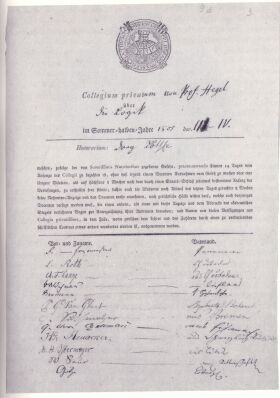
Hörerliste in Jena A copy of one of the sheets where the students of Hegel had to register when attending his courses in Jena. Above, we can see the date (Summer Semester 1805) and the signature of “Prof.Hegel”.
In winter 1801/02 Hegel began to lecture, on logic and metaphysics; at the same time he announced that he would lead a disputatorium with Schelling. The logic lecture had eleven hearers at first and, according to the report of Ignaz Paul Vital Troxler, dissolved “since only few … were able to follow the delivery.” (DE: „da nur wenige […] dem Vortrag zu folgen vermochten“) Another hearer, Bernhard Rudolf Abeken, recalled that Hegel “at the beginning of his lectures called to us the words of Dante: Lasciate ogni speranza voi ch’ entrate” (DE: „beim Beginn seiner Vorträge uns die Worte Dantes zugerufen: Lasciate ogni speranza voi ch’ entrate“) (Abandon all hope, you who enter).[142] In the following semesters Hegel lectured on the disciplines that later formed the system: logic and metaphysics, natural right, philosophy of nature and of spirit, history of philosophy, once also arithmetic. The manuscripts of these lectures are the Jena system drafts (Ch. 15.4).
5.3 Friends, Goethe, and Natural Science
Through Schelling Hegel came into Jena society. On 20 October 1801 Goethe wrote to Schelling: “If Herr Doctor Hegel wants to visit me tomorrow morning at 11 o’clock, it will be agreeable to me” (DE: „Wenn Herr Doctor Hegel mich morgen früh um 11 Uhr besuchen will, so soll es mir angenehm sein“); on the 21st he noted: “11 o’clock Dr. Hegel.” (DE: „11 Uhr Dr. Hegel.“) Soon Hegel frequented the circle around the translator Johann Diederich Gries. Caroline Schlegel, then still married to August Wilhelm and already attached to Schelling, mentions Hegel in her letters as a visitor, at joint wine orders, and as a lover of sausages. Two friendships from these years lasted long: with Friedrich Immanuel Niethammer (1766–1848) and with Heinrich Eberhard Gottlob Paulus (1761–1851), both from the Tübingen Stift and then professors of theology in Jena.[143] Niethammer remained until the Nuremberg years Hegel’s most important correspondent and patron. To the narrower Jena circle Vieweg also counts the publisher Carl Friedrich Ernst Frommann, in whose house Hegel became a family friend and read aloud at the tea table, the university syndic Ludwig Christoph Ferdinand Asverus, the father of the later Berlin hearer Gustav Asverus (Ch. 9.2), and the natural scientists Seebeck and Schelver; Hegel was a guest at the evening gatherings of the families Frommann, Knebel, Seebeck, and Asverus.[144]
With Goethe Hegel was bound above all by the interest in nature. In August 1806 he made with Goethe and the physicist Thomas Johann Seebeck in the camera obscura “experiments on the more or less warming power of colored lights” (DE: „Versuche wegen der mehr oder weniger wärmenden Kraft der gefärbten Lichter“); on 30 January 1804 he became assessor of the Ducal Mineralogical Society, on 1 August 1804 member of the Naturforschende Gesellschaft Westfalens.[145] Jaeschke warns against ascribing a key role for Hegel’s philosophy to Goethe on this account; what is documented is a shared interest, not a dependence.
5.4 Without Salary
Schelling’s departure for Würzburg in May 1803 ended the collaboration and the Kritisches Journal; the friendship lived on for a while in favors, Hegel represented Schelling in a legal dispute with the publisher Gabler. For Hegel the departure was an opportunity. “I have begun lecturing again and get on better with it than before,” (DE: „Ich habe das Lesen wieder angefangen und komme damit besser aus als sonst“) he wrote to Schelling in November 1803, and Schiller reported to Goethe that “our Dr. Hegel is said to have got many hearers who are not dissatisfied even with his delivery.” (DE: „unser Dr. Hegel soll viel Zuhörer bekommen haben, die selbst mit seinem Vortrag nicht unzufrieden sind“)[146] Three weeks later the two considered how Hegel could be helped. Goethe wrote on 27 November 1803 from Jena that with Hegel the thought had come to him “whether one could not procure him a great advantage through the technical side of the art of speaking. He is a quite excellent man; but far too much stands against his utterances.” Schiller replied on 30 November that what Hegel lacked could “hardly” be given him; this “lack of gift of presentation” was “on the whole the German national fault” (DE: „im ganzen der deutsche Nationalfehler“) and was offset by “the German virtue of thoroughness and honest earnestness.” (DE: „die deutsche Tugend der Gründlichkeit und des redlichen Ernstes“) He proposed bringing Hegel together with the art scholar Carl Ludwig Fernow: “In dealings with Fernow Hegel must think of a teaching method in order to make his idealism understood to him, and Fernow must come out of his shallowness.” (DE: „Im Umgang mit Fernow muß Hegel auf eine Lehrmethode denken, um ihm seinen Idealismus zu verständigen, und Fernow muß aus seiner Flachheit herausgehen.“) Goethe began, by his own report of 2 December, at once “to put the proposal into effect” (DE: „ins Werk zu setzen“); on the evening of 3 December he had as guests, among others, Hegel, Fernow, Niethammer, and the jurist Thibaut.[147] On 15 December he asked Hegel for a review for the Jenaische Allgemeine Literatur-Zeitung, which he was just co-founding, so that he might join “our critical institute” and give “more occasion for interesting conversations.” (DE: „zu interessanten Unterhaltungen nähere Gelegenheit“)[148] Hegel gathered a circle of pupils, to which Georg Andreas Gabler, his later successor in Berlin, and the Dutchman Peter Gabriel van Ghert belonged.
DE: „ob man ihm nicht, durch das Technische der Redekunst, einen großen Vortheil schaffen könnte. Es ist ein ganz vortrefflicher Mensch; aber es steht seinen Äußerungen gar zu viel entgegen.“
He was not paid. In September 1804 he wrote a curriculum vitae with which he applied for a professorship and reminded Goethe that he was “the oldest of the local Privatdozenten of philosophy.” (DE: „der älteste der hiesigen Privatdozenten der Philosophie“)[149] On 15 February 1805 Duke Karl August appointed him extraordinary professor, together with Jakob Friedrich Fries, who had already distinguished himself as an opponent of Fichte and Schelling; no salary was attached.[150] Hegel sought Heidelberg, where in his words “a new dawn for the welfare of the sciences” (DE: „eine neue Morgenröte für das Heil der Wissenschaften aufgehen“) would arise, Würzburg, Tübingen, even a hoped-for university in Berlin; all without success. On 24 June 1806 Goethe obtained for him an annual salary of 100 thalers, “from 1 July of this year,” (DE: „vom 1. Julii d. J. an“) and wrote to him three days later: “Look at the enclosed, my dear Herr Doctor, at least as a proof that I have not ceased to work quietly for you.” (DE: „Sehen Sie beykommendes, mein lieber Herr Doctor, wenigstens als einen Beweis an, daß ich nicht aufgehört habe im Stillen für Sie zu wircken.“)[151]
5.5 The Battle and the Manuscript
In autumn 1806 the war came to Jena. On 13 October, the day before the battle, Hegel saw Napoleon ride through the occupied town and wrote to Niethammer: “the Emperor — this world-soul — I saw ride out through the town to reconnoiter; — it is indeed a wonderful feeling to see such an individual who, concentrated here on one point, sitting on a horse, reaches over the world and rules it.”[152] Five days later it sounded different. Jena had burned, Hegel, like many others, had been plundered and found refuge with the publisher Frommann. Gabler told later that Hegel had known how to take some intruding soldiers, among them one with the cross of the Legion of Honor, “by the honor whose sign he wore on his chest” (DE: „bei der Ehre, deren Zeichen er auf der Brust trage, zu packen gewußt“) and entertained them until they left peacefully.[153] Goethe had inquiries made on 18 October from Weimar about the welfare of the Jena acquaintances, among them “Herr Professor Hegel in the old fencing hall,” (DE: „Herr Professor Hegel auf dem alten Fechtboden“) and wrote to Knebel on 24 October: “If Hegel needs some money give him up to about 10 rh.” (DE: „Bedarf Hegel etwas Geld so gieb ihm biß etwa auf 10 rh.“)[154]
Greater than the concern for his belongings was that for the manuscript of the Phenomenology of Spirit, which had gone for the most part on 8 and 10 October to the publisher in Bamberg. The last sheets Hegel carried with him; the plunderers had put his papers “in disorder like lottery tickets” (DE: „wie Lotterielose in Unordnung gebracht“).[155] The preface he sent in January 1807 to Bamberg (on the printing history, Ch. 16).
5.6 Ludwig
On 5 February 1807, at noon, Georg Ludwig Friedrich Fischer was born in Jena. His mother was Christiane Charlotte Burkhardt, née Fischer, according to the baptismal register “a Count’s servant’s abandoned wife,” (DE: „eines Gräflichen Bedienten verlassenes Eheweib“) who had already borne two children before “in dishonor”; godfather was, besides the bookseller Friedrich Frommann, Hegel’s brother Georg Ludwig, “Lieutenant in the Royal Württemberg regiment Crown Prince.” (DE: „Lieutnant im Königl. Würtemberg. Regiment Kronprinz“) Hegel was the father. The son bore the mother’s birth name and grew up in Jena in the educational institute of Johanna Sophia Bohn, a sister-in-law of Frommann, and her sister Betty Wesselhöft.[156] The child is probably the reason why Hegel in January 1807 asked for an official residence in the botanical garden and why Schelver, who had gone to Heidelberg, advised him to come if he could “leave Jena as a single man.” (DE: „als einzelner Mann Jena verlassen“)[157] Hegel’s move to Bamberg a few weeks later is in this light also a departure from a situation he could not put in order.
5.7 The Call to Bamberg
The way out was offered by Niethammer. On 16 February 1807 he wrote that in Bamberg the editorship of the newspaper was orphaned, he had been asked, and he proposed Hegel; he himself would go at Easter as referendary to the Munich school and studies bureau. Hegel answered “by return mail” that he followed “the world events with curiosity” (DE: „die Weltbegebenheiten mit Neugierde“) anyway but did not want to regard the engagement “as something definitive.” (DE: „nicht für etwas Definitives ansehen“)[158] He arrived in Bamberg on the evening of 12 March 1807, had himself granted leave in Jena for “a private business that is temporary,” (DE: „ein Privatgeschäft, das temporär ist“) and hoped to go on drawing the salary of 100 thalers; the payment was stopped from April.[159] In Weimar Goethe assumed Hegel had gone to Bamberg “to solicit the printing of his works,” (DE: „um den Druck seiner Werke zu sollicitiren“) and wrote to Knebel on 14 March: “I demand finally once to see an exposition of his way of thinking. He is such an excellent head and it is so hard for him to communicate!” (DE: „Ich verlange endlich einmal eine Darstellung seiner Denkweise zu sehen. Es ist ein so trefflicher Kopf und es wird ihm so schwer, sich mitzutheilen!“)[160]
Chapter 6: Bamberg (1807–1808) — Newspaper Editor under Censorship
Bamberg had been Bavarian since 1803, a Catholic episcopal city that the new state of Montgelas sought to permeate. Hegel had written in 1800 that he would “prefer a Catholic city to a Protestant one” (DE: „eine katholische Stadt einer protestantischen vorziehen“) (Ch. 4.5); now he lived there for a year and a half as editor of a political daily newspaper.
6.1 The Newspaper
The Bamberger Zeitung belonged to the publisher Schneiderbanger; it was a private paper that, like all smaller newspapers, took its news from other papers and stood under the censorship of the local authorities. Hegel shared the profit with the publisher, so that a good 1300 gulden remained to him, and had stipulated that he might leave at short notice on a call.[161] Besides the editorial office, Schneiderbanger’s enterprise included a printing house and a bookshop; in the newspaper’s counting-room books and printed matter were also to be had.[162] The work left him time and met his political inclinations. Hegel shared the government’s policy, the reorganization of the German states under Napoleon: “The great jurist of public law sits in Paris,” (DE: „Der große Staatsrechtslehrer sitzt in Paris“) he wrote to Niethammer on 29 August 1807. In France he also admired the public sphere: “this speaking of the government with the people about its and their interests is one of the greatest elements of strength of the French and English people.” (DE: „dies Sprechen der Regierung mit dem Volke über ihre und seine Interessen ist eines der größten Elemente der Kraft des französischen und englischen Volkes“)[163] Already in August 1807, however, he confessed to Knebel that his “bent for politics” had through the newspaper “rather weakened than found nourishment.” (DE: „vielmehr geschwächt, als daß er dadurch Nahrung gefunden hätte“)[164] To obtain news of his own he recruited correspondents among friends in Jena and Weimar. To Knebel he wrote in the same letter: “It would be a great favor to me to get a correspondent in the local area” (DE: „Es wäre mir eine große Gefälligkeit, einen Korrespondenten in der dortigen Gegend zu bekommen“); his son Karl was to be credited with “a jug of good Bamberg beer” (DE: „ein Krug guten Bamberger Biers“) for every article.[165] In autumn 1808 Knebel sent him reports from the Erfurt princes’ congress, with the request: “Use of it what you find good — only do not compromise me in any way!” (DE: „Brauchen Sie davon, was Sie für gut finden dürften – nur kompromittieren Sie mich auf keine Weise!“) An article “Erfurt” in no. 300 of 26 October 1808 earned the paper a reprimand from Munich, which according to the records began with the sentence: “With displeasure we have read in the Bamberger Zeitung no. 300 of 26 October the article from Erfurt.” (DE: „Mit Mißfallen haben wir in der Bamberger Zeitung Nro 300 vom 26ten Oktober den Artikel aus Erfurt gelesen.“) Hegel named, in his defense, the Allgemeiner Deutscher Staatsbote as source; Wilhelm Raimund Beyer traces the article back to Knebel’s letter.[166]

Headline of the BambergerZeitung
How strict the censorship was is shown by a justification of the responsible government commissioner, Baron von Stengel, of 11 November 1808. A rescript of 16 March 1808 had ordained that only “official news from official sources” (DE: „offizielle Nachrichten aus offiziellen Quellen“) might still come into the paper, and official were, as Stengel remarked with audible irony, only the French and the Westphalian Moniteur. Stengel’s letter also reveals the daily routine: The paper was printed early and distributed in the afternoon; the censorship read the first proof between eleven and twelve o’clock. The editors of GW 5 consider it very probable that Hegel agreed the wording with Stengel, whom he knew personally.[167] Hegel himself described the situation thus: The newspaper contained the considerable part of a family’s fortune, his own and the existence of two workers depended on it, “and all this is put at stake by a single article that is found offensive; … a newspaper writer only gropes blindly about in this.” (DE: „und dies alles wird durch einen einzigen Artikel, der als anstößig gefunden wird, aufs Spiel gesetzt; […] ein Zeitungsschreiber tappt darüber nur im Blinden herum“) A few months after his departure, on 20 February 1809, the Bamberger Zeitung was banned.[168]
6.2 Company
Niethammer left Bamberg a month after Hegel’s arrival. At about the same time Paulus came to the town as district and school councillor, and Hegel frequented his house daily; Dorothea Schlegel wrote in August 1808 that Hegel was “every evening at Paulus’s,” (DE: „alle Abend bei Paulus“) and both had “principles … of which one has no idea at all.” (DE: „Grundsätze […], von denen man gar keinen Begriff hat“) He also liked to go to the senior judicial councillor Liebeskind and his wife. In July 1807 he got to know Jean Paul, who judged: “Hegel pleases me beyond all expectations.” (DE: „Hegel gefällt mir über alle Erwartungen hinaus.“)[169] How Hegel appeared in this society is shown by his report to Niethammer about a festival that the physician Marcus gave on New Year’s night 1808 on the Michelsberg for the president. Of the seventy guests most came masked, as goddesses, as “Dr. Luther and his Käthe,” (DE: „Dr. Luther und seine Käthe“) as “bears and bear-leaders”; Hegel “set reality against that ideality,” (DE: „setzte jener Idealität die Wirklichkeit entgegen“) put on “a valet’s coat of the court cellarer together with his wig,” (DE: „einen Kammerdienersrock des Hofkastners nebst seiner Perücke an“) and so conversed during the three-hour supper with his table neighbor, the “Cypris.”[170] According to Vieweg, among the former professors of theology who worked in Bamberg as consistory councillors belonged, besides Niethammer and Paulus, also Karl Heinrich Fuchs, who in 1808 became the first Protestant pastor of the Catholic city; Hegel read the proofs of his writing for the consecration of the Stephanskirche, Ueber das Wesen der Kirche.[171] The correspondence with Schelling broke off. Schelling wrote on 2 November 1807 that he had so far read only the preface of the Phenomenology and did not take its polemic to apply to himself but to the “chatterers” (DE: „Nachschwätzer“) (Ch. 16.3). After that they did not write to each other again.
6.3 Way out of the “Newspaper Galley”
Hegel experienced the editorship as banishment from philosophy. He wrote in November 1807 that he, who “for many years nested on the free rock by the eagle,” (DE: „viele Jahre lang auf dem freien Felsen bei dem Adler nistete“) was now to “vegetate in the leaden air of empty chatter,” (DE: „in der Bleiluft des leeren Geschwätzes vegetieren“) and he resisted the prospect of giving “enlightened religious instruction” for schools in Bamberg under the supervision of the Protestant church: To give theological instruction and at the same time write a logic “would be a whitewasher and chimney sweep at once.” (DE: „wäre Weißtüncher und Schornsteinfeger zugleich sein“)[172] He hoped for a Protestant university like Erlangen, for Heidelberg, for a return to Jena. Niethammer, meanwhile central school councillor in Munich, offered him in May 1808 to become rector of a Gymnasium “in one of our principal provincial towns.” (DE: „in irgend einer unsrer Hauptprovinzstädte“) Hegel took this up and at the same time tried to steer it: “Whatever one is in a state, it is best to be it in the capital.” (DE: „Man sei in einem Staate, was man sei, so ist es am besten, es in der Hauptstadt zu sein“)[173] On 5 August 1808 he was in Nuremberg, at the inn “Zum roten Roß,” and on 26 October Niethammer informed him that he was appointed professor of the philosophical preparatory sciences and rector of the Nuremberg Gymnasium. Hegel thanked: “You are this my creator, I your creature,” (DE: „Sie sind dieser mein Schöpfer, ich Ihr Geschöpf“) and added the sentence often cited as motto of his Gymnasium years: “Theoretical work, I convince myself daily more, accomplishes more in the world than practical; once the realm of representation is revolutionized, actuality will not hold out.”[174]
The appointment, dated 4 November, reached Hegel after a back and forth in which Paulus sent him once more back to Bamberg, on 23 November 1808.[175] The Württemberg ministry gave him permission to accept the post with reservation of return, with a justification that shows how the stipendiary was thought of in Stuttgart: He seemed “to have neither the proper aptitude nor the requisite inclination any longer for an ecclesiastical office, and a teaching post for which he would be suited is currently not vacant”; he was also “in such modest financial circumstances” (DE: „in so geringen Vermögensumständen“) that the improvement was to be granted him.[176]
DE: „zu einem kirchlichen Amte weder die gehörige Tüchtigkeit noch die erforderliche Neigung mehr zu haben, und eine Lehrstelle, wozu derselbe tauglich wäre, ist gegenwärtig nicht vakant“
Chapter 7: Nuremberg (1808–1816) — Rector, Marriage, Logic
In Nuremberg Hegel for the first time held a permanent post, and here he founded a family. Since 1806 Nuremberg had been Bavarian, a former imperial city with a Protestant patriciate; Niethammer, as central school councillor in Munich, had reorganized the Gymnasiums of the country with his “Normativ” of 1808, and the Ägidien-Gymnasium was to become one of its models. Here the Science of Logic came into being (Ch. 18).
7.1 The Office
Hegel took up his double office unprepared. As late as 22 November 1808 he wrote to Niethammer that he knew “nothing at all yet” about the subjects to be taught and the books; Paulus, now his superior as district school councillor, warned him that “the Messrs. idealists from above” (DE: „die Herrn Idealisten von oben“) keep one “entirely pure from the material, dirty being of mammon,” (DE: „materiellen, schmutzigen Wesen des Mammons ganz rein“) and concluded: “God damn all the Idealism.”[177] On 6 December the Gymnasium was reopened with a speech by Paulus and Hegel’s oath; the old rector Schenk, who had taught there for almost fifty years, was dismissed. It had thirty pupils, eight of them in the upper class.[178] Hegel taught the “philosophical preparatory sciences” and also took over mathematics in the upper class, because the teacher designated for it “does not understand calculation with letters”; he left to him in exchange the “doctrine of religion and duties” of the lower class. The religious instruction he had dreaded in Bamberg he gave after all: according to his teaching plans, in 1810/11 he taught “doctrine of right, morals and religion” (DE: „Rechts-, Moral- und Religionslehre“) in the lower class, and in 1811/12 a joint weekly hour of religious instruction was added for the two upper classes.[179] His salary was 900 gulden as teacher and 100 gulden as rector, with free lodging in the Gymnasium. In 1813 the Royal City Commissariat additionally assigned him “the reporting in school and study matters,” (DE: „das Referat in Schul- und Studiensachen“) with a functional salary of 300 gulden.[180] As local school councillor Hegel supervised the municipal school system until 1816, from the elementary and poor schools to the new teachers’ seminary; in 1816 the newspapers announced his call to Heidelberg as that of the “school councillor and rector of the Gymnasium.” (DE: „Schulrats und Rektors des Gymnasiums“)[181] He signed his reports to the ministry as reporter alongside the city commissioner Johann Georg von Kracker; in June 1815 he reported that the elementary schools had held their examinations for the first time “before the eyes of the parents and the public.” (DE: „vor den Augen der Eltern und des Publikums“) His request for dismissal of 24 August 1816 he signed as “hitherto school and study reporter at the royal local commissariat and Gymnasium rector.” (DE: „zeitheriger Schul- und Studienreferent beim königlichen Localkommissariat und Gymnasialrektor“) Kracker passed it on with the remark that the combination of the reporting post with the rectorate had “resulted in several collisions with the foundation administration of the cult and with the teachers themselves,” (DE: „mehrere Kollisionen mit der Stiftungs Administration des Kultus und mit den Lehrern selbst zur Folge gehabt“) and asked that the reporting post be transferred again to the district school councillor Stephani in Ansbach; he also noted that Hegel was “a foreigner, namely a Württemberger by birth.” (DE: „ein Ausländer, nämlich von Geburt ein Würtemberger“)[182]

Ägydiengymnasium in Nürnberg (Engraving by Johann Abraham Delsenbach - Stadtbibliothek Nürnberg)
Hegel took up the reporting post on 25 November 1813. To Niethammer, who had procured it for him, he wrote: “God grant only that I be equal to the matter and that you bring no dishonor upon yourself through me.” (DE: „Gott gebe jetzt nur, daß ich der Sache gewachsen sei und Sie keine Unehre mit mir einlegen.“) To Paulus, who as district school councillor had begun the ordering of the Nuremberg elementary schools, he said he held the post “undeservedly and hopefully not for too long,” (DE: „unverdienterweise und hoffentlich auf nicht allzu lange“) and he asked his publisher Frommann to go on addressing him as rector: “I cannot accept the school councillor,” (DE: „den Schulrat kann ich nicht annehmen“) for “the sciences and the teaching office in them still hold in me the predominant affection, so that I regard that business more as a hindrance to it.” (DE: „die Wissenschaften und das Lehramt in demselben behaupten in mir noch die überwiegende Zuneigung, daß ich jenes Geschäfte mehr als ein Hindernis dabei betrachte“)[183] The work he did thoroughly all the same. The public examinations of the elementary schools in October 1814 he followed “completely, in order to survey the whole interior.” (DE: „vollständig, um das ganze Innere zu überblicken“) For the teachers’ seminary, which the government had decided on in 1809 and had not opened, he rejected in March 1814 the way out of demanding an enrollment fee from the prospective teachers: that would contradict the promise of free instruction and would hit the “mostly poor” candidates “very hard.” In April the ministry granted 500 gulden, and on 27 June 1814 the seminary was opened in the Lorenz parsonage. Hegel took part in the examinations at admission and graduation. On 1 August 1815 he himself conducted three of nine subjects, history of religion and reading, arithmetic, mathematical geography and geometry; in August 1816 he had “to examine some 60 subjects four days in a row from morning into the night.” (DE: „ein 60 Subjekte vier Tage hintereinander von Morgen bis in die Nacht zu examinieren“)[184]
The report on the poor schools Hegel submitted only in February 1815, and he mocked himself: “After a year and more finally the report on the poor schools, not even the elementary schools in general!” (DE: „Nach einem Jahr und darüber endlich der Bericht über die Armenschulen, nicht einmal die Volksschulen insgemein!“) In the same letter he complains about the administrator of the foundations, who as “such a good Nuremberg patriot” (DE: „so guter Nürnberger Patriot“) sought “to the best of his power” (DE: „nach Kräften zu entziehen“) to withhold from the Bavarian school system “what he can,” and about buildings of the educational institutions that the administration made “simply a property of the cult.” (DE: „schlechtweg zu einem Eigentum des Kultus“) This indicates what the “collisions with the foundation administration of the cult” (DE: „Kollisionen mit der Stiftungs Administration des Kultus“) consisted in, of which Kracker wrote in 1816.[185] That Hegel pursued the poor schools as a social concern Max Liedtke considers an exaggeration. Their reorganization was prescribed by the rescript of October 1813 and came first because they had foundation assets of their own. Whether they should be incorporated into the fee-paying schools, so that the children of the poor would not be set apart, as the district school councillor Heinrich Stephani demanded, had been decided against Stephani before Hegel took office, and in Hegel’s letters and files this question does not occur, only queries about the lower pay of the poor-school teachers.[186]
What Hegel dictated and explained in the philosophy classes gives less the picture of school instruction than of continued work on the system, above all on logic and encyclopaedia (Ch. 17). He himself doubted its use. In 1812 he wrote to Niethammer that too much philosophy was taught in the Gymnasium, and considered “that perhaps all philosophical instruction at Gymnasiums might seem superfluous, that the study of the ancients is the most suitable for Gymnasium youth and, in its substance, the true introduction to philosophy.”[187] The pupils remembered it differently. Johann Georg August Wirth, later an opponent of his philosophy, wrote: “as rector in Nuremberg Hegel worked infinitely beneficially.” (DE: „als Rektor in Nürnberg wirkte Hegel unendlich segensreich“) How he taught Rosenkranz describes: Hegel dictated paragraphs and explained them “sharply, urgently, but without great outward liveliness,” (DE: „scharf, eindringlich, aber ohne große äußere Lebendigkeit“) the papers before him, “strewing tobacco abundantly right and left” (DE: „Taback rechts und links reichlich verstreuend“); at the beginning of each hour he had a pupil repeat the lecture of the last one, everyone was allowed to ask questions and even to interrupt him, and often “a large part of the hour” (DE: „ein großer Theil der Stunde“) passed in this way.[188] The daily routine of office was more laborious. Hegel had to petition the police to get two school buildings a privy, because in one “the military and the night watchmen have the necessary place in their possession,” (DE: „das Militär und die Nachtwächter den notwendigen Ort in Besitz haben“) and he complained of the “copying of all possible reports, attestations, communications, lists.” (DE: „Abschreiben von allen möglichen Berichten, Attestaten, Kommunikationen, Listen“)[189]
From here on the account has a witness from the family. Karl Hegel (1813–1901), the elder son, historian in Rostock and Erlangen, wrote his Leben und Erinnerungen between November 1899 and July 1900, at eighty-six and almost seventy years after his father’s death; “diaries and letters” had served him “to refresh” his memory, but he “could not vouch” that he had not somewhere “fallen into an error.” His own memories begin, by his own statement, only in Berlin; what he writes about Nuremberg and Heidelberg is family tradition. The first twenty pages deal chiefly with the father.[190] The program by which his father taught in Nuremberg he described thus: according to Niethammer’s Normativ, “highly characteristic of the trend of the time, especially in Bavaria,” (DE: „für die Zeitrichtung, zumal in Bayern, höchst charakteristischen“) the Gymnasium was “to occupy its pupils preferentially with the learned study of languages and the introduction to the speculative study of ideas,” (DE: „vorzugsweise mit dem gelehrten Sprachstudium und der Einleitung in das spekulative Studium der Ideen zu beschäftigen“) with four hours of philosophy in each of the four upper classes, “and indeed in such a way that religious instruction was entirely absorbed in it.” (DE: „und zwar so, daß der Religionsunterricht ganz darin aufging“)[191]
7.2 Marriage
In October 1809 Hegel wrote to Niethammer that he wished “finally” also “to take a wife or rather to find one” (DE: „eine Frau zu nehmen oder vielmehr zu finden“); he was “soon 40 years old and a Swabian” (DE: „nächstens 40 Jahre alt und ein Schwabe“) and did not know whether he must not take the step before then.[192] The woman he found was Marie Helena Susanna von Tucher (1791–1855), eldest daughter of the senator Jobst Wilhelm Karl von Tucher, from one of the old Nuremberg patrician families, twenty years younger than he. In spring 1810 he said he would become “either eternally happy” or get a refusal, and the market superintendent Paul Wolfgang Merkel mediated. Formally Hegel had his suit opened at the beginning of April 1811 through Herr von Grundherr; on 8 April he presented it to the father himself, who, as the latter noted, answered him “that the determination of my consent depends on the decision of my daughter,” (DE: „daß die Bestimmung meiner Einwilligung von der Entschließung meiner Tochter abhängt“) whereupon Hegel asked “merely for permission” (DE: „blos um die Erlaubnis“) “to visit my daughter in a friendly way.” (DE: „meine Tochter freundschaftlich besuchen zu dürfen“)[193] On 13 April 1811 he wooed her in a poem, three days later he could call her “mine.”[194] The royal commissariat granted the “marriage license” on 14 August, and on 15 September 1811 the two were married; the marriage register gives 1771 as Hegel’s year of birth, a rejuvenation that no one noticed.[195] On 10 October Hegel wrote to Niethammer: “With this I have on the whole — a few still desirable modifications aside — reached my earthly goal, for with an office and a dear wife one is finished in this world.”[196]

MARRIAGE ANNOUNCEMENT (From the “Nürnberger Friedens- und Kriegskourier” of September 19, 1811 - Stadtbibliothek Nürnberg)
The first child, the daughter Susanna Maria Louisa Wilhelmine, was born on 27 June 1812 and died on 8 August, six weeks old. On 7 June 1813 Karl Friedrich Wilhelm was born, on 25 September 1814 Thomas Immanuel Christian; Immanuel’s godparents were Niethammer, after whom he received his given name, Seebeck and Hegel’s sister Christiane; at the baptism Niethammer, as Immanuel later told, expressed the wish “that I might become, as Thomas, a Christian through Immanuel.” (DE: „daß ich als Thomas durch den Immanuel zum Christian werden möchte“)[197] Karl Hegel wrote that he was born “in the Gymnasium building at Nuremberg,” (DE: „im Gymnasialgebäude zu Nürnberg“) baptized next door in the Egidien church and spent his first years in the official residence on the Egidienplatz; his mother, “the finely educated twenty-year-old patrician’s daughter,” (DE: „die feingebildete zwanzigjährige Patrizierstochter“) had “conceived a rapturous love for the man 21 years her senior.” (DE: „eine schwärmerische Liebe zu dem um 21 Jahre älteren Manne gefaßt“)[198] Several miscarriages of Marie followed; the last, at the end of 1815, thwarted a godparenthood of Jacobi.[199]
7.3 Christiane
After Hegel’s marriage the first signs of a mental illness showed in his sister. Christiane had been governess in the house of Count Josef von Berlichingen in Jagsthausen since 1807 and had lived in retirement for reasons of illness since 1814 with her cousin Karl Wilhelm Göriz in Stuttgart. In April 1814 Hegel offered her to move to him in Nuremberg; she came for a visit but in November 1815 went to Aalen to another cousin, Ludwig Friedrich Göriz. Her farewell letter thanks warmly for “all the love shown me and all the good that came to me with you” (DE: „alle mir erwiesene Liebe und alles Gute, das mir bei Euch zuteil wurde“); at the same time, according to later letters, she was full of “deep hatred” against her sister-in-law and of “great dissatisfaction” with her brother.[200] In 1820 she entered the asylum at Zwiefalten, afterwards she lived in Stuttgart, medically cared for by Schelling’s brother Karl Eberhard and supported to a small extent by Hegel.
7.4 Friends and Politics
Until 1810, when Paulus went to Ansbach and then to Heidelberg, Hegel lived in cordial intercourse with his family; according to Karl Hegel, who could know it only by hearsay, he kept up a “jocular intercourse” with Paulus’s wife, “a humorous Swabian woman, and her piquant daughter Sophie”.[201] In addition he found friends among the teachers of the Realinstitut: the mathematician Johann Wilhelm Andreas Pfaff, a former Stift student, the naturalist Gotthilf Heinrich Schubert and the philologist Johann Arnold Kanne. At Kanne’s wedding, which was celebrated in Schubert’s house, Hegel was a guest; the bridegroom, according to Schubert, ran off before evening, to Würzburg. Clemens Brentano, who had visited Nuremberg shortly before, wrote to Görres at the beginning of 1810 that the young woman had got him back “only through Hegel’s following after him”; according to Schubert, Johann Jakob Wagner stopped the fugitive in Würzburg, and he returned contrite. In the same letter Brentano also describes Hegel: he had found in Nuremberg “the honest wooden Hegel”, who reads the Heldenbuch and the Nibelungen and “translates them into Greek while reading, in order to be able to enjoy them”.[202] Schubert reported on Hegel to Schelling, and Schelling answered with a characterization that contains a judgment on their common time: “Such a pure specimen of inner and outer prose must be held sacred in our over-poetic times.” In 1812 Schelling visited Hegel in Nuremberg; “We have not touched on Philosophica”, Hegel wrote to Niethammer.[203] Jacobi, on the other hand, whom Hegel had sharply attacked in 1802 in Faith and Knowledge, became his friend through Niethammer’s mediation. He visited Nuremberg in the summer of 1812, and Jean Paul found afterwards that “even his philosophical enemy Hegel loves him now”.[204]
To the Nuremberg circle Vieweg also counts the physicist Johann Salomo Christoph Schweigger, the friend Seebeck, the philologist Ludwig Heller, teacher at the Gymnasium, and the physician Friedrich Wilhelm von Hoven, a youthful friend of Schiller, who lived in Nuremberg as a medical official of the government. In his memoirs Hoven counted among his friends “especially the rector” of the Gymnasium, “Hegel, who afterwards became so famous as professor of philosophy in Berlin,” (DE: „den in der Folge als Professor der Philosophie in Berlin so berühmt gewordenen Hegel“) along with Heller, Schweigger, Schubert and Pfaff: “As long as I lived together with these men, I had the happiest days in Nuremberg.” (DE: „Solange ich mit diesen Männern zusammenlebte, hatte ich die frohesten Tage in Nürnberg.“) Of Hegel’s philosophy he thought nothing; he had understood most systems, “except the Hegelian, whose author seems not to have understood himself.” (DE: „ausgenommen das Hegelsche, dessen Urheber sich selbst nicht verstanden zu haben scheint“)[205] Guests of the circle were Jean Paul and Jacobi. A close confidant became the market superintendent Paul Wolfgang Merkel, who also mediated Hegel’s marriage (Ch. 7.2).[206] Among his pupils was Georg Friedrich Daumer (1800–1875), later Gymnasium professor in Nuremberg and philosopher of religion. Daumer wrote that Hegel “made such a great impression on me that the philosophical lectures I afterwards got to hear in Erlangen seemed to me only childish and silly.” (DE: „machte so großen Eindruck auf mich, daß mir die philosophischen Collegien, die ich nachher in Erlangen zu hören bekam, nur kindlich u[nd] läppisch vorkamen“) In 1826, when the family visited Nuremberg, Daumer taught Hegel’s sons, and Hegel had greetings conveyed to him from Berlin.[207] Another pupil of the Gymnasium became a Hegelian: the jurist Julius Friedrich Heinrich Abegg (1796–1868), of whom a transcript of the Philosophical Encyclopaedia from the upper class of 1812/13 is preserved (Ch. 17.2). He heard Hegel in Berlin in 1819, became professor of criminal law in Königsberg in 1821 and in Breslau in 1826 and represented, according to his biographer in the Neue Deutsche Biographie, “as the first (about since 1826) Hegelian ideas in jurisprudence.” (DE: „als erster (etwa seit 1826) in der Rechtswissenschaft Hegelsche Gedanken“)[208]
Through Daumer and the Tucher family a Nuremberg story reached into Hegel’s house. Daumer was involved in the upbringing of the foundling Kaspar Hauser, and in December 1829 Marie’s brother Gottlieb von Tucher, who had attended the Nuremberg Gymnasium under Hegel, had heard him in Heidelberg and Berlin and had lived in Hegel’s family in Berlin, became Hauser’s court-appointed guardian; at the end of 1831 he laid down the office. After the first attack on Hauser, in October 1829 in Daumer’s house, Marie’s mother, Susanne von Tucher, wrote to her daughter on 29 November: “Things go well with Kaspar Hauser; he has visited us with his guard. […] Kaspar thanks you for your sympathy, of which I have told him.” (DE: „Mit Kaspar Hauser geht es gut; Er hat uns mit seiner Bewachung besucht. […] Kaspar dankt Dir für Deine Teilnahme, von der ich ihm gesagt habe.“) For a year and a half Hauser then lived, as she wrote after Hegel’s death, “in simple, quiet family life with us,” (DE: „im einfachen, ruhigen Familienleben mit uns“) with her and Gottlieb, until at the end of 1831 a count who had declared himself his “lifelong protector” took him to Ansbach. Because the mother’s letters were read aloud in the Hegel house in the evenings, Beyer assumes that Hegel too knew of Hauser.[209]
Politically the Nuremberg years were those of Napoleon’s zenith and fall, and Hegel stood on Napoleon’s side to the last. His colleague Schubert found him “too unconditional an admirer of the great general and conqueror of peoples.” (DE: „einen zu unbedingten Verehrer des großen Feldherrn und Völkerbezwingers“) The wars of liberation Hegel saw without enthusiasm; by the “excellent liberators” he thought of “Cossacks, Bashkirs, Prussian patriots,” (DE: „Kosaken, Baschkiren, preußische Patrioten“) and he promised to “take to his legs” “if ever par hazard liberated people are to be seen.” (DE: „wenn einmal par hazard Befreite zu sehen sein werden“)[210] After Napoleon’s abdication he wrote to Niethammer: “It is a monstrous spectacle to see an enormous genius destroy itself. — That is the τραγικώτατον [the most tragic] there is.” (DE: „Es ist ein ungeheueres Schauspiel, ein enormes Genie sich selbst zerstören zu sehen. – Das ist das τραγικώτατον [das Tragischste], das es gibt.“)[211] Two years later, against the complaint about the reaction in Bavaria, he wrote the sentence about the world-spirit that “has given the word of command to advance” (DE: „das Kommandowort zu avancieren gegeben“): “this being advances like an armored, tightly closed phalanx, irresistibly and with a movement as imperceptible as the sun’s, forward through thick and thin.” (DE: „dies Wesen schreitet wie eine gepanzerte, festgeschlossene Phalanx unwiderstehlich und mit so unmerklicher Bewegung, als die Sonne schreitet, vorwärts durch dick und dünn.“)[212]
7.5 The Call
Hegel’s “sole and last goal” (DE: „einziges und letztes Ziel“) was, as he wrote to Sinclair in 1813, “to be a teacher at a university.” (DE: „Lehrer auf einer Universität zu sein“) The hopes for Erlangen, Tübingen, Heidelberg and, after Fichte’s death in 1814, Berlin came to nothing for years. In 1816 three calls came almost at once. In Berlin, where Fichte’s succession was to be decided, Hegel received at the vote on 6 March 1816 the most votes for speculative philosophy; de Wette, a friend of Fries, however, gave a separate vote and called Hegel’s delivery confused, and the proceedings stalled until in July Friedrich von Raumer visited Hegel in Nuremberg and reported that his conversation was “fluent and sensible.” (DE: „geläufig und verständig“)[213] Meanwhile Fries had left Heidelberg. Paulus, the Paulus family and Sulpiz Boisserée pressed for Hegel’s call there, and on 30 July 1816 the theologian Carl Daub inquired in the name of the university whether Hegel was “inclined” to accept the professorship.[214] Hegel accepted on 20 August. The grand duke appointed him on 19 August with a salary of 1500 gulden from 23 October, plus moving expenses.[215] On 24 August a letter arrived from the Prussian minister von Schuckmann asking Hegel to comment on the objections to his delivery, and on 25 August the Bavarian king appointed him professor of eloquence and poetry in Erlangen. Hegel declined both.[216] To his friend Niethammer he confessed that, “little as my wife wants to hear of it,” (DE: „so wenig meine Frau davon hören will“) Berlin might perhaps have been the preferable one. On 2 October 1816 the king dismissed him “with testimony of Our special satisfaction with his active and honest conduct of office.” (DE: „mit Bezeugung Unserer besonderen Zufriedenheit über seine tätige und redliche Amtsführung“)[217]
Chapter 8: Heidelberg (1816–1818) — Professorship, Hearers, Burschenschaft
8.1 Teaching and Encyclopaedia
On 28 October 1816 Hegel opened his Heidelberg lectures with an inaugural speech. He was glad, he said, to resume philosophy at a moment when the struggles over actuality were ended; the “German nation” had “hewn its way out of the worst, since it has saved its nationality, the ground of all living life,” (DE: „sich aus dem Gröbsten herausgehauen, da sie ihre Nationalität, den Grund alles lebendigen Lebens gerettet hat“) and now, “beside the state, which has swallowed up all interest,” (DE: „neben dem Staate, der alles Interesse in sich verschlungen“) also “pure science, the free rational world of spirit, should bloom again.” (DE: „die reine Wissenschaft, die freye vernünftige Welt des Geistes wieder emporblühe[n]“)[218] The national tone Hegel, the admirer of Napoleon, had not struck before; Jaeschke reads the simultaneous polemic against the “flatness and shallowness” of philosophy as a turn against his predecessor Fries, who was then distinguishing himself by “Jew-hatred and Teutonism.”

view of Heidelberg around1818
A year later Hegel called himself “only a beginning university professor,” (DE: „erst ein angehender Universitätsprofessor“) who “for the most part has actually still to make” (DE: „eigentlich meist erst zu machen“) the sciences he lectures on. In the four Heidelberg semesters he read three times on encyclopaedia, once of these privately for Prince Gustav of Sweden, twice on history of philosophy, twice on aesthetics, once each on logic, on anthropology and psychology, and on natural right and political science, the first of his seven lecture courses on philosophy of right.[219] As a guide he had the Encyclopaedia of the Philosophical Sciences in Outline printed, which appeared in June 1817 (Ch. 19.1). Success came slowly: on 29 October 1816 he complained to his wife that one lecture course had only four hearers; in April 1817 the logic had seventy.[220]
Among the hearers who attached themselves to him were Friedrich Wilhelm Carové, who as a Burschenschafter was later not habilitated, Hermann Friedrich Wilhelm Hinrichs, to whose philosophy of religion Hegel wrote the preface in 1822, the theologian Richard Rothe and the Estonian baron Boris von Uexküll. Victor Cousin came to Heidelberg in summer 1817 to get to know Hegel’s philosophy; the encounter became a friendship that grew firmer in Berlin.[221]
8.2 The Jahrbücher and the Break with Paulus
Hegel joined the editorial board of the Heidelbergische Jahrbücher der Litteratur. An early result was the break with Paulus, who had been his friend since Jena. The editors, Hegel, Wilken, and Thibaut, rejected in January 1817 a review in which Paulus attacked the Württemberg minister von Wangenheim; Paulus thereupon broke off the connection. Hegel called the review “quoad personam malicious” and “quoad rem highly philistine.” (DE: „quoad rem höchst philisterhaftig“) Behind it stood the Württemberg constitutional dispute, in which Paulus supported the estates, Hegel the king. At the end of 1817 Hegel himself intervened in the dispute with his review of the proceedings of the Württemberg Landstände (Ch. 14.4).[222]

cover of ‘Heidelberger Jahrbücher’
Heidelberg sociability also knew this opposition. Boisserée noted in July 1817, after a boat trip, a “boorishness”: when Hegel proposed the health of the Swedish crown prince, Welcker cried that he must “first earn his laurel” and toasted “German freedom” and the estates.[223] Among Hegel’s friends were the jurist Thibaut, whom he already knew from Jena, with whom he stood “on a friendly, almost familiar footing” and at whose house he attended musical evenings, the philologist Friedrich Creuzer, and above all Carl Daub. Daub, as Karl Rosenkranz learned from him and his wife ten years later, was moved by Hegel to a new study of his philosophy and therefore let the third part of his Judas Ischarioth, which was printed in Hegel’s Heidelberg years, no longer appear; in 1827 there lay on his table beside a New Testament “in the original text” Hegel’s Phenomenology of Spirit, “which he held to be the most significant of all philosophical books.”[224] Thibaut was also the teacher of Eduard Gans, who took his doctorate in Heidelberg in 1819 and in Berlin became Hegel’s pupil and the editor of the Grundlinien in the Friends’ Edition (Ch. 20.4).[225] To the wider circle belonged, according to Vieweg, the cameralist Heinrich Eschenmayer, who had been convicted in the Württemberg Jacobin trial of 1800, the mineralogist Karl Cäsar von Leonhard, with whom Hegel hiked through the Neckar valley, the historian Friedrich Christoph Schlosser, Friedrich Wilken, who recommended Hegel for the editorship of the Jahrbücher, and Sulpiz Boisserée.[226] In July 1817, after a punch evening, Hegel proposed the honorary doctorate for Jean Paul and proved to a colleague who doubted his Christianity “that Jean Paul is a quite splendid Christian.”[227] Through Boisserée the connection with Goethe was renewed, who thanked Hegel for coming to his aid “so mightily” in the theory of colors.[228]
How firm these friendships were showed itself sixteen years later. When Karl Hegel came to Heidelberg in 1834 to study, he was, by his account, “most warmly received by the old friends of my parents from the time of 1816 to 1818, Daub, Nägele, Thibaut, Creuzer, and others” (DE: „von den alten Freunden meiner Eltern aus der Zeit von 1816 bis 1818, Daub, Nägele, Thibaut, Creuzer und andern“); he spent most time in the house of the gynecologist Nägele, which had been friends with his parents. The family had lived in the Friedrichstraße.[229]
8.3 Ludwig in the House
In Heidelberg Hegel took his son Ludwig to live with him. Ludwig left Jena at the beginning of April 1817. In his album the foster mothers, the Frommann family, Gries, Knebel and, on 30 March 1817, Goethe wrote to him: “As a little boy I saw you / Go forth to the world with highest self-confidence; / And however it may meet you in the future, / Be of good cheer, blessed by a friend’s glance.” Gries gave him on his way the thought of “your excellent father, who will show you in life what the poet promises.” (DE: „Deinen trefflichen Vater, der, was der Dichter verspricht, Dir im Leben zeigen wird“)[230] After a stay in Franconia, where he still collected entries at the end of April, he arrived in Heidelberg in spring; Heinrich Voß had “delivered” him. Hegel wrote to Frommann that he had disclosed to the son the death of his mother: “It affected him more than me. My heart has long been finished with her.” (DE: „Er hat ihn mehr als mich affiziert. Mein Gemüt ist längst mit ihr fertig gewesen“) Of the boy he wrote: “I and my wife take pleasure in Ludwig. […] he shows a good head.” (DE: „An Ludwig erfreue ich mich und meine Frau. […] er zeigt einen guten Kopf“)[231]
DE: „Als kleinen Knaben hab’ ich Dich gesehn / Mit höchstem Selbstvertraun der Welt entgegen gehn; / Und wie sie Dir im Künftigen begegnet, / So sei getrost von Freundes Blick gesegnet.“
Of Hegel’s family life after 1816 the letters of his mother-in-law Susanne von Tucher, née Haller von Hallerstein, to Marie tell: 201 letters from the years 1816 to 1832, preserved in the archive of the Tucher family and published in extracts by Wilhelm Raimund Beyer; Marie’s replies are missing except for a few from the months around Hegel’s death.[232] The mother-in-law took Ludwig into the family without ado. She sent bedding for him and advised making up a bed for him, “about like Fritz’s,” (DE: „ungefähr wie das von Fritz“) her daughter Friederike’s; she wrote to Marie: “Your good Louis too is dear to me, he will surely be very good,” (DE: „Auch Dein guter Louis ist mir lieb, er wird wohl recht brav sein“) and at Christmas sent money “for the three boys.” (DE: „für die drei Knaben“)[233] In autumn 1817 Hegel also took Marie’s brother Gottlieb, who in Erlangen had been, in the mother’s words, one of the “matadors among the Teutons,” (DE: „Matators unter den Teutonen“) into the house as a boarder. That Gottlieb was allowed to go to the Wartburg festival in October Hegel had obtained from her: “Since Hegel is sorry that he should not go to the Wartburg, I will in God’s name allow it.” (DE: „Weil es denn doch Hegel leid tut, daß er nicht auf die Wartburg soll, so will ich’s ihm denn in Gottes Namen erlauben.“)[234]
8.4 The Call to Berlin
In autumn 1817 the new Prussian minister of culture Karl Siegmund Franz vom Stein zum Altenstein (1770–1840) got to know Hegel in Heidelberg. On 26 December he invited him to Berlin: “You have still greater obligations to science, for which a wider and more important sphere of action opens to you here.” (DE: „Sie haben noch größere Verpflichtungen für die Wissenschaft, für die sich Ihnen hier ein ausgebreiteterer und wichtigerer Wirkungskreis eröffnet.“) To the king he recommended Hegel as a “man of the purest character” (DE: „Mann von dem reinsten Charakter“), “equally far removed from religious fanaticism and from unbelief” (DE: „gleich weit entfernt von religiöser Schwärmerei und von Unglauben“).[235] On 31 March 1818 Hegel accepted. Altenstein had held out to him a change in the Academy of Sciences that was to open “a very fine sphere of effectiveness” (DE: „eine sehr schöne Wirksamkeit“) to him, and Hegel justified his request for dismissal in Baden with the prospect of passing, “in advancing age, from the precarious function of lecturing philosophy at a university” (DE: „in weiter vorrückendem Alter von der prekären Funktion, Philosophie auf einer Universität zu dozieren“) to another activity.[236] To his sister he wrote: “Berlin is a great center in itself” (DE: „Berlin ist ein großer Mittelpunkt für sich“). Richard Rothe suspected a further reason: in the dispute over the Baden succession Heidelberg might become Bavarian, and the Bavarian was “exceedingly hateful” (DE: „überaus verhaßt“) to Hegel.[237]
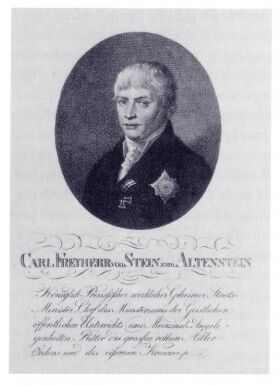
von Altenstein (From “Hegel in Berlin Preussische Kulturpolitik und idealistische Ästhetik - Ausstellungskatalog”, Preussischer Kulturbesitz, Berlin, 1981, out of print)
Around 18 September 1818 the family left Heidelberg. From 23 to 26 September Hegel visited Frommann, Goethe and Knebel in Jena and Weimar and arrived in Berlin about 29 September; Immanuel remembered that on the “rest day in Jena” his fourth birthday was celebrated in Frommann’s house.[238] With Berlin Karl’s own memories begin: “Here my earliest memories go back to the dwelling in the Leipziger Straße and to the school of Herr Blenz, to which I was sent as a five-year-old boy.” The first dwelling, which Altenstein’s sister had rented for 300 talers a year, lay in a corner house, Leipziger Straße 29 at the corner of Friedrichstraße. After a good year, according to Vieweg in 1820, the family moved to Kupfergraben No. 4a, opposite the Museum Island, where Hegel lived the remaining eleven years until his death. The way to the old school was now long, and when Karl once stayed away over midday because he was chatting with a comrade, he put his parents “in the greatest anxiety” (DE: „in die größte Angst“); afterwards he went to the school of Herr Kupsch in the Dorotheenstraße.[239]
DE: „Hier gehen meine frühesten Erinnerungen auf die Wohnung in der Leipziger Straße und auf die Schule des Herrn Blenz zurück, in die ich als fünfjähriger Knabe geschickt wurde.“
Chapter 9: Berlin I (1818–1820) — Call, Karlsbad, Persecution of Demagogues
The Prussia that Hegel entered in autumn 1818 was split between reform and restoration. The king had promised a constitution on 22 May 1815 and did not like to be reminded of it; the reformers around Hardenberg lost influence, and at court a party of restoration gathered around the crown prince. For the universities it was fortunate that in 1817 a separate ministry of culture under Altenstein had come into being, which delayed many a measure of the restoration party until it became moot.[240] The first two Berlin years are the most densely narrated in Hegel’s life, because the origin of the Elements of the Philosophy of Right falls within them. Its history stands in Hegel’s Philosophy of Right – How Freedom Becomes Real (2026), Ch. 2.6–2.8 and in Ch. 20 of this book; here follows only what concerns Hegel as a person.
9.1 Taking Up the Post
On 22 October 1818 Hegel gave his Berlin inaugural speech, a only slightly expanded version of the Heidelberg one, and in it took up the saying of the reform period that “Prussia” was “built on intelligence.” (DE: „auf Intelligenz gebaut“)[241] His colleague Solger wrote to Tieck: “No one speaks of him, for he is quiet and diligent.” (DE: „Es spricht niemand von ihm, denn er ist still und fleißig.“)[242] Goethe saw in the calls of Hegel and Seebeck Altenstein’s intention “to procure a scientific bodyguard for himself.” (DE: „sich eine wissenschaftliche Leibgarde anschaffen zu wollen“) In the first semester Hegel read on encyclopaedia and on natural right and political science; in winter 1819/20 he announced the philosophy of right “following the guide of his forthcoming outline.” (DE: „nach Anleitung seines demnächst erscheinenden Leitfadens“)[243]

University of Berlin (From Hans Günther Reissner “Eduard Gans - Ein Leben im Vormärz”, J.C.B. Mohr, Tübingen, 1965, out of print) The University (Humboldt Universität) is still located in the same building today. Since 1871, a small bust of Hegel has been placed in front of it.
In spring 1820 Arthur Schopenhauer habilitated in Berlin. To the dean Boeckh he wrote that his lecture on “the whole of philosophy,” six times a week, should be announced for the hour “when Herr Prof. Hegel reads his main course” (DE: „wo Herr Prof. Hegel sein Hauptkollegium liest“); the topic of his trial lecture, four kinds of causes, Hegel had approved for him “with the greatest readiness.” (DE: „mit der größten Bereitwilligkeit“)[244] Of the disputation on 23 March there is only one report, which the collection of Schopenhauer’s conversations transmits after Karl Bähr: Hegel asked what the motive is when a horse lies down in the street, and the physician Lichtenstein sided with Schopenhauer against Hegel on the question of what “animal functions” are. Vieweg considers the report tendentious. Schopenhauer’s lecture had few hearers.[245]
9.2 Murder, Dismissal, Persecution
On 23 March 1819 the Jena Burschenschafter Karl Ludwig Sand stabbed the writer August von Kotzebue to death in Mannheim. Hegel’s Berlin colleague, the theologian Wilhelm Martin Leberecht de Wette, a friend of Fries, wrote to Sand’s mother a letter in which he called the deed “a fine testimony of the time,” (DE: „ein schönes Zeugnis der Zeit“) and was dismissed without notice.[246] Among the professors this led to a quarrel. Hegel defended the right of the state “to dismiss a teacher, if only it leaves him his salary” (DE: „einen Lehrer abzusetzen, wenn er ihm nur seinen Gehalt lasse“); Schleiermacher called that “wretched,” and Hegel answered “with equal coarseness.” To a collection of colleagues for de Wette he nevertheless gave 25 talers. As late as 2 May 1819 he had taken part with Schleiermacher in a festival of the students on the Pichelsberg.[247]
The Karlsbad Decrees of August 1819, adopted by the Bundestag on 20 September, abolished the freedom from censorship of the universities and installed government commissioners. Hegel was drawn into the consequences several times. His hearer Gustav Asverus, son of a Jena acquaintance, was arrested on 15 July 1819; Hegel furnished a surety and obtained his release only in June 1820. Leopold von Henning, likewise suspected and briefly imprisoned, afterwards became his repetitor.[248] To Creuzer Hegel wrote in October 1819: “I am nearly 50 years old, have spent 30 of them in these ever restless times of fearing and hoping and hoped that fearing and hoping was at an end once and for all. Now I must see that it continues, indeed, one thinks in gloomy hours, grows ever worse.”[249] In retrospect, in 1821, he wrote to Niethammer: “The demagogic distress I have weathered without danger.” (DE: „Die demagogische Not habe ich ohne Gefährde bestanden“)[250]
It is attested that Hegel supported endangered pupils and at the same time urged them to moderation: Asverus wrote in 1821 that the Burschenschaft must have “no political aims; for that is folly,” (DE: „keine politischen Zwecke haben; denn das ist Torheit“) and recommended to a friend to attach himself to Hegel.[251] How Hegel’s public position in these years is to be judged has been disputed in the reception since Haym (History of Hegel’s Reception, Volume I, Ch. 17.8); the facts on the printing history of the Elements that play a role in this dispute stand in Ch. 20.
An episode from these years Rosenkranz told in 1844, without name and date. One of Hegel’s hearers sat “on account of political associations” in the prison of the Stadtvogtei, which lay with its rear on the Spree. Friends rowed at midnight in a boat under his window to speak with him, and persuaded Hegel to come along once. The conversation was to be conducted in Latin out of caution; but Hegel asked only “num me vides?” (do you see me?), which, since one could almost reach the prisoner one’s hand, aroused “great merriment.” Rosenkranz tells it as an example of Hegel’s benevolence, which “here perhaps let itself be carried away to the very limit of the adventurous.” (DE: „sich hier wohl selbst bis an die Grenze des Abenteuerlichen“)[252]
Reading. Jacques D’Hondt has made this story the key of his book on the Berlin years. The fact, a Berlin professor in a boat with “demagogic” students at midnight before the state prison, speaks against the picture of the subservient state philosopher; Rosenkranz’s jocular interpretation is tailored to the watchful eyes of 1844. Hegel lived in Berlin “in hiding,” outwardly the professor, inwardly an adherent of the Napoleonic “new order.” (DE: „neuen Ordnung“)[253] The narrative rests on Rosenkranz alone; that it is true D’Hondt assumes because the other witnesses were still living in 1844. Attested besides are Hegel’s surety for Asverus, his intervention for Cousin and an exchange of letters with the Burschenschafter Karl Ulrich, arrested in 1819, of which only a single letter of Ulrich’s from the year 1822 is preserved; the remaining letters of both sides, according to Hoffmeister, as emerges from that letter, were “destroyed for reasons of caution immediately upon receipt,” (DE: „aus Gründen der Vorsicht sogleich nach Empfang vernichtet“) according to Nicolin “by agreement.” (DE: „vereinbarungsgemäß“)[254] What these acts say about Hegel’s disposition D’Hondt and Rosenkranz interpret differently; the testimonies admit both readings.
9.3 Family and First Journeys
The family had not yet found its footing in Berlin. “The circle of friends I have not yet found,” (DE: „Den Kreis der Freunde habe ich noch nicht gefunden“) Hegel wrote to Creuzer in November 1819.[255] In summer 1819 he traveled with his wife and son Karl to Rügen; the six-year-old retained of it that in Schwedt on the Oder he was so stung by mosquitoes “that I could not open my eyes,” (DE: „daß ich die Augen nicht aufmachen konnte“) and that stormy weather delayed the return journey by days.[256] From the same first Berlin years he retained the great parade at which he was shown, beside the king, “also the famous field marshal of the wars of liberation, Prince Blücher, sitting bent forward on horseback” (DE: „auch den berühmten Feldmarschall der Freiheitskriege, Fürst Blücher, in vorgebeugter Haltung zu Pferde sitzend“); Blücher died in September 1819. The mother was allowed twice, in 1820 and 1826, to visit her family in Nuremberg with both sons, in a hired carriage “a full six days” on the road; Karl remembered her jubilation when behind Erlangen “first the castle and the towers of the beloved native city” (DE: „zuerst die Burg und die Türme der geliebten Vaterstadt“) came into view.[257] In August and September 1820 Hegel made his first “art journey” to Dresden, where he stood for the first time before Raphael’s Sistine Madonna and at a celebration of Goethe’s birthday heard Ludwig Tieck read Othello aloud. Friedrich Förster, who accompanied him, later placed the journey in his memory on 14 July and connected it with Hegel’s toast to the storming of the Bastille (Ch. 12.5).[258]
Hegel to Schelling, 2 November 1800, Br. 1, no. 29, pp. 58–60, here p. 59 (Ch. 13.4). The curriculum vitae of 1804 is printed in Br. IV/1, doc. 72, pp. 88–90 (draft). Abbreviations of the sources as in Part II (Ch. 12): Br. = Briefe von und an Hegel, ed. Johannes Hoffmeister, vols. 1–3, 3rd ed. Hamburg 1969, vol. IV/1–2 ed. Friedhelm Nicolin, Hamburg 1977/1981; Nic. = Günther Nicolin (ed.), Hegel in Berichten seiner Zeitgenossen, Hamburg 1970 (number and page); Nicolin 1970 = Friedhelm Nicolin (ed.), Der junge Hegel in Stuttgart. Aufsätze und Tagebuchaufzeichnungen 1785–1788, Marbach a. N. 1970 (Marbacher Schriften 3); Rosenkranz 1844 = Karl Rosenkranz, Georg Wilhelm Friedrich Hegel’s Leben, Berlin 1844. ↩︎
Walter Jaeschke, Hegel-Handbuch. Leben – Werk – Schule, 3rd ed., Stuttgart: Metzler 2016, p. 13: The “surprising paucity of the sources” (DE: „überraschende Dürftigkeit der Quellen“) is “glossed over by voluminous collages, almost embellished like a novel by means of an addition of information of different provenance” (DE: „überspielt durch voluminöse, mittels einer Addition von Informationen unterschiedlicher Herkunft fast schon romanhaft ausgeschmückte Kollagen“); in this way arises “a picture nonetheless dense and rich in color, but methodologically questionable.” (DE: „ein gleichwohl dichtes und farbenfreudiges, methodologisch allerdings fragwürdiges Bild“) Hereafter “Jaeschke, Handbuch” (pages according to the print edition). ↩︎
Klaus Vieweg, Hegel. Der Philosoph der Freiheit. Biographie, Munich: C. H. Beck 2019. Cited by chapter (Roman numeral) and section heading, the notes by their number within the chapter, e.g. “Vieweg, Hegel, Ch. II, section ‘Das Tübinger Stift’, n. 36.” (DE: „Vieweg, Hegel, Kap. II, Abschn. ‚Das Tübinger Stift‘, Anm. 36“) The quotation: Ch. II, n. 36, on the scene “Ein langer Tag im Stipendium Theologicum”: “The events mentioned are largely documented, only they did not all take place on one day.” (DE: „Die genannten Ereignisse sind weitgehend belegt, nur fanden sie nicht alle an einem Tag statt.“) Equally narrative are the scenes “Ein Sommerabend in Tschugg” (Ch. III) and the “‘Sonnenklare Bericht’ über ein denkwürdiges Treffen in Frankfurt anno 1797” (Ch. IV). Further biographies: Terry Pinkard, Hegel. A Biography, Cambridge 2000 (hereafter “Pinkard”); Domenico Losurdo, Hegel und das deutsche Erbe. Philosophie und nationale Frage zwischen Revolution und Reaktion, Cologne 1989 (hereafter “Losurdo, Erbe”). ↩︎
Horst Althaus, Hegel und die heroischen Jahre der Philosophie. Eine Biographie, Munich/Vienna: Carl Hanser 1992 (hereafter “Althaus, Hegel”, by page); Jürgen Kaube, Hegels Welt, Berlin: Rowohlt Berlin 2020 (hereafter “Kaube, Hegels Welt”), cited by chapter, which Kaube numbers with ordinals (“Neuntes Kapitel” = Ch. 9). ↩︎
Rosenkranz 1844, pp. 3 f. (birth, the father’s offices, siblings); Christiane Hegel to Marie Hegel, Nic. no. 1, pp. 3 f. (the mother’s education); Vieweg, Hegel, Ch. I, opening (birthplace “Auf dem kleinen Graben, today’s Eberhardstraße 53,” (DE: „Auf dem kleinen Graben, der heutigen Eberhardstraße 53“) the mother’s origins, nickname; “Four further children of the family died shortly after birth,” (DE: „Vier weitere Kinder der Familie sind kurz nach der Geburt verstorben“) n. 2); Pinkard, pp. 3 f. (brother: captain, ennobled, missing in the Russian campaign of 1812). Life dates of the family after the personal index Br. IV/2, pp. 192–194 (mother 1741–1783, father 1733–1799, from 1796 revenue-office expedition councillor, brother Georg Ludwig 1776–1812, “fell in Napoleon’s Russian campaign in 1812,” (DE: „1812 im russ. Feldzug Napoleons gefallen“) Christiane 1773–1832; in addition four siblings who died early). Christiane took her own life in 1832, about three months after her brother’s death (Ch. 11.5). That admission to the Stift indicated not neediness but membership in the “Ehrbarkeit”: Jaeschke, Handbuch, p. 3. ↩︎
Christiane Hegel to Marie Hegel, Nic. no. 1, pp. 3 f. (Nicolin normalizes the spelling). Rosenkranz 1844, p. 4: “She died in 1783 of a bilious fever, from which at the same time the father, the sister, and Hegel himself also lay gravely ill.” (DE: „Sie starb 1783 an einem Gallenfieber, woran gleichzeitig auch der Vater, die Schwester und Hegel selbst schwer darniederlagen.“) Vieweg, Hegel, Ch. I, opening, names “typhus” as the illness; which fever is meant, the sources do not say. The Stuttgart church register records her death on 20 September 1783, at the age of 41 (Br. IV/1, doc. 9, p. 13); in the Landexamen of that month Hegel is listed as “absens ob morbum,” absent because of illness (doc. 8b, p. 13). Pinkard, p. 3, places the mother’s death on “20 September 1781,” when Hegel was “eleven”; that is a slip. ↩︎
Hegel to Christiane Hegel, 20 September 1825, Br. 3, no. 497, p. 96 (the whole letter). Rosenkranz 1844, p. 4, prints it as evidence that the memory of the mother was “sacred” to Hegel. ↩︎
Christiane Hegel to Marie Hegel, 7 January 1832, Nic. no. 1 (Nicolin 1970, p. 83: “as a boy of 3 years he was sent to the German and in the 5th year to the Latin school, at which age he already knew the first declension and the Latin words belonging to it, which our blessed mother taught him”); Rosenkranz 1844, p. 6 (“In his fifth year Hegel attended a so-called Latin school. From his seventh year on he frequented the Gymnasium of his native city” (DE: „Im fünften Jahr besuchte Hegel eine sogenannte Lateinische Schule. Vom siebenten ab frequentirte er das Gymnasium seiner Vaterstadt“)); Diary, 6 July 1785, GW 1, p. 7, with n. p. 530 (Löffler took over the I suprema in the autumn of 1777, “not, as Hegel writes: infima” (DE: „nicht, wie Hegel schreibt: infima“); when Hegel entered the lower Gymnasium remains open). On the structure of the school GW 1, p. 526, and Br. IV/1, note to doc. 10; on German schools and Latin schools GW 1, pp. 541 f.; Nicolin 1970, pp. 7, 11 f., 129 f., 152 (which German school Hegel attended is not documented; autumn 1776 as the calculated regular entry). Jaeschke’s “probably from 1776” (DE: „wahrscheinlich seit 1776“) (n. b1-schule) follows this calculation of Nicolin; GW 1 leaves the question open. ↩︎
Christiane Hegel to Marie Hegel, Nic. no. 1, pp. 3 f.; Jaeschke, Handbuch, p. 1 (“probably from 1776 the Gymnasium, from 1784 the ‘Obergymnasium’” (DE: „wahrscheinlich seit 1776 das Gymnasium, seit 1784 das ‚Obergymnasium‘“); Shakespeare: “the boy of about eight,” after GW 1, p. 8). Vieweg, Hegel, Ch. I, section “Das Gymnasium Illustre,” has the pupil attend the Gymnasium “from his 6th birthday on” (DE: „von seinem 6. Geburtstag an“) and Löffler give Shakespeare “to the nine-year-old”; the discrepancy of a year is of no weight, Christiane writes “at the age of 8 years.” (DE: „im Alter von 8 Jahren“) Christiane calls the geometry teacher “the still living Obrist Duttenhofer” (DE: „dem noch lebenden Obristen Duttenhofer“); meant is Karl August Friedrich Duttenhofer, schoolmate of Schiller at the military academy and there teacher of mathematics, in 1782 the first doctor of philosophy of the Karlsschule, colonel only in 1807. Rosenkranz reproduced Christiane’s statement as a rank of 1780 (Nicolin 1970, pp. 83 f., 153). ↩︎
Rosenkranz 1844, p. 26, cited after Jaeschke, Handbuch, p. 1, who suspects as the textbook the Elementa philosophiae rationalis for the Württemberg schools (after Pozzo 1989). ↩︎
Jaeschke, Handbuch, pp. 1 f. (GW 1, pp. 1–33); the quotations GW 1, p. 3 (sermon on the Augsburg Confession, 26 June 1785; “Schröks,” that is Johann Matthias Schröckh’s Lehrbuch der allgemeinen Weltgeschichte, 27 June), p. 5 (Scharnhausen), and p. 30 (languages); Vieweg, Hegel, Ch. I, section “Das Gymnasium Illustre” (the quotation on the languages, GW 1, p. 30). The dated entries run to 7 January 1787 (GW 1, p. 453); a German translation of the Latin parts is given by Nicolin 1970, pp. 90–105. On the diary as a source see also Ch. 13.1. ↩︎
Rosenkranz 1844, pp. 12 f., cited in Vieweg, Hegel, Ch. I, section “Herantasten an die Wissenschaft und die Philosophie.” ↩︎
First excerpt, from Schlözer’s Stats-Anzeigen, dated “1785. 22. April” (GW 3, p. 3); Thaulow and Nicolin 1970, p. 24, read 1784, according to GW 3, p. 257 a misdating, since the issue only appeared in 1785. “Definitions of all sorts of objects” (DE: „Definitionen von allerhand Gegenständen“) from 10 June 1785 (GW 3, pp. 201 ff.); diary from 26 June 1785 (GW 1, p. 3). Letter to Haug from “Mathematikhausen,” 8 June 1785: Nicolin 1970, pp. 29 f., with n. p. 88 (after the manuscript in the WLB Stuttgart; Karl Hegel 1887 and Hoffmeister, Br. 1, read the addressee wrongly as “Haag,” and in Hoffmeister the sequence of the text is also disturbed). ↩︎
Jaeschke, Handbuch, pp. 1 f. (excerpts GW 3, pp. 1–205); Kant in reviews: GW 3, pp. 184–200 (excerpts 28 “Ueber Freiheit,” review of J. A. Ulrich’s Eleutheriologie, 31 July 1788, and 29 “Verhältniss der Metaphysik zur Religion,” review of Rehberg’s Über das Verhältniß der Metaphysik zu der Religion, 29 September 1788); Vieweg, Hegel, Ch. I, sections “Das Gymnasium Illustre” and “Gesunder Menschenverstand und Wunderglauben – Hegels Lehrer Jakob Friedrich Abel” (Hopf, Abel, Cleß, Griesinger; confirmation on 21 November 1784 in St. Leonhard). Christiane names Hopf and Abel, “Prelate Abel,” as early patrons and distinguishes: Hopf “was his teacher at the Gymnasium, the last, to be sure professor at the academy in Stuttgart, knew him early” (DE: „war sein Lehrer aufm Gymnasium, der Letzte, zwar Prof. an der Akademie in Stuttgardt, kannte ihn schon frühe“) (Nic. no. 1, p. 4; Nicolin 1970, p. 84). Diary, 14 July 1785: “Herr Prof. Abel and Herr Prof. Hopf honored our societies the day before yesterday with a visit. We went walking with them” (DE: „Herr Prof. Abel, und Herr Prof. Hopf, beehrten unsere Gesellschafften vorgestern mit einem Besuch. Wir gingen mit Inen spazieren“) (GW 1, p. 10; on Abel n. p. 533). Rosenkranz 1844, p. 6 (“attachment to older persons, namely to his teachers, whom he accompanied on walks or who also visited his paternal house” (DE: „Anschluß an ältere Personen, namentlich an seine Lehrer, die er auf Spaziergängen begleitete oder die auch sein väterliches Haus besuchten“); among them “the Prelate Abel, professor at the academy in Stuttgart, later in Tübingen” (DE: „der Prälat Abel, Professor an der Akademie in Stuttgart, später in Tübingen“)). Abel’s autobiography (manuscript WLB Stuttgart, the sheet in question in the DLA Marbach) after Alexandra Birkert, Hegels Schwester. Auf den Spuren einer ungewöhnlichen Frau um 1800, Ostfildern: Thorbecke 2008, pp. 44–48, the quotation p. 46 after the original; Birkert, p. 44: Abel “counted among Hegel’s private teachers.” (DE: „zählte zu den Privatlehrern Hegels“) At the Gymnasium Abel did not teach; he is absent from the list of teachers in Nicolin 1970, pp. 18–20. Griesinger was 1784–1786 town pastor at St. Leonhard, prelate only later (Nicolin 1970, p. 137). ↩︎
GW 1, pp. 43 f., after Jaeschke, Handbuch, p. 2. ↩︎
Jaeschke, Handbuch, pp. 1 f. (speech of 25 September 1788, GW 1, p. 49; “his poor delivery already then criticized several times” (DE: „sein schlechter Vortrag schon damals mehrfach getadelt“)). The program, written by Balthasar Haug, assigned to Hegel: “Rem Turciae litterariam tractet, item germanice, et in valedictionem cum gratiarum actione desinat” (GW 1, pp. 460 f., with the framework after the Schwäbische Chronik 1788; Br. IV/1, doc. 15; Nicolin 1970, pp. 27 f.). The teacher’s remark on the delivery is given by Vieweg, Hegel, Ch. I, n. 70, after GW 1, pp. 458 f., and Rosenkranz 1844, p. 18. ↩︎
GW 1, p. 533 (note on Abel: 1772 professor at the Karlsschule, “teacher and friend of Schiller,” (DE: „Lehrer und Freund Schillers“) 1790 ordinary professor of philosophy in Tübingen); Vieweg, Hegel, Ch. I, section “Gesunder Menschenverstand und Wunderglauben – Hegels Lehrer Jakob Friedrich Abel” (Abel 1790 successor of Ploucquet), section “Das ‘Kettenhaus’ der Welt – Rousseau und Schiller” (Fiesko “dedicated to his teacher Abel” (DE: „seinem Lehrer Abel gewidmet“)), Ch. II, section “Logik – Metaphysik – Epistemologie – philosophische Psychologie,” with nn. 177 f. (magister disputation 1792); Hegel to Schelling, 30 August 1795, Br. 1, no. 14, p. 30. ↩︎
Rosenkranz 1844, p. 425 (Christiane), p. 523 (fragment); the lost “Analyse von Schillers Fiesko” is recorded by GW 1, p. 413, after Rosenkranz; Vieweg, Hegel, Ch. I, section “Das ‘Kettenhaus’ der Welt – Rousseau und Schiller.” According to Gustav Schwab even the pastor who baptized Schiller was a Hegel (Rosenkranz 1844, p. 3). ↩︎
Vieweg, Hegel, Ch. I, section 1 “‘Freunde, die dir nicht nach dem Munde reden, halte fest’ – Der Stuttgarter Freundeskreis,” with nn. 18–26 (supported above all by Alexandra Birkert, Hegels Schwester. Auf den Spuren einer ungewöhnlichen Frau um 1800, Ostfildern: Thorbecke 2008, pp. 29, 43–48). Hegel’s diary records that Professors Hopf and Abel honored “our societies […] with a visit” (DE: „unsere Gesellschafften […] mit einem Besuch“) (GW 1, p. 10, after Vieweg). ↩︎
Diary, 27 June 1785, GW 1, p. 4 (“aus der 6ten Staeudlin”), with n. p. 528 (Christian Friedrich Stäudlin, 1769–1814, brother of the poet Gotthold Friedrich Stäudlin); Nicolin 1970, notes pp. 109 f. ↩︎
Jaeschke, Handbuch, pp. 1 f. ↩︎
Vieweg, Hegel, Ch. I, section “Das Gymnasium Illustre” with nn. 30 f. (Landexamen, first in September 1780, after Br. IV/1, pp. 254 ff.); Christiane’s note sheet, Nic. no. 2, p. 4 (“was to go to the lower seminaries” (DE: „sollte in die niedern Seminarien“)). Documented are the lists of 1780 (12–14 September) and 1783 (Br. IV/1, doc. 8, p. 13). ↩︎
Br. IV/1, pp. 19 f., cited after Jaeschke, Handbuch, p. 3. Vieweg, Hegel, Ch. I, end, dates the deed to 21 October 1788. ↩︎
Jaeschke, Handbuch, pp. 2 f.: From this period “no direct testimonies are transmitted that would give detailed or at least reliable information on his life and interests” (DE: „keine direkten Zeugnisse überliefert, die ausführliche oder wenigstens zuverlässige Auskunft über sein Leben und seine Interessen gäben“); research is dependent on surveys of university and Stift “as well as on later reports of third parties.” (DE: „sowie auf spätere Nachrichten Dritter“) The life documents: Br. IV/1, pp. 17–55; the reports: Nic. pp. 7–19. ↩︎
Jaeschke, Handbuch, p. 3: admission to the Stift on 21 October 1788 “by ducal order of 16.9.,” (DE: „auf herzoglichen Befehl vom 16.9.“) matriculation at the university on 27 October 1788. Vieweg, Hegel, Ch. I, end, writes that Hegel enrolled “as a student in Tübingen” (DE: „als Student in Tübingen“) on 22 October 1788. Both dates are right: The Tübingen deposition book records “Georg Wilhelm Friderich Hegel aus Stutgardt” on “22 (?) Oct. 1788,” the university’s matriculation on 27 October (Br. IV/1, doc. 18, p. 21; matriculation certificate doc. 19, p. 22). ↩︎
After Jaeschke, Handbuch, pp. 3 f. (source: Hegel 1770–1970. Leben, Werk, Wirkung, exhibition catalog, Stuttgart 1970, p. 80). The daily routine according to the statutes is described by Vieweg, Hegel, Ch. II, sect. “Ein langer Tag im Stipendium Theologicum,” as a narrated scene; according to Vieweg’s own note the events are “largely documented” but “did not all take place on one day” (DE: „nicht alle an einem Tag statt“) (ibid., Ch. II, n. 36). ↩︎
Jaeschke, Handbuch, p. 4 (“the detention penalties that Hegel too had to serve in 1791 for unauthorized absence” (DE: „den Karzerstrafen, die auch Hegel 1791 wegen unerlaubter Abwesenheit verbüßen mußte“)); Rosenkranz 1844, p. 31 (the friends had walked “for a few hours into the Stift prison” (DE: „auf einige Stunden in das Stiftscarcer“)). The wording of a consistory rescript that threatened Hegel with detention is given by Vieweg, Hegel, Ch. II, sect. “Ein langer Tag im Stipendium Theologicum” (“that at the next time under like cautions he would unfailingly be incarcerated” (DE: „daß er das nächstemal bey gleichen Caritionen unfehlbar werde incarceriert werden“)), without date and source. ↩︎
Jaeschke, Handbuch, p. 4 (baccalaureate, speech of thanks after Br. IV/1, p. 34; the professors; Flatt’s psychology lecture). On the dependence of the Bernese manuscript on a transcript of Flatt’s lecture also Vieweg, Hegel, Ch. II, n. 99 (after the edition of Klüpfel’s transcripts by Michael Franz and Ernst-Otto Onnasch, 2018). ↩︎
Jaeschke, Handbuch, pp. 4 f. (Br. IV/1, p. 34). Vieweg, Hegel, Ch. II, sect. “Das Studium der Theologie und Philosophie,” gives the same date. ↩︎
Jaeschke, Handbuch, p. 5 (Rosenkranz 1844, p. 25; Schwab; Christiane Hegel and Leutwein). Leutwein’s report: Nic. no. 8, pp. 10–13, here p. 12 (“vorher war ihm seines Vaters Entgegenstreben im Wege gestanden” [before, his father’s opposition had stood in the way]). ↩︎
Jaeschke, Handbuch, p. 5 (“because of a persistent fever repeatedly granted leave for a cure in Stuttgart, likewise at the beginning of 1793” (DE: „wegen eines anhaltenden Fiebers mehrfach für eine Kur nach Stuttgart beurlaubt, ebenso zu Beginn des Jahres 1793“); the dissertation “De ecclesiae Wirtembergicae renascentis calamitatibus”; “In his promotion Hegel takes fourth place” (DE: „In seiner Promotion nimmt Hegel den vierten Rang ein“)). According to Vieweg, Hegel, Ch. II, sect. “Französische Revolution als Morgenröte,” Hegel stayed in Stuttgart in 1791 “from February to August” (DE: „von Februar bis August“); according to Ch. II, n. 85, “from February 1791.” ↩︎
Leutwein to Theodor Pressel, undated, Nic. no. 8, pp. 11 f. (first printed: Dieter Henrich, “Leutwein über Hegel”, Hegel-Studien 3, 1965, pp. 53–57; according to Nicolin’s note, p. 565, Leutwein lived from 1768 to 1838, and Schwegler used the letter for his essay of 1839); likewise, after Schwegler and Fink, Rosenkranz 1844, p. 29 (“Diese Herabsetzung habe in Hegel eine bleibende Wunde zurückgelassen” [this demotion had left a lasting wound in Hegel]). ↩︎
Jaeschke, Handbuch, p. 5 (“and not, as arisen through a later copying error and spread by Eduard Zeller, ‘philosophiae nullam operam impendit’” (DE: „und nicht, wie durch einen späteren Abschreibefehler entstanden und durch Eduard Zeller verbreitet, ‚philosophiae nullam operam impendit‘“); Haym 1857, p. 40). Vieweg, Hegel, Ch. II, sect. “Ins ‘Freiheitsland,’” describes the error differently: Through a slip of the pen, “on the final certificate at first” (DE: „auf dem Abschlusszeugnis zunächst“) nullam appeared, the right assessment multam stands in a marginal correction (Br. IV/1, p. 54). The documents bear out Vieweg: The Tübingen testimonia read “multam” (there “felicem” is struck out), the Stuttgart testimonial book “nullam” with the marginal correction (Br. IV/1, doc. 46a and b, p. 54). The error thus stands in the official Stuttgart copy, not first in a later transcript; Zeller and Haym followed it. ↩︎
Jaeschke, Handbuch, p. 5 (the reports on Hegel’s sociability; Fallot’s drawing; “Vive A!” as a watchword for Auguste Hegelmaier, “die nicht auf die Heroen der Revolution anspielt” [which does not allude to the heroes of the Revolution]); Rosenkranz 1844, pp. 31 f. (Auguste Hegelmeier; on p. 32 he renders the passage as “V. A! Vive la belle Augustine pour toi seul! u. s. w.”). In the album itself, according to Hoffmeister’s edition, the passage reads “V. la belle Augustine — pour toi! / et la C . . . pour moi seul!”; it belongs to the entry signed by “Bernard de Montb[éliard]” (Br. IV/1, p. 154, no. 60). Rosenkranz’s report on Auguste also Nic. no. 17, p. 18; according to Gustav Binder’s recollection, Rosenkranz asked Fink about “la belle Augustine”, who “auf mehreren Blättern von Hegels Stammbuch als seine Herzenskönigin gepriesen wurde” [was praised as the queen of his heart on several leaves of Hegel’s album] (Nic. no. 16, pp. 17 f.). Hölderlin’s allusion: Hölderlin to Hegel, 20 November 1796 (“bis nächsten Frühling wieder der Alte sein” [to be his old self again by next spring], after Vieweg, Hegel, chap. IV, section “Hauslehrer bei der Familie Gogel”, Br. 1, p. 45). ↩︎
Rosenkranz 1844, pp. 29 f.; Jaeschke, Handbuch, p. 6 (on Fink as a source). On Renz Vieweg, Hegel, Ch. II, section “Das Tübinger Stift” and n. 112. ↩︎
Vieweg, Hegel, Ch. II, opening (the “Augustinerstube”; “In the year 1791 the Augustinerstube was occupied by 16 stipendiaries,” (DE: „Im Jahr 1791 war die Augustinerstube mit 16 Stipendiaten belegt“) after Fritz/Schneiderhan 1919, p. 35; Hegel “probably […] lived in the first four semesters on the Rattensphäre” (DE: „wahrscheinlich […] in den ersten vier Semestern auf der Rattensphäre“)). ↩︎
Jaeschke, Handbuch, p. 6 (Hölderlin to his sister, mid-November 1790; K. F. A. Schelling, Aus Schellings Leben, vol. 1). Jaeschke reproves that Bertaux (1969) and Jamme (1983) made out of Hölderlin’s letter a room only for Hölderlin, Hegel, Schelling, and Breyer. ↩︎
Hölderlin to Hegel, 10 July 1794, Br. 1, no. 5; Hegel to Schelling, end of January 1795, Br. 1, no. 8; both after Jaeschke, Handbuch, p. 6. ↩︎
Leutwein, Nic. no. 8, pp. 12 f.; Jaeschke, Handbuch, p. 6 (Schwab: “he ‘pritschte,’ as his friends told, Kant” (DE: „er ‚pritschte‘, wie seine Freunde erzählten, den Kant“)). ↩︎
Vieweg, Hegel, Ch. II, section 4 “‘Das Ideal des Jünglingsalters’ – Bildung und Volkserziehung” and section 6.3 “Die ‘Partei der Pyrrhoniker’ und das ‘Tor des Zweifels.’” ↩︎
After Vieweg, Hegel, Ch. II, sect. “Französische Revolution als Morgenröte,” with nn. 72–77 (based on Uwe Jens Wandel, Verdacht von Democratismus?, Tübingen 1981, and Axel Kuhn/Jörg Schweigard, Freiheit oder Tod!, Cologne etc. 2005). ↩︎
Rosenkranz 1844, p. 33; Pinkard, pp. 24 f. The expulsion of Wetzel (“rejectus Mai 1793 – democrata”) after Wandel, cited in Vieweg, Hegel, Ch. II, n. 58. Pinkard calls him “Christian Ludwig Wetzel,” Vieweg “Christian Ludwig August Wetzel.” ↩︎
Br. IV/1, pp. 135–164 (Hegel’s album), no. 73 (Knapp, “Tübingen, 2 July” (DE: „Tübingen, d. 2. Juli“) 1793) and no. 75 (Billing: “S’il y avait un gouvernement des anges, ils se gouvernoient démocratiquement,” “André Billing, Et. en Theol. de Colmar”), p. 158; no. 93 (Stäudlin: “In tyrannos! Ulrich Hutten”), p. 163. Cf. Vieweg, Hegel, Ch. II, sect. “Französische Revolution als Morgenröte,” with nn. 39, 62, and 88. ↩︎
Vieweg, Hegel, Ch. II, sect. “Französische Revolution als Morgenröte,” with nn. 61–65 (Mömpelgard room; quotation from an official report, n. 65), and Ch. II, n. 12 (Mömpelgard Württemberg since the 14th century, “with French-speaking population,” 1796 to France; around 1800 about twelve students from these regions; Fallot and Bernard as Mömpelgarders). ↩︎
Jaeschke, Handbuch, p. 7. (DE: „keine einzige zeitgenössische Aussage von oder über Hegel zu seiner damaligen Stellung zur Revolution und den in ihrem Gefolge entstandenen Richtungen – anders als etwa bei Hölderlin“) ↩︎
Rosenkranz 1844, p. 29 (Schwegler’s report verbatim, then Rosenkranz’s judgment). On the transmission Ch. 12.5 and Nic. nos. 9, 10, 14. ↩︎
Jaeschke, Handbuch, p. 7 (“as a product of his myth-making power to be rejected — at best as a contamination with a later event” (DE: „als Produkt seiner mythopoietischen Kraft zu verwerfen – bestenfalls als Kontamination mit einem späteren Vorgang“); the report of 14 July 1793 after Hölderlin, StA VI, p. 618, and Beck 1947, p. 38). Of the Reign of Terror “Hegel anyway spends only the first four weeks in Tübingen” (DE: „verbringt Hegel ohnehin nur noch die ersten vier Wochen in Tübingen“) (ibid.). ↩︎
Vieweg, Hegel, Ch. II, n. 63 (“there is so far no evidence for this”); Pinkard, p. 24 (“almost surely false”). Pinkard tells the version of 14 July 1793 with Hölderlin, Schelling, and Hegel and the Carmagnole. ↩︎
Althaus, Hegel, p. 40: “The enthusiasm must have overwhelmed Hegel so much that he marched with a few friends onto a free field to raise a freedom tree there.” (DE: „Die Begeisterung muß Hegel damals so überwältigt haben, daß er mit einigen Freunden auf ein freies Feld zog, um dort einen Freiheitsbaum aufzurichten.“) P. 69 he calls Hegel among the “Tübingen student demonstrations with freedom tree” (DE: „Tübinger Studentendemonstrationen mit Freiheitsbaum“) a “fellow traveler.” ↩︎
Vieweg, Hegel, Ch. II, sect. “Französische Revolution als Morgenröte” (quotation at the end of the section; on the “Collegium alogicum” nn. 53–55). ↩︎
Losurdo, Erbe, p. 34 (“When one could perceive in the early writings, in the appeal to the folk religion of Hellas, the echo of the national celebrations introduced by Robespierre …” (DE: „Wenn man in den Jugendschriften bei der Berufung auf die Volksreligion der Hellade das Echo der von Robespierre eingeführten Nationalfeiern wahrnehmen konnte …“)); Pinkard, p. 24 (“Hegel was a member of the club”). ↩︎
Jaeschke, Handbuch, p. 7: the “tendency” already manifests itself “in the common plural ‘the Stiftler,’ which methodically levels potential differences.” (DE: „bereits im gängigen, potentielle Differenzen methodisch einebnenden Plural ‚die Stiftler‘“) ↩︎
Jaeschke, Handbuch, p. 5 (Schnurrer to J. E. H. Scholl). New statutes of the Stift came into force on 12 May 1793, “thus two months before Hegel again leaves Stift and university” (DE: „also zwei Monate bevor Hegel Stift und Universität wieder verläßt“) (ibid., p. 4). (DE: „langer Aufenthalt zu Hauß, wo er selbst vielleicht mehr gilt als der Vater, möchte keine eigentliche Vorbereitung auf das nicht eben zwanglose Leben eines Hofmeisters seyn“) ↩︎
Vieweg, Hegel, Ch. II, sect. “Französische Revolution als Morgenröte” (after Rosenkranz); Stäudlin to Hegel, 14 December 1793, Br. 1, no. 4, p. 9. ↩︎
Pinkard, p. 45: “The innkeeper was later to become famous in biographies of Schiller, who had earlier frequented the place”; Br. IV/2, personal index, p. 147 (Brodhag, d. 1809, “landlord of the inn ‘Zum Ochsen’ in Stuttgart” (DE: „Wirt d. Gaststätte ‚Zum Ochsen‘ in Stuttgart“)). ↩︎
Jaeschke, Handbuch, pp. 8 f., after Hans Strahm, “Aus Hegels Berner Zeit”, Archiv für Geschichte der Philosophie 41 (1932), pp. 514–533, and Nic. pp. 20–23. Hegel’s letters to v. Rütte of 24 August and 11 September 1793: Br. 1, nos. 2 and 3 (Hegel’s doubts about the salary no. 2, p. 4). Brodhag to v. Rütte, 28 July and 25 August 1793, Nic. nos. 23 and 24, pp. 21–23 (the testimony p. 22, the Magister near Geneva p. 23). ↩︎
Jaeschke, Handbuch, pp. 8 f. (Stäudlin to Schiller, 20 September 1793; Hölderlin to Hegel, 10 July 1794, Br. 1, no. 5). ↩︎
Vieweg, Hegel, Ch. II, sect. 7 “Ins ‘Freiheitsland’ – Vor dem Wechsel zur Hofmeisterstelle nach Bern”. ↩︎
Br. IV/1, p. 53, after Jaeschke, Handbuch, p. 9, and Vieweg, Hegel, Ch. II, sect. “Ins ‘Freiheitsland.’” ↩︎
Br. IV/1, doc. 72, p. 89. ↩︎
Jaeschke, Handbuch, p. 9 (“on 10.10. he will have departed for Bern” (DE: „am 10.10. wird er nach Bern abgereist sein“)); Vieweg, Hegel, Ch. II, sect. “Französische Revolution als Morgenröte,” with nn. 84–88 (the album entries, Br. IV/1, p. 160). ↩︎
Christiane Hegel’s note slip, Nic. no. 30, p. 27; Jaeschke, Handbuch, p. 13. ↩︎
Martin Bondeli, Hegel in Bern, Bonn: Bouvier 1990 (Hegel-Studien, Beiheft 33; unchanged reprint Hamburg: Meiner 2016), p. 61 with nn. 15–18 (after Hans Strahm, “Aus Hegels Berner Zeit,” p. 524; against Strahm also Hans Haeberli, “Die Bibliothek von Tschugg und ihre Besitzer,” pp. 737, 741). Steiger’s own life story in the Tschugg archive, Mss. h. h. L 92, bears the title “alt Landvogt zu Erlach” (Bondeli, p. 61, n. 18). About Steiger’s father Bondeli (p. 61, n. 17, after Haeberli, p. 736) reports that he saw in Rousseau’s Social Contract “la source de tous ces malheurs” “qui ne seroient pas arrivés, si J. J. Rousseau avait esté toute sa vie un Oureng Outan” (the source of all these misfortunes, which would not have happened if J. J. Rousseau had been an orangutan all his life). ↩︎
Br. IV/1, doc. 50, p. 70 (passport of the city of Bern, 15 May 1795); likewise Bondeli, Hegel in Bern, p. 57. ↩︎
Jaeschke, Handbuch, p. 10 (Steiger’s expectations after Strahm; the letter of 9 July 1795, Br. 1, no. 12); Vieweg, Hegel, Ch. III, opening (house Junkerngasse 51, which the Steigers had acquired only in 1793; in it Albrecht von Haller had lived from 1766 to 1772). Bondeli, Hegel in Bern, p. 59 with nn. 8 and 9, takes the expectations from a letter of the former private tutor Schwindrazheim to Steiger of 9 January 1793 (Tschugg archive, Mss. h. h. L 103) and gives the pupils’ ages as six and nine; he understands the report of 9 July 1795 as the usual rapport, which points “to no closer relationship of trust between Hegel and Steiger.” (DE: „auf kein engeres Vertrauensverhältnis zwischen Hegel und Steiger“) ↩︎
Bondeli, Hegel in Bern, pp. 59 f. with nn. 10–14 (Steiger to his wife, 25 October 1795, Tschugg archive, Mss. h. h. L 118; the “gazettes” after the letters of 15 and 16 October 1795; greetings of the sisters and other letter writers in L 101, L 104, L 106, and L 117, among them also to Mögling). The translation is that of the author of this book; “contant” for “content” is Steiger’s spelling. ↩︎
Bondeli, Hegel in Bern, p. 62 with nn. 19 and 20 (J. R. Steiger to Steiger, 7 November 1796, Tschugg archive, Mss. h. h. L 102, pag. 181, after Haeberli, p. 741; Steiger’s letter to his brother lost); Jaeschke, Handbuch, p. 10; Vieweg, Hegel, Ch. III, opening, with n. 8 (after Helmut Schneider/Norbert Waszek [eds.], Hegel in der Schweiz (1793–1796), Frankfurt a. M. 1997, introduction, p. 18). The translation is that of the author of this book; “fâche” stands so in Bondeli. That Hegel, by the testimony of the Fichtean Rudolf Steck, had stood out “through unconcealed sympathy with the French Revolution” (DE: „durch unverhohlene Sympathie mit der französischen Revolution“) is reported by Vieweg ibid., n. 9. ↩︎
Hegel to Schelling, 24 December 1794 (Br. 1, no. 6), end of January 1795 (no. 8), 16 April 1795 (no. 11), 30 August 1795 (no. 14), after Jaeschke, Handbuch, pp. 10 f. ↩︎
Bondeli, Hegel in Bern, pp. 62–64 with nn. 22–27 (Catalogue de la Bibliothèque de Tschougg, Tschugg archive, Mss. h. h. L 97, “a good 200 pages”; the library was “essentially built up under Carl Friedrich’s father” (DE: „wesentlich unter dem Vater Carl Friedrichs aufgebaut“) and afterwards not systematically expanded; “recent German philosophy (e.g. Kant) is wholly missing” (DE: „die neuere deutsche Philosophie (z. B. Kant) fehlt völlig“); under “Histoire générale/Brochures” a Recueil de diverses Pièces sur la Révolution en France 1789–90 with writings up to 1793; among the periodicals the Politisch-Literarische Kurier and the Straßburger Kurier 1790–1792, the Bulletin National et Républicain 1793–1795, and the Gazette de Berne 1789–1797). Strahm had used only a later auction catalog (Bondeli, p. 63, n. 24); it is also printed by Jaeschke, Handbuch, pp. 10 f., as Catalogue de la précieuse bibliothèque de feu M. l’Avoyer Christoph de Steiger de Tschugg, in: Schneider/Waszek 1997, pp. 319–379. On Hegel’s reading of Gibbon since Bern Hegel’s Philosophy of Right – How Freedom Becomes Real (2026), Ch. 35.6.1 (after Jaeschke, pp. 65, 368). ↩︎
Rosenkranz 1844, p. 43 (there also a Herr Fleischmann, with whom Hegel, as with Sonnenschein, exchanged letters from Frankfurt); Jaeschke, Handbuch, p. 10; Bondeli, Hegel in Bern, pp. 57 f. (with the reference to the “revolutionary content” of the song) and p. 60, n. 14 (greetings to Mögling in a letter to Steiger of autumn 1794); Br. 1, pp. 10, 13, 29, 34, 36 (greetings to Mögling). Rosenkranz and Bondeli call Sonnenschein a painter, Jaeschke a sculptor; Bondeli refers to Owsei Breitbart, Johann Valentin Sonnenschein 1749–1828, diss. Zurich 1912. ↩︎
Jaeschke, Handbuch, p. 10; Vieweg, Hegel, Ch. III, opening (“might have … met,” “Probably Hegel met …,” “Contact is conceivable …” (DE: „Denkbar ist der Kontakt …“)); Martin Bondeli and Helmut Linneweber-Lammerskitten, “Zum Berner Kantianismus in der Zeit von Hegels Berner Aufenthalt,” in: dies. (eds.), Hegels Denkentwicklung in der Berner und Frankfurter Zeit, Munich: Fink 1999 (Jena-Sophia, Abt. II, vol. 3), pp. 365–393, here pp. 366 f. with nn. 5 and 6 (Politisches Institut since 1787, location on the Herrengasse; Sonnenschein “from 1792” teacher of academic drawing; “To be sure there is to this day no proof that Hegel was in personal contact with the representatives of Bernese Kantianism,” (DE: „Zwar fehlen bis heute Beweise, daß Hegel mit den Vertretern des Berner Kantianismus persönlich in Kontakt stand“) yet one may assume “that this was with great probability the case” (DE: „daß dies mit großer Wahrscheinlichkeit der Fall war“)); Bondeli, Hegel in Bern, pp. 39 f. with n. 14 (Ith, 1747–1813, professor of philosophy; Stapfer, 1766–1840, professor of philology at the Politisches Institut, later minister of arts and sciences of the Helvetic Republic), p. 44 (Sonnenschein, after Ludwig Hasler, “Aus Hegels philosophischer Berner Zeit,” Hegel-Studien 11, 1976, pp. 205–211); ders., Der Kantianismus des jungen Hegel, Hamburg: Meiner 1997 (Hegel-Deutungen, vol. 4), p. 20, n. 13 (Sonnenschein professor of “academic drawing”). ↩︎
Bondeli, Hegel in Bern, pp. 36–56 (Ch. C, “Der geistig-kulturelle Hintergrund des Berner Hegel”), esp. p. 49 f. (Baggesen, marriage to Sophie Haller, stays 1793 to beginning of 1795; Hölderlin’s question, Br. 1, p. 10), p. 51 (Fichte and Baggesen at the end of 1793 in Zurich and Bern), p. 56 (quotations); ders., Der Kantianismus des jungen Hegel, p. 253 with n. 7 (Fichte’s visit “end of October 1793” to Baggesen and Ith, after Fichte’s letter to Rahn of 26 October 1793, GA III/2, pp. 5–8; Steck); Bondeli/Linneweber-Lammerskitten, “Zum Berner Kantianismus in der Zeit von Hegels Berner Aufenthalt” (1999), pp. 366 f. (quotation “basic conception”; Steck in Jena from 1795). Hasler: Ludwig Hasler, “Aus Hegels philosophischer Berner Zeit,” Hegel-Studien 11 (1976), pp. 205–211, after Bondeli. Deviating from Hegel in Bern, Bondeli and Linneweber-Lammerskitten 1999, p. 366, have Baggesen “since 1792 in Bern” and call Frau von Berlepsch “Sophie” (p. 367, n. 6); Hölderlin writes only “Frau von Berlepsch” (Br. 1, p. 10), Jaeschke calls her Emilie. Further literature: Helmut Schneider and Norbert Waszek (eds.), Hegel in der Schweiz (1793–1796), Frankfurt a. M. etc. 1997. ↩︎
Jaeschke, Handbuch, p. 10 (Hölderlin to Hegel, 10 July 1794). ↩︎
Jaeschke, Handbuch, p. 9 (Hegel to Schelling, 16 April 1795, Br. 1, no. 11; excerpts on the Bernese state system GW 3, pp. 223–233). On the parties Bondeli, Hegel in Bern, p. 28 (after Kurt von Steiger, Schultheiß Niklaus Friedrich von Steiger, Bern 1976, pp. 101 ff.): the war party was oriented toward Prussia and England. ↩︎
Rosenkranz 1844, p. 61; Bondeli, Hegel in Bern, p. 30 with nn. 19–22 (Meiners, Briefe über die Schweiz, part 1, pp. 232 ff.; Heinzmann, 1st ed. 1794, pp. 120 ff.; Hegel’s references to Meiners in the Vertrauliche Briefe and GW 1, pp. 386 f.). The manuscript is lost. ↩︎
Vieweg, Hegel, Ch. III, sect. “Staatsverfassung, Ökonomik und Republikanismus – Hegels Übersetzung einer girondistischen Kampfschrift”; Jaeschke, Handbuch, p. 9 (Haller as “commission secretary of the government”; the polemic in the Grundlinien §§ 219 and 258 as “partial echo” of the Bernese aversion to the patriciate). On Haller in the Grundlinien Hegel’s Philosophy of Right – How Freedom Becomes Real, Ch. 2.4.1. ↩︎
Hegel to Schelling, 24 December 1794, Br. 1, no. 6, after Jaeschke, Handbuch, p. 9 (with reference to Jacques D’Hondt, Hegel secret, Paris 1968, pp. 7–43). Vieweg, Hegel, Ch. III, opening, n. 10, reports after D’Hondt (Verborgene Quellen des Hegelschen Denkens, Berlin 1983, pp. 64 ff.) of a meeting of Oelsner with Kerner and the Girondist Gorani in Bern in June 1794 under police observation; that Hegel took part, the note does not say. D’Hondt himself (Hegel secret, pp. 74 f.) gives as source the report of the Prussian resident Marval of 7 June 1794 (after Rossberg); the meeting lay half a year before Hegel’s encounter with Oelsner. According to Bondeli and Linneweber-Lammerskitten (“Zum Berner Kantianismus in der Zeit von Hegels Berner Aufenthalt,” 1999, p. 367, n. 6) Oelsner was “not primarily because of Hegel in Bern, but because as friend of the Revolution and publicist he had relations to the Stapfer circle” (DE: „nicht primär wegen Hegel in Bern, sondern weil er als Revolutionsfreund und Publizist Beziehungen zum Stapfer-Kreis hatte“); they cite no evidence for this. ↩︎
Hegel to Schelling, 16 April 1795, Br. 1, no. 11, pp. 23 f.; likewise Vieweg, Hegel, Ch. II, sect. “Französische Revolution als Morgenröte” (Br. 1, p. 24), and Jaeschke, Handbuch, p. 11. ↩︎
W X/3, pp. 477 f. (Friends’ Edition, Aesthetics, on Klopstock’s Revolution odes), after Jaeschke, Handbuch, pp. 9 f.; Jaeschke: “In these words Hegel depicts in retrospect no less the change of his own position toward the French Revolution.” (DE: „In diesen Worten schildert Hegel im Rückblick nicht weniger den Wandel seiner eigenen Stellung zur Französischen Revolution.“) ↩︎
Jacques D’Hondt, Hegel secret. Recherches sur les sources cachées de la pensée de Hegel, Paris: PUF 1968, pp. 7–10 (Oelsner and Minerva), 19–23 (Oelsner, the Neuchâtel circle, Steiger at the Sévery after Sévery, La vie de société au pays de Vaud, vol. 2, Lausanne 1912, p. 296), quotations pp. 20 and 23. German: Verborgene Quellen des Hegelschen Denkens, Berlin 1972. D’Hondt dates Hegel’s Cart translation to 1799 (p. 76); it appeared in 1798 (Ch. 14.1). ↩︎
Bondeli, Hegel in Bern, pp. 66 f. with nn. 30–33 (on D’Hondt, Hegel secret, pp. 8 ff., 21 ff., 260 ff., 83 ff.); GW 1, p. 119 (text 17, Bernese fragments; Bondeli quotes after Nohl, p. 33). ↩︎
Jaeschke, Handbuch, pp. 11 f. (Schelling to Hegel, 6 January and 4 February 1795, Br. 1, nos. 7 and 10; Hegel to Schelling, end of January and 16 April 1795; Hölderlin to Hegel, 26 January 1795, Br. 1, no. 9). ↩︎
Vieweg, Hegel, Ch. III, sect. “Eine mühsame und riskante philosophische Bergtour”. ↩︎
Rosenkranz 1844, p. 43; Jaeschke, Handbuch, p. 12 (Br. IV/1, pp. 70 f.: “mentioned nowhere by him” (DE: „nirgends von ihm erwähnten“); as reason Jaeschke conjectures Hegel’s high regard for Rousseau “but just as well a visit to a private tutor known to him (Br 1.433)” (DE: „aber ebensogut einen Besuch bei einem ihm bekannten Hofmeister (Br 1.433)“)). According to the Geneva gate certificate “le Citoyen Hegel allant en Suisse” left the city on 23 May through the Porte de Cornavin together with “deux Citoyen et une Citoyenne,” two men and a woman, and deposited eight and a half louis d’or (Br. IV/1, doc. 51, p. 70); who the companions were, the document does not say. ↩︎
Schelling to Hegel, January 1796, Br. 1, no. 16, pp. 34–36, here p. 36. Vieweg, Hegel, Ch. III, sect. “Staatsverfassung, Ökonomik und Republikanismus,” writes: “Hegel reported to Schelling about his journey to Geneva and the Vaud (Br I, 36 f.).” (DE: „Hegel berichtete Schelling über seine Reise nach Genf und ins Waadtland (Br I, 36 f.)“) At this place, however, it is Schelling who reports what Klett told him, and Geneva or the Vaud is not mentioned. ↩︎
Vieweg, Hegel, Ch. III, sect. “Staatsverfassung, Ökonomik und Republikanismus – Hegels Übersetzung einer girondistischen Kampfschrift” (Klett was private tutor in Prangins in the Vaud). ↩︎
Jaeschke, Handbuch, pp. 12 and 67 (Rosenkranz 1844, pp. 470–490; GW 1, pp. 381–398). The companions are already named by Rosenkranz 1844, pp. 43 f.: “Thomas, Stolde, and Hohenbaum” (DE: „Thomas, Stolde und Hohenbaum“); likewise Vieweg, Hegel, Ch. III, n. 16. ↩︎
Br. 1, no. 18, pp. 38–40 (Hoffmeister prints the poem among the letters, “An Hölderlin, August 1796”); on the question whether it was sent Ch. 13.2. ↩︎
Schelling to Hegel, 20 June 1796, Br. 1, no. 17, pp. 36 f., here p. 37. (DE: „in einem Zustand der Unentschlossenheit und – nach Deinem letzten Briefe an mich – sogar Niedergeschlagenheit zu sein, der Deiner ganz unwürdig ist. Pfui! ein Mann von Deinen Kräften muß diese Unentschlossenheit nie in sich aufkommen lassen.“) ↩︎
Hölderlin to Hegel, 20 November 1796 (Br. 1, no. 21); Hegel to Windischmann, 27 May 1810 (Br. 1, p. 314); both after Jaeschke, Handbuch, p. 13. ↩︎
Jaeschke, Handbuch, p. 13; Vieweg, Hegel, Ch. III, section 3 “Eine veritable Lebenskrise.” ↩︎
Hölderlin to Hegel, 24 October 1796, Br. 1, no. 19, after Jaeschke, Handbuch, p. 12. ↩︎
Schelling to Hegel, January 1796, Br. 1, no. 16, p. 36 (“That Hölderlin is in Frankfurt you will know” (DE: „Daß Hölderlin in Frankfurt ist, wirst Du wissen“)); Hölderlin’s post in the Gontard household after Vieweg, Hegel, Ch. IV, section “Hauslehrer bei der Familie Gogel.” ↩︎
Hölderlin to Hegel, 24 October 1796, Br. 1, no. 19, p. 41; Bondeli, Hegel in Bern, p. 62. ↩︎
Jaeschke, Handbuch, p. 12 (Hölderlin to Hegel, 25 November 1795 [Br. 1, no. 15] and 24 October 1796; Schelling to Hegel, 20 June 1796). Vieweg, Hegel, Ch. III, section 4 “Neue Hoffnung – Auf dem Weg nach Frankfurt,” dates Hölderlin’s offer mistakenly to “22 October 1794.” ↩︎
Hegel to Hölderlin, Tschugg, November 1796, Br. 1, no. 20, here p. 43 (there also “gegen das Ende des Jahrs”); cf. Kaube, Hegels Welt, Ch. 4. (DE: „mit Worten und Begriffen zu füllen, gelingt zwar gewöhnlich, aber auf das Wesentlichere der Charakterbildung wird ein Hofmeister nur wenig Einfluß haben können, wenn der Geist der Eltern nicht mit seinen Bemühungen harmoniert“) ↩︎
Jaeschke, Handbuch, pp. 12 f.; the poem of Nanette Endel for Hegel’s 57th birthday, Nic. no. 31, pp. 28 f. ↩︎
Jaeschke, Handbuch, p. 12 (Br. IV/1, p. 71; Hölderlin to Ebel, 10 January 1797, Nic. p. 33). ↩︎
Hölderlin to Hegel, 24 October and 20 November 1796, after Jaeschke, Handbuch, pp. 13 f.; Hölderlin to his mother, 20 November 1796, Nic. no. 29, p. 27 (“into one of the happiest families here” (DE: „in eine der glücklichsten hiesigen Familien“)). ↩︎
Vieweg, Hegel, Ch. IV, section “Hauslehrer bei der Familie Gogel” (Johann Matthias and Johann Noë Gogel IV., eleven and nine years old at Hegel’s arrival; after Rudolf Jung, Die Frankfurter Familie Gogel 1576–1918, Frankfurt a. M. 1920, p. 37). The age statements deviate slightly from Hölderlin’s announcement. ↩︎
Hegel to Nanette Endel, 9 February 1797, Br. 1, no. 22, after Jaeschke, Handbuch, p. 14. ↩︎
D’Hondt, Hegel secret, pp. 284–286 (after the Annalen der Loge zur Einigkeit, Frankfurt a. M. 1842, pp. 137, 275–279, 293, 303, 320, 327; Johann Noë Gogel, 1758–1825, from 1794 Swedish chargé d’affaires, 1806 senator); the inference on the Cart translation p. 286 (“Hegel n’a pas publié en 1798 sa traduction des Lettres de J.-J. Cart sans l’assentiment de Gogel”). D’Hondt counts four children in the house, the two nephews, their sister, and Gogel’s daughter Sara Charlotte (p. 285). ↩︎
Hegel to Nanette Endel, 9 February, 2/17 July, and 13 November 1797, Br. 1, nos. 22, 24, 25, after Jaeschke, Handbuch, p. 14. ↩︎
Jaeschke, Handbuch, p. 14 (Hegel to Hufnagel, 30 December 1801, Br. 1, no. 32). Vieweg, Hegel, Ch. IV, section “Hauslehrer bei der Familie Gogel,” names further acquaintances (the poet Johann Erich von Berger, the translator of the Contrat social Franz Wilhelm Jung, the tutor Carl Ritter, who later became Hegel’s Berlin colleague); Jaeschke holds “Berger” in Rosenkranz to be a misreading of “Breyer” (p. 15). ↩︎
Rosenkranz 1844, pp. 83 and 100, after Jaeschke, Handbuch, p. 14. ↩︎
Rosenkranz 1844, pp. 23 f. (“In Frankfurt 1798 he wrote down the following remark on card playing itself” (DE: „Zu Frankfurt 1798 schrieb er über das Kartenspiel selbst folgende Bemerkung nieder“)); GW 2, p. 585 (text 71, “Neigung zum Kartenspiel,” heading by the editors, dating after Rosenkranz). Cf. Kaube, Hegels Welt, Ch. 2. ↩︎
Karl August Varnhagen von Ense, Denkwürdigkeiten des eigenen Lebens, vol. 1, Berlin: Rütten & Loening 1971, pp. 100 f. (section “Hamburg,” without date of the conversation; first printed in Varnhagen’s Denkwürdigkeiten und Vermischten Schriften, Mannheim 1837–1842). Hegel later also owned the poem in the Latin translation of the Count of Berlichingen (auction catalogue 1832, nos. 809 f.; Ch. 14.1). ↩︎
Jaeschke, Handbuch, pp. 14 f. (“It is peculiar that none of the testimonies preserved from Hegel’s circle touches the constellation much discussed in today’s scholarship on the Frankfurt Hegel” (DE: „Eigentümlich ist es, daß keines der aus Hegels Umkreis erhaltenen Zeugnisse die in der heutigen Forschung zum Frankfurter Hegel vielbesprochene Konstellation berührt“); “The manifold and voluminous studies of this bond of friendship cover over the silence of the transmitted sources” (DE: „Die vielfältigen und voluminösen Studien zu diesem Freundschaftsbund verdecken das Schweigen der überlieferten Quellen“)). ↩︎
Hölderlin to Neuffer, 16 February 1797; Hölderlin to Hegel, 20 November 1796; both after Jaeschke, Handbuch, p. 15. ↩︎
GW 2, Editorial Report, p. 659, n. 10 (diary entry of the princess, after Werner Kirchner, Hölderlin. Aufsätze zu seiner Homburger Zeit, Göttingen 1967, pp. 120 f.: “Yesterday this year’s rector Magnificus dined with us, the world-famous Professor Hegel” (DE: „Gestern aß der diesjährige rector Magnificus bey uns, der weltberühmte Professor Hegel“)); according to GW 2 the meal took place on 6 March 1830, in Hegel’s rectorate year. Cf. Jaeschke, Handbuch, p. 15, and Vieweg, Hegel, Ch. IV, opening. (DE: „da sprach er von ihm, von Bonamös, von seinen Wanderungen mit ihm auf unseren Bergen, nannte jeden beim Namen – da fing er von Hölderlin an, der für die Welt verschollen ist – von seinem Buch Hyperion“) ↩︎
Draft of a letter to Sinclair, October 1810, after Jaeschke, Handbuch, p. 15. (DE: „Grüße mir auch den hohen Feldberg und Alkin, nach dem ich von dem unglückseligen Frankfurt so oft und so gern hinübersah, weil ich Dich an ihrem Fuße wußte.“) ↩︎
GW 1, p. 399. Jürgen Kaube writes that Hegel mentions Hölderlin “in his entire work not a single time” (Hegels Welt, Berlin 2020, Ch. 2); that holds except for this dedication. In the other volumes of the Collected Works the name stands only in the editors’ apparatus. ↩︎
Vieweg, Hegel, Ch. IV, sect. 4 “Ein Bund enthusiastischer und skeptischer Geister – Hölderlin, Sinclair, Zwilling und Hegel” (quotation there) and the scene “‘Sonnenklarer Bericht’ über ein denkwürdiges Treffen in Frankfurt anno 1797”; n. 56 (on the authorship of the System-Program: “To this day the authorship cannot be demonstrated beyond doubt” (DE: „Bis heute kann die Autorschaft nicht zweifelsfrei nachgewiesen werden“)). ↩︎
Jaeschke, Handbuch, p. 15: “Despite the lack of direct testimonies it is not doubtful that the Frankfurt-Homburg circle of friends had great significance for the development of Hegel’s philosophy — in particular for the manuscripts in the broad sense on philosophy of religion.” ↩︎
Vieweg, Hegel, Ch. IV, sect. 7 “Frankfurter Bilanz und der Abschied vom Main”. ↩︎
Vieweg, Hegel, Ch. IV, sect. 5.1 “Die Vereinigung freier Staatsbürger – Philosophieren und Politisieren” (“In summer 1798 Hegel is said to have sent his finished constitutional draft to three Stuttgart friends; these were probably Baz, Märklin, and Louis Göriz” (DE: „Im Sommer 1798 soll Hegel seinen fertigen Verfassungsentwurf an drei Stuttgarter Freunde geschickt haben; dies waren wahrscheinlich Baz, Märklin und Louis Göriz“)); Jaeschke, Handbuch, p. 76. ↩︎
Birkert, Hegels Schwester, pp. 111–113 and 121–123 (Penasse, after a report of 5 May 1800; p. 122: “through a Magister Hegel in Frankfurt” (DE: „über einen Magister Hegel in Frankfurt“)), pp. 76–78 (Christiane and Hauff, “plausible but not proven” (DE: „plausibel, aber nicht erwiesen“)); cf. Hegel’s Philosophy of Right – How Freedom Becomes Real (2026), Ch. 29.7.2; Jaeschke, Handbuch, p. 76. ↩︎
Justinus Kerner, Bilderbuch aus meiner Knabenzeit (first printed Braunschweig 1849), Frankfurt a. M.: Insel 1978, pp. 214 f. (section “Hegels Schwester”); the arrests, among the arrested “a lieutenant Pinasse,” Baz, and “Secretary Hauff (nephew of my mother, father of the poet),” (DE: „Sekretär Hauff (Neffe meiner Mutter, Vater des Dichters)“) p. 211. Kerner wrote almost fifty years later. That Christiane was “then employed as governess with the bailiff Count of Berlichingen in Ludwigsburg” (DE: „damals als Gouvernantin bei dem Landvogte Grafen von Berlichingen in Ludwigsburg angestellt“) does not hold for 1800; at that time she lived in Stuttgart, she entered the service of the Berlichingen family later (Ch. 7.3). Kerner also reports her later illness, the “fixed idea” that one wanted to send her by post like a parcel, and her death in the Nagold (p. 215). ↩︎
Vieweg, Hegel, Ch. IV, sect. “Hauslehrer bei der Familie Gogel,” n. 15 (“Cf. Birkert: Hegels Schwester, 316. Hegel is named by name” (DE: „Vgl. Birkert: Hegels Schwester, 316. Hegel wird namentlich genannt“)). Vieweg places Christiane’s letter smuggling in 1799 (Ch. II, sect. “Französische Revolution als Morgenröte”); according to Birkert it was early 1800. ↩︎
Birkert, Hegels Schwester, p. 112 (report of the Secret Investigation Commission: “The letter he had incidentally … sent to M. Hegel in Frankfurt, without however acquainting him with the content, in order to forward it further”; the reference first in Hellmut G. Haasis 1988), p. 113 (Reinhard; dating), p. 114 (Penasse’s arrest on 21 January 1800; route via Frankfurt), pp. 121 f. (Penasse’s letter to the chairman of the commission, Freiherr von Normann, 20 March 1800; interrogation; report of 5 May 1800). ↩︎
Birkert, Hegels Schwester, pp. 118 f. (“Hegel had performed courier services in Frankfurt for his conspiratorial mail,” (DE: „Hegel habe in Frankfurt Kurierdienste für seine verschwörerische Post übernommen“) as Birkert’s summary of Penasse’s statement), pp. 119 f. (second wave of arrests in the night of 1 to 2 February 1800, those arrested from Christiane’s milieu), pp. 122 f. (Günzler; “When his Frankfurt courier service was exposed at the end of March 1800 in the Stuttgart Jacobin investigation, his sister got into an extremely difficult situation” (DE: „Als sein Frankfurter Kurierdienst Ende März 1800 in der Stuttgarter Jakobineruntersuchung aufflog, geriet seine Schwester in eine äußerst schwierige Situation“); “Hegel’s engagement probably also gave the final impetus for Christiane to leave Stuttgart, indeed Württemberg, in late summer 1801” (DE: „Hegels Engagement dürfte auch den letzten Ausschlag gegeben haben, dass Christiane im Spätsommer 1801 Stuttgart, ja Württemberg verließ“)). ↩︎
Hegel to Nanette Endel, 25 May 1798, Br. 1, no. 27, pp. 57 f., here p. 58; Jaeschke, Handbuch, p. 14. ↩︎
Jaeschke, Handbuch, p. 14 (Br. IV/1, p. 77) and p. 87 (“immediately after the return from his second journey to Mainz”); Pinkard, pp. 84 f. (“to see at first hand the results of the Revolution as it had been put into practice in Germany”). ↩︎
Vieweg, Hegel, Ch. IV, sect. 5.1 “Die Vereinigung freier Staatsbürger”. ↩︎
Jaeschke, Handbuch, pp. 75 f. ↩︎
Rosenkranz 1844, p. 86; Jaeschke, Handbuch, p. 16; Norbert Waszek, “‘Das Gemüth des Menschen retten.’ Zu Hegels verschollenem Kommentar über Sir James Steuart,” in: Bondeli/Linneweber-Lammerskitten (eds.), Hegels Denkentwicklung in der Berner und Frankfurter Zeit, Munich: Fink 1999, pp. 277–293, here pp. 277–280 (Waszek defends Rosenkranz’s summary against Lukács’s judgment on its “meagerness” and against the suspicion that Rosenkranz lost the manuscript). On the significance of the Steuart commentary for Hegel’s later doctrine of civil society Hegel’s Philosophy of Right – How Freedom Becomes Real, Ch. 1; Vieweg, Hegel, Ch. IV, sect. 5.1, reads the sentence as first evidence that Hegel voted “clearly for this modern industrial society.” (DE: „klar für diese moderne industrielle Gesellschaft“) Hegel’s copy of the translation, “John Steuart, Untersuch. d. Grundsätze der Staatswissensch., a. d. Engl. übersetzt. 2 Bde. Hamburg 796,” stands in the auction catalog of 1832, nos. 956 f. (p. 40). (DE: „Mit edlem Pathos, mit einer Fülle interessanter Beispiele bekämpfte Hegel das Todte desselben, indem er inmitten der Concurrenz und im Mechanismus der Arbeit wie des Verkehrs das Gemüth des Menschen zu retten strebte.“) ↩︎
GW 2, p. 586, after Jaeschke, Handbuch, p. 16. ↩︎
Rosenkranz 1844, pp. 151 f., after Jaeschke, Handbuch, p. 16 (with reference to GW 5, pp. 624, 634). On the habilitation Ch. 15.2. ↩︎
Christiane Hegel to Hegel, [Stuttgart, 15 January 1799], Br. 1, no. 28, p. 58 (Hoffmeister put the date in square brackets). Rosenkranz 1844, p. 4, gives as day of death 14 January 1799, Jaeschke, Handbuch, p. 16, 15 January. According to Christiane’s letter the father died in the night before the day she wrote, “scarcely before 12 o’clock,” (DE: „kaum vor 12 Uhr“) thus shortly before midnight; if the date of the letter is right, the day of death was 14 January. The burial register of the Stiftskirche records as day of death 14 January 1799, “12 [o’clock]”; Christiane’s notice in the Schwäbische Chronik of 17 January, dated “15 January 1799,” (DE: „Den 15. Januar 1799“) says the father “tonight at 12 o’clock, after an 18-month illness in his 65th year gently fell asleep” (DE: „heute Nacht um 12 Uhr, nach einer 18monatlichen Krankheit im 65. Jahre sanft entschlafen“) (Br. IV/1, doc. 54a and c, p. 71). Thus 14 January is secured, Jaeschke’s 15 January a slip. ↩︎
Jaeschke, Handbuch, pp. 16 f. (Br. IV/1, pp. 72–74). Vieweg, Hegel, Ch. IV, sect. 7, gives “3150 gulden” and has Hegel settle “the inheritance matters in March.” (DE: „im März die Erbschaftsangelegenheiten“) ↩︎
Rosenkranz 1844, p. 142, and Br. IV/1, pp. 75 f., after Jaeschke, Handbuch, pp. 16 f. Even the “Summary Overview of 1804” (DE: „Summarische Übersicht von 1804“) of the examined stipendiaries lists Hegel as “on the road” (DE: „auf der Reise“) (ibid.). ↩︎
Hegel to Schelling, 2 November 1800, Br. 1, no. 29, pp. 58–60; Jaeschke, Handbuch, p. 17. Who Hegel’s connection to Jena was is not known; Jaeschke names as possibilities Schelling’s cousin Karl Wilhelm Friedrich Breyer, Niethammer, and Paulus (ibid.). ↩︎
Rosenkranz 1844, pp. 147 f., after Jaeschke, Handbuch, p. 16. On the Jena writings Ch. 15. ↩︎
Jaeschke, Handbuch, pp. 17 f. On the arrival in January 1801 Ch. 4.5. ↩︎
Schelling to Mehmel, 4 July 1801, Nic. no. 41, p. 39, and Hegel to Hufnagel, 30 December 1801 (Br. 1, no. 32), both after Jaeschke, Handbuch, p. 18. ↩︎
Hegel to Mehmel, [before mid-August 1801], Br. IV/2, supplement no. 30b, pp. 5 f., here p. 6. (DE: „wohl genötigt sein, Fichtes und Schellings Sache immer mehr zu trennen, und ich habe dies durch eine Schrift zu befördern versucht, die unter der Presse ist“) ↩︎
Jaeschke, Handbuch, p. 18. On the work Ch. 15.1. ↩︎
Jaeschke, Handbuch, p. 18 (Schelling sent the first issue on 4 January 1802 to A. W. Schlegel and Fichte, Nic. p. 43). In the curriculum vitae of 1804 Hegel names as his contributions the introduction, “Wie der gemeine Menschenverstand die Philosophie nehme,” the skepticism essay, “Die Kant-, Jakobi- und Fichtesche Philosophie” (Glauben und Wissen), and the natural-law essay (Br. IV/1, doc. 72, p. 89). ↩︎
Hegel to the philosophical faculty, 8 August 1801 (presented 13 August), Br. IV/2, supplement no. 30a, p. 5; Jaeschke, Handbuch, pp. 18 f. (after Kimmerle, “Dokumente zu Hegels Jenaer Dozententätigkeit,” Hegel-Studien 4, 1967). The enrollment in the faculty’s matriculation on 20 August 1801: Br. IV/1, doc. 62, p. 78. ↩︎
Hegel to Voigt, 16 August 1801, Br. IV/2, supplement no. 30c, pp. 6 f., here p. 7. On the inheritance Ch. 4.5. ↩︎
Jaeschke, Handbuch, p. 19; Hegel to Voigt, 26 August 1801, Br. IV/2, supplement no. 30d, pp. 7 f. (respondent and opponents “quite as” announced). ↩︎
Jaeschke, Handbuch, pp. 19 f. (Troxler after Düsing 1988, p. 13; Abeken, Nic. p. 41). Hegel’s first list of hearers: Br. IV/1, doc. 67, p. 85. ↩︎
Goethe to Schelling, Jena, 20 October 1801, Goethes Werke, Weimar edition, Abt. IV, vol. 15, no. 4427, pp. 269 f.; Goethe, diary, 21 October 1801, ibid., Abt. III, vol. 3, pp. 38 f. Goethe’s letters and diaries are cited below after the Weimar edition (“WA,” Abt. III: diaries, Abt. IV: letters, Weimar 1887–1919), conversations after Goethes Gespräche, ed. Woldemar Freiherr von Biedermann, vols. 1–10, Leipzig 1889–1896 (hereafter “Biedermann”). On the other company Jaeschke, Handbuch, p. 20 (Nic. pp. 39, 41, 44 f., 47, 49). Life dates after the personal index, Br. IV/2, p. 241 (Niethammer) and pp. 245 f. (Paulus). Two letters to Goethe of 1803 and 1804 that Hoffmeister ascribed to Hegel are, according to Nicolin, not by him (Br. IV/2, preface, p. IX); they are therefore missing in this picture of the first contacts. ↩︎
Vieweg, Hegel, Ch. V, sect. “‘Ein gemütlicher junger Mann voll guter Laune’ – Hegel und seine Jenaer Freundeskreise,” with nn. 22–26 (evening gatherings after Br. 1, p. 89). ↩︎
Goethe, diary, 20 August 1806, WA III, vol. 3, pp. 161 f. (Nic. no. 98, pp. 73 f.); Jaeschke, Handbuch, p. 22. In the same weeks Goethe noted conversations with Hegel “on Steffens’s newest work” (DE: „über Steffens neuestes Werk“) (29 August) and “on philosophical subjects” (DE: „über philosophische Gegenstände“) (1 October 1806; ibid., pp. 165 f., 172 f.). Br. IV/1, docs. 69 and 71, pp. 87 f. The document on the Mineralogical Society bears the dating “[1803?]/30.1.1804”; Hegel himself writes in the curriculum vitae of autumn 1804 that the society had accepted him “last year as second assessor” (DE: „voriges Jahr zum zweiten Assessor“) (Br. IV/1, pp. 89 f.). This explains the deviation between Jaeschke (1804) and Vieweg (1803): Hegel counted the acceptance to the year 1803, the document is of 30 January 1804. ↩︎
Jaeschke, Handbuch, p. 21 (Hegel to Schelling, 16 November 1803; Schiller to Goethe, 9 November 1803, Nic. no. 75, p. 53). ↩︎
Goethe to Schiller, Jena, 27 November 1803, WA IV, vol. 16, no. 4764, pp. 355–357, here p. 356; Schiller to Goethe, Weimar, 30 November 1803, Nic. no. 79, p. 54; Goethe to Schiller, Jena, 2 December 1803, WA IV, vol. 16, no. 4773, pp. 369–372, here p. 371 (“Ihren Vorschlag Fernow und Hegel zusammenzubringen habe ich ins Werk zu setzen schon angefangen” [I have already begun to put into effect your proposal to bring Fernow and Hegel together]); Goethe, diary, 3 December 1803, WA III, vol. 3, pp. 89 f.; together Nic. nos. 78–81, pp. 54 f.; Jaeschke, Handbuch, p. 21 (the “Plan, Hegel und Fernow einander anzunähern” [plan to bring Hegel and Fernow closer to each other]); Rosenkranz 1844, pp. 222 f. ↩︎
Goethe to Hegel, Jena, 15 December 1803, WA IV, vol. 16, no. 4779, pp. 378 f.; already on 27 November he had sent him a writing “to look through” (ibid., no. 4765, p. 357). The “critical institute” is the Jenaische Allgemeine Literatur-Zeitung opened in 1804 (Goethe to Schiller, 2 December 1803, ibid., no. 4773, p. 369: “our literary undertaking”). ↩︎
Br. IV/1, doc. 72, pp. 88–90 (draft, dated “Sept. 1804 (?)”); Hegel to Goethe, 29 September 1804, after Jaeschke, Handbuch, p. 22. ↩︎
Br. IV/1, doc. 73, p. 90 (decree of 15 February 1805); Hegel acknowledged the fees for the issuing in Gotha on 5 February 1805, the installation on 7 March (doc. 74, pp. 90 f.). The Württemberg consistory approved the acceptance “salvo regressu in patriam,” with reservation of return to service in the country (doc. 76, pp. 92 f., resolution of 6 July 1805). Jaeschke, Handbuch, p. 22, gives “February 1805.” ↩︎
Br. IV/1, doc. 77, p. 93; Goethe to Hegel, Jena, 27 June 1806, WA IV, vol. 19, no. 5213, p. 151; Jaeschke, Handbuch, p. 22 (Hegel to Voß, summer 1805; Br. 1, pp. 95–103). ↩︎
Hegel to Niethammer, 13 October 1806, Br. 1, no. 74, pp. 119–121, here p. 120. On the concern for the manuscript Ch. 16.2. (DE: „den Kaiser – diese Weltseele – sah ich durch die Stadt zum Rekognoszieren hinausreiten; – es ist in der Tat eine wunderbare Empfindung, ein solches Individuum zu sehen, das hier auf einen Punkt konzentriert, auf einem Pferde sitzend, über die Welt übergreift und sie beherrscht.“) ↩︎
Jaeschke, Handbuch, pp. 22 f. (Gabler, Nic. no. 92, pp. 59–70, here p. 68; Frommann, Nic. pp. 75 f.); Hegel to Niethammer, 18 October 1806, Br. 1, no. 76. ↩︎
Goethe to the Jena friends, Weimar, 18 October 1806, WA IV, vol. 19, no. 5253, pp. 199 f. (list of acquaintances with their dwellings); Goethe to Knebel, Weimar, 24 October 1806, ibid., no. 5270, pp. 216–218, here p. 217 (postscript; spelling of the original). ↩︎
Hegel to Niethammer, 18 October 1806, Br. 1, no. 76, p. 124; Jaeschke, Handbuch, p. 23. ↩︎
Br. IV/1, “Über Hegels Sohn Ludwig Fischer,” no. 1 (Jena baptismal register), p. 231; Jaeschke, Handbuch, pp. 23 f. (with reference to Birkert 2008, pp. 280–292). Jaeschke gives 5 February as birthday, Nicolin’s heading the baptismal date 7 February. ↩︎
Jaeschke, Handbuch, p. 23. The connection of both passages with Ludwig’s birth is Jaeschke’s conjecture (“probably the same background”). ↩︎
Jaeschke, Handbuch, p. 24 (Niethammer to Hegel, 16 February 1807; Hegel to Niethammer, 20 February 1807). ↩︎
Niethammer to Schelling, 13 March 1807 (“he has been here again with us since yesterday evening” (DE: „er ist seit gestern Abend wieder hier bei uns“)), after GW 5, Editorial Report, p. 689; Jaeschke, Handbuch, p. 24 (Hegel to Knebel, 30 August 1807). The Gelehrte Teutschland noted in 1810 that Hegel had been “at Bamberg since 1806” (DE: „seit 1806 zu Bamberg“) (Br. IV/1, doc. 78b, p. 94); the year is wrong there. ↩︎
Goethe to Knebel, Weimar, 14 March 1807, WA IV, vol. 19, no. 5390, pp. 283–285, here p. 283. ↩︎
GW 5, Editorial Report, pp. 687 f.; Jaeschke, Handbuch, pp. 24 f. ↩︎
Vieweg, Hegel, Ch. VI, sect. “Hegel als Redakteur der Bamberger Zeitung,” with n. 12 (Schneiderbanger had run since 1802 “both the newspaper office, the printing house, and the bookshop,” (DE: „sowohl das Zeitungskontor, die Druckerei und die Buchhandlung“) after Joachim Heinrich Jäck, Denkschrift für das Jubelfest der Buchdruckerkunst, Bamberg 1840, p. 34); GW 5, p. 438 (advertisements of the Bamberger Zeitung of August and September 1808: “In the counting-room of the Bamberger Zeitung as in all bookshops is to be had …” (DE: „Im Comptoir der Bamberger Zeitung so wie in allen Buchhandlungen ist zu haben …“)). ↩︎
Hegel to Niethammer, 29 August 1807 and 22 February 1808, after Jaeschke, Handbuch, p. 25. ↩︎
Hegel to Knebel, 30 August 1807, Br. 1, p. 186 (after GW 5, p. 687, n. 147). ↩︎
Hegel to Knebel, 30 August 1807, Br. 1, no. 104, p. 188. ↩︎
Knebel to Hegel, 28 September and 7 October 1808, Br. 1, no. 128, here p. 247 (postscript); GW 5, p. 694 with n. 164 (Hegel’s justification; draft of the complaint of 2 November, sent on 4 November 1808); Wilhelm Raimund Beyer, “Hegels Beziehungen zu Weimar und Jena während seiner Bamberger Zeitungsjahre,” in: ders., Denken und Bedenken. Hegel-Aufsätze, ed. Manfred Buhr, Berlin: Akademie-Verlag 1977, pp. 127–134, here pp. 128–132 (the wording of the reprimand p. 130, after the records of the Bayerisches Geheimes Staatsarchiv, MA 1882); first printed Goethe-Jahrbuch 1956, pp. 302 ff. Hereafter “Beyer, Denken und Bedenken.” ↩︎
GW 5, Editorial Report, pp. 688 f. (Geheimes Staatsarchiv Munich, MA 25001, fol. 64 ff.); Jaeschke, Handbuch, p. 25. The rescript is of 16 March 1808; Stengel’s letter, in which it is cited, of 11 November 1808. Hoffmeister’s date 2 November 1808 does not designate the decree. ↩︎
Jaeschke, Handbuch, pp. 25 f. ↩︎
Jaeschke, Handbuch, p. 25 (Dorothea Schlegel to Sulpiz Boisserée, 20 August 1808, Nic. p. 89; Hegel to Niethammer, 8 July 1807; Jean Paul, Nic. p. 86). ↩︎
Hegel to Niethammer, Bamberg, 22 January 1808, Br. 1, no. 112, here p. 208 (“The greater part of the company (of 70 persons) was masked” (DE: „Der größte Teil der Gesellschaft (von 70 Personen) war maskiert“)); cf. Kaube, Hegels Welt, Ch. 8. ↩︎
Vieweg, Hegel, Ch. VI, sect. “‘Es ist sehr schön in und um Bamberg’ – Hegels Gesprächskreise,” with nn. 36–41 (consecration of St. Stephan on 28 January 1808). ↩︎
Hegel to Niethammer, November 1807, Br. 1, no. 108, here p. 196; Jaeschke, Handbuch, pp. 24 f. ↩︎
Hegel to Niethammer, 20 May 1808, after Jaeschke, Handbuch, p. 26. ↩︎
Br. IV/1, doc. 79, p. 95 (“Im roten Roß. … Hr. Hegel Prof. von Bamberg,” Nürnbergisches Anzeigblatt, 5 August 1808); Hegel to Niethammer, 28 October 1808, Br. 1, no. 135, pp. 251–255, here pp. 253 and 255; Jaeschke, Handbuch, pp. 26 f. (DE: „Die theoretische Arbeit, überzeuge ich mich täglich mehr, bringt mehr zustande in der Welt als die praktische; ist erst das Reich der Vorstellung revolutioniert, so hält die Wirklichkeit nicht aus.“) ↩︎
Br. IV/1, doc. 80, p. 95 (decree of the General Commissariat of 15 November 1808, “praes. 23 Nov.”); Jaeschke, Handbuch, p. 27. ↩︎
Br. IV/1, doc. 81, p. 96 (submission of Minister Jasmund, 18 February 1809, approved by the King); Jaeschke, Handbuch, p. 27, cites only the first sentence. ↩︎
Jaeschke, Handbuch, p. 27 (Hegel to Niethammer, 22 November 1808; Paulus to Hegel, 28 November 1808). ↩︎
Br. IV/1, Doc. 82, p. 97 (Jenaische Allgemeine Literatur-Zeitung, 10 May 1809: opening on 6 December 1808, dismissal of Schenk); Hegel to Niethammer, 14 December 1808, according to Jaeschke, Handbuch, p. 27. For Schenk’s anniversary in office Hegel gave a speech in 1809 that was printed (Br. IV/1, Doc. 83, pp. 97 f.). ↩︎
Hegel to Niethammer, 14 December 1808, Br. 1, No. 144, p. 272; Hoffmeister, n. 6 to Br. 1, No. 196, p. 511 (after Hegel’s teaching plans for 1810/11 and 1811/12). The texts: Doctrine of Right, Duties and Religion for the Lower Class (Ch. 17). ↩︎
Br. IV/1, Doc. 89, pp. 102 f. (budget 1812/13: “rectorate salary … 100 f,” “teacher’s salary … 900 f,” “together with free lodging”), Doc. 92, p. 105 (functional salary of “three hundred gulden” for the reporting post in school and study matters, decree of 13 December 1813). ↩︎
Br. IV/1, Doc. 92, p. 105 (decree following the rescript of 16 October 1813 on the organization of the elementary schools in Nuremberg), Doc. 96b, p. 108 (Schwäbische Chronik, 23 September 1816); Vieweg, Hegel, Ch. VII, section “‘The educated person is free,’” (DE: „‚Der gebildete Mensch ist frei‘“) with notes 40–43 (after Max Liedtke, Georg Wilhelm Friedrich Hegel – Schulrat in Nürnberg, and Wilhelm Raimund Beyer, Denken und Bedenken, Berlin 1977, pp. 141 ff.). In detail Beyer, “Hegel als praktischer Verwaltungsbeamter (Lokal-Schulrat in Nürnberg),” in: Denken und Bedenken, pp. 141–164 (first printed in Deutsche Zeitschrift für Philosophie 9, 1961, pp. 747–766). ↩︎
Beyer, Denken und Bedenken, p. 144 (Kracker; the reports mostly with both signatures), p. 146 (request for dismissal and covering letter of the city commissariat of 24 August 1816, from the personnel file, Bayerisches Hauptstaatsarchiv München, M Inn 22089), p. 153 (report of 14 June 1815). What the “collisions” were, Beyer could not determine from the files (p. 146, with n. 21). The mathematics: Jaeschke, Handbuch, p. 28. ↩︎
Hegel to Niethammer, 23 December 1813, Br. 2, No. 225, pp. 13 f.; to Paulus, 18 April 1814, Br. 2, No. 230, p. 23; to Frommann, 2 September 1814, Br. 2, No. 237, p. 36. Max Liedtke, Georg Wilhelm Friedrich Hegel. Schulrat in Nürnberg 1813–1816, ed. by the City of Nuremberg, Nuremberg 2009, pp. 8, 10 f. ↩︎
Hegel to Niethammer, 26 October 1814, Br. 2, No. 243, p. 45; to Paulus, 8 August 1816, Br. 2, No. 281, pp. 106 f. On the seminary Liedtke, loc. cit., pp. 29–35, from the files in the Staatsarchiv Nürnberg (Rep. 270/II, Reg. v. Mfr., KdI., Abg. 1932, Tit. XIII, No. 168/1): the letter of 17 March 1814, signed by Kracker, Hegel and Stürzenbaum and, according to Liedtke, drafted by Hegel (pp. 30 f.), the grant of 9 April 1814 and the opening (p. 32), the entrance examination of 2 to 4 June 1814 and the examination of 1 August 1815 with 23 seminarians (pp. 34 f.). ↩︎
Hegel to Niethammer, 21 February 1815, Br. 2, No. 246, p. 49; Kracker’s covering letter to the request for dismissal (above) after Beyer, Denken und Bedenken, p. 146. ↩︎
Liedtke, loc. cit., pp. 15 f. (Stephani, the city commissioner Kracker and Niethammer) and pp. 26 f., against Winkler (1981) and Hermann Glaser, Georg Wilhelm Friedrich Hegel. Weltgeist in Franken, Gunzenhausen 2008; Wolfgang Konrad Schultheiß, who experienced Hegel as a teacher in Nuremberg, wrote in his Geschichte der Schulen in Nürnberg (1853–1857) that the free schools had been considered first “because many endowment funds were available” (DE: „weil viele Dotationsmittel vorhanden waren“) (after Liedtke, p. 26). ↩︎
Hegel to Niethammer, 24 March 1812, and “On the Presentation of Philosophy in Gymnasiums,” (DE: „Über den Vortrag der Philosophie auf Gymnasien“) enclosure to the letter of 23 October 1812, after Jaeschke, Handbuch, p. 28. (DE: „daß vielleicht aller philosophischer Unterricht an Gymnasien überflüssig scheinen könnte, daß das Studium der Alten das der Gymnasialjugend angemessenste und seiner Substanz nach die wahrhafte Einleitung in die Philosophie sei“) ↩︎
Wirth: Nic. no. 166, pp. 114–116, the quotation p. 116 (after Jaeschke, Handbuch, p. 28). Rosenkranz 1844, p. 249 (section “Hegel als Pädagog”); cf. Kaube, Hegels Welt, chap. 9. ↩︎
Jaeschke, Handbuch, p. 28 (Wirth, Nic. no. 166, pp. 114–116, and further pupils’ reports, pp. 128–136; Hegel to Niethammer, 12 February and 26 June 1809). ↩︎
Karl Hegel, Leben und Erinnerungen, Leipzig: Verlag von S. Hirzel 1900 (“With 1 portrait in heliogravure” (DE: „Mit 1 Portrait in Heliogravüre“)), Preface, pp. III f. (age “over 86 years”; prompting by the Erlangen colleague Eversbusch on 19 November 1899; “Diaries and letters have served to refresh my memory, but I cannot vouch that I have not somewhere fallen into an error” (DE: „Tagebücher und Briefe haben zur Auffrischung meines Gedächtnisses gedient, doch kann ich nicht dafür stehen, daß ich nicht irgendwo in einen Irrtum verfallen wäre“); dated “November 1899 to July 1900” (DE: „November 1899 bis Juli 1900“)), p. 2 (“Here my earliest memories go back to the dwelling in the Leipziger Straße and to the school of Herr Blenz” (DE: „Hier gehen meine frühesten Erinnerungen auf die Wohnung in der Leipziger Straße und auf die Schule des Herrn Blenz zurück“)). The chapter “Im Elternhause. 1813–1831” covers pp. 1–20; Karl’s own index lists the father on pp. 1, 4–18 and 206 (Hegel celebration 1871). In what follows “Karl Hegel, Erinnerungen”; quotations in the spelling of the original, without long s. ↩︎
Karl Hegel, Erinnerungen, p. 2. Karl adds that the dictations of the instruction were printed as Philosophical Propaedeutic in the 18th volume of the works (Ch. 17). ↩︎
Hegel to Niethammer, 4 October 1809, after Jaeschke, Handbuch, p. 28. ↩︎
Note of Jobst Wilhelm Karl von Tucher in the Tucher family archive, after Beyer, Denken und Bedenken, pp. 167 f. Beyer relates Hegel’s letter to Niethammer of 11 May 1810 to the same suit, prepared by Merkel (pp. 168 f.). The Tucher family was raised to the baronage only on 16 April 1815 (ibid., p. 217), after the father’s death in 1813. ↩︎
Jaeschke, Handbuch, pp. 28 f. The poems are printed by Rosenkranz 1844; Karl Hegel calls them “two profound poems” that “reveal the manner in which he made the betrothed his own” (DE: „die Art bekunden, wie er sich die Verlobte zu eigen machte“) (Karl Hegel, Erinnerungen, p. 1). Marie Hegel’s dates after Br. IV/2, p. 194. ↩︎
Br. IV/1, Doc. 85, p. 98 (marriage permission of 14 August 1811), Doc. 86, p. 99 (marriage register: “15 Septbr. 1811,” “born in Stuttgart 1771”), Doc. 87, p. 100 (announcement by the couple: “marital union consummated on the 15th of this month” (DE: „am 15. dieses vollzogene eheliche Verbindung“)). Jaeschke, Handbuch, p. 29, gives 16 September 1811; the documents give the 15th. ↩︎
Hegel to Niethammer, 10 October 1811, Br. 1, No. 198, p. 386. (DE: „Ich habe damit im ganzen – einige noch wünschenswerte Modifikationen abgerechnet – mein irdisches Ziel erreicht, denn mit einem Amte und einem lieben Weibe ist man fertig in dieser Welt.“) ↩︎
Br. IV/1, Doc. 88, pp. 100 f. (birth 27 June, death 8 August 1812, “6 weeks”), Doc. 90, p. 103 (Karl, “7 June evening 11 o’clock” (DE: „7. Juni Abends 11 Uhr“)), Doc. 93, pp. 105 f. (Immanuel, “25 Septbr. … ev[ening] 6 o’clock,” (DE: „25. Septbr. … ab[ends] 6 Uhr“) godparents). Immanuel Hegel, Erinnerungen aus meinem Leben, Berlin: Verlag des Christlichen Zeitschriftenvereins 1891, p. 5 (godparents, baptism “in St. Aegidien,” Niethammer’s wish; in what follows “Immanuel Hegel, Erinnerungen”). Immanuel himself and Karl Hegel, Erinnerungen, p. 1, give 24 September for Immanuel; Immanuel celebrated his birthday on that day (pp. 5 f.), as does a family tradition that the Neue Deutsche Biographie mentions; birth register and newspaper notice give the 25th. ↩︎
Karl Hegel, Erinnerungen, pp. 1 f. The statements are family tradition, not his own memory; his earliest memories begin only in Berlin (ibid., p. 2). The age difference of the parents was twenty years (Hegel born 27 August 1770, Marie von Tucher 1791); the first daughter died after Karl “shortly after birth,” (DE: „kurz nach der Geburt“) according to the register six weeks old (Br. IV/1, Doc. 88, pp. 100 f.). ↩︎
Jaeschke, Handbuch, p. 31 (Niethammer to Hegel, 19 January 1816). ↩︎
Jaeschke, Handbuch, p. 29 (Br. 2, pp. 58 and 486 f.; Birkert 2008); Br. IV/2, Personenregister, p. 192 (governess since 1807, retirement since 1814, “1818/20” in Aalen, 1820 Zwiefalten). Jaeschke dates the move to Aalen to November 1815, the register to 1818/20. ↩︎
Karl Hegel, Erinnerungen, p. 28 (on a visit to the old Paulus in Heidelberg in 1834, with reference to his own edition of the Briefe von und an Hegel, vol. 2, p. 22, n.). Sophie Paulus was later for a short time married to August Wilhelm Schlegel (ibid., pp. 28 f.). ↩︎
Gotthilf Heinrich Schubert, Der Erwerb aus einem vergangenen und die Erwartungen von einem zukünftigen Leben, vol. 2, Erlangen 1855, Nic. No. 145, p. 99; Brentano to Görres, Berlin, beginning of 1810, Nic. No. 146, p. 103; Schubert’s account of the return (vol. 2, p. 300) after Nicolin’s note to No. 146, p. 590. Cf. Kaube, Hegels Welt, Ch. 9 and 11. ↩︎
Jaeschke, Handbuch, pp. 29 f. (Schelling to Schubert, Nic. no. 143, p. 95; Hegel to Niethammer, 23 October 1812). ↩︎
Jaeschke, Handbuch, pp. 30 f. (Nic. p. 108). Jacobi on 21 October 1815 pressed Nicolovius for Hegel’s call to Berlin, though only as a substitute for Fries, in case “die Partei wider Fries dort zu mächtig” [the party against Fries there is too powerful] (Nic. no. 172, pp. 118 f.). ↩︎
Friedrich Wilhelm von Hoven, Lebenserinnerungen, ed. by Hans-Günther Thalheim, Berlin: Rütten & Loening 1984, pp. 255 f. (the Nuremberg friends; Paulus as school councillor), pp. 342 f. (Hegel’s system). First printing: Biographie des Doktor Friedrich Wilhelm von Hoven … von ihm selbst geschrieben, Nuremberg 1840. ↩︎
Vieweg, Hegel, Ch. VII, sections “The Confidant Paul Wolfgang Merkel” (DE: „Der Vertraute Paul Wolfgang Merkel“) and “The Intellectual Scene in Nuremberg,” (DE: „Die intellektuelle Szene in Nürnberg“) with notes 56–58. ↩︎
Vieweg, Hegel, Ch. VII, section “‘The educated person is free,’” (DE: „‚Der gebildete Mensch ist frei‘“) with n. 26 (quotation after an autograph of Daumer); Br. IV/2, Personenregister, p. 156 (Daumer, “pupil of Hegel in Nuremberg” (DE: „Schüler Hegels in Nürnberg“)); Karl Hegel, Erinnerungen, p. 9; Hegel to wife and children, 29 July and 17 August 1826, Br. 3, No. 516, p. 121, and No. 520, p. 128. ↩︎
Br. IV/2, Personenregister, p. 129 (“pupil of Hegel at the Nuremberg Gymnasium, studied in Erlangen, Heidelberg, Landshut (doctorate 1818) and from 1819 in Berlin, there hearer of Hegel, 1821 prof. of criminal law in Königsberg, 1826 in Breslau”); Reinhart Maurach, “Abegg, Julius Friedrich Heinrich,” Neue Deutsche Biographie 1 (1953), pp. 6 f.; Albert Teichmann, “Abegg, Julius Friedrich Heinrich,” Allgemeine Deutsche Biographie 1 (1875), pp. 5–7 (Abegg had “always remained faithful to the guiding principles of his master Hegel” (DE: „immer dabei als Schüler Hegel’s den leitenden Principien desselben treu“)). ↩︎
Susanne von Tucher to Marie Hegel, 7 and 29 November 1829, and fragment of a letter after Hegel’s death (No. 192 of the collection), after Beyer, Denken und Bedenken, p. 253 (section “Kaspar Hauser läßt die Frau Professorin Hegel grüßen”; attack of 17 October 1829), pp. 270 f.; on the reading aloud of the letters pp. 166, 253. Johannes Zahn, “Tucher, Christoph Karl Gottlieb,” Allgemeine Deutsche Biographie 38 (1894), pp. 767–770 (“In December 1829 T. was appointed Kaspar Hauser’s court-appointed guardian” (DE: „Im December 1829 wurde T. zu Kaspar Hauser’s gerichtlichem Vormund ernannt“)); Br. IV/2, Personenregister, p. 287 (Gottlieb von Tucher); Vieweg, Hegel, Ch. VII, section “‘The educated person is free’” (DE: „‚Der gebildete Mensch ist frei‘“) (Daumer and Hauser), Ch. IX, section “Monte Croce – Das ‘Schlößchen am Kreuzberg’” (print edition p. 671), with n. 499 (after Beyer, p. 253). ↩︎
Jaeschke, Handbuch, pp. 31 f. (Schubert; Hegel to Niethammer, 21 May and 23 December 1813). ↩︎
Hegel to Niethammer, 29 April 1814, Br. 2, No. 233, p. 28. ↩︎
Hegel to Niethammer, 5 July 1816, Br. 2, No. 272, here p. 89; Jaeschke, Handbuch, p. 32. ↩︎
Jaeschke, Handbuch, pp. 32 f. (Hegel to Sinclair, draft early 1813; de Wette to Fries, Nic. p. 117; separate vote, Nic. p. 121; Raumer, Nic. p. 124). ↩︎
Jaeschke, Handbuch, p. 33. ↩︎
Br. IV/1, Doc. 94, pp. 106 f. In addition, at Hegel’s request, came ten Malter of grain and twenty Malter of spelt annually, against a deduction of 135 gulden from the salary (Doc. 100, pp. 111 f.). In Nuremberg Hegel had drawn 1000 gulden, since 1813 1300 gulden, with free lodging (Ch. 7.1). ↩︎
Br. IV/1, Doc. 95, pp. 107 f. (Bayerisches Regierungsblatt, 4 September 1816); Jaeschke, Handbuch, pp. 33 f. ↩︎
Hegel to Niethammer, 11 August 1816, after Jaeschke, Handbuch, p. 34; Br. IV/1, Doc. 97, pp. 109 f. ↩︎
GW 18, pp. 3–8, after Jaeschke, Handbuch, p. 34 (Boisserée to Goethe, 9 October 1817). ↩︎
Jaeschke, Handbuch, p. 34 (Hegel to Niethammer, 11 December 1817); the announcements Br. IV/1, Doc. 99, pp. 110 f. On the list of lecture courses Ch. 21.3. ↩︎
Jaeschke, Handbuch, pp. 34 f. (Hegel to Frommann, 19 April 1817). ↩︎
Jaeschke, Handbuch, p. 35; Karl Hegel, Erinnerungen, p. 13 (Cousin 1817). In detail on the Heidelberg pupils History of Hegel’s Reception, Volume I (2026), Ch. 2.6 and 26.2. ↩︎
Jaeschke, Handbuch, p. 35 (editors to Paulus, 29 January 1817; Hegel to Niethammer, 19 April 1817). Varnhagen, who spent these years in Karlsruhe, writes: “Men from all fields engaged in politics, the theologian Paulus and the philosopher Hegel” (DE: „Männer aus allen Fächern trieben Politik, der Theologe Paulus und der Philosoph Hegel“) (Denkwürdigkeiten des eigenen Lebens, vol. 2, Berlin 1971, pp. 207 f.; Werke, Deutscher Klassiker Verlag, vol. 3, p. 159). ↩︎
Boisserée, diary, 13 July 1817, Nic. no. 214, pp. 147 f., after Jaeschke, Handbuch, p. 35. ↩︎
Karl Rosenkranz, Von Magdeburg bis Königsberg, Leipzig: Erich Koschny (L. Heimann’s Verlag) 1878, pp. 312 f. (Judas Ischarioth: “Daub himself had brought the work to completion in manuscript, but he had only two parts printed; the third […] he had withdrawn” (DE: „Daub selber hatte das Werk handschriftlich zu Ende geführt, aber er hat nur zwei Hefte drucken lassen; das dritte […] hatte er zurückgenommen“); “That he did so was occasioned by Hegel’s presence in Heidelberg” (DE: „Daß er es aber that, war durch Hegel’s Anwesenheit in Heidelberg veranlaßt worden“); the communication of Daub’s wife), p. 337 (Daub’s table). Rosenkranz was in Heidelberg in the summer of 1827 (ibid., pp. 306–308). Hereafter “Rosenkranz, Von Magdeburg bis Königsberg.” ↩︎
Hermann Lübbe, “Gans, Eduard,” Neue Deutsche Biographie 6 (1964), p. 63 (“Thibaut was his teacher” (DE: „Thibaut war sein Lehrer“); doctorate Heidelberg 1819); Br. IV/2, personal index, p. 176 (Gans, “stud. jur. in Berlin, Göttingen and Heidelberg, pupil of Hegel, promoted 1819” (DE: „stud. jur. in Berlin, Göttingen u. Heidelberg, Schüler Hegels, promov. 1819“)); Thibaut in Jena at Goethe’s: Nic. no. 81, p. 55; Vieweg, Hegel, Ch. VIII, section “‘Alles athmet hier einen freyen, heiteren Geist’” (Thibaut “familiar to him already from Jena” (DE: „ihm schon aus Jena vertraut“)). ↩︎
Vieweg, Hegel, Ch. VIII, section “‘Alles athmet hier einen freyen, heiteren Geist,’” with nn. 23–31. ↩︎
Jaeschke, Handbuch, pp. 36 f. (Hegel to Frommann, 31 May 1817; Nic. pp. 149–152, 157). ↩︎
Goethe to Boisserée, Jena, 1 July 1817, WA IV, vol. 28, no. 7793, pp. 155–159, here pp. 155 f. (“Greet Herr Hegel most kindly and thank him that he comes so mightily to my aid” (DE: „Herrn Hegel grüßen Sie zum allerschönsten und danken ihm daß er mir so mächtig zu Hülfe kommt“)); Goethe to Hegel, Jena, 8 July 1817, ibid., no. 7807, pp. 177 f. (thanks for the “as welcome as decided way of declaring himself in favor of the ancient theory of colors only presented anew by me” (DE: „so willkommene als entschiedene Art sich zu Gunsten der uralten nur von mir auf’s neue vorgetragenen Farbenlehre zu erklären“)). ↩︎
Karl Hegel, Erinnerungen, p. 26 (old friends), p. 28 (“in the house Nägele, friends of my parents” (DE: „in dem meinen Eltern befreundeten Hause Nägele“)), p. 29 (Karl’s lodging in 1834 “in the Friedrichstraße opposite the former parental dwelling” (DE: „in der Friedrichstraße gegenüber der früheren elterlichen Wohnung“)). Karl was three to five years old in 1816–1818; what he writes about Heidelberg rests on the visit of 1834. Karl calls Nägele without first name “the excellent gynecologist”; meant is the Heidelberg gynecologist Franz Karl Naegele (1777–1851), from 1810 director of the gynecological clinic (Br. IV/2, personal index, p. 238). ↩︎
Br. IV/1, “Über Hegels Sohn Ludwig Fischer,” No. 2, pp. 231–236, entries 6 (Goethe) and 12 (Gries). ↩︎
Hegel to Frommann, 31 May 1817, after Jaeschke, Handbuch, p. 36. ↩︎
Wilhelm Raimund Beyer, “Aus Hegels Familienleben. Die Briefe der Susanne von Tucher an ihre Tochter Marie Hegel,” in: Beyer, Denken und Bedenken, pp. 213–275, here p. 213 (201 letters from 18 November 1816 to 6 November 1832, among them one to Hegel of 2 December 1817 and one each to Immanuel and Karl; twelve numbers are missing); p. 165 (find in the family archive in Simmelsdorf; Marie Hegel’s replies); p. 277 (six letters of the widow and two of the sons, 6 November 1831 to 14 March 1832). First printing Hegel-Jahrbuch 1966, pp. 52 ff., and 1967, pp. 114 ff. ↩︎
Susanne von Tucher to Marie Hegel, 18 and 24 May 1817, 15 December 1818, 13 December 1819, after Beyer, Denken und Bedenken, pp. 241–243. Friederike (“Fritz”) was Marie’s younger sister (ibid., pp. 176, 251). ↩︎
Susanne von Tucher to Marie Hegel, 22 September and 7 October 1817, after Beyer, Denken und Bedenken, pp. 246 f. Beyer reads in it a siding of Hegel with the political student movement (pp. 246–248); the letter says only that Hegel “is sorry.” ↩︎
Jaeschke, Handbuch, pp. 37 f. (Altenstein to the king, 20 February 1818, Nic. no. 253, p. 168). Altenstein’s dates after Br. IV/2, Personenregister, p. 130 (1770–1840; 1817 “Chef des neugebildeten Ministeriums für Kultus” [head of the newly formed ministry for culture]); Altenstein remained minister until his death on 14 May 1840 (Heinz Gollwitzer, “Altenstein, Karl Freiherr vom Stein zum”, Neue Deutsche Biographie 1 [1953], pp. 216 f.); Jaeschke has the term of office run “bis 1839, in das Jahr vor seinem Tod” [to 1839, into the year before his death] and speaks of the “Ende der Ära Altenstein (1839)” [end of the Altenstein era (1839)] (Jaeschke, Handbuch, pp. 37 and 476). After his death Adalbert von Ladenberg, whom Altenstein had brought into the ministry in 1839, led the ministry on a provisional basis from 14 May to 22 October 1840 (Karl Wippermann, “Ladenberg, Adalbert von”, Allgemeine Deutsche Biographie 17 [1883], pp. 499–502). The lexica of the mid-century also list Altenstein as minister until his death: Pierer’s Universal-Lexikon, 4th ed., vol. 1, Altenburg 1857, p. 362, and Herders Conversations-Lexikon, vol. 1, Freiburg i. Br. 1854, p. 139; Herder ascribes to him “die Berufung Hegels nach Berlin und die officiöse Geltung der hegelschen Philosophie” [the call of Hegel to Berlin and the semi-official standing of the Hegelian philosophy]. ↩︎
Altenstein to Hegel, 18 March 1818; Hegel to the Baden Ministry of the Interior, 21 April 1818; both after Jaeschke, Handbuch, p. 38. The dismissal from Baden service: Br. IV/1, Doc. 101, pp. 112 f. (16 June 1818). ↩︎
Hegel to Christiane, 12 September 1818; Rothe, Nic. p. 174; both after Jaeschke, Handbuch, p. 38. ↩︎
Jaeschke, Handbuch, p. 38; Goethe to Frommann, Weimar, 24 September 1818, WA IV, vol. 29, No. 8172, pp. 293–295, here p. 294 (“I had the pleasure of speaking for a moment with the esteemed Hegel couple; how much I should have wished a longer conversation” (DE: „Das werthe Hegelische Ehepaar habe das Vergnügen gehabt einen Augenblick zu sprechen; wie sehr hätte ich eine längere Unterhaltung gewünscht“)); Immanuel Hegel, Erinnerungen, pp. 5 f. (birthday according to his statement on 24 September). ↩︎
Karl Hegel, Erinnerungen, pp. 2 f.; when the family moved, Karl does not say. Vieweg, Hegel, Ch. IX, section “Hegels erste Monate in der Leipziger Straße” (Leipziger Straße 29 “at the corner of Friedrichstraße” (DE: „an der Ecke zur Friedrichstraße“); Allgemeines Adreßbuch für Berlin, Berlin 1820, p. 161) and section “Neue Ausblicke vom Kupfergraben und neue Sorgen” (move 1820; Haus- und General-Adreßbuch der Königl. Haupt- und Residenzstadt Berlin auf das Jahr 1822, p. 209); Pinkard, p. 415 (dwelling of the widow Grabow, 300 talers; “the Hegel family stayed there only about a year”). ↩︎
Jaeschke, Handbuch, p. 39. ↩︎
GW 18, p. 4, after Jaeschke, Handbuch, p. 39. ↩︎
Solger to Tieck, Berlin, 22 November 1818, Nic. no. 290, p. 189. Jaeschke, Handbuch, p. 42, gives GW 16, p. 121 for this; there, however, Hegel quotes the letter in abridged form in his review of Solger and omits precisely this sentence (GW 16, p. 537, note on 121,12–22). Goethe to Boisserée, Jena, 1 May 1818, WA IV, vol. 29, no. 8069, pp. 157–164, here pp. 159 f. (Nic. p. 173; Jaeschke, p. 39). ↩︎
Br. IV/1, Doc. 103, pp. 114–120, here p. 119 (German lecture catalogue, winter 1819/20). ↩︎
Schopenhauer to Boeckh, Dresden, 31 December 1819, Nic. No. 313, p. 202 (the desired hour according to Nicolin’s note, p. 615: between 4 and 5 p.m.); Schopenhauer to Boeckh, Berlin, 18 March 1820, Nic. No. 320, pp. 211 f. ↩︎
Karl Bähr, in: Arthur Schopenhauers Gespräche, ed. by A. Hübscher, Zwanzigstes Jahrbuch der Schopenhauer-Gesellschaft, Heidelberg 1933, pp. 38 f., Nic. No. 321, pp. 212 f. (under 23 March 1820). Vieweg, Hegel, Ch. IX, section “Neue Ausblicke vom Kupfergraben und neue Sorgen” (Schopenhauer “has few participants”) and n. 219 (“A tendentious report on Schopenhauer’s habilitation disputation” (DE: „Ein tendenziöser Bericht über Schopenhauers Habilitationsdisputation“)). Cf. Althaus, Hegel, pp. 368 ff.; Kaube, Hegels Welt, Ch. 20. ↩︎
Br. 2, pp. 445 f. (notes), after Jaeschke, Handbuch, pp. 39 f. On the wording of the letter and its two readings Hegel’s Philosophy of Right – How Freedom Becomes Real, Ch. 2.7 and 22.1.1. ↩︎
Jaeschke, Handbuch, p. 40 (Br. 2, p. 450; Nic. pp. 193 f., 199). ↩︎
Jaeschke, Handbuch, pp. 40 f. (Br. 2, pp. 432–442). On the surety of 500 talers Hegel’s Philosophy of Right – How Freedom Becomes Real, Ch. 2.7 and History of Hegel’s Reception, Volume I (2026), Ch. 1a.4. ↩︎
Hegel to Creuzer, 30 October 1819, Br. 2, No. 359, p. 219. (DE: „Ich bin gleich 50 Jahre alt, habe 30 davon in diesen ewig unruhvollen Zeiten des Fürchtens und Hoffens zugebracht und hoffte, es sei einmal mit dem Fürchten und Hoffen aus. Nun muß ich sehen, daß es immer fortwährt, ja, meint man in trüben Stunden, immer ärger wird.“) ↩︎
Hegel to Niethammer, 9 June 1821, Br. 2, No. 390, p. 271. ↩︎
Asverus to a friend, 11 October 1821, Br. 2, pp. 432–442, after Jaeschke, Handbuch, p. 40. ↩︎
Rosenkranz 1844, pp. 338 f. Who the prisoner was Rosenkranz does not say; among Hegel’s hearers arrested in 1819/20 D’Hondt names, besides Asverus, Karl Ulrich (Hegel in his Time, Ch. “The Advocate of the Oppressed,” pp. 129 f.). ↩︎
Jacques D’Hondt, Hegel in his Time. Berlin, 1818–1831, trans. by John Burbidge, Peterborough (Ontario) 1988, pp. 168–170 (Ch. “The Clandestine Hegel”; French Hegel en son temps, Paris 1968); the formula “in hiding” after the translator’s introduction, ibid., pp. i f. ↩︎
Ulrich to Hegel, Wittmoldt near Plön, 2 August 1822, Br. 2, No. 423, pp. 330 ff., and Hoffmeister’s note to it, Br. 2, pp. 500 f. (quotation p. 500); Br. IV/2, p. 113 (note to Hegel to Asverus, 8 January 1825, No. 486a: the correspondence had been “destroyed, except for one letter, by both correspondents by agreement” (DE: „bis auf einen Brief von beiden Briefpartnern vereinbarungsgemäß vernichtet worden“)). On Ulrich D’Hondt, Hegel in his Time, pp. 129 f. ↩︎
Hegel to Creuzer, 30 November 1819, after Jaeschke, Handbuch, p. 43. ↩︎
Karl Hegel, Erinnerungen, p. 8. ↩︎
Karl Hegel, Erinnerungen, p. 3 (parade), pp. 8 f. (visiting trips “with a hackney hired in Berlin” (DE: „mit einem in Berlin gemieteten Hauderer“); lodging at the grandmother’s in the Tucher widow’s house under the castle; 1826 instruction by “Professor Daumer, known as a philosophical thinker and poet,” (DE: „als philosophischen Denker und Dichter bekannten Professor Daumer“) “in order not to fall behind in learning” (DE: „um nicht im Lernen zurückzubleiben“)). ↩︎
Jaeschke, Handbuch, p. 48 (arrival 26 August 1820, Nic. pp. 213–217). ↩︎