The five ways of ordering
At the lower tip of every triangle there is a small sign. It does not say what the concept is, but how its three parts are ordered — by which question they follow from one another.
An object can be ordered in several ways, and each asks a different question. Five recur again and again. Where two apply at once, two signs stand side by side; where none stands, the node is either an end point or not yet assigned.
Unfolding of the concept
The question: How does the concept determine itself out of itself?
Universal, particular, singular — not three things side by side, but three moments of the same thing. The universal is determined by the particular, the particular made living by the singular, the singular made intelligible by its return to the universal.
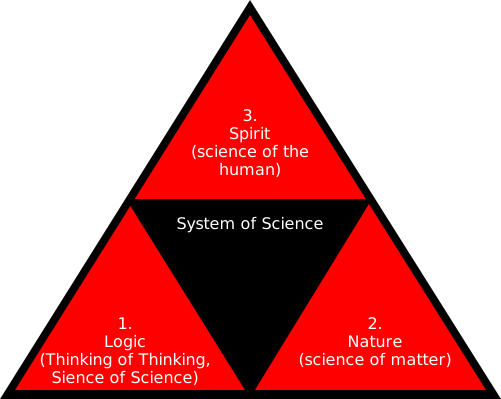
The sign is the construction of this site itself: a triangle with an inverted one inside, whose points meet the midpoints of the sides.
Kinds
The question: What kinds are there?
The members exclude one another, together they cover the object, and they draw their boundaries where the thing itself makes distinctions. They stand alongside one another and do not follow from one another — a dog is a kind of mammal, not a stage of one.
Three separate shapes, without a frame. The gap carries the meaning.
Parts
The question: What does it consist of?
A whole is taken apart. A heart is part of a dog, but not a kind of dog. The number of parts is determined by the thing and may be any number at all.
One single closed shape, differentiated within.
Relation
The question: What does it hang together with?
Here nothing is classified and nothing taken apart; things are linked. A concept spins threads to other domains, and the web is the order. This way joins what lies in different fields — and it is where the most common criticism of systematic thinking begins.
Several shapes, joined by lines.
Process
The question: What moves, and by what principle?
Not every sequence is a process. “First this, then that, then the other” is not yet an ordering by process — what matters is that the change itself has a form. A process may grow, ripen, recur, tip over or fall apart.
Hence a curved path and not a straight arrow: a straight arrow says “progress”, what is meant is “here the course is what counts”.
When two signs stand side by side
World history divides into the Orient, antiquity and the Christian world. It carries two signs, process and kinds. The course is the advance of one thought — one is free, some are free, all are free — and the three realms are what it takes shape in.
Art divides into the ideal, the art forms and the individual arts. Here too there are two signs. The ideal is the concept of art, the art forms are its history, the individual arts are kinds: three questions about the same object, placed one after another, because a table of contents knows only one sequence.
In the first case one takes hold of the other; in the second one lies beside the other.
The five ways are developed in full in Systematisches Denken by Kai Froeb — free to read: