Commentary on the Philosophy of Nature
Part One: Hegel’s Philosophy of Nature
1. I. What It Undertakes
- Why This Part Has the Worst Reputation
- Three Things to Keep Apart
- Hegel Himself on the Boundary
- What the Lectures Show
- The Question That Remains
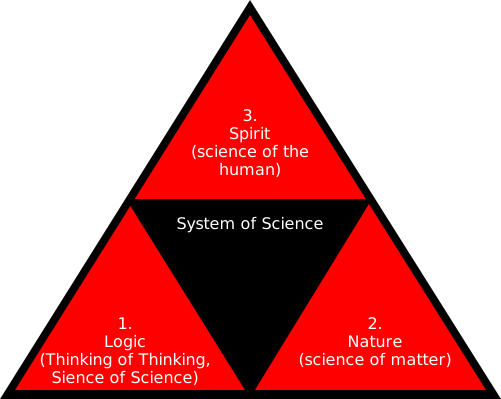
- Where This Volume Stands in the System
2. Excursus: The Logical Determinations and Their Application
3. II. Mechanics (§§ 253–271)
- The Stages in Detail
- Why Hegel Begins with Space and Not with Body
- The Newton Critique
- The Number of the Planets — an Accusation Standing on Its Head
- The List of Errors — and Why It’s Shorter Than Its Reputation
- What Mechanism Lacks — The Stone Falling from the Roof
- What Remains of Mechanics
4. III. Physics (§§ 272–336)
- Why This Part Is the Weakest
- Three Misunderstandings to Clear Away in Advance
- The “Wide Field” — Why Physics Contains So Much
- What Physics Deals With
- The Escalation from Magnetism to Chemism
- What Hegel Fastens Magnetism To
- The Four Elements — and Why They Are Not a Regression
- Two Passages Where Hegel Anticipates Later Developments
- Why Nature Often Has Four Steps, Not Three
- What Remains of Physics
5. IV. Organics (§§ 337–376)
- What the Organics Deals With
- The Geological Organism
- Plant and Animal
- Gaia, Ecosystems, Viruses — the Borderline Cases
- What Organics Has Survived
- The Question of Evolution
- What Remains of Organics
6. V. What Remains
- A Pattern That Repeats
- What Hegel Achieved on His Own
- The Three Levels, Once More
- Where the Question Stands Today
- A Direction in Which the Answer Might Lie
- Retrospect and Transition
Part Two: The Reception
7. VI. The Disciples: Erdmann, Rosenkranz, and Michelet
- The Contradiction from Which the Sequence of Stages Follows
- What Separates Erdmann from the Other Two
- What Both Undertake
8. VII. The Historians: Neuser and Petry
- Neuser: why nature is the sphere of externality
- Neuser: The Other Logical Tradition
- Petry: The State of Knowledge, Passage by Passage