Commentary on the Philosophy of Nature, Chapter 6
Where This Volume Stands in the System
Before the matter begins, an orientation. It is brief, because it can lean on nothing that has not yet been shown; the retrospect in Chapter 37a takes it up again at the end, then with the material in hand.
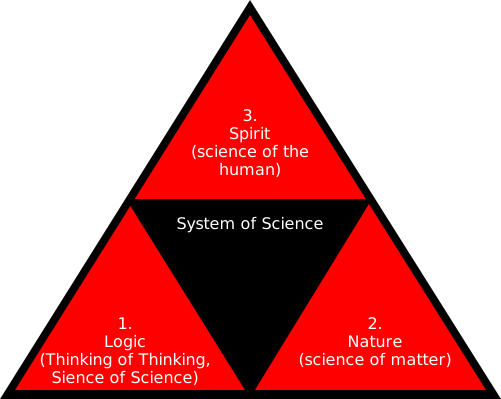
The philosophy of nature stands between the Logic and the philosophy of spirit. This position is not a rung on a ladder. It designates a relation: in the Logic the determinations stand together, in nature they fall apart, in spirit they are taken together again — and knowingly so. On this everything further depends. Nature needs a sphere of its own because in it the mediating term itself comes apart; hence the four steps where the Logic has three, hence the impotence to hold fast to the concept, hence contingency.
The Logic is presupposed, but only as a tool. It says that something can relate to itself, distinguish itself, preserve itself, and sublate itself. It does not say which elements there are, how heredity works, and how long an organism lives. The excursus in Chapters 6 to 8 develops what is needed; the full version stands in Hegels Logik. Whoever does not draw the distinction between structural condition and content reads this volume as an attempt at derivation and then rightly finds it a failure.
What is passed on goes to subjective spirit. This volume ends with the animal, because nature attains universality only as repetition: ever new singulars, never a singular that would be universal. What the animal lacks is to know itself as genus. That is where Der Übergang aus der Natur (§ 381) sets in. One expectation is to be warded off at once: the cut is no cut in the material. Anthropology treats of what the human being shares with the animal — ages of life, sex, waking and sleeping, sensation — and of how he relates to it. What changes is the relation, not the object.
What this volume does not undertake. It gives no natural history; the order of the stages is a conceptual order, not a line of descent. It prescribes nothing to natural science; both paths are scientific, and neither has precedence. And it does not decide whether Hegel’s doctrine of stages can be renewed on today’s findings — that remains a direction, not an execution.
How it is to be read. The first part goes through Hegel’s text, the second through the reception. Whoever wants only to know what remains of the philosophy of nature reads Part V. Whoever wants to know why it has its reputation reads Chapter 1 and then Part VI, where it becomes visible what Hegel’s own pupils already made of it.
Excursus: The Logical Determinations and Their Application
The philosophy of nature is an application of logic, but not its repetition. The difference must be grasped precisely, because most misunderstandings hinge on it.