Commentary on the Philosophy of Nature, Chapter 7
What Logic Provides
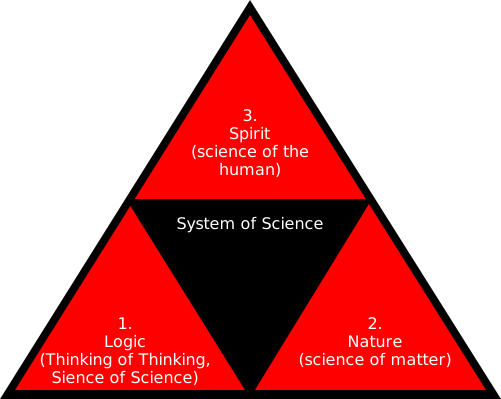
Four groups of determinations come from the Logic into the philosophy of nature, and they come not as contents but as forms by which connections can be distinguished.
From the Logic of Being: quality, quantity, measure. The philosophy of nature does not begin with objectivity, but earlier. Space and time are determinations of pure externality, and what Hegel develops concerning them has its logical counterpart in quantity: continuity and discreteness, point and extension, the question of whether a continuum can be composed of points.
More important still, for physics, is measure — the unity of quality and quantity. Hegel’s nodal line of measure relations (Encyclopedia, vol. 1, §§ 108–111) states that quantitative change flips into qualitative change at determinate points: water becomes steam at a hundred degrees, not gradually, but at a point. This is exactly the structure that the physics section rediscovers in the states of matter, in specific gravity, and in chemical combination ratios.
Developed in Die Quantität and Das Maß.
From the Logic of the Concept: the three forms of objectivity.
Three forms of objectivity: mechanism, chemism, teleology. They are not three kinds of things, but three ways in which determinations are connected.
In mechanism, the members are indifferent to one another — and indifferent does not mean uninfluenced, but rather: the relation does not constitute their determinateness. The ball is not a ball by virtue of being pushed.
In chemism, it is the reverse: what a member is shows itself only in the relation. An acid determination cannot be specified without reference to a counterpart.
In teleology, a purpose stands opposed to the material and remains external to it.
And then the idea of life — the determination most important for the philosophy of nature, because the entire third division depends on it. Here the purpose is immanent to the object — developed in Hegels Logik, 15–16 —: the organs are not means that get used up, but moments that sustain the connection which sustains them.
Hegel develops three processes out of this, and they form the framework of the entire organics:
Self-differentiation — the organism articulates itself internally, and the members are only what they are through the whole. Hegel himself uses for this the concepts of the physiology of his time — sensibility, irritability, reproduction — which go back to Albrecht von Haller and John Brown and are cumbersome today. But what they denote can be said without them: sensing, reacting, self-renewing.
Self-preservation — the organism contends with an environment and asserts itself within it.
Self-sublation — it goes beyond itself, in the process of the species. The individual passes away, the connection persists.
Important for reading the philosophy of nature here is a distinction drawn in the Logic: whether consciousness is at play does not decide the transition from teleology to life. An organism need not know its purpose in order to be an inner purpose — knowledge only enters with spirit; this is redeemed in Der praktische Geist (§§ 469–480), as drive. Whoever separates the stages by way of consciousness misses the step that is actually at issue.
This is developed in Hegels Logik, 16–17, including the question of how one recognizes whether the structure can be carried over onto an object.
A criterion that orders the entire progression. Hegel gives it in the 1825 lecture course, and it is easy to remember: “In chemism and mechanism there is too much identity; in external purposiveness, too little; in the Idea, this is the unity.”[1] What is measured is the degree of identity between concept and object. The series is developed in Hegels Logik, 13–16.
For this volume the criterion says by what the three divisions are ordered. In mechanics there is too much identity: The bodies are what they are, indifferent to their relation. In physics the concept emerges as quality — weight, heat, sound, chemical affinity —, but what comes out of the process is passive and does not return of itself. Only in organics does the centre to which the parts relate lie in the same body as the parts.
And in this is shown what separates this volume from the Logic. There the wrong measures correct one another until the Idea is reached. Here the measure is never fully reached: The organism too dies, and the genus subsists only as repetition of the singulars. The impotence of nature is the form in which this criterion holds here. [KF]
Vorlesungen über die Wissenschaft der Logik, Kehler transcript, course of 1825: GW 23.1, p. 397. ↩︎