Commentary on the Philosophy of Nature, Chapter 8
What Logic Delivers and What It Does Not
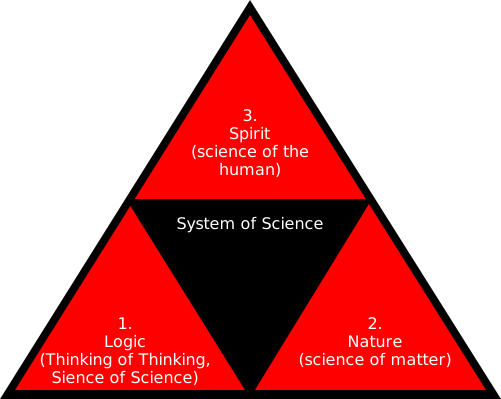
The distinction can be summed up in two lists, which form the working basis for the entire volume.
What logic gives us are structural conditions: self-relation — not merely being-for-another; self-differentiation — internal articulation that remains a unity; self-preservation — active engagement with the environment; self-sublation — the generation of the new out of itself.
These conditions hold for any possible life, not only for terrestrial, carbon-based life.
What logic does not give us: which chemical elements life requires, how heredity works, which species exist, how evolution proceeds, how long an organism lives. These are empirical questions.
And from this follows the rule for reading this volume. Hegel himself conflates the two at certain points; his philosophy of nature contains empirical claims that are now outdated. But the logical structure is independent of this — and that is precisely why Hegel’s logic can be used to correct his philosophy of nature.
How logic works as a heuristic is shown by the difference between two sentence forms. Not: “There must be 92 elements” — that would be logicism. But rather: “The elements can be ordered according to the principle of qualitative measure.”
Logic supplies guiding questions, not predictions: What kind of self-differentiation does this system exhibit? How does it preserve itself? How does it develop across generations? [KF]
This is at the same time the answer to the charge that Hegel obtained his material by stealth, because his determinations of nature come from travel reports and physiologists. Physiology produces neither the body nor the food; it expounds what happens anyway. The question is therefore not whether Hegel produced the material himself, but whether the order he states is the order of the object. The argument against Exner is carried out in Exner: Die Psychologie der Hegelschen Schule. [KF]