Kommentar zur Naturphilosophie, Chapter 8
What the Philosophy of Nature Adds
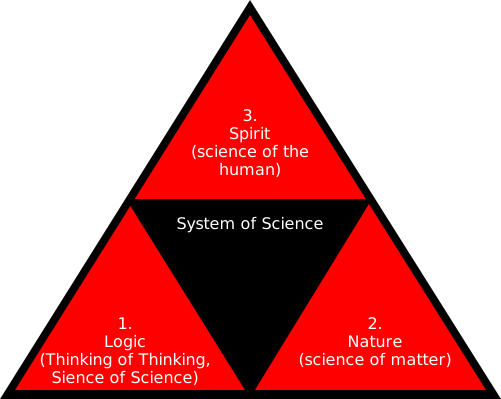
The lectures reveal the difference through frequency counts: magnetism appears 163 times in the lectures on nature, 14 times in the lectures on logic. For quantity it is the reverse. Where a determination depends on a phenomenon, it belongs in the philosophy of nature; where it is a form of thought, it belongs in logic.
Hegel marks the boundary himself by naming the natural correspondence within the logic: the circuit of processes is, he says, “the absolute chemism that in nature is the meteorological process.” That is a reference from one level to another, not an equation of the two.
The solar system shows this most clearly, since Hegel treats it in both works—and at very different lengths. In the Logic it appears as an example of absolute mechanism and is dealt with in a single paragraph (§ 198); in the Philosophy of Nature it fills several (§§ 270, 280) and goes into orbits, laws, and measured values. There we find the form of reciprocal constitution through external relations; here, concrete celestial mechanics.
Whoever conflates the two turns a structural statement into an astronomical one—and that is precisely the error for which Hegel is reproached. [KF]
The more interesting direction is the feedback. The categories are sharpened by the findings, not merely applied to them. Hegel’s concept of chemism looks different after he has read Berzelius. [KF]