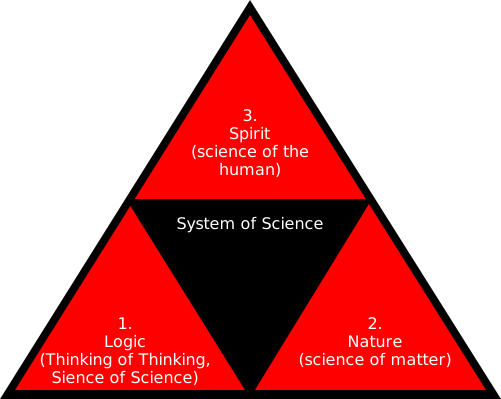
Commentary on the Philosophy of Nature, Chapter 10
The Stages in Detail
Space and Time (§§254–259). Hegel does not develop them as containers, but as determinations of being-apart itself. In space, being-apart differentiates itself into point, line, and surface — each determination is the negation of the previous one and, at the same time, its determinate being [Dasein]. In time, the same happens as succession: past, future, present.
Why the present comes last is the interesting point. It is not the transition between the other two, but their unity — the “now” in which both what-has-been and what-is-coming are determined as not-being. This is the same figure as becoming in the Logic (Die Qualität — there, Section 1.4): being and nothing are actual only in transition.
Critically: the order cannot be justified from the matter itself. One could equally start from the present and develop past and future as its horizons — this is how twentieth-century phenomenology proceeds. What supports Hegel’s arrangement is the parallel to space, not any necessity in time itself.
Place and Motion (§§260–261). Place is the unity of space and time at a given individual; motion is its change. Hegel determines it as the “existing unity” [daseiende Einheit] of both — which means: anyone who wants to understand motion cannot presuppose space and time separately and then connect them.
The relation to science: this is not physics, but a remark about its concepts. That space and time cannot be determined independently of one another in the theory of relativity is a physical insight — Hegel’s claim is a conceptual one, independent of that.
Finite Mechanics (§§262–271) treats matter that does not yet have its own center. Three stages: inert mass, which pushes and is pushed; fall, in which a foreign center asserts itself; and the striving toward the center, which Hegel calls gravity.
What Neuser clarifies here: in the first edition of the Principia, Newton had explicitly refrained from stating a cause of gravity — he described only “the mathematical concept of it, for I here take no account of the physical causes and seats of the forces.”[1] Hegel’s objection is thus not directed against Newton’s calculation, but against interpreting it as an explanation.
And here his argument holds: a force introduced to describe a motion does not explain it — it names it. That bodies fall because they are heavy is no information at all, so long as “heavy” means nothing other than “falls.”
Absolute Mechanics (§§269–271) is the stage at which a system has its center within itself. Rotation on its own axis (the sun), orbiting (comet and moon), and both together in the planet.
Why Hegel singles out the planet: it is the only body that unites both motions — it has a foreign center and one of its own. This is the mechanical preliminary form of what, in the organic realm, is called self-relation.
Critically: assigning comets and moons each to a one-sided moment is an interpretation, not a derivation. It works as long as one considers only these bodies — asteroids and binary stars do not fit.
Newton, Principia, 1st edition, quoted in Neuser, op. cit., on the relation between the concept of force and explanation. ↩︎