Commentary on the Philosophy of Nature, Chapter 34
A Pattern That Repeats
If one compares the three divisions in terms of their durability, something emerges that can also be found elsewhere in Hegel: the middle part is the most changeable.
Mechanics has survived because it is simple — it treats separateness in its poorest form, and no discovery changes that. Organics has survived because it is intuitive — the difference between plant and animal can be traced in any specimen. Physics in between has suffered the most, because it depends on findings that have changed, and because it is the most susceptible to further differentiation.
The Logic shows the same pattern when its versions are compared: beginning and end remain fixed — Being, Nothing, Becoming there, the Idea here — while the middle has grown. The Nuremberg Logic of 1808/09 manages the same stretch of ground with 81 paragraphs; the Encyclopedia of 1830 needs a good two hundred for it.
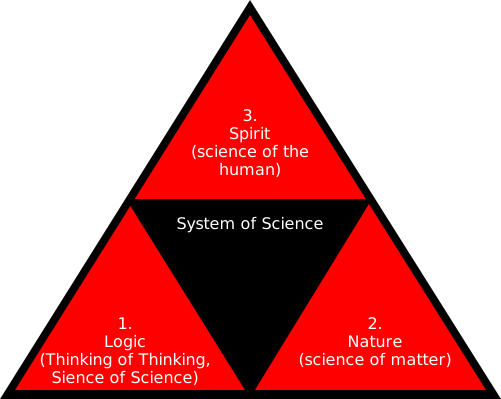
And in the system as a whole, Nature stands in the middle, between Logic and Spirit — and is the part that has aged worst.
This follows from the layout itself. Beginning and end are determined by their position: the beginning is the poorest, the end the most complete. The middle is what has to be traversed between the two — and how finely one divides it up depends on how much one knows. Whoever sees more inserts more intermediate steps. [KF]
What follows from this is a rule of reading: where a presentation changes between versions, the first question is whether a different order is at work, or merely a finer one. Usually it is the finer one.