Commentary on the Philosophy of Nature, Chapter 42
What Both Undertake
Rosenkranz and Michelet carried out what Erdmann sketched: each a book, each with the claim of bringing Hegel’s philosophy of nature up to the state of his own time. They solve the same problem differently, and the difference does not lie where the dates lead one to expect it.
Michelet’s subtitle is a program: “On the Basis of Experience.” He does not want to deduce but to raise the material of the natural sciences inductively to principles and then submerge these principles back into matter — the two paths are meant to coincide. At the same time he holds fast to philosophy as an ordering force: without it, empirical knowledge remains a “disordered collection of particulars.”
His preface contains the very objection at issue here — and he formulates it himself. The physicists reproached philosophy for “lagging, amid the restless inflow of ever-new empirical knowledge, especially in our times, behind the treasures gained, and for building its claims on something long since superseded.” Michelet’s answer is sober: “I know this reef very well, and have applied every effort of my powers to steer around it.”[1]
This was written in 1876, a quarter century after Rosenkranz and forty-five years after Hegel’s death. The objection is thus as old as the subject itself, and the natural philosophers’ answer has always been the same: to move closer to empirical fact.
His guiding principle here comes from Hegel, from his discussion of the Aristotelian method: “The fact, comprehensively considered from every side and well weighed — that is speculation itself.” Michelet says he “always took it as the guide of my inquiries.”
This sentence is the best commentary on the question of what natural philosophy should be: not an alternative to empirical research but its complete consideration.
What makes Michelet distinctive, and what it costs. Three observations from the book itself.
He names his own fallibility. At the end of the preface he asks the “men of the field” for indulgence should something more important have escaped him — “than, say, a planet, or a small planet, of which even the astronomer’s microscopes have let a few slip past.” The ironic sideways glance at the history of planetary discovery is hard to miss. And he closes: “I would therefore gratefully accept any correction and supplementation of my propositions, from whatever quarter it may come.”
He warns both sides. His declared aim is “to give the representatives of the empirical natural sciences points of view for a new procedure, but also to warn the philosophers against overlooking the results of experience in one-sided trains of thought.” This double warning is the best thing about his program — and it is absent in Hegel, who warns in only one direction.
And he pays a price. The opening of his natural philosophy turns into figurative language: nature is “the restless Proteus,” “the Greek Sphinx,” “the goddess Isis, veiled by a covering that no mortal has yet lifted.” What is meant is Hegel’s sober determination — nature as the otherness of the Idea, to which we stand both foreign and akin. Michelet makes it vivid and gives up sobriety in exchange.
Any updating can learn from this: whoever wants to make an abstract thought accessible reaches for images — and images carry meanings the thought did not have. In the case of veiled Isis, it is unknowability, precisely what Hegel disputes.
And how does the execution hold up? A passage on mathematics (p. 45) is instructive because it shows how the method works — and how easily it is misunderstood.
Michelet there paraphrases Rosenkranz: “Rosenkranz describes the progress from point to sphere […] very well, roughly as follows: that the constitutive elements appear in ever-greater number: the point is the One, the angle Two, the triangle the Triad, the square the Tetrad, up to the polygon of infinitely many sides.”
On first reading this looks like number symbolism. It is not: Trias and Tetras are Greek numeral words, and the series counts determining elements — a triangle has three, a square four. What Michelet finds good in this is the description of a progression, not a thesis about the essence of numbers.
What the passage really shows. Immediately afterward Michelet draws a line that is useful: geometry does not “properly belong in philosophy, because it does not develop its objects dialectically out of one another but proceeds along the thread of the identity of the understanding.” The identity it aims at is one “in which the differences remain external, indifferent to one another.”
The formulation is precise and also places the preceding paraphrase correctly: the series of constitutive elements proceeds along the thread of the identity of the understanding, and Michelet knows this — which is why in his scheme it belongs under geometry and not under philosophy.
Where he goes beyond Hegel: the three modes of knowing nature. Michelet begins his philosophy of nature with a distinction that Hegel does not make in this form (§ 165). He distinguishes three ways of knowing nature and orders them by the relation between intuition and concept:
The natural sense — here “the sensuous and the universal, husk and kernel, are immediately one.” The otherness of nature has not yet emerged at all. His witness is Goethe, whom he quotes: “There is a delicate empiricism which identifies itself most intimately with the object, and thereby becomes proper theory.”
Empirical physics — here the opposition of the two sides is “the persisting presupposition,” notwithstanding their relative connection. The otherness has reached full consciousness.
Natural philosophy — here both sides move “out of opposition toward a conscious and mediated, and thus only now completed, reconciliation with one another.”[2]
The gradation has a stateable ground: what at first does not emerge at all reaches, second, full consciousness, in order, third, to be overcome within its own persistence. And it answers a question Hegel leaves open — in what relation natural philosophy stands to empirical physics. Not as competition and not as superstructure, but as the stage at which their fundamental opposition itself becomes the object.
Notable too is what he rejects in the process. Against Haller’s verse, that nature has separated kernel and husk, he holds: “we must say that we want to penetrate through this outer husk of nature’s otherness right into its innermost kernel.” This is the same objection Hegel raises against an essence “behind” appearance — here applied to the knowledge of nature.
The second point: why mathematics belongs, for him, under mechanics. Hegel treats space and time as the beginning of mechanics; Michelet turns this into its own chapter, “Mathematics,” comprising space, time, geometry, and arithmetic (§§ 169–187). His justification stands in § 168, and it is the same distinction of levels that runs throughout this volume:
“When we begin with mechanical nature, which has the category of quantity as its ground, we no longer have to do here, as in logic, with the pure thought of quantity, but with quantitative nature, i.e., with quantity as a real shape.”[3]
And here a correction is needed, made possible only by a late discovery: Michelet’s chapter is not an innovation but a return.
Hegel’s Nuremberg Encyclopedia of 1812/13 — teaching lectures for the upper class, never intended for publication — divides natural science in exactly this way: a first part, “Mathematics,” with geometry, arithmetic, “analysis of the infinite,” and applied mathematics, and only afterward “Physics in General” with mechanics.[4]
Hegel’s justification there is the same as later: “Space and time constitute the wholly ideal determinate being, or the pure sensuous form” (§ 21) — only in 1812 he draws from this the conclusion that they belong before physics, and in 1830 that they form its first division.
Which arrangement holds up better? In favor of the later one is that it produces no break: space and time are determinations of externality-to-one-another, and externality-to-one-another is the object of mechanics. A separate division “Mathematics” would have to explain how one gets from it to matter — and this transition is precisely what Hegel does not have in 1812.
In favor of the earlier one is an observation Hegel himself makes there and which was lost in the rebuilding. On applied mathematics he says: “Applied mathematics does indeed prove things; but if one examines these proofs more closely, one finds that they presuppose the fact and derive the proof from it. The derivation from experience is what it substitutes for the proof of the law.”
This is a precise objection — and it concerns exactly what this volume criticizes in Newton and in Michelet: that a proof is made out of the ordering of a finding. That Hegel formulates it in 1812 with regard to mathematics, and no longer later, is a loss.
Michelet’s chapter thus stands not against Hegel but against the later Hegel — and with the earlier one.
And he could have known this. The Nuremberg manuscripts had been accessible since the edition put together by his friends: Rosenkranz published them as the Philosophical Propaedeutic, and they have stood in the collected works ever since. What was added in 2002 is the transcript of the lectures — that is, what Hegel said about it, alongside what he dictated.
That Michelet does not mention the connection is thus a decision, not ignorance. Perhaps he wanted the chapter to be credited as his own achievement; perhaps he considered the recourse so self-evident that he did not mention it.
What is remarkable is the process itself: the students fall back on a version that Hegel had rejected — and do so without discussing the rejection. Rosenkranz does the same with the logic: he understands his own reworking as a return to the Nuremberg arrangement.
And the structural consequence: “Because mechanics, although only one side of nature, is nonetheless as such again a totality, since every stage of philosophy presents itself precisely as a whole, quantitative nature thus again forms the object of three sciences.”
From this follows the sequence: first ideal or formal mechanics, in which the falling-apart-into-externality is indeed sensuously present but still abstract — “as Kant expresses it, the wholly universal forms of sensuous things”; then realization; then the whole.
This is a good justification, and it accomplishes something Hegel leaves undone. Whoever asks why geometry and arithmetic occur in a philosophy of nature gets no clear answer from Hegel; from Michelet the answer is: because quantitative nature is a totality and must therefore be articulated in itself.
Whether one follows him depends on the premise that every stage presents itself as a whole. This premise is present in Hegel, but, applied consistently, it leads to a multiplication of articulations — and this is precisely what makes Michelet’s work more extensive than Hegel’s.
The test case: Darwin and the fossil sequence. Here it is decided whether the dual procedure holds — and it does not hold.
Michelet knows Darwin and accepts natural selection: through the struggle for existence, original genera would have split into species. But he disputes the temporal succession of life forms, and the justification stands in his own words:
“But if one wants here to present the sequence of plant and animal forms, from the lowest grasses up to mammals, as a temporal succession, depending on whether they occur in the lower or upper strata: then the answer must be given in principle that plants and animals belong together, and cannot have arisen one after another, because they need each other.”[5]
And he explains the fossil strata by differing chances of being buried: “that the plants growing on the ground were of course buried first; the reptiles, mammals, and birds were always better able to save themselves from the waters than the fish, but need not have arisen later for that reason.”
The word “in principle” bears the entire weight. It is not paleontology that corrects the system — the system decides in advance what the fossils are permitted to mean. This inverts the announced procedure: induction and deduction were supposed to coincide; here deduction determines what induction is allowed to yield.
Substantively the conclusion cannot be sustained. From present-day ecological dependence nothing follows about simultaneous origin — Michelet projects a developed ecosystem back onto the origin of life. And early autotrophic and heterotrophic forms need not correspond at all to the later types “plant” and “animal.”
What remains is a theory of subsequent species differentiation: Michelet assumes what we call microevolution in order to fend off what we call macroevolution.
The asymmetry he himself names. The reason stands in the preface: if an empirical link of the system breaks, it can be exchanged without the whole being affected. This sounds like robustness and is an immunization — the facts may correct individual contents, but not the sequence of stages or the categories.
The dual procedure is thus laid out asymmetrically before it even begins. And this is precisely the lesson for any updating, including today’s: a renewed natural philosophy must allow that new science does not merely reoccupy positions within the system but revises the articulation itself. Whoever excludes this does not have a system capable of learning but a procedure of confirmation.
The second test case: cell theory. The same pattern, and here the point-line-surface deduction really is at work.
Michelet takes up cell theory, names Schleiden, Schwann, and Müller, and adopts the cell as the elementary organic unit: “The germ, as material point, is at once a cell, the primal cell.” He rightly opposes the atomistic consequence — that the organism is an aggregate of independent cells; the unity of the organism does not exist alongside cellular processes as a special life-force, but in their organization. This is a lasting core.
But then: “Let us now consult experience, and we in fact see the shape of the plant undergo three metamorphoses. The simple point extends itself from itself into a line, the line becomes a surface, and the surface finally contracts into the enclosing surface. This yields the three processes: the germination of the plant within itself, its diremption outward in the leaf, and the return to itself in the bud.”[6]
“Let us now consult experience” — and what it answers is fixed beforehand. The spatial categories are so general that almost any formation can subsequently be brought under them. They say nothing about how cell division is regulated, how differentiation arises, by what axis formation is controlled. The novelty of cell theory is taken up and simultaneously neutralized: the cell is permitted to illustrate the older morphology, but not to alter its categories.
The third test case: the concluding chapter on medicine. Here it becomes clearest what the procedure produces when it is not braked by resistance.
Michelet articulates fever according to the triad sensibility — irritability — reproduction: after the fever of the nerves comes the transition into the blood-organism, then the organism falls “into the overexcitation of the lymphatic system and of reproduction in general.” Sweat appears as dissolution — as the “cooked matter of illness, in which the organism excretes precisely its pathological activity.”[7]
And here the mechanism shows itself in pure form. Michelet knows the counter-positions and cites them: Diesterweg explains fever as a pathological intensification of muscle metabolism, Virchow as “the law of heat under altered conditions.” His verdict: “so both of them have kept only this second stage of fever in view.”
The empirical finding is not examined but classified as a partial aspect of his own scheme. Whoever proceeds this way cannot be refuted — every counter-position becomes a partial view.
This is the point at which systematicity turns into pseudo-precision: the presentation appears determinate without having any power of distinction or prediction.
And the underlying plan is not his own. The triad sensibility — irritability — reproduction already stands in Rosenkranz, as an articulation of the three life-systems: lymph and metabolism, blood and muscles, ganglia and brain. What in Rosenkranz is an ordering of functional domains becomes, in Michelet, an explanation of the course of a disease.
Michelet’s medical speculation is thus no derailment of his late work. It is the consistent application of an articulation he took over — and it shows what happens when an ordering of aspects is read as a sequence of events.
What follows from this for how one should approach this work. Michelet’s language — trained in French elegance; he taught at the French Gymnasium and came from a Huguenot family — sounds today like it claims more than the sentences actually assert. A phrase of paraphrase like “very good, roughly like this” reads like a verdict on a thesis, but is a courtesy toward a colleague.
Whoever examines this work must therefore first subtract the rhetoric in order to see what is actually being claimed. Whether the execution as a whole holds up is not thereby decided — more than spot checks would be needed for that.
Two samples from his text show how he works.
The first concerns the limits of experiment (§ 295) and remains, from the standpoint of philosophy of science, useful to this day. The difficulty of subjecting organic nature to experiment lies “in its spontaneity”: individual liveliness is so irritable, and “through the manifold of its processes so capable of unpredictable reactions, that it can be investigated by experiment only very approximately.” And then the sentence that matters: “But an experiment on the dead organic body no longer touches life, which is precisely its distinguishing peculiarity, but only its inorganic, mechanical, and chemical presupposition.”[8]
Not a derivation from categories, then, but an observation about the reach of a method — and it hits home. Alongside this, a remark on experimentation in general, directed against Bacon’s metaphor of torture: good experiments are “not so much a torturing of nature to wring a confession from her, as a gently and gradually loosening midwifery, bringing the phenomenon and its process to appear clearly and completely.”
The second concerns his handling of innovations. On the meteorological process he introduces the concept of “monadic totality” and writes of it: “This concept of the monadic totality of those processes is accordingly a new concept. It forms, in the sphere of dynamics, the parallel to the movement of the celestial bodies in mechanics.”[9]
The finding that reverses the order. Rosenkranz goes beyond Hegel on the question of evolution — and Michelet falls back behind him.
Hegel had distinguished the systematic sequence of stages from a temporal development. Rosenkranz asserts the opposite (§ 300): “The order in which nature as actuality develops is essentially not different from the course of the system. Mechanical nature must attain a relative completion before physical nature, physical nature before organic nature, because the formation of cosmic matter conditions the meteorological process, and this in turn conditions individual life. Within organic nature, again, the existence of the plant world conditions that of herbivorous animals, and the existence of warm-blooded animals conditions that of predatory animals.”
At the same time he qualifies this, and the qualification is what is interesting: “Yet in this succession one must think of nature as a free creatrix, who does not follow the paragraphs of a compendium, who does not pedantically conclude one thing before passing on to another, but who attempts, out of her eternal idea, what is possible at each place and each moment, unconcerned whether it will be able to endure.”
And one paragraph earlier: “But for the complete appearance of nature one must reckon not only the vanished but also the future types, which can still develop out of the infinite flexibility of organic life” (§ 299).[10]
For 1850 this means: the systematic order is real, but its realization is contingent, overlapping, and unfinished. It is not Darwinism. In § 301 Rosenkranz explicitly denies that “within the same individual there existed a process of gradual transformation, as though the mineral thereby became plant, the plant animal, the worm insect, the insect fish, the fish amphibian, and so on.” The decisive point lies in the qualification: within the same individual. He is arguing against a ladder of transformation, not against common descent — which he could not have known. His objection strikes at the linear metamorphosis of fixed types, not at the branching descent.
And here lies the sharpest finding of this whole line of development: Michelet in 1876 knows Darwin — and limits his reach so severely that the typology need not be historicized. Rosenkranz, in 1850, without an evolutionary mechanism, had the more open starting point.
The encounter with Darwin in Michelet thus does not lead to the completion of the natural history opened up by Rosenkranz, but to its defense against.
This distinguishes him from Michelet. Rosenkranz marks where he introduces something new and justifies it through an analogy — not through the claim that it had already stood there. Whoever proceeds this way makes his additions open to examination.
Rosenkranz goes further and calls it by its name. He had long used Hegel’s Encyclopedia as a handbook, but its uneven execution and outdated polemic had moved him to a revision. And the main reason was the progress of empirical natural research since Hegel. His conclusion: “Given the almost complete lack of preliminary studies, nothing remained for me but to melt down the whole of natural philosophy and reshape it anew.”
Notable is what he relies on in doing so: the exchange with the natural researchers of his city — Baer, Bessel, Rathke in Königsberg. This is the same procedure as Hegel’s, only a generation later and with better conversation partners.
What the comparison shows. Both retain the method and change the content. In doing so they demonstrate that the separation this volume is concerned with is possible — and both are themselves outdated today.
This returns us to the question: what accounts for the fact that a revision ages while the method does not?
The answer can be read off both works, and it turns out otherwise than expected.
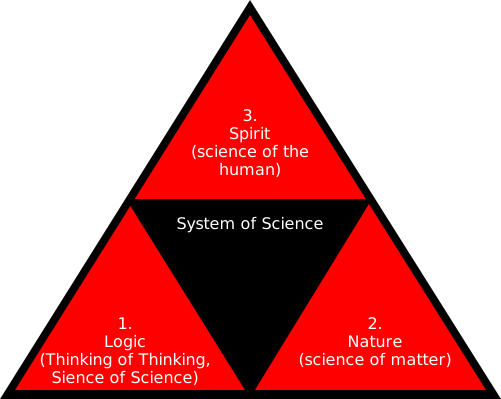
Rosenkranz does not retain the articulation. He replaces Hegel’s mechanics — physics — organics with matter — force — life, and orders the stages ontologically rather than phenomenologically. This is a reform of the architecture, not merely of the filling.
Michelet rejects precisely this reform. It is, he says, “thoroughly to be disapproved” to make force into the second main stage; force remains something “spectral.” He returns to Hegel’s articulation and fills it with the material of a quarter century more.
This reverses the expected order: the earlier author is the more experimentally minded, the later one the more conservative — and precisely under the pressure of the theory of evolution that had by then appeared.
What follows from this. A revision does not age because it exchanges its content, but because it remains immovable at one point — and the point is the same in both: both let experience correct contents, but not the categories with which things are ordered. Rosenkranz rebuilds the architecture, but for reasons of his own, not empirical ones; Michelet rebuilds it back, likewise for reasons of his own.
This is why this volume does not attempt a revision. It asks what remains of the method if one does not replace the content but examines its replaceability — and holds fast to what the two predecessors show: without categories capable of revision, every updating becomes a procedure of confirmation.
VII. The Historians: Neuser and Petry
Between the disciples and the present stands a third way of engaging with this work: presenting it and holding it up against the state of knowledge — that of its own time and that of ours. Wolfgang Neuser and M. J. Petry do this; they are therefore the most sober-minded of the six.
Carl Ludwig Michelet, System der Philosophie, vol. 2: Die Naturphilosophie auf dem Grunde der Erfahrung, Berlin 1876, preface, p. X. ↩︎
Michelet, Naturphilosophie, § 165 (pp. 3 ff.). The Goethe quotation is from the Maximen und Reflexionen. ↩︎
Michelet, op. cit., § 168 (p. 24). ↩︎
Philosophische Enzyklopädie. Nürnberg 1812/13, transcribed by Meinel and Abegg, ed. Udo Rameil, Hamburg 2002 (Vorlesungen, vol. 15), § 21 and the accompanying note. The underlying dictations had already been published by Rosenkranz in the edition prepared for friends as Philosophische Propädeutik; what is new in Rameil’s edition is the transcript of the oral explanations. ↩︎
Michelet, op. cit., p. 344. ↩︎
Michelet, op. cit., § 295 (p. 369). ↩︎
Ibid., p. 473. ↩︎
Karl Rosenkranz, System der Wissenschaft, Königsberg 1850, § 295 (p. 163). ↩︎
Ibid., p. 257. ↩︎
Rosenkranz, op. cit., §§ 299–301 (pp. 166 f.). ↩︎