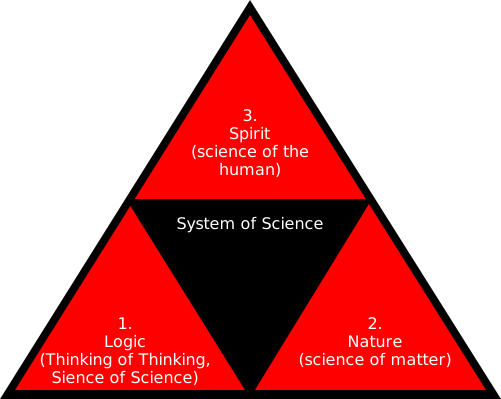
Commentary on Subjective Spirit, Chapter 21
a. Consciousness in General (§§ 418–423)
Sensuous certainty (§§ 418–419), perception (§§ 420–422), understanding (§ 423) — the same sequence as in 1807, in six paragraphs instead of thirty pages.
Sensuous certainty has its object as “immediately singular” (§ 418); perception takes it “as mediated, reflected into itself, and universal” (§ 420) and thereby encounters the contradiction of thing and properties; understanding resolves it through the distinction between appearance and force.
What remains brief here is likewise brief in Hegel himself. The Encyclopedia refers at this point to the 1807 book — it need not spell out the course, since it need only place it.
b. Self-Consciousness (§§ 424–437)
The reversal stands in § 424: “The truth of consciousness is self-consciousness, and the latter is the ground of the former, such that in existence all consciousness of another object is self-consciousness; I know of the object as my own […], I therefore know myself in it.”
And the formula for it: “I = I — abstract freedom, pure ideality.” With the immediate objection: “Thus it is without reality.”
In the lecture course Hegel places the formula historically: “The expression of self-consciousness is I = I. Fichte established this. It is a necessary standpoint, and the principle of spirit is already established therein.”
Necessary and yet not enough — that is the form in which Hegel deals with his predecessors. Fichte correctly determined the position and took it for the whole.
And the note to § 415 says what is missing here — for both Kant and Fichte at once. It is the sharpest placement Hegel gives the transcendental philosopher:
“The Kantian philosophy can most precisely be regarded as having grasped spirit as consciousness, and it contains wholly only determinations of phenomenology, not of the philosophy of spirit itself.”
Wholly only determinations of phenomenology. This is no polemic but a placement — and specifically within this volume: Kant took the second of three parts for the whole.
Hegel immediately names the consequence: it regards “the I as relation to a beyond, which in its abstract determination is called the thing-in- itself; and only according to this finitude does it grasp both intelligence and will.”
Fichte fares no better: “The Fichtean philosophy has the same standpoint, and the not-I is determined only as object of the I, only within consciousness; it remains as an infinite check, that is, as thing-in-itself.”
Both remain stuck within consciousness — and hence a counterpart remains for them that is never overtaken. Whoever takes the Phenomenology for the whole philosophy of spirit keeps the thing-in-itself.
With this, the whole part has its critical point: psychology is not an appendix to the Phenomenology, but what is missing when one stops at it. [KF]
And a remark on the transition, absent from the printed text: “I, within my consciousness, know nothing of the necessity of this transition, although it is an inwardly necessary progression.”
Desire (§§ 425–429) is the first attempt to remedy this. Abstract self-consciousness is “the first negation of consciousness, hence also afflicted with an external object” and “the contradiction of itself as self-consciousness and as consciousness” (§ 425). Self-consciousness sublates the object by consuming it — and gains in this a self-feeling. But what is consumed is gone, and hunger returns. What fails here is the bad infinity of satisfaction: every sublation produces the next deficiency.
The struggle for recognition (§§ 430–435) follows from this. It “goes to life and death; each of the two self-consciousnesses puts the life of the other in danger and risks its own, but only as risking it, for each is equally directed at the preservation of its life as the determinate being of its freedom” (§ 432). What self-consciousness needs is an object that cannot be consumed — another self-consciousness. “I see in it, as I, my own self, but also in it an immediately existing object, as I, absolutely independent against myself” (§ 430).
Stekeler draws attention to a nuance lost in German: Hegel does not speak of a struggle for recognition, but of a struggle of recognizing.[1] It is not about attaining recognition, but about the fact that recognizing itself first arises — and does so through the process in which both experience that they cannot sublate each other.
And what lordship and bondage really show: Stekeler’s reading is sober and hits the mark. In subjugation to a lord we see not only that human beings prefer life to freedom, but also that a rational life together is impossible without recognition of structures of dominance. At the beginning of states there is therefore always also real violence — but Hegel explicitly calls this “the external or apparent beginning of states, not their substantial principle” (§ 433).
The relation itself Hegel determines doubly (§§ 434–435): it is, on the one hand, “a commonality of need and of care for its satisfaction” — the lord must keep the bondsman alive. On the other hand, the bondsman gains in labor what the lord lacks.
The result is universal self-consciousness (§§ 436–437): “the affirmative knowledge of oneself in the other self, each of which, as free singularity, has absolute independence, but […] does not distinguish itself from the other.”
Here is the place from which the philosophy of right draws its concept of the person. Whoever recognizes does not make the other into their end and not into their means — they know themselves in the other. This is the presupposition of contract and right. [KF]
c. Reason (§§ 438–439)
The conclusion is brief and says what has been achieved: self-consciousness has “the certainty that its determinations are just as much objective, determinations of the essence of things, as they are its own thoughts” (§ 439).
With this, the deficiency of § 415 is remedied. There the movement of the concept appeared as change of the object; now spirit knows it as its own — and at the same time as that of the thing.
Understanding and Reason — Why the Distinction Becomes Visible Only Here
A look back is possible here that could not be made earlier. Understanding cannot see the distinction between itself and reason — for to see it, understanding would already have to be capable of what it is not capable of. Only from reason’s vantage point does it become retroactively recognizable what understanding does and where it stops.
On the origin of the terms. Hegel uses them not in the everyday sense, but in the meaning Kant had given them — and that is no longer self-evident today, and even less so in translation. In English the words are understanding and reason, in French entendement and raison; in both languages everyday usage suggests that reason is the sober faculty and understanding the sharp-witted one. In Kant and Hegel the order is reversed.
For Kant, understanding is the faculty of concepts and rules: it brings the manifold of intuition under unities and thereby cognizes objects. Reason is the faculty of ideas — it wills the unconditioned, the whole, the completion of the series. And it thereby falls into antinomies: equally good proofs can be given for “the world has a beginning” and for “it has none.” For Kant this is a signal that reason has overstepped its bounds.
Hegel’s twist is the decisive one: what for Kant signals the failure of reason is, for Hegel, its proper achievement. That the determinations fall into contradictions is due not to the faculty but to the determinations themselves — and it is no defect but the way they develop further.
The three sides Hegel distinguishes (Encyclopedia §§ 79–82) make this precise:
Understanding (§ 80) “remains fixed at determinate determinateness and its distinctness against others; such a limited abstraction counts for it as subsisting and being for itself.” It separates, defines, holds apart — and this is no defect but the condition of everything further. Without fixed determinations there is nothing to set in motion.
The dialectical (§ 81) is “the sublating of such finite determinations by themselves and their passing over into their opposites.” Decisive is the word by themselves: nothing is imported from outside. The determination fails on account of what it itself asserts.
And Hegel warns against the truncation: taken by itself, the dialectical constitutes “skepticism; it contains merely negation as result.” Whoever only shows that everything is contradictory has only half the movement.
The speculative (§ 82) “grasps the unity of the determinations in their opposition, the affirmative that is contained in their dissolution and their transition.”
And the sentence decisive for reading: these three sides “do not constitute three parts of logic, but are moments of everything logically real” (§ 79). They are not stages one climbs one after another, but sides present simultaneously in every thought.
Why this belongs here. The course of the Phenomenology has traversed exactly this movement, without being able to name it. Sensuous certainty held fast to its object — the work of understanding. It failed on account of what it itself asserted — dialectical. And what arose from this failure was not nothing, but perception — speculative.
Whoever has read this volume up to this point has carried out the three sides three times: in the Anthropology, in the Phenomenology, and now in the insight that it was the same figure each time. [KF]
Stekeler-Weithofer, Hegels Realphilosophie, on §§ 431 f. (p. 656). ↩︎