Kommentar zum subjektiven Geist, Chapter 6

The Articulation of Spirit (§§ 385–386)

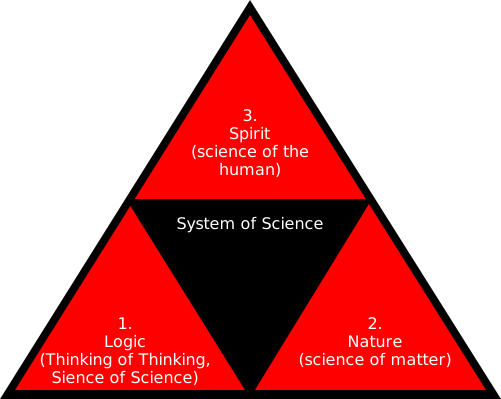
Hegel enumerates three forms, and the principle is the same as in the philosophy of nature: increasing self-relation.

I. Subjective spirit — “in the form of relation to itself,” such that what its concept is becomes for it, and its being consists in “being with itself, that is, being free.”

II. Objective spirit — “in the form of reality as a world to be brought forth and brought forth by it, in which freedom is present as necessity.” These are right, morality, ethical life — the subject matter of the philosophy of right.

III. Absolute spirit — art, religion, philosophy.

An intervening sentence often skipped over (§ 384): the revealing of free spirit is “positing of nature as its world; a positing that, as reflection, is at the same time presupposing of the world as independent nature.”

Both at once — positing and presupposing. Spirit makes nature into its world and at the same time finds it as independent. This is not a contradiction but the determination of what appropriation means: one only appropriates what does not simply fall into line by itself.

On finitude: the first two parts concern “finite spirit,” and Hegel determines precisely what this means: “the inadequacy of concept and reality” — but with the addition that this inadequacy “is a shining within itself — a shine that spirit sets for itself in itself as a limit, in order, by sublating it, to have and know freedom as its essence for itself” (§ 386).

The limit is self-posited. This is no glossing-over but a determination: what limits spirit only limits it as long as it does not recognize the limit as its own positing.