Kommentar zum subjektiven Geist, Chapter 1
The Gap It Closes
Between the philosophy of nature and the philosophy of right stands a question that both presuppose and neither answers: How does a living being become a being that has rights?
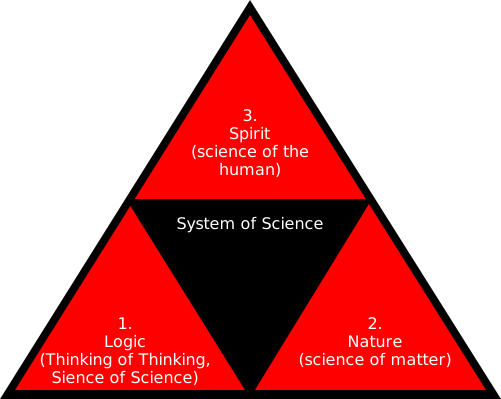
The philosophy of nature ends with the animal — an organism with sensation, movement, and a genus process. The philosophy of right begins with the person — a being who can hold property and enter into contracts. The stretch between the two is the subjective spirit.
Hegel divides it into three stages: Anthropology, which deals with the soul; Phenomenology, which deals with consciousness; Psychology, which deals with spirit (§§ 387–482).
What is summarized briefly here is developed at greater length in [[kleine-logik]] (optional) for the logical side and [[hegel-natur]] (optional) for the preceding stage.
On the title. Hegel’s lectures were called “Philosophy of Spirit,” but they dealt only with the subjective spirit. The transcript of the 1827/28 course bears the title “Psychology or Philosophy of Spirit, according to Hegel” — both names side by side, for the same material.
The subjective spirit already contains the whole in nucleus. Theoretical spirit is carried out in the absolute, practical spirit in the objective, and free spirit is the unity of both — which then separates into world and knowledge of the world. Whoever has worked through the subjective spirit has the forms together; what follows is their elaboration. [KF]