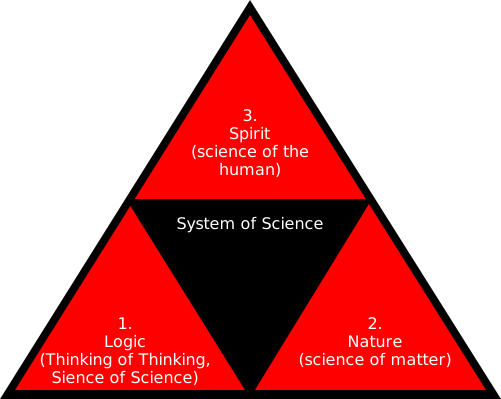
Commentary on Subjective Spirit, Chapter 2
What Makes Access Difficult
Three reasons work together here — and they differ from those in the philosophy of nature. There, outdated factual claims make access difficult; here, it is the language itself.
The names are misleading. Anthropology does not here mean what the discipline is called by that name today; Phenomenology is not Husserl’s, and not simply that of the great book of 1807 either; Psychology is no empirical science. Hegel uses the technical names of his time for systematic locations.
The subject matter is cut in an unfamiliar way. What today is treated separately as neurology, developmental psychology, perception research, and action theory stands here in a single sweep — and the order does not follow disciplinary divisions but the question of how much self-relation has been achieved at each point.
And the language suggests a subject that does not exist. “Spirit develops itself,” “the soul rises up” — this sounds like an agency that acts. Stekeler’s remark on this is the best warning one can give the reader: “Spirit, of course, does nothing at all in the literal sense.”[1]
What is meant is that we develop the spiritual forms — not purely by intention, but also in an event-like way, since proposals for shaping shared knowledge and action must first be generally recognized in order to become norms. Spirit develops “of itself” only insofar as we are led by the matters themselves to take part in this development.
Stekeler-Weithofer, Hegels Realphilosophie, on § 387 (p. 507). ↩︎