Commentary on Subjective Spirit, Chapter 3
Where This Volume Stands in the System
Anyone who wants to know where he stands before the paragraphs begin will find it here — of necessity asserted, since the grounds follow only later. Chapter 26a makes up for that at the end.
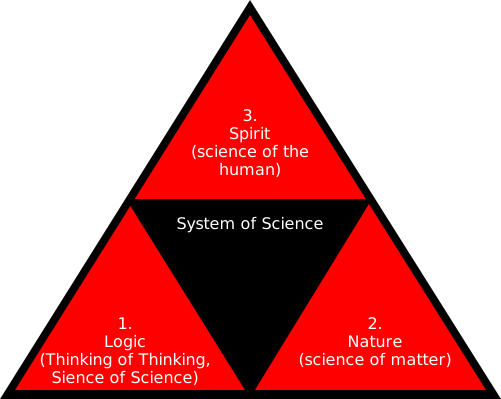
Subjective spirit stands between two neighbors, and it is the only part of the system that has to keep contact in both directions. Ahead of it lies nature, behind it objective spirit. What this volume accomplishes is the stretch in between: from the soul still wholly sunk in its own bodiliness to the free will with which the philosophy of right sets in.
More comes from nature than the cut would suggest. Hegels Naturphilosophie, 37a ends with the animal, because nature reaches universality only as repetition. What is missing there — to know oneself as genus — is the beginning here. But anthropology does not deal with what separates man from animal; it deals with what he shares with it, and with how he relates to that. Whoever expects a boundary drawn between two subject areas expects the wrong thing.
From logic comes the tool, not the articulation. Five determinations are used throughout; Chapter 7a develops them briefly before they first appear. The order of the three parts does not follow from them. It is grounded in the fact that each stage fails at its own determination — whether that holds can be tested at every joint, and Chapter 10 says how.
What is passed on goes to objective spirit. Vom natürlichen zum freien Willen begins with the free will and presents the road to it once more in brief. This is no duplication by oversight: Hegel himself gave the presuppositions twice, in the Elements compressed into §§ 4 to 32, in the Encyclopaedia explicitly as theoretical, practical, and free spirit. The detailed version stands here.
Three parts, three constitutions. Anthropology, phenomenology, and psychology do not deal with three objects but with one process in three relations: spirit sunk in nature, spirit in relation to an other, spirit at home with itself. Whoever reads them as disciplines will not understand the transitions — and the transitions are what matters.
I.2 The Entryway (§§ 381–387)
Before the Anthropology begins, Hegel clarifies four questions, and none of them is dispensable: How does spirit emerge from nature? What constitutes it? How is it structured? And from what does the articulation of the subjective spirit follow?