Frequently Asked Questions: After Hegel
Back to the overview of all questions.
What Became of Hegel’s School?
It fell apart within a decade of his death.
The occasion was a book: David Friedrich Strauss’s Life of Jesus, from 1835, applied Hegel’s distinction between representation and concept to the Gospels — they were myth, not report. The question of whether this was Hegelian split the school into a Right, which held fast to Christianity, and a Left, which abandoned it.
Both sides invoked the same text. That is not a mishap but reveals something about the system: it permits both readings.
Further reading: The Hegelian School and Its Disintegration · Strauss
Did Marx Turn Hegel “from His Head onto His Feet”?
That is what he himself called it, and the formula misleads.
Marx accuses Hegel of taking thought to be primary and conditions to be its product; in truth, he says, it is the other way around.
The story that has grown from this comes from Marx himself, and it has spread so widely that it hardly registers anymore as a claim: Hegel derived the world from thought, Marx turned him from his head onto his feet, and whoever follows the one is no longer bound to the other.
As a description of how Marx understood himself, this is accurate. As a description of what he does, it does not hold up. His procedure is Hegelian before he turns it against Hegel: he begins with the most abstract and develops the more concrete out of it, he seeks the contradiction in the matter itself rather than between opinions, and he shows how an order produces what it cannot resolve out of itself. This is not a borrowing of a method one could just as well have had otherwise—it is the same form of order.
What one gets from whom. Hegel supplies what must emerge from one another: that property comes before contract, the abstract before the concrete, and that something is already given to a later concept in its very presupposition. Two misunderstandings must be kept at bay here—logic is neither a derivation of reality from which one could read off what is empirically the case, nor a mere instruction for searching without any yield of its own.
Marx supplies the material and the test: which conditions actually exist, what they support, and where they break apart. The question “Hegel or Marx” is therefore wrongly posed.
Continue: Marx · Hegel and Marx · The Suspicion Against Conditions
What Was Kierkegaard’s Objection?
That the system cannot grasp the individual — and that this is precisely what matters most.
Hegel understands the human being as a moment of spirit: determined by language, law, custom, all of which existed before him. Kierkegaard objects that my existence is not exhausted by what holds true of me in general. What I have to decide, I decide as this person and no other, and the concept knows nothing of that.
What Hegel would say in response. That the objection assumes the individual is a remainder left over once the universal has been subtracted. This is precisely not the case for him. The individual is the third moment — the place where universal and particular become actual together, without which both would remain mere abstractions.
A doctor of Indian origin working in Germany is not half one thing and half the other. When she treats a patient, she does so according to the rules of her profession, out of her background, and as this person with this history — all three at once. Whoever plays one off against the other has lost the very concept of the individual that is at stake.
This does not settle the matter with Kierkegaard, however. His objection hits home wherever the universal is presented as though the individual were merely its instance of application — and this happens often enough among Hegel’s followers. It is the sharpest form of the question whether a philosophy of the whole does justice to the individual, and that question must be answered anew each time.
Continue: Kierkegaard · Universal, Particular, Individual
Why Did Analytic Philosophers Reject Hegel?
Because they started out by taking a stand against him.
Russell and Moore began as Hegelians — British philosophy around 1900 was largely Hegelian — and then broke with it. Their charge: Hegel’s sentences cannot be tested; his language obscures where it claims to clarify. Whoever says that the finite is at the same time infinite, in their view, says nothing at all.
That verdict held for eighty years. Since the 1990s he has been read again, and from two sides at once: in Pittsburgh by Brandom and McDowell, who find in him answers to questions on which their own tradition had become stuck — and in Leipzig by Stekeler-Weithofer, whose Hegels Analytische Philosophie already showed in 1992 that the two could be thought together.
What comes along with this. In this return, a dispute continues over whether the logic is metaphysics or a theory of justification — “Pippin versus Pinkard.” The dispute is conducted seriously and carefully, only both sides presuppose exactly what Hegel dissolves: that thought and being are two distinct things, between which a bridge would need to be built.
Continue reading: The Pittsburgh School · Analytic Hegelianism
Why Is Hegel Being Read Again?
Several reasons converge.
Philological work has changed the basis: the historical-critical edition and the lecture-course editions show a different Hegel than the nineteenth-century Friends’ Circle edition — more mobile, less finished.
On the substantive side: questions he raised have come back. How are consciousness and world connected, without reducing one to the other? What makes institutions legitimate? How can one speak of freedom without turning it into mere arbitrariness?
And finally: the alternatives have shown their own limits. Positivism foundered on its criterion of meaning, postmodernism on the question of why its own position should hold.
Continue: The Return to the System · History of Reception
Who are the most important Hegel interpreters today?
A selection, without any claim to completeness.
In the German-speaking world. Pirmin Stekeler-Weithofer has produced the most comprehensive modern body of commentary: dialogical commentaries on the Logic (three volumes), on the Phenomenology, on the Philosophy of Right, and on the Realphilosophie, published between 2014 and 2024. His early work Hegels Analytische Philosophie (1992) was the pioneering attempt to think Hegel together with analytic philosophy.
Klaus Vieweg, with Hegel — Der Philosoph der Freiheit (2019), has written the most extensive biography, with great depth of detail on both life and work.
Christian Iber works differently: his Metaphysik absoluter Relationalität (1990) works through the first two chapters of the Logic of Essence sentence by sentence. It is the standard work of microscopic analysis — and it shows that “reflection” in Hegel is not a psychological act but an objective structure.
In the English-speaking world. Robert Brandom and John McDowell have brought Hegel back into analytic discussion. Stephen Houlgate reads him step by step from within — for anyone who wants to follow the compelling force of the argument, The Opening of Hegel’s Logic is the way in.
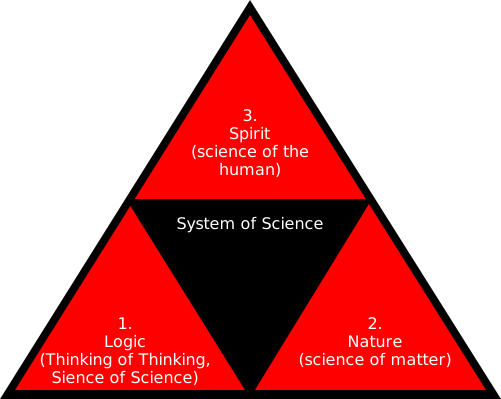
Richard Dien Winfield goes further than any commentary: he defends Hegel’s claim to a presuppositionless science and has carried out all three parts of the Encyclopedia anew — Logic, Nature, and Spirit — over two decades and reaching into the philosophy of economics and of right.
Julie Maybee’s Picturing Hegel (2009) has been little read, and the title is probably to blame: it suggests a picture book. In fact it is one of the clearest presentations of the Logic there is, and it holds up even without the diagrams. Her thesis of necessity as exhaustion — a transition becomes necessary because all the possibilities of a stage have been played out — states precisely what others vaguely call “immanent contradiction.”
Robert Pippin and Terry Pinkard are often cast as opponents on the question of whether the Logic is metaphysics. But that dispute presupposes exactly what Hegel is dissolving — the separation of thought and being. More on this in the answer to that question.
Next: People · The Systematic Turn
Back to overview of all questions