Frequently Asked Questions: Hegel's System
Back to the overview of all questions.
Why Logic, Then Nature, Then Spirit?
Because each part presupposes what the previous one has developed.
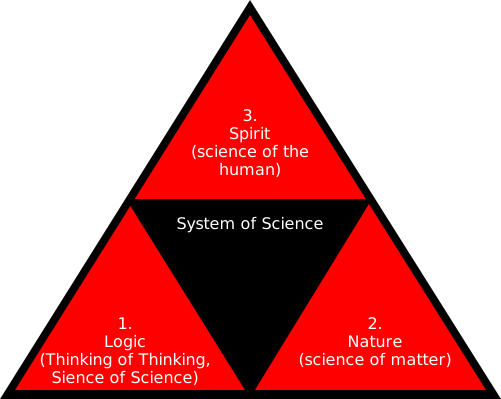
Logic develops the determinations by which anything at all can be thought — being, essence, concept. It deals with nothing determinate and therefore with everything. Nature is then the same conceptual content, but pulled apart into space and time: what in Logic was thought together side by side lies here dispersed. Spirit, finally, is what comes back to itself — what knows itself.
The sequence, then, is not temporal. Hegel does not claim that thoughts existed first, then stones, then human beings. He claims that one cannot understand the later without having grasped the earlier.
Three paths, one subject matter. The systematic order is one of three, and none is more true than the others. At the end of the Logic, Hegel says that science presents itself as “a circle returning into itself” — and further: “this circle is a circle of circles.”
| Starting point | Order | Question | |
|---|---|---|---|
| Performative | our thinking | Spirit → Nature → Logic | How do we know? |
| Chronological | natural history | Nature → Spirit → Logic | How did it come about? |
| Systematic | logic as known | Logic → Nature → Spirit | How do we order it? |
Performatively, we cannot get behind our own thinking. We always already begin as thinking, living, social beings; from there we investigate nature, form institutions, and reflect on both. Logic turns out in the end to be what we had been doing the whole time — only now made explicit.
Chronologically, nature was there first. From the Big Bang through the emergence of life to consciousness, and only two and a half thousand years ago, philosophy. We recognize ourselves as part of a history that began before us.
Systematically, logic stands at the beginning, because its determinations are the condition for knowing anything at all — including natural history, which comes earlier in time.
Why this is not a contradiction. The three questions are different, and so are the answers. Someone who thinks only chronologically asks: how can logic stand at the beginning, if it arose last? Someone who thinks only systematically asks: how can spirit be a presupposition, if it stands at the end? Both questions dissolve once one sees that they ask about different things.
An example. Take democracy. Performatively, we live within one and argue about it — that is our starting point. Chronologically, it arose, in ancient Greece and in the modern revolutions, and has changed: from restricted to universal suffrage. Systematically, it is a shape of objective spirit, a particular way in which freedom gives itself institutions. All three statements are true, and none replaces the others.
The circle is open. At the end of absolute spirit, in the history of philosophy, one arrives back at logic — but not at the empty beginning. It has been enriched by the passage through, correctable by what has proven contradictory, and open to what is still to come.
Continue: Overview of the System · Logic and Philosophy of Real Being · The Absolute Idea
What Does It Mean: “The True Is the Whole”?
That any single determination always says too little.
The sentence appears in the preface to the Phenomenology and is usually read as a profession of totality — as if Hegel were claiming that one must know everything in order to know anything. What is meant is something more modest and more precise: every determination, once thought through, shows that it cannot stand alone, and points beyond itself to others.
“The rose is red” is true and yet says too little, as soon as one asks what redness is, or what a rose is. The whole is not the sum of all propositions, but the context in which each has its place and its limit.
More: Wahrheit in the glossary · Phenomenology, Preface
Is the System Complete?
Hegel considers it complete; we do not.
He stated this explicitly: philosophy had arrived at itself, because it had grasped that it is philosophy that does the grasping. This is not vanity but follows from his approach — if thought becomes its own object, nothing remains outside it.
The objection is obvious and has often been raised: what Hegel did not know, he could not incorporate. Evolution, psychoanalysis, mathematical logic, quantum physics. Anyone who considers the system complete must explain why it does not need these things.
We consider it a framework, not a finished building — and the places where we have extended it are marked in square brackets.
Continue: Beyond Hegel · History of Reception
Why the Triangles?
Because Hegel’s organization is consistently threefold, and a text shows this poorly.
In a book, one chapter follows another; that three of them belong together and a fourth encompasses them is something you have to remember. In a triangle you can see it: each concept stands with its two neighbors, and the center leads to what unites them.
The presentation comes from Martin Grimsmann and Lutz Hansen. Its limit is the same as that of the threefold division itself: where Hegel divides differently — the forms of judgment are fourfold — one must force it in or write it alongside.
Continue: Usage · Modes of Ordering
Does the Phenomenology Belong to the System?
This is disputed, and Hegel himself changed his mind.
In 1807 he calls it the “first part of the system of science” — it is meant to lead ordinary consciousness to the standpoint from which logic can begin. In the Encyclopedia of 1817 it appears as part of the philosophy of spirit, in strongly abridged form, and the claim to be an introduction to the whole has been dropped.
For reading purposes, this means: the Phenomenology stands on its own. One can read it without knowing the Logic, and many read only it.
Next: Phenomenology of Spirit · Editions
Can you take parts of the system and leave the rest?
Almost everyone does this, and the question is whether it can be done.
People read the Philosophy of Right without knowing the Logic; the Aesthetics without the Philosophy of Nature; the master-servant passage without anything else. In practice, this works — the texts are worth reading on their own.
Hegel’s own answer would be: then you understand the results, but not the grounds for them. Why ethical life follows morality, and not the reverse, cannot be shown without the Logic — only asserted.
For those who want both, our commentary on the Philosophy of Right attempts to make the logical order visible without presupposing the Logic.
Back to the overview of all questions · onward to Nature