Frequently Asked Questions: Hegel's Logic
Back to the overview of all questions.
What Is Dialectic?
For Hegel, dialectic is the second of three steps — not the whole of the movement.
This is the most common misunderstanding, and it has a history. Hegel himself distinguishes, in the Encyclopedia (§79–82), three sides of thought:
The Understanding (§80) holds fast. It distinguishes, delimits, determines: this is this and not that. Without it there would be no clarity, and Hegel speaks of it with respect — whoever cannot distinguish is not thinking at all.
The Dialectical (§81) is the movement in which such a determination reaches its limit. Not because someone contradicts it, but because it turns over into its opposite on its own account: the finite shows itself to be that which points beyond itself. Hegel also calls this the negatively rational moment.
The Speculative (§82) holds both together — the determination and its turning-over — and finds the standpoint from which both make sense. The positively rational moment.
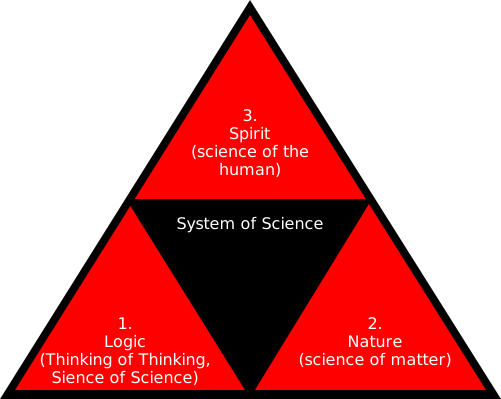
These three are not three parts of the logic but moments of every concept. This is why we represent Hegel’s system as triangles: the middle triangle is the understanding, the small ones are the dialectical, the upper one is the sublation.
When does the movement set in? When something becomes problematic. As long as nothing contradicts it, things remain at the level of the understanding, and that is fine. Only where boundaries one has drawn prove untenable — differing interests, incompatible views, concepts that no longer hold — does the pressure to move on arise.
Continue: Commentary on Enz. §79–82 · The Method as Triangle · Dialectic in the Glossary
Is Dialectic Not Thesis – Antithesis – Synthesis?
No, and the formula does not come from Hegel.
It goes back to Chalybäus, who in 1837 wanted to present Hegel in a popularized form, and it became widely known through the Marxist tradition. Hegel himself does not use it.
Why it misleads. It suggests that two finished positions confront each other and a third mediates between them. In Hegel, the movement arises from the matter itself: the first determination generates its opposite because it proves to be one-sided. No one sets it against that determination from outside.
The confusion surrounding the word. In the Marxist tradition, “dialectic” names the whole movement — understanding, reversal, sublation. In Hegel, it names only the middle step. Both usages have become established; one need only know which is meant at any given point. Where dialectic is discussed here in the broad sense, this is noted.
Next: Commentary on Enc. §79–82
What Does “Aufhebung” Mean?
Three things at once, and Hegel exploits this deliberately: to end, to preserve, to raise up.
Whoever adjourns (aufhebt) a meeting ends it. Whoever keeps (aufhebt) a document preserves it. Whoever picks up (aufhebt) something lying on the ground lifts it. In the dialectical transition, all three happen at once: the earlier stage no longer holds in its own right, its truth is preserved, and it now stands within a larger context.
Where the threefold division comes from. Not from Hegel himself — he exploits the word’s ambiguity but does not name it in this form. The first to spell it out is his student Johann Eduard Erdmann, in a footnote: “Aufheben taken in the threefold sense of tollere, conservare, elevare; hence to sublate and to demote at the same time.” (Grundriß der Logik und Metaphysik, 1841, p. 20, § 33, note 1)
So whoever today lists the three meanings is citing Erdmann while meaning Hegel.
This is why Hegel’s critique of a position is never mere rejection. What he refutes, he also preserves — as a moment of a whole that encompasses more.
Continue reading: Aufhebung in the glossary · Enz. §96, note
Why always three? Isn’t that numerology?
The suspicion is justified, and Hegel himself shared it: he mocks “triplicity” as a mere scheme when it is imposed on material from outside.
For Hegel, threeness is not supposed to be posited but found. It arises where it arises: something is at first in itself, then its relation to something else shows itself, then both are grasped together as one. Where Hegel divides something differently, he divides it differently — the forms of judgment, for instance, are fourfold.
The same holds for our presentation, with one qualification: the triangles force threeness even where the subject matter does not yield it. Where we have done this, it is noted — for instance in the workshop reports on nature.
Next: Moment in the glossary · Modes of ordering
What Is a “Concept” in Hegel?
Not what we usually mean by the word.
Ordinarily, a concept is a mental representation abstracted from things: you see many trees and form the concept “tree.” For Hegel, the concept is what constitutes the thing itself — its inner determinacy, in virtue of which it is what it is. Not our summary of it, but its structural plan.
From this follows the claim that provokes the most resistance: that the concept moves itself. This does not mean that thoughts lead a life of their own, but that the determinations of a thing follow from one another and are not arbitrarily assembled.
Further reading: Begriff in the glossary · Introduction to the Concept · Commentary on the Logic, Chapter 9
Does Hegel Claim That Contradictions Are True?
No — but he claims that they are real.
The difference is decisive. Hegel does not dispute that a proposition and its opposite cannot both hold. He claims that reality contains tensions that cannot be resolved by better formulation: a society can promise freedom and exercise coercion, and this is not an error of thought but its condition.
Logic should not define such tensions away but show where they are driving. Whoever smooths them over loses sight of the matter itself.
Further: Widerspruch in the glossary · Science of Logic, Book Two, Chapter 2
Is Logic Speculation Without Reference to Experience?
No — it develops the structures within which experience is possible at all.
The categories it works through — being, essence, cause, purpose — are not inventions. They are derived from thought’s self-examination, and this thought is always already bound up with experience. Without them, none of what natural science says could be said: that something is the cause of something, that a process serves a purpose, that a quantity has a measure.
Logic thus does not stand against experience but lays bare what experience already presupposes. Yet without support in experience there would be no truth either — an internally consistent fairy tale is not yet a truth.
Next: Nature
Does Hegel Confuse Logic and Ontology?
He overcomes the separation — and that is something other than a confusion.
The question presupposes that there are, on one side, mere forms of thought and, on the other, the structures of being, and that whoever equates the two is making an error. In Hegel, the logical categories are at the same time the basic determinations of what is — not because reality were a product of thought, but because thought itself is a moment of reality and does not access it from outside.
This is the most difficult point in his philosophy and the place where most readers get off. But it is no oversight; it is the result of an argument: whoever states the boundary of thought already stands beyond it.
Continue: Is Logic Metaphysics? · Commentary on the Logic
Does Logic End in Dogmatism?
No. For Hegel, “absolute” means: without logical presupposition — not: omniscient.
The absolute idea at the end of the Logic is not the end of thinking, but insight into its method. It recognizes its own limits and therefore passes over into nature and spirit: it knows that it cannot generate from itself what it encounters there.
Logic does not claim to answer concrete questions. It lays bare the structures within which questions can be posed and answered. Whoever expects it to say how many planets there are has misunderstood it — and this error has cost Hegel dearly.
Next: Is Hegel’s System Complete?
Is Logic Purely Formal — Without Ethics, Without the Other?
This is the most consequential misunderstanding, and it does not hold up under scrutiny.
In the Logic of the Concept, particularly in Life, Cognition, and the Absolute Idea, it becomes clear: the thinking subject is never alone. Logic presupposes the Other without naming it explicitly — for every thought, every act of grounding, addresses itself to someone who can agree or object. Whoever thought entirely for themselves would need no reasons.
This means the structures of recognition and the foundations of ethical standards are already laid down in the Logic. Hegel did not develop them explicitly there — that happens only in the Philosophy of Spirit — but they are prepared for, and whoever takes the Logic to be a formal set of rules overlooks this.
Continue: Recognition · Spirit
Do I Need to Read the Logic to Understand Hegel?
Not for a first understanding — but yes, for a solid one.
You can read the Philosophy of Right and get a great deal out of it without knowing the Logic. But at the decisive points it becomes incomprehensible why one step follows the next: why morality emerges from abstract right, why the family comes before civil society. These transitions are logical, not historical or pedagogical.
Whoever has grasped them understands the rest in half the time — that is why we recommend, in the Getting Started section, beginning with the Logic, provided a commentary is at hand alongside it.
Which Logic? The short one, in the Encyclopedia. It is more concise than the greater Logic and includes additions drawn from the lectures, in which Hegel speaks more plainly than in the textbook paragraphs. Our commentary follows it across eighteen chapters.
And the transcripts. Little known: there are lecture transcripts on the Logic in which Hegel speaks more freely than in the textbook paragraphs. At Meiner, two volumes of the Ausgewählte Nachschriften [Selected Transcripts] are relevant — Berlin 1831, transcribed by his son Karl (volume 10), and Heidelberg 1817, taken down by F. A. Good (volume 11).
More complete is volume 23 of the Gesammelte Werke [Collected Works], edited by Annette Sell: three sub-volumes containing the transcripts from 1801/02 to 1831. Anyone who wants to know how Hegel explained the same passage differently across more than thirty years will find it there.
Not the Phenomenology. It is often recommended as a starting point, with the observation that Hegel himself conceived it in 1807 as an introduction to the system. That is true for 1807 — but Hegel later distanced himself from it; in the planned new edition shortly before his death, he called it a peculiar earlier work.
Its value lies elsewhere: it shows how standards of cognition themselves become questionable when tested against their object. This is a form of preparation — but a harder one than the Logic, not an easier one.
Continue: How Do I Begin? · Commentary on the Logic · The Phenomenology
Is Logic Metaphysics or Epistemology?
The question presupposes exactly what Hegel is disputing.
It assumes a separation: thought on one side, being on the other — and then it is a matter of clarifying what logic is about. This very separation is the point Hegel goes beyond.
He does not do this by assertion, but by carrying Kant through to the end. Kant had shown that we never have the world otherwise than through the forms of our cognition — and concluded from this that the thing in itself remains unreachable. Hegel asks back: how would one know of a boundary, if not by already standing beyond it? Whoever states the limit of thought has already gone past it.
With this, the alternative falls away. The determinations with which we think are not a lens placed before reality but reality’s own determinations — otherwise it would be inexplicable why they accomplish anything with respect to it.
Why the debate goes on regardless. In Anglo-American scholarship the dispute is conducted under the heading “Pippin versus Pinkard”: one side reads the Logic metaphysically, the other post-Kantian, as a theory of justification. Both sides argue carefully — but both presuppose the very separation that Hegel dissolves. The dispute is therefore less an open question than a relapse behind what is actually at issue.
The same structure appears in the dispute between the coherence and correspondence theories of truth: is a statement true because it fits with our other beliefs, or because it agrees with reality? Here too, both sides presuppose inside and outside as separate — overlooking that we ourselves first learned this separation, through the resistance of things.
Continue: The Pippin-Pinkard Debate · Analytic Hegelianism · Kant in the System
Back to Overview of All Questions · Glossary of Logic