Skip to content
hegel.net

    Nothing found

    Search data could not be loaded

    • 🇩🇪 deutsch
    • 🇫🇷 français
    • 🇮🇹 italiano
    • 🇪🇸 español
    • 🇧🇷 português
    • 🇳🇱 hollands
    • 🇷🇺 русский
    • 🇨🇳 中国
    • 🇰🇷 한국의
    • 🇯🇵 日本の
    • 🇮🇳 हिन्दी
    • 🇸🇦 العربية
      • Overview
      • Logic
      • Nature
      • Subjective Spirit
      • Objective Spirit
      • Art
      • Religion
      • Philosophy
      • Quotations
      • Phenomenology
      • Texts online
      • All writings
      • Editions
    • E-Texts
      • Articles
      • Topics
      • Commentary on the Logic
      • Commentary on the Philosophy of Nature
      • Commentary on Subjective Spirit
      • Commentary on the Philosophy of Right
      • Glossary
      • Hegel-Studien
      • The Owl of Minerva
      • Biography
      • Timeline
      • Contemporaries
      • Gallery
      • People
      • Hegelian PDFs
    • FAQ
      • Download posters
      • Buy posters
      • Audiobooks (German)
      • Quiz
      • What's new
      • Use and symbols
      • Ways of ordering
      • Kinds of cross-reference
      • About these pages
      • Links
      • Imprint
      • Terms of use
      • Privacy policy
      • E-mail
    • 🇩🇪 deutsch
    • 🇫🇷 français
    • 🇮🇹 italiano
    • 🇪🇸 español
    • 🇧🇷 português
    • 🇳🇱 hollands
    • 🇷🇺 русский
    • 🇨🇳 中国
    • 🇰🇷 한국의
    • 🇯🇵 日本の
    • 🇮🇳 हिन्दी
    • 🇸🇦 العربية

    2

    Nature (science of matter)

    ?
    2. Nature (science of matter) © 2003-2026 hegel.net · Kai Froeb 2. Nature (science of matter) 2.1. Mechanics 2.2. Physics (including Chemistry) 2.3. Organism / Life (Subjectivity) One level back to Hegel's 'System of Science' One level further to Mechanics One level further to Physics (including Chemistry) One level further to Organism / Life (Subjectivity) b p
    2. Nature (science of matter) © 2003-2026 hegel.net · Kai Froeb 2. Nature (science of matter) One level back to Hegel's 'System of Science' One level further to Mechanics One level further to Physics (including Chemistry) One level further to Organism / Life (Subjectivity) b p 2.1. Mechanics 2.1.1. Abstract extension/extrinsicality 2.1.2. Finite mechanics 2.1.3. Celestial mechanics One level back to Mechanics One level further to Abstract extension/extrinsicality (immaterial nature) One level further to Finite mechanics (matter and motion) One level further to Celestial mechanics (infinite motion, astronomy) b 2.2. Physics (including Chemistry) 2.2.1. General physicalities 2.2.2. Peculiarities 2.2.3. Physical body One level back to Physics (including Chemistry) One level further to General physicalities One level further to Peculiarities (special individuality) One level further to Physical body (single individuality) b 2.3. Organism / Life (Subjectivity) 2.3.1. The Earth (Geology) 2.3.2. Plant life 2.3.3. Animal life One level back to Organism / Life (Subjectivity) One level further to The Earth (Geology) One level further to Plant life (biology of the vegetal) One level further to Animal life (biology of the animal) p b
    2. Nature (science of matter) © 2003-2026 hegel.net · Kai Froeb 2. Nature (science of matter) One level back to Hegel's 'System of Science' One level further to Mechanics One level further to Physics (including Chemistry) One level further to Organism / Life (Subjectivity) b p 2.1. Mechanics One level back to Mechanics One level further to Abstract extension/extrinsicality (immaterial nature) One level further to Finite mechanics (matter and motion) One level further to Celestial mechanics (infinite motion, astronomy) b 2.1.1. Abstract extension/ extrinsicality 2.1.1.1. Space (geometry) 2.1.1.2. Time 2.1.1.3. Location (event) One level back to Abstract extension/extrinsicality (immaterial nature) One level further to Space (geometry) One level further to Time One level further to Location (event) b 2.1.2. Finite mechanics 2.1.2.1. Inert matter 2.1.2.2. Impact 2.1.2.3. Fall One level back to Finite mechanics (matter and motion) One level further to Inert matter One level further to Impact (unfree motion) One level further to Fall (semi-free motion) b p 2.1.3. Celestial mechanics 2.1.3.1. Self rotation 2.1.3.2. Orbits 2.1.3.3. Orbits of Planets One level back to Celestial mechanics (infinite motion, astronomy) One level further to Self rotation (solar rotation) One level further to Orbits (comets and moons) One level further to Orbits of Planets b 2.2. Physics (including Chemistry) One level back to Physics (including Chemistry) One level further to General physicalities One level further to Peculiarities (special individuality) One level further to Physical body (single individuality) b 2.2.1. General physicalities 2.2.1.1. Celestial bodies 2.2.1.2. Basic elements 2.2.1.3. Weather One level back to General physicalities One level further to Celestial bodies (solar system and universe) One level further to Basic elements (aggregates, phases) One level further to Weather (elementary process, meteorology) b 2.2.2. Peculiarities 2.2.2.1. Density 2.2.2.2. Cohesion 2.2.2.3. Externalization of particularity One level back to Peculiarities (special individuality) One level further to Density (specific gravity) One level further to Cohesion (holding together) One level further to Externalization of particularity b 2.2.3. Physical body 2.2.3.1. Body shape 2.2.3.2. Properties against others 2.2.3.3. Chemical process One level back to Physical body (single individuality) One level further to Body shape One level further to Properties against others One level further to Chemical process b 2.3. Organism / Life (Subjectivity) One level back to Organism / Life (Subjectivity) One level further to The Earth (Geology) One level further to Plant life (biology of the vegetal) One level further to Animal life (biology of the animal) p b 2.3.1. The Earth (Geology) 2.3.1.1. Position in the solar system 2.3.1.2. Processes of the Earth 2.3.1.3. Transition to life One level back to The Earth (Geology) One level further to Position in the solar system One level further to Processes of the Earth One level further to Transition to life r p 2.3.2. Plant life 2.3.2.1. Shapes of plant life 2.3.2.2. Plant relation to its enviroment 2.3.2.3. Genus process of the plants One level back to Plant life (biology of the vegetal) One level further to Shapes of plant life One level further to Plant relation to its enviroment One level further to Genus process of the plants b 2.3.3. Animal life 2.3.3.1. Shaping 2.3.3.2. Appropriation of the outside world 2.3.3.3. Genus process of the animals One level back to Animal life (biology of the animal) One level further to Shaping (metabolism) One level further to Appropriation of the outside world (assimilation) One level further to Genus process of the animals (reproduction) b
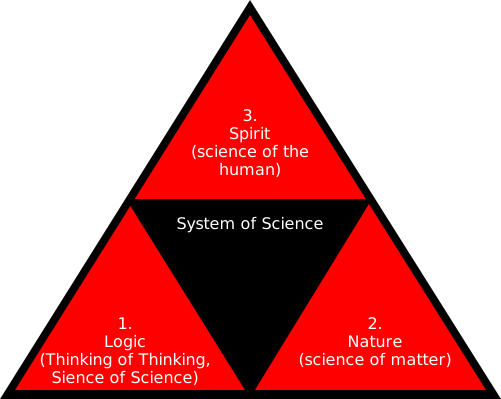
    • 0 Hegel's 'System of Science'
    • 1 Logic (Thinking of Thinking, Science of Science)
    • 2 Nature (science of matter)
    • 3 Spirit/Mind (Science of humanities)
    • 21 Mechanics
    • 22 Physics (including Chemistry)
    • 23 Organism / Life (Subjectivity)

    Texts online

    • HTM The Philosophy of Nature (Book 2 of the Encyclopedia) 1817

    Hegel texts on this topic

    • Enzyklopädie II, § 245🇩🇪 DE
    • Nürnberger Enzyklopädie, § 96🇩🇪 DE

    Commentary on this

    • Why This Part Has the Worst Reputation
    • Three Things to Keep Apart
    • What Logic Provides
    • What Logic Delivers and What It Does Not
    • What the Philosophy of Nature Adds
    • A Pattern That Repeats
    • What Hegel Achieved on His Own
    • The Three Levels, Once More
    • Erdmann: The Sketch in the Lectures on Academic Life
    • What Distinguishes the Three Students
    • What Both Undertake
    • Neuser: why nature is the sphere of externality
    • Neuser: The Other Logical Tradition
    • Petry: The State of Knowledge, Passage by Passage
    • Stekeler: The Reach of Forms of Explanation
    • Winfield: Determination Applied to a Present-Day Object
    • Four Approaches, Compared
    • What the Four Together Add Up To

    Articles on this term

    • Hegel's Philosophy of Nature (overview from EB1911)Encyclopedia Britannica 1911

    See also

    • 132 The Object (real Concept) ◆

    Nature

    To the glossary index · ↑ Top of page

    The Idea in the form of otherness --- thought in the shape of externality.

    In Hegel: 2

    Cross-references: Part One, I

    Commentary on the Philosophy of Nature: I. What It Undertakes

    To the glossary index · ↑ Top of page

    ← Logic (Thinking of Thinking, Science of Science) ↑ Hegel's 'System of Science' Spirit/Mind (Science of humanities) →

    Copyright for the triangle diagram, its labelling and the selection of links above this notice:
    © 2020–2026 by hegel.net, Kai Froeb. This content is licensed under CC BY-NC-SA 4.0.

    Copyright for the explanatory text below the triangle:
    © 2020–2026 by hegel.net, Kai Froeb. The explanatory text is licensed under the ZMC licence.

    Share

    Share

    ✉ Email 𝕏 X in LinkedIn f Facebook

    Imprint Terms of use Privacy policy