Skip to content
hegel.net

    Nothing found

    Search data could not be loaded

    • 🇩🇪 deutsch
    • 🇫🇷 français
    • 🇮🇹 italiano
    • 🇪🇸 español
    • 🇧🇷 português
    • 🇳🇱 hollands
    • 🇷🇺 русский
    • 🇨🇳 中国
    • 🇰🇷 한국의
    • 🇯🇵 日本の
    • 🇮🇳 हिन्दी
    • 🇸🇦 العربية
      • Overview
      • Logic
      • Nature
      • Subjective Spirit
      • Objective Spirit
      • Art
      • Religion
      • Philosophy
      • Quotations
      • Phenomenology
      • Texts online
      • All writings
      • Editions
      • Paragraph concordance
    • E-Texts
      • Articles
      • Topics
      • Commentary on the Logic
      • Commentary on the Philosophy of Nature
      • Commentary on Subjective Spirit
      • Commentary on the Philosophy of Right
      • Glossary
      • Hegel-Studien
      • The Owl of Minerva
      • Biography
      • Timeline
      • Contemporaries
      • Gallery
      • History of Hegel's reception I
      • History of Hegel's reception II
      • People
      • Hegelian PDFs
    • FAQ
      • Download posters
      • Buy posters
      • Audiobooks (German)
      • Quiz
      • What's new
      • Use and symbols
      • Ways of ordering
      • Kinds of cross-reference
      • About these pages
      • Links
      • Imprint
      • Terms of use
      • Privacy policy
      • E-mail
    • 🇩🇪 deutsch
    • 🇫🇷 français
    • 🇮🇹 italiano
    • 🇪🇸 español
    • 🇧🇷 português
    • 🇳🇱 hollands
    • 🇷🇺 русский
    • 🇨🇳 中国
    • 🇰🇷 한국의
    • 🇯🇵 日本の
    • 🇮🇳 हिन्दी
    • 🇸🇦 العربية

    2211

    Celestial bodies (solar system and universe)

    ?
    2.2.1.1. Celestial bodies (solar system and universe) © 2003-2026 hegel.net · Kai Froeb 2.2.1.1. Celestial bodies (solar system and universe) 2.2.1.1.1. Sun (the self-luminous: light, stars, universe) 2.2.1.1.2. Moon and comet (the moments of opposition) 2.2.1.1.3. Planet (the totality of the celestial body) One level back to General physicalities One level further to Sun (the self-luminous: light, stars, universe) One level further to Moon and comet (the moments of opposition) One level further to Planet (the totality of the celestial body)
    2.2.1.1. Celestial bodies (solar system and universe) © 2003-2026 hegel.net · Kai Froeb 2.2.1.1. Celestial bodies (solar system and universe) One level back to General physicalities One level further to Sun (the self-luminous: light, stars, universe) One level further to Moon and comet (the moments of opposition) One level further to Planet (the totality of the celestial body) 2.2.1.1.1. Sun (the self-luminous: light, stars, universe) 2.2.1.1.1.1. Light 2.2.1.1.1.2. [Stars] 2.2.1.1.1.3. [Galaxies and universe] One level back to Sun (the self-luminous: light, stars, universe) One level further to Light (electromagnetism) One level further to [Stars] One level further to [Galaxies and universe] 2.2.1.1.2. Moon and comet (the moments of opposition) 2.2.1.1.2.1. [Moons] 2.2.1.1.2.2. [Comets] 2.2.1.1.2.3. [Meteoroids] One level back to Moon and comet (the moments of opposition) One level further to [Moons] (subsistence without a process of its own) One level further to [Comets] (process without subsistence) One level further to [Meteoroids] (the disintegrated: unity of subsistence and passing away) 2.2.1.1.3. Planet (the totality of the celestial body) 2.2.1.1.3.1. [Sun-like planets] 2.2.1.1.3.2. [Moon-like bodies] 2.2.1.1.3.3. [Planets proper] One level back to Planet (the totality of the celestial body) One level further to [Sun-like planets] (giant planets with a satellite system of their own) One level further to [Moon-like bodies] (without atmosphere or without control of their orbit) One level further to [Planets proper] (rock, atmosphere, a process of their own)
    2.2.1.1. Celestial bodies (solar system and universe) © 2003-2026 hegel.net · Kai Froeb 2.2.1.1. Celestial bodies (solar system and universe) One level back to General physicalities One level further to Sun (the self-luminous: light, stars, universe) One level further to Moon and comet (the moments of opposition) One level further to Planet (the totality of the celestial body) 2.2.1.1.1. Sun (the self-luminous: light, stars, universe) One level back to Sun (the self-luminous: light, stars, universe) One level further to Light (electromagnetism) One level further to [Stars] One level further to [Galaxies and universe] 2.2.1.1.1.1. Light 2.2.1.1.1.1.1. [Photon] (Quantum) 2.2.1.1.1.1.2. [Light Wave] 2.2.1.1.1.1.3. [Propagation] One level back to Light (electromagnetism) One level further to [Photon] (Quantum) One level further to [Light Wave] One level further to [Propagation] (Light speed) 2.2.1.1.1.2. [Stars] 2.2.1.1.1.2.1. [Star formation] 2.2.1.1.1.2.2. [Suns] 2.2.1.1.1.2.3. [Death of stars] One level back to [Stars] One level further to [Star formation] One level further to [Suns] (stable phase) One level further to [Death of stars] 2.2.1.1.1.3. [Galaxies and universe] 2.2.1.1.1.3.1. [Star clusters and dwarf galaxies] 2.2.1.1.1.3.2. [Galaxies] 2.2.1.1.1.3.3. [Galaxy clusters and cosmos] One level back to [Galaxies and universe] One level further to [Star clusters and dwarf galaxies] (multiplicity without a centre) One level further to [Galaxies] (the articulated whole with a centre) One level further to [Galaxy clusters and cosmos] (the whole as process: expansion) 2.2.1.1.2. Moon and comet (the moments of opposition) One level back to Moon and comet (the moments of opposition) One level further to [Moons] (subsistence without a process of its own) One level further to [Comets] (process without subsistence) One level further to [Meteoroids] (the disintegrated: unity of subsistence and passing away) 2.2.1.1.2.1. [Moons] 2.2.1.1.2.1.1. [Earth's Moon] 2.2.1.1.2.1.2. [Moons of the giant planets] 2.2.1.1.2.1.3. [Captured minor moons] One level back to [Moons] (subsistence without a process of its own) One level further to [Earth's Moon] (tidally locked, without atmosphere) One level further to [Moons of the giant planets] (Io, Europa, Ganymede, Titan) One level further to [Captured minor moons] (Phobos, Deimos, satellites of the minor planets) 2.2.1.1.2.2. [Comets] 2.2.1.1.2.2.1. [Comet nucleus] 2.2.1.1.2.2.2. [Coma and tail] 2.2.1.1.2.2.3. [Cometary orbits] One level back to [Comets] (process without subsistence) One level further to [Comet nucleus] (ice and dust) One level further to [Coma and tail] (dissolution in sunlight) One level further to [Cometary orbits] (short- and long-period; Kuiper belt, Oort cloud) 2.2.1.1.2.3. [Meteoroids] 2.2.1.1.2.3.1. [Meteoroid] 2.2.1.1.2.3.2. [Meteor] 2.2.1.1.2.3.3. [Meteorite] One level back to [Meteoroids] (the disintegrated: unity of subsistence and passing away) One level further to [Meteoroid] (the body in space) One level further to [Meteor] (shooting star: the flaring up in passing away) One level further to [Meteorite] (the remnant fallen to earth) 2.2.1.1.3. Planet (the totality of the celestial body) One level back to Planet (the totality of the celestial body) One level further to [Sun-like planets] (giant planets with a satellite system of their own) One level further to [Moon-like bodies] (without atmosphere or without control of their orbit) One level further to [Planets proper] (rock, atmosphere, a process of their own) 2.2.1.1.3.1. [Sun-like planets] 2.2.1.1.3.1.1. [Jupiter] 2.2.1.1.3.1.2. [Saturn] 2.2.1.1.3.1.3. [Uranus and Neptune] One level back to [Sun-like planets] (giant planets with a satellite system of their own) One level further to [Jupiter] (the largest, almost a star) One level further to [Saturn] (the pronounced rings) One level further to [Uranus and Neptune] (ice giants) 2.2.1.1.3.2. [Moon-like bodies] 2.2.1.1.3.2.1. [Mercury] 2.2.1.1.3.2.2. [Minor planets] 2.2.1.1.3.2.3. [Dwarf planets] One level back to [Moon-like bodies] (without atmosphere or without control of their orbit) One level further to [Mercury] (solar moon) One level further to [Minor planets] (asteroid belt: Vesta, Pallas, Juno) One level further to [Dwarf planets] (Ceres, Pluto-Charon, Eris) 2.2.1.1.3.3. [Planets proper] 2.2.1.1.3.3.1. [Venus] 2.2.1.1.3.3.2. [Mars] 2.2.1.1.3.3.3. [Earth] One level back to [Planets proper] (rock, atmosphere, a process of their own) One level further to [Venus] (no moon: being-in-itself) One level further to [Mars] (two captured moons: difference) One level further to [Earth] (one moon of its own: the totality, transition to 231)
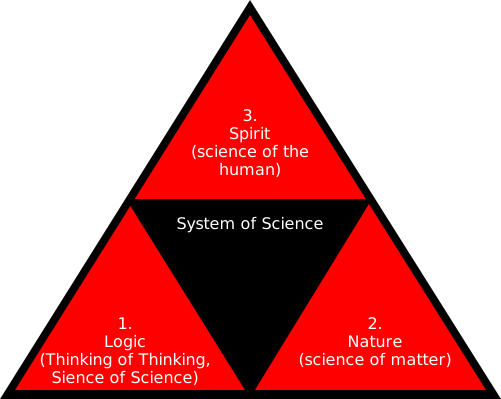
    • 0 Hegel's 'System of Science'
    • 1 Logic (Thinking of Thinking, Science of Science)
    • 2 Nature (science of matter)
    • 3 Spirit/Mind (Science of humanities)
    • 21 Mechanics
    • 22 Physics (including Chemistry)
    • 23 Organism / Life (Subjectivity)
    • 221 General physicalities
    • 222 Peculiarities (special individuality)
    • 223 Physical body (single individuality)
    • 2211 Celestial bodies (solar system and universe)
    • 2212 Basic elements (aggregates, phases)
    • 2213 Weather (elementary process, meteorology)
    • 22111 Sun (the self-luminous: light, stars, universe)
    • 22112 Moon and comet (the moments of opposition)
    • 22113 Planet (the totality of the celestial body)

    Texts online

    • HTM The Philosophy of Nature (Book 2 of the Encyclopedia) 1817

    Hegel texts on this topic

    • Enzyklopädie II, § 274🇩🇪 DE

    Commentary on this

    • What Remains of Mechanics
    • Why This Part Is the Weakest
    • Three Misunderstandings to Clear Away in Advance
    • The "Wide Field" — Why Physics Contains So Much

    See also

    • 213 Celestial mechanics (infinite motion, astronomy) ◆
    • 2311 Position in the solar system ◆

    Celestial Bodies

    To the glossary index · ↑ Top of page

    The bodies of absolute mechanics: sun, moons, comets, planets. Their relation is the first in which a whole determines its members.

    In Hegel: 2211

    Cross-references: Part One, III

    Commentary on the Philosophy of Nature: I. What It Undertakes

    To the glossary index · ↑ Top of page

    ↑ General physicalities Basic elements (aggregates, phases) →

    Copyright for the triangle diagram, its labelling and the selection of links above this notice:
    © 2020–2026 by hegel.net, Kai Froeb. This content is licensed under CC BY-NC-SA 4.0.

    Copyright for the explanatory text below the triangle:
    © 2020–2026 by hegel.net, Kai Froeb. The explanatory text is licensed under the ZMC licence.

    Share

    Share

    ✉ Email 𝕏 X in LinkedIn f Facebook

    Imprint Terms of use Privacy policy