Commentary on the Philosophy of Right, Chapter 35
Absolute Spirit — the Sphere of Ultimate Ends
In Hegel, objective spirit (right, morality, ethical life, world history) is followed by absolute spirit as the sphere in which spirit no longer determines itself through finite ends and their material, but relates to itself. Hegel divides it into art, religion, and philosophy, in that order. Whether this order is the correct one substantively will be discussed elsewhere; it is not pursued here, because the philosophy of right needs only the position of absolute spirit, not its internal articulation.[1]
What is absolute about this sphere is not some metaphysical loftiness but a position within the movement of spirit. Ab-solutus means: not bounded by another. In family, civil society, and the state, spirit relates to finite ends and to whatever material is available — a loaf of bread is baked, a machine is built, a law is passed. In the sphere of absolute spirit, the concern is not with finite ends but with ultimate ends — what we take, in the last instance, to be good, true, and important, and toward which all finite ends are oriented.
That absolute spirit appears here — and not merely as an appendix — has its reason in an observation that sustains the whole conception: the ultimate ends articulated in religion, art, philosophy, and science shape objective spirit in turn. The forms of life of a society cannot be explained from its economic or legal structure alone; they are also shaped by what people hold to be good, true, sacred. A Confucian civilization, a Christian civilization, an Islamic civilization differ not only economically and politically but also in the deep structure of what they recognize as ultimate ends. The civilizations mentioned in connection with external state law can be distinguished precisely on this basis: they have different religious traditions, different aesthetic idioms, different philosophical backgrounds. This is the deep structure that runs across individual states and shapes the relations of civilizations to one another.
But — and this is the counterpoint to a culturalist idealism — forms of life cannot simply be derived from absolute spirit. What a society recognizes as its ultimate ends shapes it; but how it realizes these ends depends on the material, on geographical conditions, on the means available, on the economic constellation. As noted, Hegel drew on Ritter; materiality remains a condition through which the ultimate ends must pass in order to become actual. Mountain peoples, river-valley empires, port-city cultures develop different forms in which their religious, artistic, and philosophical ultimate ends are likewise articulated — not because the ultimate ends differ, but because they must be given different concrete shape.
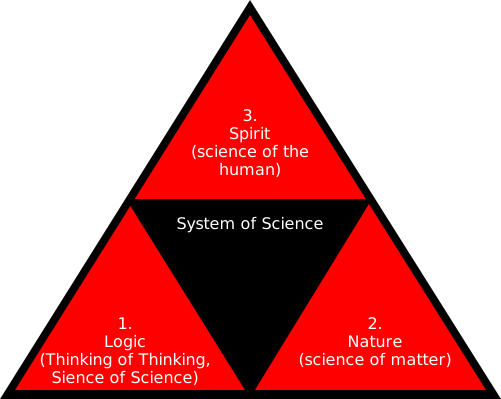
The point at this stage of the philosophy of right is therefore this: the determinations developed here — person, property, contract, family, civil society, state — do not stand in isolation. They stand in a twofold mediation: on the one hand with the material, with geographical substance, with economic conditions (this is the vertical dimension downward — philosophy of nature, economics); on the other hand with the ultimate ends articulated in religion, art, philosophy (this is the vertical dimension upward — absolute spirit). The philosophy of right is the sphere in between — the sphere in which material is formed by ultimate ends and ultimate ends are given concrete shape by material.
A full treatment of absolute spirit — the diversity of religions, the history of artistic forms, the disputes among philosophies — belongs in a separate volume. What needed to be established here is the position: absolute spirit does not lie beyond the philosophy of right, but stands as the sphere in which the ultimate ends that act upon objective spirit are articulated. Whoever reads the philosophy of right without this connection loses what conceptually sustains the entire structure.
The grounds for a different ordering — religion, art, philosophy — are worked out in a separate volume on absolute spirit. To develop them here would mean opening a second debate in this concluding section, one whose outcome would contribute nothing to the course of this volume. ↩︎