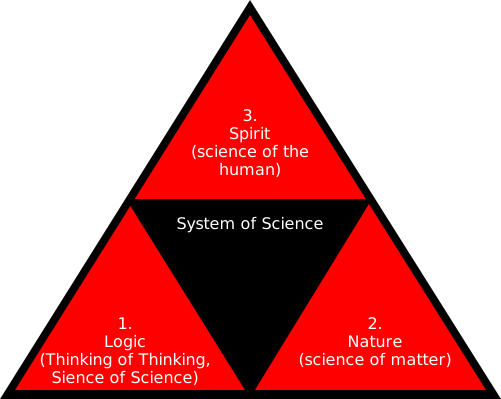
Commentary on the Philosophy of Right, Chapter 6
Historical Variation in the Form of the Family
Here, too, the double caution from I.8 must be applied. The family as an ethical unity that binds its members through love, forms an economic household unit, and brings forth the next generation is a general determination — it occurs in every known society. But the form in which these determinations are organized varies considerably. The tribal family embeds the nuclear family within a larger association, in which the individual family does not stand for itself but is a member of an extended kinship with its own ethical bonds. The ancient family — the Roman household, for instance — comprises, alongside biological relatives, slaves, clients, and freedmen; the pater familias holds a comprehensive authority that is scarcely conceivable today. The medieval extended family or household economy includes several generations, often integrates servants and apprentices into the household, and closely joins familial and economic functions. The modern nuclear family — father, mother, children, living apart from the family of origin, economically independent — is a specific form that took shape in this pure configuration only in industrial modernity.
This variation is not arbitrary. What appears in Hegel’s architecture of ethical life as “the family” is modeled predominantly on the modern nuclear family — a fact he does not conceal, but also does not reflect on systematically. Anyone who wants to think the family conceptually today should carry this historical variation along, without dwelling in detail on every single form. The structural determinations — ethical unity, economic household unit, generational reproduction — hold for all forms; the specific configuration differs from case to case.
An Empirical Confirmation of the Conceptual Order
At this point a remark on the relation between Hegel’s concept and modern empirical research is called for. Hegel maintains — and this is one of the more delicate points of his theory of ethical life — that the form of the family is not arbitrary, but shapes the later configuration of the political order. This thesis long sounded like speculation; but it has found an empirical confirmation that Hegel himself could not have had.
The French demographer Emmanuel Todd, who understands himself as an “empirical Hegelian,” has shown, in a series of large-scale studies, that a society’s basic family form — inheritance rules, patterns of generational residence, the standing of men and women — stands in a non-accidental relation to its political structures. Where inheritance is distributed individually and unequally (the English absolute nuclear family), a different political mentality arises than where inheritance is divided egalitarian (the French nuclear family), where one generation holds the entire farm and must provide for the others (the German stem family), or where property remains collective (the Russian or Chinese joint family).
These findings are doubly important for Hegel’s argument. First, they confirm that the family is not a private antechamber to the properly political world, but ethical life in the strict sense — a form that reaches into the entire structure of society. Second, they show that the form of the family is not the same everywhere, nor does it generate the same political institutions everywhere. What appears in the Hegelian architecture as the family is always already a particular familial form, and the transition to civil society and to the state is shaped by it accordingly. This is not said against Hegel, but for him: the conceptual order is a heuristic; its concrete content is a matter of empirical fact.
4. Civil Society — the System of Mediation
Here lies the systematic center where Hegel and Marx meet most closely — and where the methodological clarification from I.5 faces its first major test.
Preliminary remark: Civil society as a modern phenomenon
Before the individual determinations are unfolded, a clarification is needed that corresponds to the dual caution developed in I.8. The sphere analyzed here as civil society — the mediation of needs through markets, formally equal private persons, economic mediation as the central structural level between family and state — is, in this form, a specifically modern production. In earlier societies there were markets, there was exchange, there was economic mediation; but as a central structural level pervading the whole of life, civil society is modern. The genesis of this form lies in the dissolution of estate-based bonds, in the concentration of capital, in the separation of producers from their means of production, in the generalization of the wage contract — all those processes that constitute the transition to a capitalist economy. The validity of the form must be assessed dialectically: it brings with it a richer and more differentiated mediation of needs, a formal equality of all as a precondition of market participation, a liberation from estate-based bonds — but at the same time structural problems that did not occur in earlier forms, or not with the same sharpness: the inversion of need-satisfaction into self-purposive accumulation, the structural production of the rabble, ecological externalization, the atomization of ways of life. This dual assessment is to be kept in mind throughout what follows; it guards against two symmetrical errors — glorifying what has been achieved, and cynically refusing to make any judgment at all.
In older forms of society, what we grasp as civil society was organized differently. In tribal societies, economic reproduction is embedded in familial and kinship structures; an independent sphere of the market barely exists. In the ancient city-states, markets and trade exist, but they are integrated into the political life of the citizenry and are not the central structural level; the household economy (oikos) remains the foundation. In medieval Europe, the economy is organized through estate, guild, and feudal bond; markets exist, but they are embedded in the estate order. Only with the rise of the capitalist economy does the economic sphere detach itself as an independent structural level that shapes the whole of life — and this is the historical material on which Hegel develops civil society as an ethical sphere.
Civil society, as treated here, is thus not “the” general form of economic mediation, but a particular historical shape. What is general in its determinations (for instance: every society needs forms in which people satisfy each other’s needs) will be marked as general in what follows; what is specifically modern (for instance: competition as the central form of mediation, wage labor as the central contractual form) will be marked as specific. The detailed analysis of the specifically capitalist form belongs to an investigation of capitalism and must be carried out there; here it is developed only as far as is necessary for the place of civil society within the architecture of ethical life.
Civil society is the sphere in which subjects encounter one another as private persons, each pursuing his own purpose. What binds them is no longer the love of the family, but the mutual dependence of their needs.
The system of needs — the cunning of reason and its underside
In civil society, the general structure of human metabolism developed in the Prelude (II.3) appears in a specific form: what people produce is, for the most part, not intended for their own use but for others — and it does not reach the person in need directly, but through the mediation of the market. In pursuing his own purposes, each must simultaneously satisfy the purposes of others — otherwise he does not arrive at his own. This is Hegel’s appropriation of classical political economy (Smith, Ricardo, Steuart). He sees that a peculiar reason rules here. No one wants the universal; everyone wants his own particular good — and yet a nexus arises that produces the universal. Adam Smith’s “invisible hand” is the economic form of what Hegel calls the “cunning of reason”: the end does not assert itself directly, but presses the self-interests of market participants into its service and lets emerge, from their interplay, what none of them individually intended.
The specific concepts in which this mediation can be described — use value and exchange value as the two determinations under which products appear as commodities; money as universal medium of exchange; the capitalist movement M-C-M′, in which money becomes an end in itself — are to be relegated in detail to an investigation of capitalism and developed there as specifically capitalist determinations. Here only the structural point needs to be fixed, because it bears on the place of civil society within the architecture of ethical life: the mediation of needs through the market contains the possibility of the teleological inversion that was developed in the Prelude (II.2) as a general possibility of the means-end structure. Where money turns from a means between needs into an end in itself, to which need-satisfaction becomes subordinate, what is at work is not a moral defect of individual actors but a structural inversion inherent in the very form of market mediation. Civil society is the historical shape in which this inversion becomes system-sustaining; why it becomes system-sustaining here can only be explained from the specific form of economic mediation, which is to be pursued in the volume on capitalism.
A specific contractual form, without which this inversion could not become system-sustaining, is wage labor — the arrangement in which a person sells his labor-power for a period of time in exchange for money, without further bonds to the person of the buyer. It is a modern-specific form of contract that in earlier societies occurred only at the margins; its conceptual place belongs in the chapter on contract (III.3), where different historical contract forms are to be set against one another. Here it need only be noted that the specific character of civil society — and the sharpness of the passage on the rabble that follows shortly — cannot be separated from the generalization of wage labor. The detailed analysis of what wage labor achieves economically, and what structural consequences it has, belongs in the volume on capitalism.
Hegel sees not only the cunning of reason but also its structural shadow — the famous passage on the rabble (§§ 243–246):
With the excess of wealth, civil society is not rich enough — that is, it does not possess enough in its specific resources — to check the excess of poverty and the creation of a rabble.
This passage is among the most honest in the entire Philosophy of Right. In wealth, civil society simultaneously produces poverty that it cannot abolish. It produces a class of people who fall out of its logic — the “rabble” not in a moral but in a structural sense: people to whom society gives no place in which they could realize their subjectivity.
A clarification is needed here that is often missing in the reception of this passage: what does “rabble” actually mean? Hegel primarily means the marginalized — those who fall out of the system of need-satisfaction because they have no place in it: the unemployed, the impoverished, vagrants who find no livelihood through any regular activity. Structurally similar phenomena exist in other historical forms — the Roman plebs, as the stratum below full citizenship dependent on grain distributions, is one example; the wandering poor of medieval Europe, who appeared in the towns after the crises of the fourteenth century, is another. But these comparisons must be drawn with caution: the conditions under which marginalization arises in different societies vary, and the specifically modern form of the rabble is closely bound to the conditions of civil society — to the dissolution of estate-based bonds, which had still held the previously marginalized in some form, and to the separation of producers from the means of production, which makes a livelihood outside the wage contract structurally difficult.
Marx has both extended and radicalized the question of the rabble. Extended, because for him the problem encompasses not only the unemployed but also the misery within wage labor itself — those who formally “have work” but work under conditions that allow their subjectivity no more scope for realization than that of the marginalized. Radicalized, because for him the unemployed are not the core of the problem but its necessary consequence: Marx’s “industrial reserve army” shows that capitalist production structurally requires a reserve of unemployed labor to maintain downward pressure on wages and flexibility for accumulation. Unemployment is thus not a regrettable side effect of an otherwise functioning order, but a necessary moment of its reproduction. But the real problem is not unemployment but wage labor itself: the structural constitution that forces people to sell their life-activity for money, and thereby places them in a position in which their subjectivity comes to realization only incompletely, if at all, and only under constant pressure. The question of the rabble in civil society is therefore, for Marx, a question of wage labor as a whole, not only of the marginalized.
This extension shifts the weight of the passage on the rabble. In Hegel it is the diagnosis of a residual stratum that the system cannot provide for. In Marx it becomes the diagnosis of a structural characteristic of the whole of reproduction: wage labor itself — as the central contractual form of civil society — structurally produces the very problems Hegel observes in the marginalized, and these problems affect not only the marginalized but, in varying degrees of sharpness, all wage-dependents. The more detailed analysis of this characteristic belongs to the investigation of capitalism; here what matters is the clarification that the question of the rabble is not confined to the marginalized, but points to the form of wage labor.
What Hegel diagnoses here has a conceptual depth that can be precisely captured through Hegel’s own logic of the Idea of Life. A living system reproduces itself by articulating itself internally (self-differentiation), by preserving itself against its environment (self-preservation), and by reproducing itself beyond itself in the next generation (self-sublation). But these formal structures, taken by themselves, allow no distinction between successful and parasitic self-preservation. One can conceive of processes that formally satisfy all criteria of living self-reproduction while destroying the overarching nexus on which they themselves depend. Civil society, as Hegel describes it, has exactly this structure: it reproduces itself in fully formal terms while at the same time destroying the preconditions on which it lives — people who find no place in it in which they could realize their subjectivity.
In Hegel, the rabble appears as a crisis phenomenon structurally produced by civil society, which it cannot sublate by its own means. What the logic of mere life does not resolve out of itself remains, within his architecture, as an unresolved problem — a residual problem in the sense of what ethical life does not simply reconcile. In Marx, this insight is radicalized: what appears in Hegel as an unresolved crisis phenomenon proves to be a necessary moment of capitalist reproduction. The specific legal constitution of civil society — private property in the means of production on the one hand, the wage-labor contract as the generalized form of labor’s valorization on the other — structurally, not accidentally, produces people who fall out of its logic. The rabble is not an exception to the reproduction of civil society, but one of its conditions.
Thus the passage on the rabble stands as the hinge of the Philosophy of Right. Hegel sees the problem with full conceptual sharpness — he has prepared the teleological inversion in the Logic and knows the limit of mere life. What he cannot accomplish with his own means is the economic analysis that would show why this contradiction is not a residual problem but a structural condition of civil society.
At this point Eduard Gans is the important intermediate figure, without whom the transition from Hegel to Marx could not be read as a continuous movement within the same method. Gans was Hegel’s student and close collaborator — he co-founded the Society for Scientific Criticism, organized the Jahrbücher für wissenschaftliche Kritik, and after Hegel’s death edited the second edition of the Grundlinien (1833). From 1826 he was professor at the Berlin law faculty and regularly lectured there on natural law and philosophy of right following Hegel’s compendium; he was the most charismatic philosopher of right at the university, and most of Hegel’s students heard the philosophy of right not from Hegel himself but from Gans. In his lectures on natural law in the winter semester of 1832/33 — three years after Hegel’s death, three years before Marx’s time as a student in Berlin — Gans takes up precisely the point at which Hegel’s treatment of the rabble had remained open, and carries out the step that Hegel himself had not taken.[1] Where Hegel had treated the existence of the rabble with a “curiously ambivalent” determination, as a residual problem that could be alleviated—but not sublated—through alms, public assistance, and ultimately through world trade and colonization, Gans states literally: “Must the rabble remain? Is it a necessary existence? […] Among us such a rabble is not yet organized, but it is in London. The police must therefore be able to act so that no rabble exists. It is a fact, but not a right. One must be able to get at the grounds of the fact and sublate them.”[2] This is the methodological turn: the rabble is no longer accepted as a residual problem but treated as a fact whose grounds are themselves subject to sublation — the Hegelian method turned on what Hegel himself had not sublated.
A clarification is important here, one that bears on the entire relationship between Hegel and Marx. In the later Marxist reception, the charge became established that Hegel’s philosophy reconciles only “in the concept,” that it sublates the contradictions merely in thought while leaving reality standing as unreasonable. This charge misses what the Hegelian Logic actually accomplishes. The Idea, as the unity of concept and objectivity, is not silent contemplation but a movement of realization: cognition and volition, theoretical and practical Idea, whose truth comes together only in the speculative Idea, which sinks cognition into volition and volition into cognition. Hegel does have reservations — but they concern not the transformation of reality, but the subjectivity of Morality, in which each person constructs his own conception of the good and believes the world must conform to it. Ethical life, by contrast, is the sphere in which people give themselves rational organizations and rules — family, civil society, state are not givens to which the individual would have to submit, but shapes that the free will works out, criticizes, and rebuilds for itself, because only in them does it find itself as truly free. What Gans does at the passage on the rabble is not to go beyond Hegel but to take Hegel at his word: if ethical life is the realization of the free will, then a fact that falls outside it while at the same time being structurally produced by it is a scandal within ethical life, one it must work to sublate. The task of the state as mediating instance is precisely this: to sublate the contradictions of civil society in practice, by critically examining and reorganizing the institutions and rules that produce them. Whoever reads Hegel along this line finds the charge of reconciliation losing its edge: reconciliation in the Hegelian sense does not mean that the unreasonable is accepted as reasonable, but that the reasonable is made practical. Gans states this more openly than Hegel, and Marx radicalizes it further — but all three stand in the same practical-philosophical line.
Three years later, in his Rückblicke auf Personen und Zustände (Retrospects on Persons and Circumstances, 1836), Gans draws from his stay in Paris in 1830 the line to a Saint-Simonian-inflected class analysis: “[…] the class relationship, which has remained the same through all the changes of history hitherto, between master and slave, patrician and plebeian, feudal lord and vassal, factory owner and worker.”[3] The formulation is not accidental: it is the class formula that recurs in the Communist Manifesto of 1848 — and Marx, at the time Gans published these sentences, had only just attended his lectures.[4] Gans nevertheless holds fast to the Hegelian concept of property — he explicitly criticizes the Saint-Simonian abolition of inheritance rights as a loss of the “moralizing” dimension of property — but he translates the question of the rabble into the language of modern class relations and proposes as a solution the “free corporation” or “association”: an ethical form in which wage laborers can organize themselves against the “despotism” of factory owners.[5]
What Hegel prepared methodologically, and what Gans carried forward within the Hegelian method into class analysis, has in Marx become the economic necessity of the form — the radicalization already captured in the preceding paragraph. The line is continuous, but it has real fracture points, which shall be marked here in advance (a more extensive treatment follows in the concluding Part VII). In Hegel, three layers must be distinguished: the logical core — the state as the place where the universal becomes conscious, ethical life as the sphere in which the reasonable is to become practical — is load-bearing and untouched by the critique. Hegel’s linguistic expression in certain passages, by contrast, goes too far, because it makes reconciliation sound as though already accomplished. And the time-bound assumption that the unity of cognition and volition was already actual in the state of his time (Napoleonic reform-era Prussia) is historically unfulfilled and is asserted by Hegel himself more strongly than the matter can bear. Marx criticizes chiefly the second and third layers; his objection allows the logical core to be brought out as what it is, without carrying along the problematic layers. In Gans the difference lies elsewhere: he thinks in a Hegelian spirit — cognizing reality, cognizing the circumstances, acting and willing rightly — and applies this consistently to the rabble. His statement that the rabble must disappear means, in substance: the circumstances that produce the rabble must disappear. What Gans does not accomplish is the detailed economic analysis of these circumstances. Marx thus differs from Hegel and Gans mainly in this analysis — he shows in detail which circumstances produce the rabble and what form of engagement with them would be necessary. Pistor later supplements this analysis at the level of legal form, but does not replace it.
Three levels of appropriation and bargaining asymmetry — reference to the volume on capitalism
Both Hegel’s passage on the rabble and the block on wage labor in III.3 point to a structural analysis in depth that is only briefly indicated here, because in substance it belongs to the volume on capitalism.
Three levels are to be distinguished analytically within civil society, without being developed in detail here. The production of the useful — what comes into being as useful goods — is the sociological-anthropological fact of every complex society; people, nature, animals, machines all contribute to it, and it is always more than what the immediate producers need for themselves. Legal appropriation decides to whom what is produced falls; it proceeds exclusively through legal forms (property, contract) and follows a logic of its own that does not coincide with production as such. Enterprise cost accounting is the bookkeeping-internal view of the second level. Confusing these three levels is the root of several classical controversies — for instance, the question of whether “labor” or “capital” “creates value.” The Hegelian passage on the rabble becomes legible in its structural depth once one distinguishes: the surplus product arises at the first level and is not the problem; that it falls to a particular class of owners is a fact of the second level and is bound to the specifically capitalist structure of appropriation. The detailed analysis of these structures — including the question of who is even a fully participating legal subject, and how historical and present-day forms of semi-free labor (slavery, debt bondage, precarious supply-chain labor) are integrated into capitalist appropriation — belongs in the volume on capitalism.
A corresponding analysis concerns the side of exchange: the bargaining asymmetries through which the formal equality of contracting parties is systematically undermined within the mediating relations of civil society. Urgency (situational bargaining power) and lack of alternatives (structural bargaining power — whether as a legally secured monopoly or as a lock-in effect) operate in every exchange and can produce stable asymmetries favoring one side. In the wage contract they operate systematically to the disadvantage of wage-dependents; the historical response to this — trade unions, collective bargaining agreements, statutory protections — is the form in which the asymmetry is addressed as an asymmetry and partially corrected. Gans anticipated this in the concept of the free corporation; the detailed analysis of how bargaining asymmetries operate in modern capitalism, and what they mean for tenants, small suppliers, data producers, and other structurally weaker parties, belongs in the volume on capitalism.
The point at this juncture of the Philosophy of Right is methodological: the formal recognition of equals as equals (abstract right) does not carry its own realization within itself, but depends on ethical institutions that work through the structural asymmetries. Where this does not happen, the good abstraction of formal equality tips over into the bad abstraction of substantive control over another’s lifetime (cf. II.2). The wage contract is the central case in which this tipping point becomes visible — and the Hegelian concept of the corporation, like the Hegelian concept of the police, are the ethical responses that abstract right cannot provide from within itself.
The administration of justice
The system of needs is not raw but legally mediated. Property and contract — the determinations of abstract right — recur here, but now as consciously enacted and judicially enforced. Right becomes law: pronounced, known, generally recognized. The judiciary enforces it.
Thus the person, who in abstract right was still only a concept, becomes practical here. Everyone is known and treated as a legal person. This is an enormous achievement — and its limit. For this person remains abstract: it disregards the economic position in which legal subjects actually stand. Hegel knows this; that is precisely the point of the analysis of the rabble. What Pistor shows today regarding the coding of capital is the institutional concretion of exactly this point: law is not the neutral form in which economic substance would remain untouched; it is itself part of the shape in which certain economic relations endure — and thus part of the means that can turn against the end.
Police and corporation
“Police” has, in Hegel, the older, broader sense: it comprises all public provisions for security, welfare, and well-being — oversight of markets, public health, poor relief, education. The police represent society’s insight that private purposes alone do not suffice; an external instance is needed to guard the universal.
This insight has a conceptual depth that must be separated here into two layers. The general form, effective in every complex society: there are tasks that exceed what individual actors (persons, families, smaller communities) can accomplish — defense against external threats, protection and stewardship of shared resources, large infrastructures for transport and water management, securing peaceful coexistence, cross-generational education. Such tasks require an overarching instance that takes them on for society as a whole; without it, society either disintegrates into uncoordinated individual actions or the task simply remains unsolved. Which of these tasks arises in which form, and how they are addressed, depends on the given form of society.
Four brief historical cross-references make the variation of solutions visible without collapsing into a small world history. In tribal societies, universality is organized through direct assembly, through elders, or through ritualized instances; what concerns everyone is jointly deliberated or decided through customary procedures. In the river-valley civilizations — Mesopotamia, Egypt, ancient China — a central bureaucracy arises that administers irrigation systems, stockpiling, flood protection, and the census; what Lewis Mumford called the “megamachine” is the highly coordinated bureaucracy that first makes such large infrastructures possible. In medieval Europe, many of these tasks are taken on by guilds, fraternities, and communal orders; the town regulates its own markets, the guild controls the quality of work, the fraternity cares for its members in sickness and death. In modern state administration, finally, most of these tasks are centralized in a network of ministries, agencies, and municipal services; the form that seems self-evident to us today is a specifically modern one — it arose together with the modern territorial state, uniform citizenship, and the dissolution of estate-based structures.
These cross-references show the structural generality (in every developed society, overarching tasks must be taken on) and its historical variation (the concrete forms differ in each case); but they do not narrate the transition from one form to another. How the medieval guilds transformed into modern state administration belongs to world history, not here.
In civil society, a particular difficulty is added to this general form, one that is specific and that Hegel primarily has in view at this point. Because here the mediation of needs runs through markets and producers stand against one another as competitors, prisoner’s-dilemma constellations arise: tasks that everyone recognizes as necessary cannot be taken on by individuals, because any attempt to solve them disadvantages them in competition. Three examples from the developed capitalist economy make this constellation visible. First, the training of qualified labor: an individual entrepreneur who invests in training his employees bears the costs alone and shares the benefit with all his competitors, who can later poach the fully trained workers. The rational individual calculation is to refrain from doing so — with the collective result that no one does it and the labor force as a whole is under-qualified. Second, the conservation of shared resources, such as the environment: whoever internalizes environmental costs as an individual produces more expensively than one who externalizes them; if everyone externalizes, the system tips over and everyone suffers — including those who would have been careful. Third, the limitation of self-exploitation: an individual entrepreneur who offers shorter working hours or higher wages than the competition is undercut; but if everyone maximally exhausts the labor force, an exhausted working population results, and everyone suffers.
These three constellations are not merely historical concretions of a general structure, but have their own specific form: the competition dilemma. In societies where economic reproduction does not run through competition, these problems either do not arise at all or arise in a completely different form. The training of the next generation in a tribal society is a matter for the tribe, not for a competing individual; shared resources in many pre-capitalist societies are protected through commons institutions, religious taboos, or direct communal administration; the question of self-exploitation does not arise in the same form where labor is not organized through wage contracts. That these problems take on the specific form of the competition dilemma in civil society is a consequence of the specifically capitalist form of societal mediation. The detailed analysis of how capitalist competition structures these problems, and what response forms the state has developed for them (education systems, environmental law, labor law), belongs in an investigation of the capitalist state. Here only the methodological point needs to be fixed: the Hegelian determination of police and corporation carries a general form (every society needs overarching instances for tasks that exceed the individual) and a particular form (in civil society, as competition dilemma); both must be distinguished, or else the specifically capitalist will be passed off as a general condition of the social.
The corporation is the other side of the answer: it is the self-organization of professional estates, in which individuals no longer know themselves merely as isolated private persons but as members of a concrete universal. Here too historical variation must be seen: what Hegel calls “corporation” has its historical precursors in the medieval guilds, gilds, and fraternities; in the ancient world there were comparable collegia; in the modern world the professional association, the trade union, the occupational society are the most important forms. In it, the subject finds, for the first time in civil society, an ethical home — a “second family,” as Hegel puts it. Gans takes up this concept in a direction that Hegel had left open: whereas Hegel tends to think the corporation in terms of the estates of the bourgeois class, Gans extends it into the “free corporation” or “association” of wage laborers — as an ethical form in which labor set free by industry does not fall back into despotism but finds an organizational shape of its own.[6] This is an anticipation of the idea of the trade union from the Hegelian concept of the corporation that has been underestimated in the further history of its reception.
In police and corporation, civil society presses beyond itself toward the state. It recognizes that it cannot generate its own reason out of private purposes alone; it needs an instance that represents the universal as universal.
5. The State — Conscious Ethical Life
Preliminary remark: The minimal shape as a general determination
Before Hegel’s determination of the state as the actuality of the ethical Idea is developed, an elementary determination must be brought out that is easily overlooked in Hegel’s presentation and is important for the architecture developed here: it is the general determination of the state, valid for every developed state, not specific to the modern one. The state is first of all the instance that posits and enforces right. What existed in abstract right as a formal claim, what was captured in contract as the mutual recognition of equals as equals, what became conscious in civil society through the administration of justice — all of this presupposes an instance that makes right into right in the first place: by formulating it in laws and enforcing it with force. In this minimal shape, ancient city-states, medieval feudal realms, and modern nation-states do not differ; all posit right and enforce it. The form in which this happens varies; that it happens is general.
This minimal shape is not to be confused with the “night watchman state” notion of classical liberalism, which sought to confine the state to protecting property, contract, and security. Even this supposedly minimal state, if it takes its task seriously, would be an enormous apparatus — police, judiciary, penal system, administration. Even the enforcement of abstract right requires more than the liberal concept admits. But the point of the Hegelian position is different: the state is not the minimal shape but contains it as a moment. What Hegel develops as the “actuality of the ethical Idea” has the minimal shape within it as a necessary condition, but builds upon it toward a richer determination. Whoever thinks Hegel’s state without the minimal shape idealizes it; whoever reduces it to that shape truncates it.
This determination is also the place where the structural asymmetry of law becomes a theme — one already visible in Part III (Property) and in the block on the rabble (V.4). The law that the state enforces is not the formally neutral form in which economic substance remains untouched. It is itself part of the shape in which certain relations endure. Whose property is protected more strictly, whose breaches of contract are pursued more sharply, which violations of law are systematically made visible and which kept invisible — all these are questions that the minimal shape of the state does not resolve on its own, but which the state, in its full determination, must work through. This too is not a specifically modern observation: in every society with a state, the question must be asked which relations are stabilized by the prevailing law — the specific answers vary historically.
Historical variation of state forms
Before proceeding to Hegel’s determination of the modern state, a brief sketch of the historical variation of state forms should be inserted. It is meant to make visible the structural generality of political universality without collapsing into a small world history — the transitions between forms belong to world history as its own part (cf. Part VIII).
Following the geographical dimension developed in I.7 (with reference to Carl Ritter and Hegel’s introduction to world history), a rough distinction can be drawn: tribal societies without a permanent central instance. Among mountain peoples, in pastoral cultures, often also among desert and jungle peoples, a permanently established state power is lacking; the universal is administered through tribal assembly, through elders, through ritualized procedures that become effective situationally. This form is not a preliminary stage of the state in a teleological sense, but its own solution, fulfilling its function under the corresponding natural-spatial conditions.
River-valley kingdoms and their bureaucracies. Mesopotamia, Egypt, ancient China, later the Indus kingdoms — they form centralized states with a capital city, a developed bureaucracy, written administration, coordinated irrigation economy. Here the central instance is substantial and continuous; it directs large infrastructures, coordinates stockpiling and distribution, organizes irrigation. What Lewis Mumford called the “megamachine” is the highly coordinated bureaucracy of these states.
Ancient city-states as communities of citizens. The Greek polis and the Roman Republic in its early and middle form are city-states in which the citizenry itself is the bearer of political universality. Citizens assemble, deliberate, decide — the form of political universality is more immediate than in the river-valley kingdoms, but limited to a small number of those entitled (free citizens, not slaves, not women). Port-city cultures — Athens, Corinth, Massilia, later Venice, Amsterdam — often show this form; it combines trade, political participation, and intellectual openness.
The ancient empire (Rome in its imperial phase). With the expansion of the city-state form over a vast territory, another solution arises: provincial administration, a professional bureaucracy, a unified legal system (Roman law) that later becomes a central source for European legal history. Here the citizenry is no longer directly involved in decision-making, but it is recognized as citizenry — a form that structurally produces the tension between universality and representation.
Medieval feudal states. Here the form is different again: a personal bond rather than a territorial state, staggered loyalties between feudal lord and vassals, princes, bishops, kings. The central instance is weaker, law strongly fragmented into local and estate-based units. What we today think of as “the state” is hardly clearly delineated here; the political, the religious, the economic, and the familial are interwoven through feudal bonds.
The modern nation-state. Only from the late Middle Ages onward, and especially since the early modern period, does a specific form take shape: the territorial principle rather than a personal bond, uniform citizenship rather than estate-based distinction, a developed bureaucracy, a unified legal system on a clearly delineated territory. This is the form on which Hegel develops his determination of the state — and it is important to note this: Hegel’s state is the modern nation-state, not a timeless concept. The historical genesis of this state is closely intertwined with the development of the capitalist economy, as will become clear in the following section.
This sketch is a first, simplified one; it could be expanded and differentiated in many ways. Its function here is to make visible the structural generality of political universality (every developed society has a form in which the universal asserts itself as universal) and the diversity of forms in which this universality is concretized. The transitions between the forms — how the river-valley kingdoms became the ancient city-states, how the medieval feudal states gave rise to the modern nation-states — are not to be narrated here, but in world history as its own part.
Preliminary remark: The historical constitutivity of the modern state
A second determination must be brought out that is easily shortchanged in the Hegelian architecture — and which, unlike the general minimal shape, specifically concerns the modern state. Hegel develops the state from the concept — as the form in which the universal consciously asserts itself. This conceptual development is load-bearing, but it obscures the fact that the concrete modern state did not arise from the concept, but from a historical genesis that shaped it and has entered into its very conceptual determination.
Three historical lines are especially important. The first is the interweaving of state finance and monetary economy since the early modern period. Modern warfare became too expensive in the fifteenth and sixteenth centuries to be financed from traditional revenues in land and payments in kind. Whoever wanted to wage war needed credit. Financiers such as the Fuggers appeared on the scene, financing entire realms and royal elections. The public debts that arose from this became the basis of a lasting interweaving: the state needed capital for its wars, capital needed the state for secure investments and the enforcement of its claims. This interweaving did not merely influence the modern state externally; it entered into its very form. The state that governs with money instead of payments in kind and forced labor is structurally different from the feudal state. It has itself become an actor in a monetary economy that simultaneously enables and limits its capacity to act.
The second line is the discovery of capital as a means of increasing productivity. The Venetian Arsenal — the state shipyard that, in the fifteenth century, could produce one warship a day — was an early form of systematic division of labor, standardized components, timed workflows. The model arose from military necessity, but it showed what organized production could achieve, and it was later copied. The mercantilist princely states of the early modern period invested massively in canals, postal systems, ports — and thereby created the infrastructure without which the later industrial economy could not have arisen. The modern state did not merely frame the economy legally, but created material preconditions that have entered into its history and its concept.
The third line is bureaucratization as a dynamic in its own right. The modern state no longer operates through personal rule, but through institutionalized procedures, through files, rules, administrations. This bureaucratization was not added arbitrarily, but was the condition that allowed the state to gain the spatial and substantive reach it has today. It too has entered into its concept: what Hegel develops as the differentiation of three powers is unthinkable without the institutional depth that bureaucracy makes available.
These three lines — state financing through credit, material infrastructure, bureaucratization — are not later additions to a state form developed purely from the concept. They are historical constitutive elements that have entered into the concept itself. Whoever wants to think the modern state cannot go behind them. Hegel saw this in substance, but his diction sometimes suggests that the state was developed out of the pure concept alone — a diction that misses the historical weight of its object. A philosophy of right today must carry this weight along, without falling into the opposite error of reducing the state to its historical conditions and losing its own logic.
What the state should be — Hegel’s conception as a specifically modern form
Hegel’s determination of the state is, unlike the minimal shape, specifically modern. It attempts to synthesize what can be gained from the historical variation of state forms in a shape that becomes possible only under the conditions of the modern world — the developed bureaucracy, uniform citizenship, the separation of civil society and state, the differentiation of powers. This marker is important because it prevents Hegel’s determination from being misunderstood as timelessly general; it is a determination of the modern state, in its claim and in its possibility.
For Hegel, the state is not the police (in the modern sense) and not the administrative apparatus. It is the actuality of the ethical Idea — the political community that knows itself as reasonable and wills itself as reasonable. In it, family and civil society find their truth: what was immediate in family life and mediated in market life becomes conscious in the state.
Conceptually, the state is the place where the Idea claims to realize itself in its highest form of ethical life: as the unity of cognition and volition. In Morality, the cognition of the good was separated from its realization; conscience knew what ought to be good, without being able to bring it about out of itself. In civil society, realization was separated from cognition; the cunning of reason produced a universal that no one had willed. In the state both are supposed to come together: a political community that recognizes its universal and at the same time wills it — that does not, then, generate reason behind the backs of its members, but acts as a conscious self-shaping of the form of life.
This is the teleological core of the Hegelian state: it is not a means to ends lying outside itself (as in liberalism, where it serves the protection of property or the maximization of utility). It is internal purposiveness — an end in itself — because in it the subjects are, for the first time, fully recognized as what they are: rational beings whose freedom is realized only in a community that is itself rational.
Hegel develops the internal constitution of the state as the differentiation of three powers: the legislative (positing the universal), the governmental power (subsuming the particular under the universal), and the crown (the individual as the apex of the whole). The point is not the specific form of constitutional monarchy he prefers, but the conceptual demand: the state must be internally articulated such that the universal, the particular, and the individual function as moments of a whole. Precisely at this point, Gans — without giving up his status as a Hegel student — carried out a “tacit correction” relevant to our reading: he treats the republican-representative constitution — using the example of the United States — as the form that actually matches the concept of the modern state, whereas constitutional monarchy appears to him as a historically transitional form still bound to tradition.[7] This is not merely politically interesting but methodologically significant: Gans turns Hegel’s own principle — “law itself subject to historical development” — against those very passages where Hegel did not follow this principle. The “liberal consequences” that Gans drew from Hegel’s philosophy of right are not a deviation but a consequence of the Hegelian principle. Here too the methodological line often buried in the history of reception becomes visible: criticizing Hegel with Hegelian means. The question of genesis versus validity indicated here (the validity of constitutional monarchy versus the validity of the republican-representative constitution) was mentioned in I.8 as an example; it cannot be decided by the Hegelian concept alone, but requires examining which form of political universality is, under modern conditions, more adequate to its concept.
The inner constitution of the state
What was only briefly indicated in the preceding section — the differentiation of three powers — deserves separate treatment, because an important conceptual architecture in Hegel’s doctrine of the state lies here, and because the historical variation of constitutional forms is indispensable for a concrete universality of the political form.
The conceptual architecture. Hegel does not develop the internal articulation of the state from the historical experience of the separation of powers (Locke, Montesquieu), which he knew and adopts in certain respects, but from the logic of the concept. The state, as the actuality of the ethical Idea, must be internally differentiated as the concept itself is: as the unity of universal, particular, and individual. From this follow three moments — not three separate powers checking one another (that is the liberal form of Montesquieu), but three aspects of a self-movement of the political universal.
The legislative power is the moment of the universal: it posits the general determinations by which political life orients itself — the laws, the constitution, the basic rules that apply to all. It deals with the universal as such, without going into the individual case.
The governmental power is the moment of the particular: it subsumes the individual case under the general law, it administers, it executes, it decides the concrete in light of the universal. It comprises what we today call the executive, but also the judiciary as the application of law to the case.
The princely power — in Hegel: the crown — is the moment of the individual: the final instance of decision, the point at which the universal takes shape in a single will. Hegel sees this point embodied in the monarch, who authorizes decisions with his “yes” or “no.” The point here is less the specific principle of hereditary succession or the monarchical form than the conceptual demand that the universal must ultimately be bundled together in an individual and thereby become actual. Whoever disputes this point — as republican constitutions do with other constructions (election of a president, collective head of state, parliamentary majority) — does not dispute the necessity of a moment of individuality, but finds another form in which this moment is realized.
In this architecture, the three powers are not primarily directed against one another, but stand in a relationship of mutual mediation. This is the decisive difference from the classical doctrine of the separation of powers: for Locke and Montesquieu the point is that the powers limit one another, so that none can grow into tyranny (checks and balances); for Hegel the point is that they must work as moments of a whole into one another, so that the universal becomes concrete actuality. Both views have their justification: the liberal view establishes why the separation of powers is important as protection against concentration of power; the Hegelian view establishes why the divided powers must nonetheless function as the unity of a political life if the state is to fulfill its purpose.
Estates as mediation. In Hegel, the system of estates has its own place — as mediation between civil society and the state. The estates bring the particular interests of civil society (the substantial estate of landowners, the estate of trade and industry, the universal estate of civil servants) into legislation and thus mediate between private forms of life and political universality. The estates are not a mere representation of voter interests, but the institutionalized form in which the differentiated spheres of civil society come to bear in the political process.
This conception must be read historically today, for several reasons. The estate order to which Hegel connects has dissolved; in its place has come electoral democracy with parties, in which representation is organized not by estate but individually and egalitarianly. But the structural question that Hegel takes up with the system of estates — how the diversity of forms of life in civil society finds a voice in the political process — remains current. Modern answers are associations, organized interests, civil-society organizations that participate in politics; the parliamentary diversity in a system with proportional representation has a similar function. The historical critique of Hegel’s estate form does not change the fact that the question of mediation between form of life and politics remains a lasting one.
The bureaucracy. Hegel assigned a special status to the bureaucracy, the “universal estate”: it is that stratum which acts not out of particular interest but on behalf of the universal — education, expertise, and loyalty to public service are its hallmarks. This conception has real historical substance in the Prussian reform bureaucracy, but it is not without relevance today either: the demand that a professional administration be committed to the common good and not to the particular interests of individual actors is the normative foundation of the modern administrative state. That this demand is often undermined in reality — through political patronage, through lobbying, through economic dependencies — does not change its conceptual necessity; it is the condition for the state to represent the universal at all.
Public opinion. Finally, Hegel knows the sphere of public opinion as a form in which citizens participate in the political process — through discussion, through criticism, through participation in discourse. Hegel has an ambivalent attitude toward it: he sees in public opinion both the truth of political participation and the danger of uneducated opinion that judges without expertise. Today, under the conditions of mass media and the internet, this ambivalence has sharpened — the public is more comprehensive, but also more fragmented; it is better informed, but also more susceptible to manipulation. What Hegel described as the structural tension of public opinion has deepened under modern conditions, not dissolved.
Historical variation of constitutional forms. Hegel’s inner constitution of the state is, as already said, oriented toward the modern form. But its point — differentiation as the unity of universal, particular, and individual — can be found again in various historical constitutional forms, in each case concretized differently. Aristotle distinguishes, in the Politics, six constitutional forms, depending on whether one person, a few, or the many rule, and depending on whether rule is oriented to the common good or to self-interest — monarchy/tyranny, aristocracy/oligarchy, polity/democracy. What becomes visible here is the question of the relationship of individual, particular, and universal in the constitution, long before Hegel grasps it conceptually.
The Roman Republic had an elaborate constitution in which various magistrates (consuls, praetors, quaestors), the Senate (as the deliberative assembly of patricians), and the popular assemblies (for the plebs) worked into one another — a system in which no single instance could decide alone and in which the estate-based conflicts between patricians and plebeians remained enduringly structuring. Polybius described this constitution in his Histories as a mixed constitution, uniting monarchical, aristocratic, and democratic elements — a description that became a model for Montesquieu and for the American constitutional debate.
Medieval Europe had no centralized statehood, but a structure of kings, feudal lords, imperial estates, churches, cities — a relationship in which power was divided and staggered, with its own forms of mediation (imperial diets, court assemblies, estate assemblies). The modern idea of a unified state power had its limits here.
With Locke (1689) and Montesquieu (1748) arises the classical doctrine of the separation of powers — Locke still with two powers (legislative and executive, plus a “federative” power), Montesquieu with three (legislative, executive, judicial). The point is liberal: the powers should limit one another so that tyranny is prevented. The American Constitution of 1787 worked out this idea institutionally and combined it with a complex mediation between federal government and individual states; Gans regarded this constitution as the form that actually matched the concept of the modern state.
Modern parliamentary democracy, as it took shape in the nineteenth and twentieth centuries, is another form: here the head of the executive is not elected directly, but is produced out of parliament; the separation of powers between parliament and government is modified by a relationship of confidence (majority relations); the judiciary remains an independent power; the head of state (monarch or president) has predominantly representative functions. This form has established itself as the widespread form in Europe and in many other parts of the world; it is a modification of the American model that partly softens its separation of powers in favor of a closer connection between legislative and executive.
In all these variations Hegel’s conceptual demand can be found again: political universality needs an internal differentiation in which the universal, the particular, and the individual function as moments of a whole. How these moments are concretely realized — in which institutions, with what procedures, with what standing of individual citizens — differs historically, and the question of the most adequate form under the given conditions cannot be answered from the concept alone. The Hegelian architecture is a heuristic; its concretion is a matter of historical development and political contestation — a point at which the conception developed here brings its distinction between genesis and validity to bear against all attempts to derive a particular constitutional form from the concept alone.
Where Marx begins
Hegel says: in the state, the contradictions of civil society are reconciled, because here the universal appears as universal. Marx replies: this is mystification. The real state reconciles nothing; it is the expression and instrument of the ruling class of civil society. What appears as universal interest is the particular interest of those who hold economic power.
This critique is serious — but it must be precisely formulated. It does not hit Hegel’s method, and it does not hit the demand for a reconciling instance as such. It hits a particular reading of Hegel: the one in which mediation in the state appears already accomplished, as if it sufficed to think the state in order to declare its task solved. At this point Hegel himself gave occasion for criticism — through a diction that oscillates between two readings. Read speculative-apologetically, Hegel’s sentences about the state sound like a description of the already accomplished reconciliation of contradictions; read in terms of conceptual logic, they denote the task of a mediating instance, without asserting its empirical-political fulfillment. Marx destroys the formulations that permitted this ambiguity — and thereby releases the concern that lies beneath the speculative diction.
The same holds for the unity of cognition and volition that the state is supposed to accomplish. Hegel describes it as though it were actual in the state of his time; Marx shows that the economic conditions under which this state operates precisely prevent this unity: where the cunning of reason has structurally turned against the end, the state cannot, by mere reflection, bring back together what has fallen apart in civil society. What Hegel presents as the conscious willing of the universal is, in fact, the cognition of a mediation that cannot be fulfilled under the given conditions. The theoretical Idea — the cognition of what would be good — is clearer in the Hegelian state than the practical Idea — the realization of this good.
What remains to be salvaged despite the critique
Three points remain valid.
First: the insight that the individual human being is free only in community with others, and that the question of freedom is thus necessarily the question of institutions, is irrefutable. Whoever thinks freedom as a merely individual capacity misses it. Marx shares this insight; it is not the point of difference.
Second: the insight that right, morality, and ethical life are not to be played off against one another, but become actual only in their mediation, is a lasting lesson. Whoever thinks right without the moral will has a dead letter; whoever thinks the moral will without right has an impotent interiority; whoever thinks both without ethical life has no community.
Third: the insight that the reconciliation of contradictions must occur not through their elimination but through their conscious working-through in differentiated institutions is a methodological demand that even a post-bourgeois society cannot abandon. A society that does not work through its contradictions in institutions works them out in the street, and that rarely turns out better.
The state as contested terrain
From the engagement with Marx’s critique follows a determination that Hegel did not make explicit but that is inherent in his position and becomes load-bearing for a present-day reading: the state is not a finished structure standing over against subjects, but contested terrain, on which it is decided whether it actually becomes what it is conceptually supposed to be.
This determination holds generally, not specifically for the modern state. In every developed state there are struggles over the determination of the universal — and they are not mere disturbances of an otherwise harmonious order, but constitutive of the state itself. In Athens the struggles between democrats and aristocrats over the form of citizenship, over the participation of the poorer strata, over the question of wealth were enduring; they shaped Athenian history. In Rome the conflicts between patricians and plebeians, later between the Senate and the tribunes of the people, between the optimates and the populares, were the lifeblood of the Republic; their ossification in the late civil wars was also the end of the Republic. In medieval Europe, the struggles between feudal lord and vassals, between secular and ecclesiastical powers, between towns and territorial lords were the structuring conflicts in which the form of political universality was negotiated. In the estate-based conflicts of the early modern period, the question was whether the estates must consent to the prince, whether there are representative bodies that represent the universal. These examples show: the state is everywhere — where it is developed — terrain on which different forces struggle over the determination of the universal. What Gans indicated in his doctrine of opposition as a necessary moment is a conceptually general determination: if the state has no dealings with oppositions, “it falls into indolence.”
This determination wards off two symmetrical misreadings. The first misreading is the one that turns Hegel into an apologist of the existing state. It reads the Hegelian demand — the state as the actuality of the ethical Idea — as a description of whatever state happens to be given. Whoever reads this way idealizes: he assumes that the state already is what it ought to be, and thereby closes his eyes to the difference between concept and actuality, at which any serious political practice must take hold. The second misreading is the one that draws resignation from this difference. It says: if the state structurally serves economic powers, it is pointless to engage politically; the state cannot be changed because its structure determines it. Whoever reads this way misses that the state is not a monolithic bloc, but a structure of institutions, apparatuses, actors, rights, and practices that is at every moment open to change — against resistance, against unequal forces, but not against a law of nature.
In civil society, a specific difficulty is added to the general form of this terrain-character: the structural tendencies that push the state toward particular determinations are not only the general tendencies of political universality (stabilization, self-preservation, routine), but the specific tendencies that follow from the interweaving with the capitalist economy — from the dependence of state financing on capital markets, from the political power of the economically strong, from the structural asymmetry between capital and labor that enters into the state apparatus. Here too the truth is dialectical: the modern state has structural tendencies that push it toward particular determinations — tendencies that follow from its historical constitutivity (especially from its interweaving with capital), from the economic dependence of its financing, and from the political power of the economically strong. But these tendencies are not determinations. Within the structures there is latitude; against the tendencies, counterforces can be mobilized; the structures themselves can shift if the struggles within them turn out differently. Three examples from the specifically capitalist constellation make this dialectic concrete. They are to be distinguished from the general examples above (Athens, Rome, the Middle Ages) — they show the specific form that the terrain-character takes in the modern capitalist state.
Labor law in its present shape did not arise from an insight of the state, but through decades of struggles by the labor movement — struggles against the resistance of capital, which decried every protective provision as a ruinous burden. It protects real interests today — maximum working hours, minimum wage, protection against dismissal. It is at the same time an instrument that channels conflicts into legal forms and thereby pacifies them. Both are true; one does not exclude the other. What matters in this determination: labor law is an achievement that did not have to come into being — and that can be taken back at any time if the struggles that carried it subside.
Environmental protection has a similar history. It arose from ecological movements and the experience of catastrophes, against the resistance of industry. It limits real damage today — emission limits, protected areas, recycling obligations. It has at the same time itself become a field of accumulation — “green technology” as a growth sector. Here too: the achievement is real, but it can be circumvented, weakened, or reinterpreted at any time if the forces that carried it subside.
Antitrust law has a different logic. It was not primarily won by a movement, but arose from the insight that monopolies endanger market order itself — an insight of the state against individual large capitalists in the name of capital as a whole. But it is at the same time used by consumer movements and small enterprises that resist the power of large corporations. Both are true: it is system-preservation and limitation of power.
What these three examples show together is: the modern state is not a tool of capital that mechanically executes capital’s interests. Nor is it a neutral arbiter standing above interests. It is terrain on which different forces struggle over what shall count as universal — with unequal means, with structural asymmetries favoring the economically strong, but without a predetermined outcome. The detailed analysis of the specifically capitalist form of this terrain belongs in the investigation of the capitalist state and is to be conducted there.
This determination refines the Hegelian position without abandoning it. Hegel grasped the state as the actuality of the ethical Idea — but he often spoke as though this actuality were already given. The correction introduced here reads: the actuality of the ethical Idea is a task, not a state of affairs. It is what subjects make of the state by fighting on its terrain over its shape.
From this follows a practical consequence that rescues the Hegelian position from the reconciliation trap. Whoever wants the actuality of the ethical Idea cannot wait until the state brings it forth by itself — it does not bring it forth by itself, because its structural tendencies pull it elsewhere. Whoever wants it must contend on the terrain of the state — and at the same time know that this contention alone is not sufficient, because the economic conditions that generate the structural tendencies can only be changed by a broader social movement. State politics is necessary but not sufficient. It needs to be supplemented by extra-state countervailing power — trade unions, social movements, cooperatives, alternative institutions. Hegelian ethical life is not merely in the state, but also in the forms of its own self-elaboration. These forms must be fought for by subjects, because no instance will give them to them.
On Gans’s position within the Hegelian school and his tacit correction of Hegel on the questions of constitution, opposition, and the rabble, see Manfred Riedel, “Eduard Gans als Schüler Hegels. Zur politischen Auslegung der Rechtsphilosophie,” in idem (ed.), Materialien zu Hegels Rechtsphilosophie, vol. 1, Frankfurt am Main 1975, pp. 234–253. Riedel draws the comparison between Gans’s natural law lectures and Hegel’s Grundlinien on the basis of the lecture transcript by Immanuel Hegel, Hegel’s youngest son, from the winter semester of 1832/33. ↩︎
Eduard Gans, Naturrecht und Universalrechtsgeschichte (lecture, winter semester 1832/33), ed. Manfred Riedel, Stuttgart 1981, pp. 112f. Cf. Riedel, op. cit., pp. 249f. ↩︎
Eduard Gans, “Paris im Jahre 1830,” in idem, Rückblicke auf Personen und Zustände, Berlin 1836, pp. 99f. Cornu already highlighted the likely impression these sentences made on the student Marx in 1954; cf. August Cornu, Karl Marx und Friedrich Engels. Leben und Werk, vol. 1, Berlin 1954, p. 81. See further Norbert Waszek, “Eduard Gans und die Armut: Von Hegel und Saint-Simon zu frühgewerkschaftlichen Forderungen,” in Hegel-Jahrbuch 1988, Bochum 1988, pp. 355–363. ↩︎
Marx is documented as having attended two lecture courses with Gans in Berlin: Criminal Law in the winter semester of 1836/37 and Prussian Common Law in the summer semester of 1838. Cf. Cornu, op. cit., p. 81; Hanns Günther Reissner, Eduard Gans. Ein Leben im Vormärz, Tübingen 1965, pp. 157f.; Waszek, op. cit., n. 10. ↩︎
Cf. Gans, Rückblicke, op. cit., pp. 99–101; and Waszek, op. cit., p. 360. Gans’s proposal of the “free corporation” as an “association” of wage laborers — against the “despotism” of factory owners — is explicitly directed against the Saint-Simonian abolition of property and inheritance rights, which Gans criticizes as a loss of the “moralizing” dimension of property (Gans, Naturrecht und Universalrechtsgeschichte, op. cit., p. 52). Marx will later go decisively beyond Gans here. ↩︎
Eduard Gans, Rückblicke auf Personen und Zustände, Berlin 1836, pp. 100f. Cf. Riedel, op. cit., pp. 250f.; Waszek, op. cit., pp. 359–361. ↩︎
Cf. Gans, Naturrecht und Universalrechtsgeschichte, op. cit., pp. 117, 127; and Riedel, op. cit., pp. 243–248. Riedel emphasizes that Gans develops the doctrine of opposition as a necessary moment of the state: “Opposition is the true negation, which must contain the truly positive within itself” (Gans, ibid., p. 130; quoted after Riedel, op. cit., p. 247). If the state has no dealings with oppositions, “it falls into indolence” (Gans, ibid.). ↩︎