Commentary on the Philosophy of Right, Chapter 3
How to Read — Logic as a Form of Order
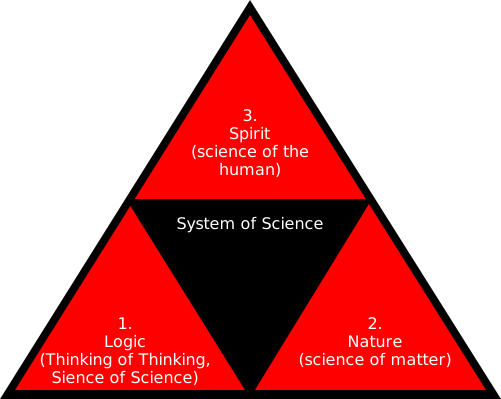
One final preliminary remark, decisive for the whole course of the argument. Hegel’s architecture can be misread in two ways, and both have remained virulent in its reception history. On one side, the misunderstanding that Hegel derives actual history from his concepts — a caricature that exposes him to ridicule. On the other side, the misunderstanding that Hegel’s movement of concepts is irrelevant to the matter itself, a mere play of derivations without cognitive yield. Both miss what Hegel’s logic actually accomplishes. It is not empirical derivation, but neither is it a merely heuristic auxiliary construction. It is a form of order of conceptual necessity: it shows which determinations must emerge from one another when freedom realizes itself institutionally — in what sequence something follows systematically from something else, which transitions are internally necessary, what must already be given, in its presupposition, to the later concept. It does not show what is empirically the case; that is answered by history, economics, the sociology of law. But that property comes before contract, family before civil society, abstract right before ethical life, that civil society structurally produces something it cannot dissolve from within itself — this Hegel’s movement of concepts makes visible with a rigor that is more than a mere heuristic guide. Wherever the term heuristic appears occasionally in what follows, it should be understood in this stronger sense: not empirical derivation, but still a conceptual order that shows what belongs together, and in what relation.
Within this order there is one thread that carries particular weight for the philosophy of right and runs effectively through the whole analysis: teleology — the doctrine of ends, and more precisely, of how an end seeks means for itself and becomes actual through them, within the logic of the concept. It will be developed separately in Part II; here only the remark that the movement of concepts in the philosophy of right cannot be read without it. The free will that sets itself ends and employs means to realize them is teleology as real philosophy — and the immanent possibility that the means turns against the end is the critical point at which Hegel and Marx converge. Both will be developed with concrete examples in II.2; at this point, in the meta-introduction, it must remain a methodological promise.
Teleology, however, is not the master key of the philosophy of right that would subsume all other structures under itself. Hegel’s philosophy of right is equally a logic of recognition — the determination of how free wills recognize one another reciprocally as free, and thereby first make themselves into free subjects in this recognition — and it is a logic of institutions — the determination of how recognition becomes objectified in durable forms. Teleology supplements these two logics; it does not replace them. It makes visible how recognition becomes objectified in means, things, contracts, and institutions — and how these objectifications can become independent of their origin. Whoever follows the teleological line in what follows should therefore not forget that it is a line within a richer architecture.
Where this concept comes from is stated in the Encyclopedia: universal self-consciousness is “the affirmative knowledge of itself in the other self, each of which, as free individuality, has absolute self-subsistence, but […] does not distinguish itself from the other” (§ 436). And there Hegel speaks not of a struggle for recognition, but of a struggle of recognizing — the point is not to attain it, but that recognizing itself first comes into being.
This has consequences for the philosophy of right: contract presupposes persons who recognize one another — and recognition is not an act they perform, but the form in which they are persons at all. See [[hegel-subjektiver-geist]] (optional), on the Phenomenology.