Commentary on the Philosophy of Right, Chapter 2
What Hegel Means by Logic
Hegel’s logic is not formal logic, which deals with rules of inference and forms of reasoning. Nor is it a science of correct thinking that lays down rules for how a subject ought to guide its thoughts. It is thinking about thinking: the systematic self-clarification of what happens in thought as such when it determines an object — whether that object is a thing, a property, a relation, a process, a person, or anything else.
The key point is that thought, in making such determinations, does not proceed arbitrarily but follows certain structures that drive each other forward. Thought first posits something as being (an “is”); it then turns out that this being is always already more than the immediate positing can say — it has an essence lying behind what appears; and finally it emerges that being and essence are only moments of a movement Hegel calls the concept: that which determines itself through its own differences and, in this self-determination, presents the truth of being and essence.
The Logic is therefore divided into three major stages: the doctrine of being, the doctrine of essence, and the doctrine of the concept. These three differ not only in their subject matter but in their form of movement: in being, one determination passes over into its other; in essence, two determinations shine into one another and mutually constitute each other; in the concept, a determination develops out of what was already implicit in it (Small Logic (2026), Ch. 1 through Small Logic (2026), Ch. 23). For the following account of the philosophy of right, the doctrine of the concept is especially relevant — and within it, three stations that are central to understanding human action.
The Doctrine of the Concept: Subjective Concept, Object, Idea
The doctrine of the concept unfolds in three stages: it begins with the subjective concept (the concept of the concept), turns then to the object (the concept of what is not itself concept), and finally arrives at the idea (in which subjective concept and object are grasped as a unity).
The subjective concept is the concept insofar as it unfolds its determinations out of itself — universality, particularity, singularity; judgment and syllogism as the forms in which these determinations are linked together (Small Logic (2026), Ch. 9 through Small Logic (2026), Ch. 11). Here thought displays its own inner articulation without relating to anything external.
The object is the next stage: the concept of what is not itself concept — that is, the logical form of what we think as nature, as objectivity, as what lies outside the concept. It is important to see here that the object in the Logic is not itself nature but the conceptual determination of what we think when we think nature. The Logic remains a self-clarification of thought; it does not itself become natural science.
Within the object, Hegel distinguishes three stages: mechanism, chemism, and teleology (Small Logic (2026), Ch. 13 through Small Logic (2026), Ch. 15). An important methodological point of Hegel’s doctrine is that these three forms recur on three levels — the level of inanimate nature, the level of life, and the level of spirit. Mechanism, chemism, and teleology are thus not successive stages of a single linear development but structural forms that appear simultaneously in every developed system — though concretized differently at each level.
Mechanism is the simplest form: external connections among things that, by their own determination, remain unconnected. What holds them together is not their inner essence but an external constellation. On the level of nature: the solar system as a gravitational system, the collision between two bodies. On the level of life: the mechanical aspects of the organism — bones as levers, blood vessels as tubes. On the level of spirit: bureaucratic structures in which files lie side by side; interchangeable positions in an administration; “human resources” treated like cogs in a machine. In all these cases the characteristic form is indifference: the members remain, in themselves, what they are, without being essentially altered by their relation to one another.
Chemism goes a step further: here the connected things are not indifferent to one another but disposed toward one another. Their own determinations only become what they are through their relation to the other, and their union brings forth something qualitatively new. On the level of nature: hydrogen and oxygen combine to form water, which is neither the one nor the other; sodium and chlorine form table salt with wholly new properties — this is emergence in the strict sense. On the level of life: the affinity between enzyme and substrate; the relation of egg cell and sperm, which brings forth a new being; DNA, in which the complementary bases presuppose one another. On the level of spirit: the relation of question and answer, in which each first brings the other to its full validity; the relation of teacher and student, which transforms both; the genuine resonance between interlocutors, in which the encounter itself is more than the contributions each brought to it. What characterizes chemism is affinity — the mutual disposedness that establishes a constitutive relation. But in chemism it remains contingent whether the union actually comes about: the substances must first meet, the conversation must first begin, the catalyst must first be present.
Teleology sublates this contingency: here mechanism and chemism are brought into an overarching context determined by a purpose. The means are no longer brought together by chance but coordinated toward an end. An important distinction belongs to teleology: that between telos and intentio. Telos is directedness, even without consciousness: the stone “aims” at the ground, the plant “aims” at the light; in living beings this directedness operates without any reflective positing. Intentio is the conscious positing of a purpose, which presupposes consciousness: “I set myself the purpose of building a house.” On the level of nature, only telos is at work (gravity, attractors); on the level of life, telos and unconscious functionality operate together (hunger as a drive toward eating, growth toward maturity); on the level of spirit, intentio is added — the human being sets purposes that he reflects on and revises.
In the sphere of spirit, teleology operates through three moments that bear directly on the philosophy of right. Subjective purpose: the idea not yet realized — “I want to build a house.” Means: the purpose objectifies itself in tools, in materials, in procedures — bricks, tools, workers. Realized purpose: idea and reality come together — the finished house. Hegel makes an important point about the means: “The plough is more honorable than the enjoyments” it makes possible. The means outlasts the individual realized purpose — the ploughshare outlives the harvests it produces; the tool preserves the human purpose beyond any single use. But the means has its own resistance: the hammer has its weight, the wood its grain, the screw its standard. This is the point at which teleology can show its dialectical reverse side: what serves as a means can turn against the purpose — a possibility developed in the Prelude (II.2) as the structure of inversion.
The teleology of the logic of the concept is the form of every intentional action in which a subject applies means to reality for the sake of a purpose. But here this purpose is still an external purpose: it does not arise from the material itself but is imposed on it by the subject. Only the idea brings forth the inner purpose — the purpose that is not imposed from outside but arises from the material itself.
The idea, finally, is the next stage, in which subjective concept and object are grasped as a unity. Here the purpose becomes internal: the idea is not an external purpose forced upon alien material but a context in which the material pursues its own determination as its own purpose.
The Idea: Life, Cognition and Volition, the Absolute Idea
The idea itself also has three stages.
The first is life. A living organism is an inner purpose in the strict sense: its organs are self-explanatory; their function is not imposed from outside but is proper to the living thing itself. The lung exists to breathe air, the heart to pump blood, the stomach to digest food — and these purposes are not set by an external designer but by the life of the organism itself, which has its own reproduction as its purpose.
Hegel’s determination of life contains three structural moments that will bear on our analysis. First, self-differentiation: the living thing articulates itself internally into distinct parts that relate to one another and together form an organism. Second, self-preservation in confrontation with the environment: the living thing takes in from its environment what it needs, expels what it does not need, and asserts itself against threats — all without ceasing to be itself. Third, self-transcendence: the living thing reproduces itself beyond itself, in the next generation, and thereby crosses the boundary from the individual organism to the species. These three moments — self-differentiation, self-preservation, self-transcendence — are the basic model of the idea as such; everything further can be understood as a generalization of what becomes paradigmatically visible in life.
The second stage is cognition and volition. Here something is added to the structures of life that in mere life remains only implicit: the conscious positing of purposes. The living thing has its purpose (to reproduce itself) within it, without knowing it; cognition perceives what corresponds to the concept and what does not, and volition alters reality accordingly. Cognition and volition are thus the uptake of the structures of life into a reflected form: self-differentiation becomes the conscious articulation of tasks and functions, self-preservation becomes the conscious engagement with environment and conditions, self-transcendence becomes the conscious formation of the next generation and the conscious transformation of one’s own forms of life.
The third stage is the absolute idea. It is not an additional sphere alongside life and cognition-volition but the self-knowledge of method: here thought becomes conscious of its own forms of movement, which had already been at work in the preceding stages — self-relation, differentiation, the sublation of one-sidedness, recognition of one’s own limits. The absolute idea contributes nothing substantially new in content; it is the reflection on the form in which content as such becomes accessible.
“Absolute” here does not mean “all-powerful” or “perfect,” but ab-solutus — not bounded by anything else. This absoluteness is itself limited: it holds only within the sphere of pure logic. The absolute idea fully knows what thinking is; but it does not yet know the other of thinking — nature, history, concrete experience. These must be examined in the philosophy of realization, whose first part is the philosophy of nature and whose second part is the philosophy of spirit (with subjective, objective, and absolute spirit).
The structure of the absolute idea as method is circular, but not static: beginning (immediate unity — life), development through inner deficiencies (reflected division — cognition and volition), result as an enriched unity (comprehended method — absolute idea). Every return to the beginning is enriched by the process it has passed through. This is Hegel’s “true infinity” — a process that does not advance endlessly into ever new content, but returns to itself by grasping itself as process.
Logic, Nature, Spirit — an Important Clarification
A clarification is called for here, one that avoids a common misunderstanding. The object and the idea in the Logic are not themselves nature and spirit. They are the conceptual form of how we think nature and spirit when we grasp them as object or as idea. The Logic remains a self-clarification of thought; it does not itself step outside itself.
The common formula that nature is “the other of the logic” or “the other of the idea” is therefore not quite precise. The idea, as logical form, is already contained within nature — nature follows structures that we can reconstruct in thought, it has its own mechanisms and chemisms, and in living beings it unfolds a teleological structure that has the form of the idea. But nature knows nothing of this. It is idea, but it is not for itself as idea. The stone falls without knowing that it falls; the animal reproduces itself without knowing that it reproduces itself.
Only in life does the idea first take on a form that is more than mere logical structure — it is there as a self-preserving, self-transcending nexus that has its purpose within itself. But even here the living thing does not know its purpose; it only enacts it. Only in the human spirit, which has emerged from nature (more precisely, from life), does the idea appear in its reflected form: as cognition, which grasps the structures, and as volition, which reshapes them according to recognized purposes.
The human being is therefore determined in a twofold sense. On the one hand, he is part of nature — a living being with all the structures of life. On the other hand, his essence is logic itself: he thinks, and in his thinking he follows the structures that the Logic has uncovered. His cognition and his volition are the human form of what the Logic distinguishes as the two moments of the idea.
For our analysis of human action, social institutions, and political form, three categories of the Logic are therefore especially relevant: teleology (the form of intentional action as such), life (the structures in which social reproduction takes place), and cognition and volition (the reflected form in which human beings consciously shape their forms of life). These three categories will accompany us throughout the entire philosophy of right.
B. Logic in the Philosophy of Right — Structural Analogies
Why the Threefold Division of Abstract Right / Morality / Ethical Life Is Not Arbitrary
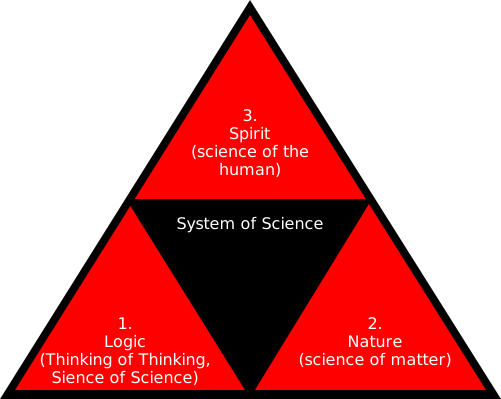
Hegel’s philosophy of right is divided into abstract right, morality, and ethical life. This division is not arbitrary; it follows a structural analogy to the doctrine of the concept. Whoever keeps the logic in view can read the architecture of the philosophy of right for what it is: a philosophy of the real that rediscovers the structures of the logic of the concept within the concrete material of human forms of life.
The analogy is neither accidental nor externally imposed. If the human being is a living being whose essence is logic, then the forms in which he acts consciously must display the structures of logic — not because some designer forces them upon him, but because he is a thinking being, and thinking follows the structures that logic has uncovered.
Abstract Right — Analogous to the Subjective Concept
Abstract right develops the determinations of the person, of property, of contract, and of the response to wrong. These determinations are initially taken in themselves, without regard to the concrete situation in which persons actually stand, without regard to their moral convictions or the institutions in which they live. Here the person is a pure subject of right, property is pure power of disposal, contract is pure mutual recognition as equals.
This treatment “in itself” corresponds structurally to the subjective concept in the logic: it concerns the inner determinations that belong to every person, every piece of property, every contract as a concept, without yet thematizing the relation to an external actuality, a concrete object, a historical situation.
Morality — The Turn Inward
In morality, the will turns inward. What in abstract right was determined as a relation of the will to external things is grasped in morality as a relation of the will to itself. Purpose, intention, the good, conscience — these are the determinations of the will insofar as it relates to its own inwardness and seeks there the determination of the good.
Morality is, in this respect, structurally analogous to the theoretical idea in the logic: it is the cognition that asks after the standard of the good without being able, on its own, to reach the actuality in which the good would be realized.
Ethical Life — Cognition and Willing Together, as Second Nature
Ethical life gathers back together, in a higher form, what had fallen apart in abstract right and morality. It is the sphere in which cognition of the good and willing of the good interlock — not as the act of an isolated subject, but as the form of life of a community whose institutions already embody the good and in which individuals do the good by participating in these institutions.
Ethical life is, in this respect, structurally analogous to the idea in its developed form, in which cognition and willing are grasped as a unity. It is what Hegel calls “second nature”: forms of life that are not given naturally, as biological life is, but have grown through history, and in which subjects find themselves again because they see their own determinations realized within them. Family, civil society, and the state are the three stages in which this second nature articulates itself in the modern world.
The structures of life — self-differentiation, self-preservation, self-transcendence — recur in ethical life, but now as conscious structures of a form of life shaped by cognition and willing. A family is not merely a biological unit of reproduction but a conscious form of self-transcendence in which the generations relate to one another. Civil society is not merely economic self-preservation but a conscious form of the mutual satisfaction of needs. A state is not merely political self-differentiation but a conscious form of political universality.
What This Structural Analogy Achieves — and What It Does Not
The structural analogy is more than a merely external parallel and less than a logical derivation. It is more than a mere parallel because it shows that the architecture of the philosophy of right has its sense: the threefold division into abstract right, morality, and ethical life follows the inner movement of the concept, in which determinations are first taken in themselves, then turned inward, and finally grasped as a unity.
It is less than a logical derivation because the logic alone cannot determine what concrete content abstract right, morality, and ethical life have — which order of property, which moral convictions, which institutions. This content comes from historical actuality and must be examined in its concreteness.
From this follows a methodological rule of thumb for the presentation that follows. Where we develop the individual determinations — person, property, contract, purpose, intention, conscience, family, civil society, state — we will keep the structural analogy to the logic present in the background, without constantly invoking it. At decisive transitions — from abstract right to morality, from morality to ethical life, and within ethical life from the family to civil society and to the state — we will refer explicitly to the logical structure, because at these points it makes visible the inner necessity of the movement.