Commentary on the Philosophy of Right, Chapter 10
Why the Threefold Division of Right / Morality / Ethical Life Is Not Arbitrary
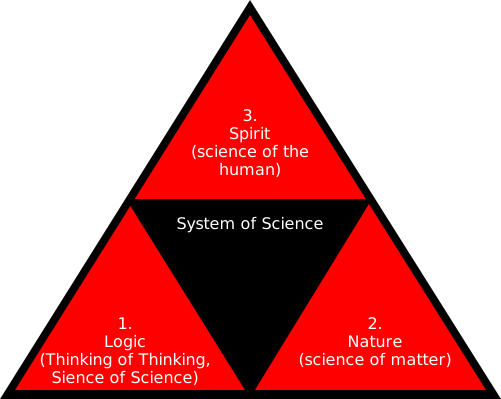
Hegel’s Philosophy of Right is organized into abstract right, morality, and ethical life. This division is not arbitrary; it follows a structural analogy to the doctrine of the concept. Anyone who keeps the logic in mind can read the architecture of the Philosophy of Right for what it is: a real philosophy that rediscovers the structures of the logic of the concept within the concrete material of human forms of life.
The analogy is neither accidental nor externally imposed. If the human being is a living being whose essence is logic, then the forms in which he acts consciously must display the structures of logic — not because some designer forces them upon him, but because he is a thinking being, and thinking follows the structures that logic has uncovered.
Abstract Right — Analogous to the Subjective Concept
Abstract right develops the determinations of the person, of property, of contract, and of the response to wrong. These determinations are initially taken for themselves, without regard to the concrete situation in which persons actually stand, without regard to their moral convictions or the institutions in which they live. Here the person is a pure subject of right, property is pure power of disposal, contract is pure mutual recognition as equals.
This treatment “for itself” corresponds structurally to the subjective concept in the logic: it concerns the inner determinations belonging to every person, every piece of property, every contract as concept, without yet thematizing the relation to an external actuality, a concrete object, or a historical situation.
Morality — the Turn Inward
In morality, the will turns inward. What in abstract right was determined as the relation of the will to external things is grasped in morality as the relation of the will to itself. Purpose, intention, the good, conscience — these are the determinations of the will insofar as it relates to its own inwardness and seeks there the determination of the good.
Hegel himself defines morality not as a stage of the Idea, but as the Idea in its diremption or particular existence (Philosophy of Right §33). It is the particular moment standing between the immediate, abstract will of right and ethical life as the “unity and truth of these two abstract moments” (ibid.). Herein lies its limit: it asks after the standard of the good without being able, on its own, to reach the actuality in which the good would be realized.
Ethical Life — Knowing and Willing Together, as Second Nature
Ethical life gathers back together, in a higher form, what had fallen apart in abstract right and morality. It is the sphere in which the knowing of the good and the willing of the good interlock — not as the act of an isolated subject, but as the form of life of a community whose institutions already embody the good, and in which individuals do the good by participating in these institutions.
Ethical life is, in this sense, the unity of both preceding moments — Hegel defines it as “the Idea of freedom, as the living good” (Philosophy of Right §142), in which the good is no longer a mere ought but carries knowing, willing, and acting all at once. It is what Hegel calls “second nature” (Philosophy of Right §151; cf. §4): forms of life that are not naturally given like biological life, but have grown through history, and in which subjects find themselves again because they see their own determinations realized within them. Family, civil society, and the state are the three stages in which this second nature articulates itself in the modern world.
The structures of life — self-differentiation, self-preservation, self-sublation — recur in ethical life, but now as the conscious structures of a form of life shaped by knowing and willing. A family is not merely a biological unit of reproduction but a conscious form of self-sublation, in which the generations relate to one another. Civil society is not merely economic self-preservation but a conscious form of the mutual satisfaction of needs. A state is not merely political self-differentiation but a conscious form of political universality.
What This Structural Analogy Accomplishes — and What It Does Not
The structural analogy is more than a mere external parallel and less than a logical derivation. It is more than a bare parallel, because it shows that the architecture of the Philosophy of Right has its own sense: the threefold division into abstract right, morality, and ethical life follows the inner movement of the concept, in which determinations are first taken for themselves, then turned inward, and finally grasped as a unity.
It is less than a logical derivation, because from logic alone one cannot deduce what concrete content abstract right, morality, and ethical life have — what order of property, what moral convictions, what institutions. These contents come from historical actuality and must be examined in their concreteness.
From this follows a methodological rule of thumb for the presentation to come. Where we develop the individual determinations — person, property, contract, purpose, intention, conscience, family, civil society, state — we will keep the structural analogy to the logic present in the background, without constantly invoking it. At decisive transitions — from abstract right to morality, from morality to ethical life, and within ethical life from the family to civil society and to the state — we will explicitly point to the logical structure, because at these junctures it makes visible the inner necessity of the movement.