Commentary on the Philosophy of Right, Chapter 1
Hegel’s Program
The philosophy of right is neither jurisprudence nor sociology. It undertakes something else: it shows how the free will must give itself its own world in order to be truly free. A will that is free only “in itself,” without giving itself shape in the world, is not actually free but merely possible. Freedom is not a state of the interior but a relation — and a relation requires an Other in which it realizes itself.
Hegel captured this in the 1825 lectures on logic in a sentence that holds for the whole philosophy of right: to be free is “to be with oneself, but not in an abstract way, rather to be with oneself in the content of the determination, to be with oneself in the particularity, the determinateness, insofar as the content corresponds to what is one’s own.”[1] Not the absence of determination, then, but the recognition of one’s own determination — and that is what a right accomplishes, when it is any good.
This is the driving movement of the whole work: the will posits itself in a thing (property), in another will (contract), in its own interior (morality), and finally in enduring communal forms (ethical life). Each of these stages is a determinate concept of freedom, and none is the last, until the will fully rediscovers itself in the world.
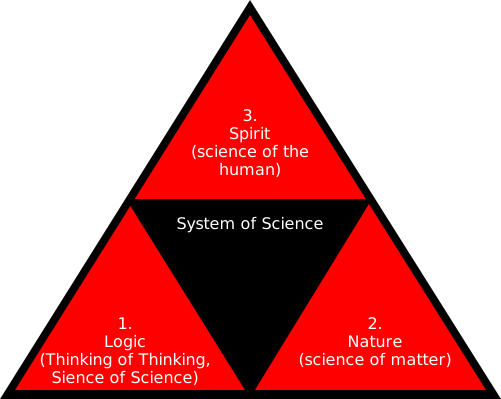
Within Hegel’s system, objective spirit stands between subjective spirit (individual consciousness) and absolute spirit (art, religion, philosophy as humanity’s self-knowledge). It is the sphere in which the interior gives itself an enduring exterior — right, morality, institutions — and thereby ceases to be merely subjective.
Hegel, Lectures on the Science of Logic, Kehler transcript, 1825 lecture course: GW 23.1, p. 381. ↩︎