Commentary on Subjective Spirit, Chapter 36
1. Leib und Seele [Body and Soul] (1837, 2nd ed. 1849)
The book treats separately a relation that in Hegel is embedded within the Anthropology — and the second edition of 1849 falls in the same period as Schaller’s work on the same question.
2. Grundriss der Psychologie [Outline of Psychology] (1840): death
The preface contains an argument concerning the architecture that is as terse as it is sharp. To the objection “that the Anthropology need not consider the death of the human being, since this is a subject for the philosophy of nature,” he answers:
“For as long as it is not maintained that man, like the animal, does not die but perishes, I must regard that objection as thoughtless.”[1]
The human being dies, the animal perishes — and if the difference is real, then death belongs to the doctrine of spirit, not to that of nature.
This is more than a witticism. It names what distinguishes the Anthropology from the philosophy of nature: not the object — both treat the body — but the relation in which one stands to it. An animal has no relation to its death; a human being has one, and this makes death a subject of spirit.
And it shows how a student works who has understood: Erdmann extends Hegel’s Anthropology with a topic missing there — using an argument drawn from Hegel’s own distinction.
3. Grundriss der Psychologie: the later editions (1842, 1847)
The Grundriss is explicitly written “for lectures” — a hundred-page compendium in which “much has been left to oral presentation.” The two subsequent editions show what Erdmann continued to work on.
The second edition (1842) names two aims, and the first concerns exactly what occupies this volume throughout:
“First, I wanted to remedy the deficiency, where in the transitions from one point to another, owing to clumsy and indefinite presentation, the necessity was not properly grasped.”
His example is the transition from nature to the concept of spirit — that is, § 381. The paragraph had already contained, in the first version, “what I still hold to be correct now,” but expressed in such a way “that the proper grounding must be missed.”
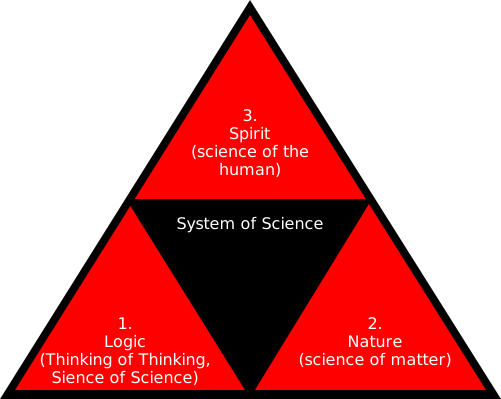
The second aim concerns orientation within the whole: the listener should know “what place within the entire system of science the point in question occupies.” Hence the second edition contains more references to the domain of nature and more comparisons.
This is a student at work on the architecture — and it shows that the transitions were regarded as the difficult passages by contemporaries as well.
4. The sketch in the Vorlesungen über akademisches Leben [Lectures on Academic Life] (1858)
The same lecture series from which the mini-philosophy of nature comes also contains a chapter on spirit — and it offers the briefest version of the whole that any Hegelian has produced.
The difference between nature and spirit is stated in a pair of sentences: both are reason, but “there in the form of being-outside- itself, here as conscious, there as a rigid, unchangeable order, here as a steady process and progress.”
And from this the mirroring he himself draws: “Just as it is a contradiction in itself to posit progress in the laws of nature, so it is here to assume standstill. Non progredi est regredi” [Not to advance is to retreat].[2]
Whoever does not advance goes backward — that is the determination of spirit, in four Latin words, and it is the exact counterpart to the unchangeability of natural law.
Freedom is the measure, and Erdmann puts it so that it becomes testable: “Freedom constitutes the essence of spirit to such a degree that it is entirely equivalent whether we say: spirit stands higher, or whether we say: it has attained greater freedom.”
Two sentences that mean the same thing — thereby the whole graduated order of this part is bound to a single criterion.
And the entire psychology is stated in one sentence:
“Speculative psychology will have to show how it lies in the concept of spirit to tear itself loose from the bonds of nature, which first fetter it, further to have this same nature confronting it as an opposite (not-I), a limitation whose resistance is partly experienced, partly broken through by the I, but finally to enter into a relation to it which, as free surrender, stands higher both than being-bound and than being-free.”
Being-bound — being-free — free surrender. This is Anthropology, Phenomenology, and Psychology in three words — and the third determination is more precise than Hegel’s own: freedom does not consist in being free of nature, but in a relation that has left both behind it.
In passing, he answers Exner, seven years later and without polemic. Empirical psychology should not be disdained: it “could only have benefited from the fact that, whereas it had earlier been more an anatomy of subjective spirit, it has gradually taken the procedure of physiology and the theory of generation as its model and attempts, from the very simplest and most primitive expressions of spirit, to develop all others genetically.”
And the two paths do not come into conflict, “because they want entirely different things”: the historian describes how the process unfolds; the ethicist or philosopher of history asks “which corresponds more to the concept of freedom, and thus has higher value?”
He explains the mutual hostilities by a misunderstanding: they have “mostly had their ground in the fact that one attributes to the other intentions it does not have at all, and then reproaches it for omitting what it never intended to do in the first place.”
This is the answer to Exner in a single sentence — and it appears in a book about study, not in a polemical tract.
5. The lectures (1850–1869)
Besides the textbooks, Erdmann published a series of popular lectures that elaborate individual themes of subjective spirit: Über Lachen und Weinen [On Laughing and Weeping] (1850), Über die Langeweile [On Boredom] (1852), Über Gewohnheiten und Angewohnheiten [On Habits and Acquired Skills] (1858), Das Träumen [Dreaming] (1861), Über Schwärmerei und Begeisterung [On Enthusiasm and Rapture] (1863), Über Dummheit [On Stupidity] (1866), Vom Vergessen [On Forgetting] (1869).
The lecture on habit contains a distinction that Hegel does not have — and it resolves a difficulty embedded in § 410.
Habit [Gewohnheit] Erdmann determines as the habit of having: “where certain passive states, e.g., sensations, become a need, such that their absence is unpleasantly noticeable, tormenting.” And from this the inference:
“But if this inability to let go is the essence of habits, then it is actually not correct to say that we have them, as though we were their possessors, but rather they have us and we are possessed by them […] which is why, the more habits we have, the more dependent and weaker we are.”[3]
Acquired skill [Angewohnheit], by contrast, is a habit of doing, and it makes one “not dependent, but master and free.” Erdmann’s examples are artists: a singer’s trills, the skill one calls virtuosity.
“The more varied the doing that a person has made habitual, the wider the domain in which he acts and moves freely, and the more, too, is the goal of education attained.”
And the assignment that follows from this: “Accordingly it seems that habits ought to be treated in the chapter on the diseases, while acquired skills ought to be treated in that on the remedies of the soul.”
This is exactly the doubleness that this volume has described in Hegel as insanity and habit — the same operation with two outcomes. Erdmann gives it two names and two places in the system.
The lecture on laughing and weeping (1850) takes up what is only named in Hegel’s addition to § 401 — and develops it genetically in the child.
Erdmann distinguishes three stages: the first laughter arising from mere pleasure; smiling-at [Zulachen], which becomes possible only once the child can picture the parents’ features — “it laughs at its parents, it laughs out of love”; and laughing-at [Belachen], which comes still later, “when the circle of its representations has expanded so far that certain combinations of them strike it as surprising.”
And then he performs an experiment — noting that the child still lives “in the happy time when jokes are cheap”:
“So we make a gesture as if we wanted to strike it, but the blow turns into a caress; or we act as if we wanted to take away its treat, but instead of reaching for it, we crouch down, hold the arm bent, so that we cannot reach it, and thus our effort is in vain.”
What is being laughed at? Erdmann’s answer is the formula he claims for the whole:
“Evidently at the mismatch, contrary to purpose, between what one does and what one is trying to achieve — the means one employs for it, and what results in the end.”[4]
And, following Goethe, he calls it a primal phenomenon — the child’s first laughter contains the general formula for everything that also makes adults laugh.
The systematic place is remarkable. The inversion of means and end belongs in Hegel to teleology, that is, to Logic. Erdmann finds it again in a bodily expression — and thereby shows what subjective spirit accomplishes: it is the place where logical forms appear as enactments.
The lecture on dreaming (1861) elaborates what in § 406 stands as the coexistence of two personalities — and it defines the dream in terms of which world its images belong to:
One calls the images of excited fantasy fantastic, spectral, “and one has a right to do so, for because they do not fit the laws of the world in which they appear, they truly resemble spirits from another.”[5]
A dream image is not false, but in the wrong place. It obeys laws — only the laws of a world other than the one in which it appears.
And Erdmann shows that the same thing happens while awake. The “castles in the air that build themselves before our eyes,” or the melody that sings to us when, “worn out from reading a folio,” we “let fantasy off the reins” — these are the same guests from the other world, only traveling in the reverse direction.
“There, images, sounds, sensations of touch, and […] taste and smell followed us into a world to which they do not properly belong, and remind us of their home; here, in turn, a message comes from the land of inwardness and claims us so entirely that we no longer notice the smell of the dying work-lamp […]”
The difference is not sleep versus waking, but which world currently holds sway — and this is exactly what Hegel means when he says the two personalities can “be side by side and alternate with one another” without this being illness.
On Boredom (1852) defines a state that Hegel does not treat separately under practical feeling — and the definition is as terse as it is vivid: boredom is “attention to the mere passage of time.”
His image for this carries the whole explanation:
“All objects are carried past us by the stream of time like floating flowers on a forest brook […] The more that what happens attracts our attention […] the less we heed the stream itself — just as, when the colorful flowers crowd together there, the floating island of blossoms hides the water.”[6]
And the boy at the brook: he complains that the brook “brings nothing” anymore, when, instead of the expected flowers, the brook offers him only itself, that is, the mass of water.
Boredom, then, is not a lack of content but the becoming-visible of time — and this explains why it torments even though nothing is missing.
On Enthusiasm and Rapture (1863) contains a determination of originality that belongs to the singularization of the soul (§ 395):
“Without the act of grasping oneself as I, spirit would not exist at all, and this act is the most original of all, because no one ever imitates or copies another in it. Every spiritual being shows at least this much originality: to be this unrepeatable I.”
And why we nevertheless do not credit everyone with it, Erdmann explains by an analogy from measurement: just as one sets a zero point for temperature, even though melting ice is warmer than melting mercury, so, “in estimating minds, we draw a line, taking a certain degree of originality as the minimum which precisely for that reason does not count.”
From this a side finding concerning address: because the spiritual being “demands for itself its own name,” it regards “designation by the species-name, in the address: human being! as an insult.”
Rightly so — Erdmann adds — “though I would not advise bringing a lawsuit for insult: a retraction from the offender could make matters even worse.”
The lecture On Forgetting (1869) shifts a systematic location — with the same move as with death thirty years earlier.
His finding comes from linguistic usage: one compares the one “who forgets nothing and the one who forgets everything” not with someone who became rich or poor without any doing of his own, but rather “the former with someone who is thrifty and keeps things together, the latter with someone who squanders and wastes.”
Forgetting, then, is an activity, not something one merely undergoes:
“linguistic usage has thus given us the instructive hint that forgetting, which most people regard only as a passive undergoing, as something happening in us, must be placed among the activities and occupations of spirit.”[7]
And from this the shift: it should be treated “not so much in the part of the doctrine of spirit […] that considers passive states and borders on the doctrine of nature, but rather in the part that is neighbor to ethics.”
Because a second question then arises: besides “when and where does it take place?” also “whether it may and should take place?”
This is the same procedure as with death — a topic migrates from the side of nature to the side of spirit because the human being relates himself to it. Erdmann does not examine what Hegel said, but where something belongs when one applies Hegel’s own criterion.
The lecture on stupidity (1866) begins with a methodological problem that in Hegel belongs to physiognomy: stupidity has the effect of irritation and laughter, but these effects “conceal the essence of their cause rather than reveal it” — for “that something is irritating or ridiculous does not tell us what the object is and how it is constituted, but rather how its observer is constituted.”
The same objection as against physiognomy: what one person perceives in another says, first of all, something about himself.
6. The Psychologische Briefe [Psychological Letters] (1852)
Erdmann’s most successful book does not belong among the specialist treatments. The Psychologische Briefe are written for a popular audience, went through five editions, and were widely read in the second half of the century.
What happens there can be shown on a single page. The first letter treats what the Encyclopedia states in a single paragraph as “planetary life” — the dependence of mood on climate, seasons, and times of day. In Erdmann this becomes an essay:
“Not only is the child more fearful at night than by day, but Bonaparte claimed to have found among his generals only two who had courage two hours before sunrise. Who has not noticed in himself that spring brings on these yearning, melancholy thoughts of travel, in which we, if we cannot migrate with the swans, would at least like to lament with Mignon.”
This is not a renunciation of the subject matter but its illustration. The determination remains the same — the human being shares in the general planetary life — only that it is shown through examples everyone knows.
And this explains its impact. A book that turns Hegel’s driest paragraph into a readable letter could be read where the Encyclopedia was not.
Johann Eduard Erdmann, Grundriss der Psychologie. Für Vorlesungen, Leipzig 1840, Preface, pp. V f. Cf. idem, Leib und Seele. Nach ihrem Begriff und ihrem Verhältniß zu einander, Halle 1837. ↩︎
Johann Eduard Erdmann, Vorlesungen über Akademisches Leben und Studium, Leipzig 1858, seventeenth lecture (pp. 304–313). ↩︎
Johann Eduard Erdmann, Über Gewohnheiten und Angewohnheiten, Berlin 1858, pp. 6 and 10. The lecture on stupidity: Ueber Dummheit, delivered at the Scientific Society in Berlin on March 24, 1866. ↩︎
Johann Eduard Erdmann, Ueber Lachen und Weinen, Berlin 1850, p. 10. ↩︎
Johann Eduard Erdmann, Das Träumen, Berlin 1861, p. 16. ↩︎
Johann Eduard Erdmann, Ueber die Langeweile, Berlin 1852, p. 10; Ueber Schwärmerei und Begeisterung, Berlin 1863, p. 9. ↩︎
Johann Eduard Erdmann, Vom Vergessen, Berlin 1869, p. 8. ↩︎