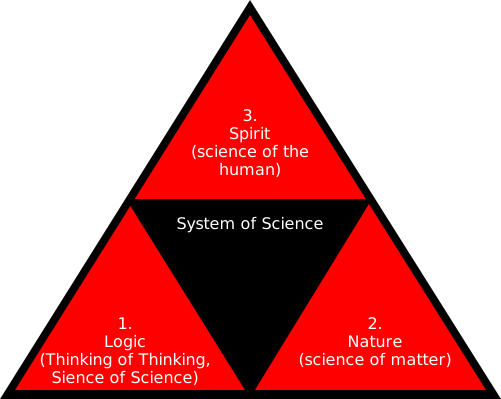
Kommentar zum subjektiven Geist, Chapter 11
The First Pass: Universal, Particular, Singular
§ 392: “Spirit lives 1. in its substance, the natural soul, sharing in the universal planetary life, the difference of climates, the alternation of the seasons, the times of day, and the like.”
That is the universal — what is common to everything living on this planet because it lives on this planet.
§ 393: “The universal planetary life of nature-spirit 2. particularizes itself into the concrete differences of the earth and falls apart into the particular nature-spirits.”
That is particularization — the same universal, but divided by continents. And § 394 carries it further “into the particularities that one can call local spirits.”
§ 395: “The soul is 3. individuated into an individual subject.”
That is singularity — as temperament, talent, character. And with the qualification Hegel immediately adds: “This subjectivity comes into consideration here, however, only as individuation of natural determinateness.”
So the sequence is A–B–E, explicitly enumerated. Whoever reads the doctrine of races as Hegel’s anthropology has mistaken one position in a sequence for the matter itself — and specifically the middle one, which by concept is that which gets sublated. [KF]
The Second Pass: The Same Figure, One Stage Higher
With § 396 the series begins again from the start, now at the individuated individual. And again Hegel numbers.
§ 396: The differences are “changes in it, in the one subject that persists in them, and as developmental moments of that subject” — the ages of life. The individual in its mere course.
The addition contains a pedagogical position that follows from the determination and still meets with objection today. The boy strives “to rise to the immediacy to which he still relates” — and therefore the material should not be presented to him as play, but in its own seriousness:
“The playful education, which offers the serious to the child as play and demands of the educator that he condescend to the childish view of the pupil instead of raising him up to the seriousness of the matter, is therefore to be treated as thoroughly perverse.”
The justification lies in what the child wants: it strives “to become a grown-up” — and whoever gives it seriousness as play takes from it exactly what it is aiming for. Hegel adds that such an education can “produce in the boy contempt for everything that is offered to him.”
Whether this holds is an empirical question — and it remains open to this day. What holds in it is the thought: children want not to be left where they are but led forward. [KF]
§ 397: “2. The moment of the real opposition of the individual against itself, such that it seeks and finds itself in another individual — the relation of the sexes.”
§ 398: “3. The distinguishing of individuality as being-for-itself against itself as merely being, as immediate judgment, is the awakening of the soul.”
The same figure: immediate course — opposition, in which the individual steps out of itself — return, in which it distinguishes itself from itself.
But this order is not the original one. Stederoth’s comparison of the versions shows an inversion Hegel does not comment on:
| Early versions | From 1825 on |
|---|---|
| 1. Awakening | 1. Ages of life |
| 2. Particular states / relation of the sexes | 2. Relation of the sexes |
| 3. Ages of life | 3. Awakening |
The outer members have swapped places. What stood first — awakening — now stands last; what stood last now stands first.[1]
And Hegel says nothing about it. Stederoth’s formulation captures what shows up repeatedly with Hegel: he “shrouds his change once again in silence.”
For reading, this means the same as for the sequence of theoretical spirit: the order carries weight, but it is not immovable, and where it changes, the reason must be inferred from the matter itself.
A reason can be given. In the early version, the series begins with awakening — that is, with what first establishes the difference between inner and outer. From 1825 on, it begins with the ages of life, that is, with mere course, and awakening stands at the end, immediately before sensation.
This is the better order if the section is meant to run toward consciousness: awakening is then not the beginning of the changes but their culmination — the point at which mere course becomes a relation. [KF]
And Erdmann’s transcript contains a warning here that is missing from the printed text — against the question that arises immediately upon reading:
“Here one must deny oneself questions such as: if the physical constitution is thus, what is the spiritual like. One must not separate these such that the physical becomes a cause; rather, in the soul this unity is present.”[2]
The question of causation is the wrong one at this point. Whoever asks how the corporeal acts upon the spiritual has already separated the two — and in the Anthropology they are not separated.
In the 1825 lecture course Hegel develops this in detail, and does so by first showing where the ordinary view fails.
He names three possible positions: “First, spirit itself is matter, the view of materialism or naturalism. Second, the relation of spiritualism or idealism; third, the relation of our ordinary representation, dualism.”[3]
And he does not begin with his own position but with the ordinary one — and shows its contradiction:
“In that representation, both are presupposed as independent, I and matter, which offers resistance. Independence requires that neither asserts itself in the other. But precisely that influence of one upon the other means nothing other than that one asserts itself in the other, and is thus altogether opposed to the independence of both.”
Dualism sublates itself. It posits both as independent and must at the same time explain how one acts on the other — which only works if they are not independent.
And Hegel does not eliminate the question but places it: “This question must not merely be eliminated, for this standpoint is necessary, but one must know that this standpoint is not an ultimate, absolute one. This standpoint of the opposition, the soul creates for itself.”
The separation is an achievement of consciousness — and therefore it can neither be denied nor taken as final. This is the same figure as with the essence “behind” appearance: the shine is real, but it is shine. [KF] The soul is the unity, not a link in a causal chain.
This is the same rejection as for the concept of soul in general, here applied to the natural determinations: whoever asks about the effect of climate on character is looking for a causality where a constitution is being described. [KF] Only here the return produces something new: the awakening, and with it sensation (§§ 399–402).
What the Lecture Courses Contribute
The lecture courses treat the same material under the numbering of the first edition — the ages of life stand there as § 317, sleeping and waking as § 316, individuation as § 314.[4]
On the ages of life stands a reason the printed text does not give — why there are ages of life at all:
“The natural individual stands in relation to its genus. This relation is a process, and falls into time, and produces differences in the individual itself. The genus realizes itself in the individual. This is the process of the living, and a contradiction, for the genus can present itself only in thought, and therefore, on account of this contradiction, the life of the individual carries death within itself.”
The ages of life are the process in which the genus asserts itself in the individual — and because the genus can never fully present itself in a single individual, this process ends with that individual’s death. This is the determination from the philosophy of nature, applied here to the human being.
On awakening, the lecture course gives the distinction that carries the step: “Sleep is, in relation to the individual soul, this undifferentiated being within itself; waking is being-for-itself against immediacy.”
And the direction that follows from it: the activity of spirit is “to return to this totality of universal ideality, but not to this unconscious totality, but to the one that spirit knows.”
Sleep is not an absence but a unity without differentiation — and the goal is the same unity, but known. [KF]
On individuation (§ 314 of the first edition), Hegel explicitly names the series: “The last particularization is that of the individual, who belongs first to a race, then to a people, and then is an individual.”
This once again confirms, in his own words, the order of the first pass — race, people, individual, with the individual as the last term, not as a case of the first.
What Follows From This for Reading
The content is bound to its time; the order is not. That Hegel treats climate zones and temperaments depends on the anthropology of his time; that he orders them as universal, particular, and singular depends on the logic.
And the order determines what to make of the content. A natural determinateness that stands at second position is, by concept, that which is particularized and overcome. Whoever makes it the standard has halted the sequence where it in fact continues.
This is not an argument lent to Hegel — it is the form of his own text. [KF]
On the natural determinations: This section contains Hegel’s statements about human races and national characters, and reading here regularly catches fire. The only question is what one is actually testing.
Hegel says it himself, in the same section. The addition to § 393, which treats racial difference, contains the sentence that decides the question:
“But from descent no ground can be drawn for the entitlement or non-entitlement of human beings to freedom and to rule. The human being is rational in itself; therein lies the possibility of the equality of right for all human beings — the nullity of a rigid distinction between entitled and rightless kinds of human beings.”
And he says what this is directed against: importance had been attached to the question of descent “because one believed one could explain, and indeed hoped to prove, by assuming a descent from several pairs, the spiritual superiority of one kind of human being over another — that human beings differ by nature in their spiritual capacities to such a degree that some might be dominated like animals.”
This is the polygenism debate of his time — the same debate used in the United States to justify slavery. Hegel rejects it, and not empirically but in principle: the historical question does not concern philosophy at all, because nothing follows from descent in any case.[5]
The logical placement confirms this. Hegel treats the natural determinations as what spirit has in itself before it relates to itself — that is, as that which gets overcome and is therefore no standard. The entire course of the Anthropology consists in the soul detaching itself from its natural determinations; were natural determinateness the standard, the section would have no forward motion.
He draws the same consequence in his political philosophy, where he grounds equal treatment in the concept of the person — explicitly also for the Jews, against the majority opinion of his time. And in world history, where the course tends toward the freedom of all, not toward the superiority of one people.
How, then, does he arrive at individual statements that stand opposed to this? Three reasons can be distinguished.
First, an anachronism on our side. Talk of races and peoples was considerably less loaded around 1820 than it is today; whoever applies the judgments and taboos of the twentieth century as a yardstick reads into the text something that does not belong to it.
Second, a rescue of the phenomena without regard for propriety. Hegel reports what is recounted and orders it — precisely because he knows it makes no difference to the worth of the human being. Where that is settled, one need not soften the description. The caution we demand today at this point presupposes that the basic question is contested; for him, it is not.
Third, too much trust in empirical reports. His sources are accounts from explorers, missionaries, and travelers — the same kind of source material as in the philosophy of nature, only far worse. This is the same type of error as with caloric: he takes the state of the reports for the state of the matter.
What follows for reading: the individual statements are to be tested like any other empirical claim in this volume — and they fall where their sources fell. The logical placement is untouched by this, and it is the opposite of what is imputed to him.
And the usual stopgap solution does not hold. Textbooks routinely say that Hegel was a great philosopher but a racist; that his dialectic is an admirable tool of thought, but its results about Africa are unacceptable. Peter-Anton von Arnim has asked what this separation is worth: can method be separated from result in philosophy? Hegel himself would have vehemently resisted such an artificial division.
The alternative is not to acquit him but to look at what he actually wrote — and then § 393 contains the opposite of what the separation assumes. Whoever wants to save the method by sacrificing the results has not examined the results. [KF]
Stederoth, op. cit., pp. 160 ff. and Table 2. The columns represent the Encyclopedia of 1817 (E1), the transcripts by Hotho 1822 and Griesheim/Kehler 1825, the second edition with Erdmann’s transcript, and the third edition. ↩︎
Vorlesungen über die Philosophie des Geistes. Berlin 1827/1828, transcript by Erdmann, on Anthropology (on § 396). ↩︎
Vorlesungen über die Philosophie des subjektiven Geistes, transcript by Griesheim, lecture course 1825 (Gr 66 f.); the classification follows Hotho (Ho 36). Discussed in Stederoth, op. cit., pp. 110–113. ↩︎
The lectures of 1822 and 1825 cite the paragraphs of the first edition (Heidelberg 1817). Anthropology there appears as §§ 308–328, which corresponds to §§ 388–412 of the third edition. ↩︎
Encyclopedia § 393 Addition (TWA 10, pp. 61 f.). Peter-Anton von Arnim has laid out this passage and its context in Hegel contre le racisme — against the textbook view that seeks to separate Hegel’s dialectic from its supposed results. ↩︎