Commentary on Subjective Spirit, Chapter 34

Anthropology and Psychology (1840): the deletion of the Phenomenology

His book is called Anthropology and Psychology — two parts instead of three. The justification is given in the preface: the dialectical resolution of ordinary consciousness has already been carried out twice, in the book of 1807 and in the Logic, which “expressly devotes a section of its own to the dialectical interweaving of subject and object.”

“And should this dialectical resolution of ordinary consciousness now take place once more within the speculative doctrine of spirit?”[1]

His systematic reason: “In the course of every scientific presentation, the identity of subject and object is thus already presupposed. Even in the philosophy of nature we, the ones considering it, know that the objective essence of things is our thoughts about nature.”

The objection does not hold, and it misses precisely the distinction that the entire volume is about. What the Phenomenology accomplishes is not the resolution that is given in the Logic: there it is shown how subject and object belong together conceptually; here, how an other-than-itself arises for a consciousness, and how consciousness finds itself within that.

Michelet confuses the insight of the ones observing with the accomplishment of what is observed — exactly what Hegel’s “for us” warns against.

Tellingly, he half-notices it: he concedes that it is “the task of theoretical spirit” that the consciousness of homogeneity should come about “not for us, the observers, but for the individual spirit itself.” He sees the distinction — and nonetheless deletes the part that deals with it.

The System of Philosophy, Volume 3 (1878)

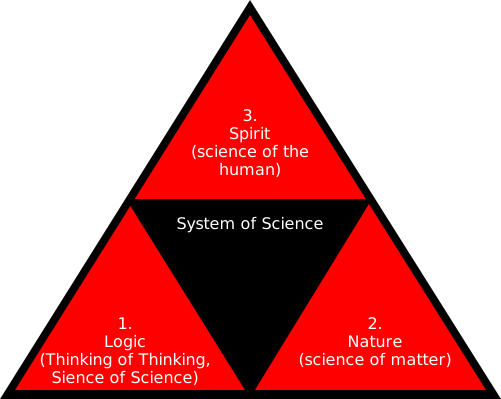
Subjective spirit appears once more in the third volume of the five-volume System of Philosophy as an Exact Science — and Michelet holds fast to the two-part division. Judging by the table of contents, there is little there that goes beyond the Anthropology and Psychology of 1840.

Something else stands out: Michelet also alters Hegel’s arrangement elsewhere — in the philosophy of right, he places the history of law where Hegel has world history, and world history fills volumes four and five instead.

The preface names the front, and it is the same one as with Schaller’s: “the materialism and atheism sprung from empiricism, which necessarily brings pessimism in its train” — a danger “whose culmination lies in the misapprehension of the nature of spirit.”

And Michelet’s program against it: “by connecting experience and dialectic, to establish exact science, comprehending spirit as much as the highest bloom of nature, as matter is grasped as the last cinder of spirit’s activity.”[2]

The image is powerful and dangerous at once. Matter as the burnt-out remainder of spirit — that says more than Hegel would say, and it is exactly the kind of overstatement against which Michelet’s own preface of 1876 had warned.

And he draws a line in both directions: not “in logic, with the dry reflective forms of discursive understanding,” not “in the philosophy of nature, with the exuberant schematism of potencies and construction within the absolute.” The first rejection is aimed at school philosophy, the second at Schelling.

The impression these restructurings make can be named: they appear rationally arranged rather than speculatively developed — as though a classification were being improved rather than a movement being traced through. This is the same finding as with the deletion of the Phenomenology: Michelet sees a duplication and removes it where Hegel is making a distinction.


  1. Carl Ludwig Michelet, Anthropologie und Psychologie oder die Philosophie des subjectiven Geistes, Berlin 1840, Preface, pp. V f. ↩︎

  2. Carl Ludwig Michelet, Das System der Philosophie als exacter Wissenschaft, vol. 3: Philosophie des Geistes, Berlin 1878, Preface, pp. V f. ↩︎