Commentary on Subjective Spirit, Chapter 10
The Three Stages and Their Organizing Principle
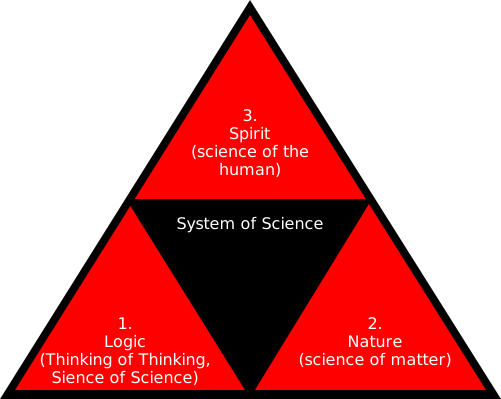
As in the philosophy of nature, Hegel orders according to increasing self-relation. His own division names it thus:
A. In itself or immediate — spirit as soul or nature-spirit, the subject matter of Anthropology.
B. For itself or mediated — spirit as consciousness, which relates to an object and therein to itself; the subject matter of Phenomenology.
C. Determining itself in itself and for itself — spirit as subject, which knows and wills; the subject matter of Psychology.
How the sequence can be tested is the same question as in the other volumes: Can the reader carry out the failure themselves?
At every transition in the Anthropology, this can be answered. The natural soul has its determinatenesses without relating to them — and whoever follows this through notices that “having” here still means nothing: a temperament of which someone knows nothing cannot be distinguished from a mere disposition. The feeling soul relates to them — and can fail at it. The actual soul has made them its own, so completely that nothing resists any longer — and precisely therein lies its deficiency.
So the series proceeds not because Hegel orders it so, but because each stage fails at its own determination. [KF]
Hegel divides in § 390: the soul is first “in its immediate natural determinateness, the merely existing, natural soul”; then it enters “as individual into relation with this its immediate being” and is “abstract, feeling soul for itself”; finally this being is “as its corporeality formed into it, and it therein as actual soul.”
The movement is therefore: having — relating to — having made one’s own. The middle term is decisive, and it has a name that misleads: feeling.
And this figure repeats itself at every level. The Anthropology is not a collection of themes Hegel considered related, but is built throughout on the logic of the concept — and he numbers the steps himself in many places.
The three main stages are A–B–E: the natural soul as the universal, the feeling soul as that which differentiates itself, the actual soul as the returned singularity. Within the natural soul, the same series repeats twice (Ch. 10). Within the feeling soul likewise, and there the figure carries a thought one would not find without it (Ch. 11).
For reading, this is the most important guidance: what stands where says what is happening there. A content at second position is, by concept, that which is particularized and overcome; one at third is that in which the movement comes to rest. Whoever reads only the contents reads half. [KF]