Commentary on the Logic, Chapter 24
Why Hegel Formulates Things This Way — The Steelman
The critique has a prior question: why does Hegel formulate things this way? What does he want to achieve, what problem does he solve by it?
19.1.1 First Concern: The Objectivity of the Categories
Hegel fights against subjective idealism — against the idea that the categories are “merely” our forms of thought, while the world “in itself” is entirely different (Kant’s “thing in itself”).
When Hegel says “the concept objectifies itself,” he means: the categories are not merely in the head. They are in the matter itself. The world is categorially structured — not because we order it this way, but because it is this way.
The concern is legitimate. Whoever considers the categories merely subjective remains caught in dualism: thought here, the (unknowable) world there.
19.1.2 Second Concern: The Unity of Thought and Being
Hegel overcomes the dualism of subject and object. Thought is not here and reality there. “Externalization” expresses: what we develop in thought is the same thing that governs in reality.
This follows from the critique of Kant: if the categories were only our forms, the thing in itself would remain unknowable. Hegel shows: there is no unknowable “behind.” The categories are the structures of reality.
19.1.3 Third Concern: The Self-Movement of the Matter
Hegel wants no external method imposed on the matter. The matter is to develop itself. “The concept externalizes itself” means: it is not we who make the transition arbitrarily, but the matter itself that compels it.
It is aimed against the compulsion of method — against schemata that come from outside and do violence to the matter.
19.1.4 Fourth Concern: Overcoming the Thinking of Finitude
Hegel criticizes the philosophy of reflection, which stops at the finite — which always only says: “That doesn’t work, that is limited, there is a limitation there.”
The “absolute Idea” is the thought that no longer breaks against an other — that is at home with itself. The formulation “the Idea releases itself freely into nature” expresses: this is no deficiency, no compulsion, but freedom.
19.1.5 The Legitimacy of These Concerns
All four concerns are legitimate:
| Concern | Problem Hegel solves | Consequence |
|---|---|---|
| Objectivity of the categories | Against subjective idealism | The world is knowable |
| Unity of thought and being | Against dualism | No unknowable “behind” |
| Self-movement of the matter | Against compulsion of method | The matter develops out of itself |
| Overcoming the thinking of finitude | Against mere skepticism | Positive cognition is possible |
The question is not whether these concerns are legitimate. The question is: do Hegel’s formulations achieve these concerns — or do they go beyond them and generate new problems?
Immanent Critique: Where Hegel’s Formulations Go Beyond His Concern
Now we can ask: do Hegel’s formulations achieve his own concern — or do they generate new problems?
19.2.1 Problem 1: Who Is the Subject of “Externalization”?
When Hegel writes “the concept externalizes itself,” this implies an acting subject. But who acts here? Not us — for we are corporeal, finite beings who think. Not a god — for Hegel wants secular philosophy. The concept itself? But the concept is a structure, not an agent.
The formulation hypostatizes the concept — it makes a subject out of a structure. That is exactly what the metaphysical reading suggests, and exactly what Hegel’s own principles ought to forbid.
19.2.2 Problem 2: When Did the “Externalization” Take Place?
If the Idea “releases itself into nature,” when is this supposed to have happened? Before the Big Bang? Then logic would be a doctrine of creation after all. Timelessly? But “releasing” is a temporal expression. Not at all? Then the formulation is misleading.
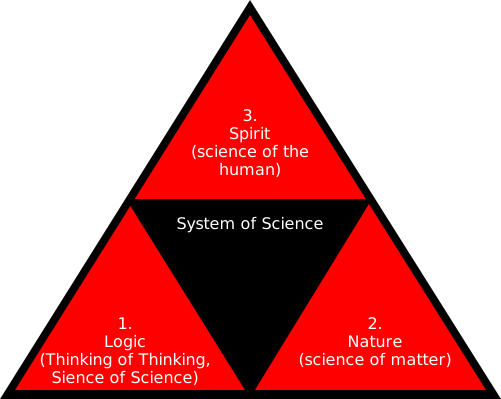
The three circles of Section 20.2 make the problem clear: chronologically, nature preceded spirit. Spirit is a late product of cosmic evolution. How, then, can the Idea “release itself into nature”?
Wandschneider’s answer to this problem deserves examination because it remains system-immanent — he explicitly asks only “to what extent these questions can be answered within the framework of the Hegelian system-design itself,” and excludes external motives as “without evidentiary value.”[1]
His starting point: the relation of Idea and reality can be interpreted “neither monistically nor dualistically.” Monistically it would lead to leveling the difference; dualistically the real would be something independent of the Idea, to which categories are merely “applied” — that is, Kant.
His solution: “Only in the opposition of Idea and reality can the Absolute complete itself into unity in the form of the dialectical triad of Idea, nature, and spirit.”
That means: externalization is not an event but the condition for the unity being more than a mere assertion. What is not opposed has nothing to unite.
And his result concerning spirit: it posits “the determinations of the Idea as such” and thereby “first brings their dialectical nature to fruition.” But it is able to do this “only by recourse to the form of natural individuation.”
This suggests an answer to the time-problem that is not chronological: spirit realizes the dialectic of the Idea by giving determinate being to its determinatenesses — and for this it needs nature not as prehistory, but as material.
What holds up and what does not. The objection against monism and dualism is clean, and determining externalization as the condition of unity avoids the creation-reading.
What it does not achieve: it does not explain why the formulation “to release itself into nature” sounds temporal if nothing temporal is meant. Wandschneider reinterprets the statement instead of asking why Hegel speaks this way. The three-circles distinction of Section 20.2 accomplishes more here: it says which circle is meant, instead of smoothing over the discourse.
19.2.3 Problem 3: Comprehending Becomes Justifying
The most problematic consequence of the metaphysical reading: if actuality is “externalization of the concept,” then comprehending actuality becomes its justification. What is, is rational — not because it has proven itself, but because it is “offspring of the concept.”
Here lies a fateful confusion. Theoretical insight into the necessity of a thing — why it is as it is — is equated with practical necessity — that it ought to be as it is. But these are two completely different things.
Hegel’s own logic makes this clear. In Chapter 7 (Actuality) we developed: “When all the conditions of a thing are fully present, it steps into existence.” That is theoretical necessity — the insight that under these conditions this result had to occur. But it does not follow from this that the conditions ought to have been as they were, or that the result is good.
I can understand why capitalism functions as it functions — I can comprehend its inner logic — and at the same time hold that it ought to be otherwise. Theoretical necessity (the system behaves this way under these conditions) implies no practical necessity (it must remain so, it ought to be so).
Hegel’s problematic formulations blur this distinction. When the concept “realizes” itself, when the Idea “objectifies” itself, it sounds as though actuality could not be otherwise — as if critique of it were senseless, since it merely does what the concept demands.
That is why in Chapter 11 (systems of syllogisms) we inserted a warning that we repeated in later chapters — for instance in Chapter 16 on life: that something can be brought into the form of a logical category, even one as high as life or the S³ structure, says nothing yet about its substantive or ethical dignity. Even a concentration camp can be understood as a system of syllogisms — it has universality (the ideology), particularity (the administration), individuality (the concrete acts). Categorial completeness does not make it legitimate — on the contrary, it makes the perversion all the more visible.
This holds for all categories: they serve analysis, not justification. To comprehend something does not mean to approve of it. The one possible exception would be the absolute Idea as a whole — but even it is primarily a method of self-knowledge, not a seal of quality for arbitrary contents.
19.2.4 Excursus: Categories, Ethics, and the Philosophy of the Real
One might object: but do the higher categories not themselves contain more ethical content? In being-for-itself there is something like self-determination; in the concept something like freedom; in the Idea something like self-expression. Would it not then be the case after all that classification under a higher category also indicates a higher ethical dignity?
Here lies a consequential fallacy. Yes, the higher categories have greater explanatory power. Explaining something through its concept is better than explaining it through its essence or its ground — we understand more, we see the inner structure. But explaining everything does not mean approving of everything. Understanding everything does not mean finding everything good.
If we explain fascism through its “concept” — if we show how it “freely” unfolds and “adequately expresses itself” — then we understand it better. But this better understanding does not make it better. On the contrary: the categorial completeness of evil shows the perversion in its full consequence. What matters is what it is that expresses itself freely of other conditions — and if it is evil, then it is precisely not justified by the form.
This distinction holds on the small scale too: the concept does not yet explain the object. The logic of the concept shows the structure of the concept — universality, particularity, individuality, judgment, syllogism. The logic of objectivity shows how this structure is realized in objective contexts — mechanism, chemism, teleology. But the transition from concept to objectivity is not the production of objects by the concept. It is the explication of the categorial structures we find in objects.
Several things must therefore be distinguished:
First: yes, the higher categories contain richer formal determinations and greater explanatory power. But that does not mean everything falling under this category is ethically superior. An organism has the structure of life — but that does not make every organism ethically valuable. A state has the structure of the ethical Idea — but that does not make every state legitimate. A work of art has the structure of self-expression — but that does not make every work of art good.
Second — and this is the decisive point: the matter of logic is not the logic of matters. Marxist critique has formulated this sentence pointedly; it hits on something essential. The philosophy of the real — philosophy of nature, philosophy of spirit — is not simply a repetition of logic. Nature follows its own lawfulness, history its own dynamics. The categories help us to see structures — but the contents follow their own logic.
Here too it is not always clear whether Hegel himself maintained this distinction cleanly. His formulations sometimes suggest that the philosophy of the real is merely “applied logic” — that spirit “frees itself from nature” because logic dictates this. Our reading distinguishes: the categories are tools of analysis, not templates of production. And they are tools of explanation — ethical judgment requires additional substantive criteria that do not follow from categorial classification alone.
This is the same problem as with “externalization”: it concerns the confusion of structure and genesis, of categorial form and real content, of explaining and approving. Logic shows which structures are possible and how they hang together. But which structures are realized, whether these realizations succeed, and whether they are ethically legitimate — that is decided in reality, not in logic.
19.2.5 Problem 4: Hegel Contradicts Himself
Interestingly, Hegel contradicts his own problematic formulations at other points:
The Phenomenology begins with sensuous certainty — not with the pure concept. Objective logic “takes the place of former metaphysics” (WdL GW21, p. 48) — it replaces the old metaphysics; it is not itself one in the dogmatic sense. Logic operates “in the abstract element of thought” (WdL GW21, p. 49) — not: in reality itself. At the end of the Encyclopedia (§§574-577): three syllogisms that mutually mediate one another — no absolute starting point from which everything is derived.
Particularly instructive is Hegel’s own treatment of teleology in the logic of objectivity (Chapter 15). Teleology appears there as a category — as one way of comprehending connections. And Hegel shows its limits: external teleology (everything has a purpose) is criticized; inner teleology (self-organization) is developed as the higher form. Hegel’s logic is thus not itself teleologically structured — it treats teleology as one category among others and shows where it is appropriate and where it is not.
Hegel’s text allows for both readings. The metaphysical one is not compelling.
19.2.6 The Pattern of the Critique
In every case the same pattern holds:
- Hegel’s concern is legitimate
- His formulation goes beyond the concern
- The problematic formulation generates new contradictions
- The reconstructive reading preserves the concern without the contradictions
Critique from outside this is not, but immanent: we show that Hegel’s formulations do not do justice to his own concern.
The Reconstructive Reading in Overview
What does our reading concretely mean? Here are the most important translations, some of which we have already practiced tacitly, some of which we will elaborate further in the following chapters:
| Hegel’s expression | Reconstructive reading | What is preserved |
|---|---|---|
| “The concept externalizes itself” | The structure of the concept shows itself in the experience of objectivity | Objectivity of the categories |
| “The Idea releases itself into nature” | We shift perspective — from logic to philosophy of nature | Unity of the system |
| “The concept objectifies itself” | We explicate how categorial structures appear in objectivity | Self-movement of the matter |
| “Nature is the otherness of the Idea” | Nature is logically structured — we can only comprehend it categorially | Knowability of the world |
| “God before the creation of the world” | The fundamental order underlying all thought and being | Universality of logic |
This reading does not claim to merely translate Hegel’s metaphysics into today’s words. It reconstructs the substantive concern while forgoing the hypostatizations of his diction — and where the two diverge, it decides in favor of the concern. On several of these points, a controversial question is thereby decided, not merely a sentence translated: whoever reads the transition to nature as done here has decided against a reading in which the Idea does something. Admitting this is not a weakness of the reconstruction but its condition. [KF] The last two points — the transition to nature and the “God” formulation — are treated in detail in Chapter 20 and in Chapter 18.
The Status of Our Reading: Sublation of Hegel
19.4.1 Is This Still Hegel?
One might ask: if we translate Hegel’s formulations this way — is this still Hegel? Or already a different philosophy?
The answer: both. And this is no contradiction, but sublation.
Preserved is the rational kernel: development of categories, self-application, S³ structure, dialectical method, the insight into the self-relation of thought, the overcoming of the dualism of thought and being, the systematic completeness.
Overcome is the metaphysical shell: the concept as demiurge, “externalization” as a real process, the formulations that make Hegel a theologian of creation, the hypostatization of the concept into an acting subject.
Elevated is the whole to the level of a reconstructive, non-dogmatic systematics — a systematics that explicitly reflects on its own status.
This is sublation in the full sense — with Hegel’s own means.
19.4.2 More Hegelian Than Hegel?
One might object: one cannot claim to be “more Hegelian than Hegel.” If the metaphysical reading is Hegel’s own position, then one must go beyond Hegel, not claim to be “within” Hegel.
To this we answer: sublation is a going-beyond-Hegel — but one that preserves him. “Going beyond Hegel” does not mean rejecting Hegel. It means sublating Hegel.
And: we do not claim that Hegel intended our reading. We claim that our reading is more coherent — that it fulfills Hegel’s concern better than his own formulations.
The thesis is not philological (“What did Hegel mean?”) but systematic (“What is true?”).
Hegel as Scientist, Not as Museum Piece
19.5.1 The Philological vs. the Systematic Approach
The philological approach asks: what did Hegel mean? What is in the text? What is the historical context?
Legitimate enough — for philologists. But Hegel himself wanted not philology, but science. He called his main work “Science of Logic,” not “Thoughts on Logic.” He called his overall system “Encyclopedia of the Philosophical Sciences,” not “Encyclopedia of My Opinions.” Throughout his texts he emphasizes the claim to intersubjective traceability, to necessity of the development of thought, to scientificity in the strict sense. He did not want to be historically interesting, but true.
Our approach asks: what is true in Hegel’s insights? How can we develop them further? Where must we go beyond the letter?
This corresponds to Hegel’s own claim. Whoever treats him as a museum piece — “here we see what the famous Hegel meant” — fails this claim.
19.5.2 The Newton Analogy
No one reads Newton only philologically. One does not ask only: “What did Newton mean in the Principia?” One asks: what is true? What must be corrected? What can be developed further?
Newton’s mechanics was sublated by Einstein — preserved in the domain of low speeds, overcome in its limits, elevated into a more comprehensive theory.
That is how we read Hegel too. His logic is no closed monument, but a living system that can and must develop further.
19.5.3 The Consequence for Interpretation
This does not mean that we arbitrarily reinterpret Hegel. We take Hegel’s arguments seriously — and test them. We distinguish between his concerns and his formulations. Where the formulations contradict the concern, we hold to the concern. And we are ready to go beyond Hegel — in his spirit.
Disrespectful this is not, but the highest form of respect: taking Hegel seriously as a scientist, not as an authority to be obeyed.
Objections to Our Reading – and Our Answer
19.6.1 Objection 1: “This Is Reinterpretation, Not Exegesis”
The objection: the translation table (23a.6) turns Hegel’s statements into something else. “The concept externalizes itself” (active subject) becomes “The conceptual structure shows itself” (passive appearance). That is not the same thing.
Our answer: the objection is right — it is not the same. We do not claim philological identity, but systematic improvement.
The distinction is important:
- Philological question: what did Hegel mean?
- Systematic question: what is true?
We answer the second question. Our thesis is not “Hegel meant it this way,” but “This reading is more coherent than the metaphysical one.” This is not disrespect toward Hegel — it is the highest form of respect: taking him seriously as a scientist, not as an authority.
19.6.2 Objection 2: “How Do We Know What Hegel’s ‘Actual Concern’ Was?”
The objection: the distinction “concern vs. formulation” is circular. We attribute to Hegel the concern that justifies our reading.
Our answer: the four concerns (23a.3) are not invented but reconstructed from Hegel’s context:
- Objectivity of the categories: Hegel’s critique of subjective idealism (Kant)
- Unity of thought and being: Hegel’s overcoming of dualism
- Self-movement of the matter: Hegel’s critique of external compulsion of method
- Overcoming the thinking of finitude: Hegel’s critique of mere skepticism
These concerns are documented in Hegel’s texts. The reconstruction is historical-systematic, not circular.
19.6.3 Objection 3: “Perhaps Hegel Really Meant It That Way”
The objection: perhaps the metaphysical reading is Hegel’s own position. Then we must go beyond Hegel, not claim to be “within” Hegel.
Our answer: if the metaphysical reading were Hegel’s position, we would have to explain why Hegel contradicts himself:
- The Phenomenology begins with sensuous certainty, not with the pure concept
- Logic “takes the place of former metaphysics” — it replaces old metaphysics; it is not itself one in the dogmatic sense
- At the end of the Encyclopedia (§§574-577): three syllogisms that mutually mediate one another — no absolute starting point from which everything is derived
These passages show: Hegel’s text allows for both readings. The metaphysical one is not compelling.
And: we do not claim to be “within” Hegel. We claim to sublate Hegel — to preserve (the rational kernel), to overcome (the problematic formulations), to elevate (to the level of reflexive systematics). This is going-beyond-Hegel in his spirit.
19.6.4 The Relationship Between Philology and Systematics
Hegel himself wanted not philology, but science. He called his main work “Science of Logic,” not “Thoughts on Logic.” He did not want to be historically interesting, but true.
Whoever treats him as a museum piece — “here we see what the famous Hegel meant” — fails this claim.
No one reads Newton only philologically. One asks: what is true? What must be corrected? So too we read Hegel.
Dieter Wandschneider, Die Entäußerung der Idee zur Natur und ihre zeitliche Entfaltung als Geist bei Hegel, in: Hegel-Studien 18 (1983), pp. 173-199. Wandschneider prepared the essay together with Vittorio Hösle; Hösle includes it in Hegels System. ↩︎