Commentary on the Logic, Chapter 23
What the Absolute Idea Is — and What It Is Not
The absolute Idea is no mystical world-being and no divine spirit. It is the unity of theoretical and practical Idea, which at the same time comprehends itself as the method of its own enactment: logic becomes aware of the forms of movement it has been performing the whole time — of transition, of shining, of development. In the reconstruction proposed here, the self-knowledge of method is placed in the foreground; this is a selection, not an exhaustive rendering of Hegel’s concept. [KF]
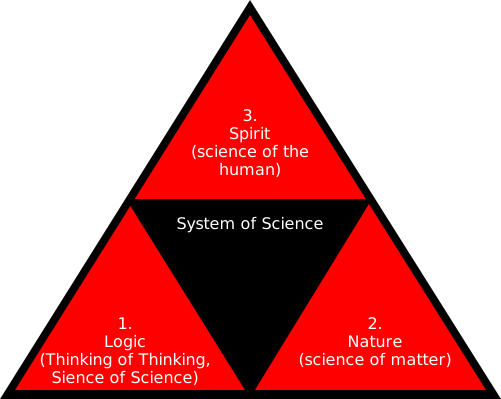
Bounded absoluteness: when Hegel speaks of absolute, he means: not limited by another — within logic. This absoluteness is itself bounded: it holds only within the sphere of pure logic. What is other to thought — nature, history, concrete experience — must be examined in the philosophy of the real (see Ch. 20).
On the question of God: when Hegel says the content of logic is “the presentation of God […] as he is in his eternal essence before the creation of nature and a finite spirit” (TWA 5, 44) — in the common shorthand: the thoughts of God before the creation of the world — he means: the pure structures underlying all experience. Before creation means: systematically more fundamental, not temporally earlier. Whether these structures are thought by a personal God or are themselves the Absolute remains open. Hegel’s logic is compatible with theistic as well as atheistic interpretations, but compels neither. This is more radical enlightenment than dogmatic atheism: not elimination of the question of God, but its methodically controlled treatment.
Self-Application Test
| Operation | Fulfilled? | Evidence |
|---|---|---|
| Self-application | ✓ | The logic has repeatedly applied itself to itself |
| Differentiation | ✓ | All relevant distinctions systematically drawn |
| Sublation | ✓ | Contradictions not avoided, but integrated |
| Recognition | ✓ | The logic has recognized its own limits |
The logic is performatively consistent: it practices what it teaches.
The Absolute Idea Is Not an End but a Beginning
It has recognized method. But logic also knows what it does not supply: concrete contents (for that, empirical inquiry), materiality (nature is given), philosophy of the real (whose elaboration is still to come). Logic releases itself freely — not because it fails, but because it has grasped its own limitedness. The following sections make the method explicit and draw the ethical consequence.