Commentary on Subjective Spirit, Chapter 37
Overview of the Students
Three authors, seven books, two decades — and one critic who compared them.
| Year | Author | Work |
|---|---|---|
| 1837 | Erdmann | Body and Soul (2nd ed. 1849) |
| 1837 | Rosenkranz | Psychology, or the Science of Subjective Spirit |
| 1840 | Erdmann | Outline of Psychology (2nd ed. 1842, 3rd ed. 1847) |
| 1840 | Michelet | Anthropology and Psychology |
| 1843 | Rosenkranz | Psychology, 2nd edition |
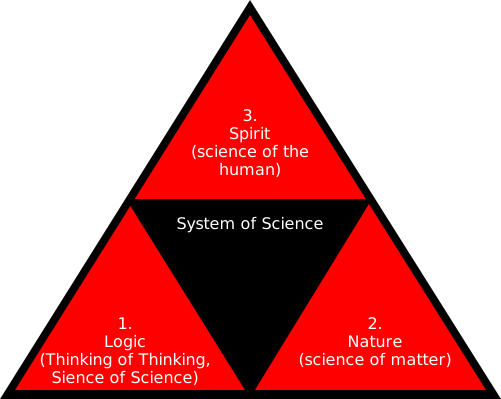
| 1850 | Rosenkranz | System of Science, part on Spirit |
| 1852 | Erdmann | Psychological Letters (2nd ed. 1856) |
The architecture is the first difference, and it is a fundamental one:
| Anthropology | Phenomenology | Psychology | |
|---|---|---|---|
| Hegel (Encyclopedia 1830) | yes | yes | yes |
| Rosenkranz | yes | yes | yes |
| Michelet | yes | struck out | yes |
| Erdmann | yes, with death | yes | yes |
Michelet strikes out one of three parts — the greatest deviation, and the only one for which an explicit reason is given.
Erdmann expands — for him, the death of the human being belongs in Anthropology, whereas Hegel assigns it to the philosophy of nature.
Rosenkranz retains the structure — and changes the mode of presentation: paragraphs become a book.
Form is the second difference. Erdmann’s Outline is a compendium for lectures, a hundred pages long, with the explicit caveat that “much has been left to the oral lecture.” Michelet’s work, at nearly six hundred pages, is the most extensive and aims to be the fully worked-out presentation. Rosenkranz falls in between, seeking a readable form.
That the three turn out differently thus has, first of all, a mundane reason: they want different things. A compendium, a system, and a book for readers need not be the same thing.