Lotze - The Forgotten Mediator (1817-1881)
This text is a preview of History of the Reception of Hegel, volume I, to be published in 2026 by Reflexivity Press.
Rudolf Hermann Lotze is one of the most influential—and today most strongly faded—philosophers of the nineteenth century. He was a central academic figure of the second half of that century, widely discussed well into the early twentieth. While his students and those he influenced—Frege, Husserl, Windelband, Rickert, the British Idealists, William James—became canonical figures, Lotze himself is barely known today.
Lotze is not the “consequence” of Trendelenburg and Bolzano, but he becomes the node at which the motifs of both become effective: Trendelenburg’s critique of speculative logic and Bolzano’s objectivism combine in Lotze into a new guiding distinction—the separation of being and validity.
Lotze belongs to the prehistory of Neo-Kantianism. He makes “validity” a central concept and cleanly separates the origin of a thought from its truth. This view later becomes, in Windelband and Rickert, the starting point of their philosophy of value and also shapes the methodological dispute of the cultural sciences. Lotze’s distinction between genesis and validity became constitutive for Husserl’s phenomenology.
11.4.1 Life and Intellectual Position
Rudolf Hermann Lotze was born in 1817 in Bautzen and studied medicine and philosophy in Leipzig. In 1844 he became a professor in Göttingen as Herbart’s successor, where he taught until 1880. In 1880 he accepted a call to Berlin; on July 1, 1881, he died there.
Köhnke (cf. Chapter 7.2) has worked out Lotze’s institutional role: in Göttingen, Lotze established a new manner of philosophizing that seemed “more sober” and “more scientific” than Berlin Hegelianism. He replaced the Hegelian “system” with a “worldview.”[1]
Lotze received stimulation from Johann Friedrich Herbart and Christian Hermann Weisse, but felt himself—as he said—most attracted to Leibniz. He shared this affinity with Herbart, whose philosophy also stood in the Leibnizian tradition. Lotze’s thought developed as a “teleological idealism” or “ethical idealism”—a position that could be identified neither with Hegel’s speculative idealism nor with the rising materialism.
Lotze as “Crisis Manager” of the Materialism Dispute
Köhnke emphasizes a role of Lotze’s that is often lost in purely philosophical accounts: he was the philosophical “peacemaker” between speculation and empiricism. While Hegel wanted to derive nature from spirit, Lotze accepted mechanism in nature completely, but subordinated it to a higher teleological significance (“teleomechanism”). In this way he took the wind out of the sails of the radical materialists (Vogt, Moleschott, Büchner) and offered natural scientists a “philosophical shelter” without patronizing them with speculative systemic constraints.[2]
The Cultural Impact: Mikrokosmos
Köhnke also documents Lotze’s broad public impact: his main work Mikrokosmos (1856-1864) was read far beyond specialist philosophy and replaced Hegel as the orientation text of the educated middle class. This explains why Lotze, despite his low profile today, was a key figure in the displacement of Hegelianism.[3]
In retrospect, Lotze can be placed within a movement that pushed against Hegelian idealism toward a new kind of objectivity. Bernard Bolzano’s Wissenschaftslehre (1837) had already attempted to distinguish logical truths from psychological processes—with his doctrine of “propositions in themselves,” which are neither physical nor psychic, but objectively “subsist.”[4] Adolf Trendelenburg’s Logische Untersuchungen (1840) criticized Hegel’s dialectic from an Aristotelian standpoint. Lotze shared with both a search for objective structures beyond the Hegelian system.
The Relation to Bolzano
The similarity between Lotze’s “validity” and Bolzano’s “propositions in themselves” is striking: both distinguish between the psychic act of thinking and its objective content; both claim that truths hold independently of whether anyone thinks them. Nevertheless, the historical relationship is complicated.
Lotze does not cite Bolzano in his major works, although the Wissenschaftslehre appeared six years before his first Logik (1843). Only later, in his Kleine Schriften, did Lotze acknowledge the kinship of his position with Bolzano’s.[5] It appears to be more a case of parallel developments than direct adoption—both were reacting to the same problem (psychologism), but by different paths.
Husserl later testifies that Lotze’s logic gave him the “key” to understanding Bolzano’s conception. In Husserl, both traditions converge—an indication that Lotze and Bolzano, despite their independence from each other, arrived at convergent solutions.
11.4.2 What Lotze Argues Against: The Awareness of the Problem
To understand Lotze’s position, we must first reconstruct the problems he sought to solve. Lotze saw himself confronted with two opposing poles, both of which seemed untenable to him.
The Problem of Materialism
In the middle of the nineteenth century, scientific materialism was gaining ground. Thinkers like Ludwig Büchner, Jacob Moleschott, and Karl Vogt held that all mental phenomena were reducible to material processes. “The brain secretes thoughts as the liver secretes bile”—so ran the popular formulation.
For Lotze, this position was not only philosophically unsatisfying but self-contradictory: if all thoughts are merely brain processes, then so is the thought of materialism itself. It would then have no greater validity than any other brain process—say, the thought of idealism.
The Problem of Speculative Idealism
On the other side stood Hegel’s speculative idealism. Lotze saw several problems here:
-
The identity of logic and ontology: Hegel seemed to claim that the logical categories were at the same time the structure of reality itself. For Lotze this was a confusion: the laws of thought are norms for correct thinking, not descriptions of what is.
-
Panlogism: Lotze understood Hegel as wanting to derive the whole of reality from pure thought. This seemed to him to undermine the independence of the empirical sciences.
-
The dialectical method: The claim that contradiction is productive and drives thought forward appeared to Lotze as a violation of the law of contradiction—the foundation of all logic.
-
The conflation of being and ought: Hegel seemed to level the distinction between what is and what ought to be. For Lotze this was dangerous: it threatened to dissolve the normative into the factual.
The Problem of Psychologism
There was also a problem within logic itself: psychologism. Many of Lotze’s contemporaries understood logical laws as descriptions of factual thought processes. Logic would then be a subfield of psychology.
Lotze saw a confusion here: that people factually think in such-and-such a way does not explain why they ought to think so. Logic deals with norms, not facts. “2+2=4” is not true because people think it so—people should think it so because it is true.
11.4.3 What Lotze Wants to Achieve: The Goals
Against this background, Lotze’s goals can be precisely formulated:
-
To secure the objectivity of logic — against the psychologism that would degrade it into an empirical science
-
To preserve the independence of natural science — against the speculative idealism that threatened to incorporate it into the system of spirit
-
To assert the irreducibility of values — against the materialism that would reduce everything normative to the material
-
To preserve the unity of knowledge — without falling into a dogmatic monism
Lotze’s solution was meant to open a “middle way”: neither materialism nor speculative idealism, neither psychologism nor empty formalism.
11.4.4 Lotze’s Solution: The Logic of Validity (Steelman Presentation)
The Central Innovation: The Concept of Validity
Lotze’s most durable contribution to philosophy is the systematic centering of the concept of “validity” (Geltung) in philosophical discourse. This concept, which today almost belongs to the basic vocabulary of philosophy, was made by Lotze into the load-bearing distinguishing concept. This innovation resolves—from Lotze’s perspective—all the mentioned problems at a single stroke.
The basic idea: there are three fundamentally different ways in which something can be “actual”:
- Being: that which factually exists (things, events, states)
- Becoming/happening: that which changes, arises, passes away (processes)
- Validity/holding: that which is true without existing or happening (truths, values, norms)
The decisive point: these three spheres are categorially distinct. From what is or happens, one cannot derive what is true or what ought to hold—and vice versa. What holds does not “exist” in the same sense as a stone or a tree. What exists does not “hold” in the same sense as a mathematical proposition.[6]
The Interpretation of Plato
In his Logik (1874, §§ 313-321), Lotze develops a novel interpretation of Plato’s theory of ideas that supports his position.
Plato’s ideas have two properties: (i) they have their own autonomous being; (ii) they have properties similar to those of the objects of reality. Lotze’s central thesis: these two conditions are fulfilled only by values. In fact, Plato’s ideas are validities of truths.
Plato presented them as “ideas” (that is, as a kind of being) only because there was no expression in Greek for things that have no being—and values are exactly such things.[7]
This interpretation explains why the Platonic ideas stand beyond space and time: they do not exist like things—they hold (or are valid).
The Example of Mathematical Truth
Lotze’s famous example clarifies the position: the ratio of the circumference of a circle to its diameter (π) “holds in itself.” Whenever any mind forms the idea of a perfect circle, it will turn out that the ratio 1:π holds between diameter and circumference.
We all feel ourselves, at the moment we think any truth, certain that we have not created it for the first time but only recognized it; it held before we thought it, and it will continue to hold regardless of any existence.[8]
The point: π has no existence, but it has validity. It is a “non-being” that is nevertheless “actual”—but in a different sense of “actual” than a stone or a tree. It holds—prior to all thought, independent of whether anyone has ever thought it or ever will.
How the Solution Addresses the Problems
From Lotze’s perspective, the logic of validity solves all the problems mentioned at the outset:
-
Against psychologism: logical laws are not descriptions of psychic processes, but norms. They “hold” regardless of how people factually think. Psychology describes being (factual thought processes), logic describes validity (normative structures).
-
Against materialism: values and truths are not reducible to material processes because they belong to a categorially different sphere. One cannot ask “where” the number three is or “when” the law of contradiction arose.
-
Against speculative idealism: logic is not identical with ontology. It does not describe what is, but what holds. This preserves the independence of the empirical sciences: they investigate being, logic investigates validity.
-
For the unity of knowledge: all three spheres are real—but in different ways. This allows for a unity without reductionism.
The Distinction Between Genesis and Validity
A central consequence is the strict distinction between genesis and validity:
- The genesis question asks: how did a thought arise? What psychological, historical, social factors led to it?
- The validity question asks: is the thought true? Does it hold objectively, regardless of its origin?
Both questions are legitimate—but they must not be confused. The historical genesis of a theory does not explain whether it is true. That Newton sat under an apple tree does not explain the validity of the theory of gravitation. That a thought arose out of certain social conditions says nothing about whether it is true.
This is the core of antipsychologism: logical laws are not descriptions of psychic processes, but norms for thinking. They do not say how we factually think, but how we ought to think if we want to think correctly.
11.4.5 The Internal Contradictions: Immanent Critique
Lotze’s solution is elegant and has historically proven influential. Nevertheless, on closer examination it leads to problems that arise from its own logic—without recourse to Hegel or other external standards.
1. The Methexis Problem: The Question of Mediation
Lotze’s central thesis is: validity does not follow of itself from facts; the categories are distinct, and any “bridge” requires additional principles.
But if this is true, a problem in need of explanation arises: how can the existing (the thinking human being) grasp the valid (the truth) at all?
Lotze separates analytically; the epistemic and metaphysical mediation occurs for him via a teleological world order and a personalist theism. Lotze’s metaphysics is not a mere addendum but the very place where he attempts to rescue the unity of validity and reality at all. But precisely here the tension arises: the objectivity of validity is meant to be secured antipsychologistically, but the accessibility and unity of the whole depends on metaphysical premises that themselves require justification.[9]
Lotze reproduces here the ancient problem of “methexis” (participation), which Plato himself critically discussed in the Parmenides: how can strictly separated spheres come into relation? Lotze’s solution—recourse to a divinely guaranteed world order—is not simply a late stopgap, but an integral part of his system. But it only shifts the problem: why should a teleological metaphysics be more plausible than the mediation that Hegel shows within the concept itself?
2. The Epistemological Underdetermination
A deeper problem concerns the relationship between validity and the cognition of validity.
Lotze claims: the origin of a thought (genesis) is irrelevant to its truth (validity). Truth “holds” independently of any thought process. This can be consistently formulated as a thesis about validity itself.
But Lotze owes an answer to the question: under what conditions can acts of thought reliably access validity—without these conditions themselves becoming psychologistic?
Here the position is underdetermined:
- If genesis is really irrelevant to validity, there must nevertheless be an explanation of why certain thought processes grasp validity and others do not.
- This explanation cannot lie purely in the sphere of validity (for there are no processes there).
- But it also cannot lie purely in the sphere of being/becoming (for then it would be psychologistic).
Lotze would need a theory of epistemic mediation that is neither psychologistic nor purely formal. This gap later becomes the starting point for Husserl’s transcendental phenomenology—the attempt to conceive intentionality as a bridge without falling back into psychologism.
3. The Problem of Mediation in Experience
A further problem concerns the way Lotze conceives the three spheres (being, becoming, validity). By strictly separating them and forbidding any transition, explanatory gaps arise:
- Being becomes the merely given—without inner development or normative relevance.
- Becoming becomes process without direction—without reference to truth or value.
- Validity becomes the ideal norm—without force to realize itself or guide action.
In actual experience, however, these three moments are interwoven: we recognize truths (validity) through thought processes (becoming) that themselves exist (being). Truths we recognize change our action. Our being is not static, but shaped by norms.
The strict separation of spheres purchases objectivity at the price of a mediation requiring explanation: how do norms become effective? How does truth become action-guiding? How are ideality and realization connected? These questions remain open in Lotze—or are delegated to teleological metaphysics.
11.4.6 Lotze’s Influence: The Legacy, Both Good and Problematic
The Influence on Frege
Gottlob Frege, the founder of modern logic, studied under Lotze in Göttingen. The connection between Lotze’s and Frege’s thought is discussed in the scholarship, though the exact borrowings must be considered with care.[10]
The shared context: Lotze’s antipsychologism and his insistence on the objectivity of the conceptual form an important background for Frege’s philosophy. Both share:
- The rejection of reducing logical laws to psychic processes
- The insistence on the objectivity of meanings and truths
Frege’s radicalization: Frege postulated a “third realm” of thoughts, which are neither physical nor psychic—an explicit hypostatization that goes beyond Lotze’s more cautious formulation. This sharpens the problem of mediation: how is access to ideal thoughts possible, if they exist neither in space nor in time?
The Influence on Phenomenology
The distinction between genesis and validity became constitutive for Husserl’s phenomenology. In the Logical Investigations (1900/01), Husserl sharply distinguishes between:
- the act of judgment (the psychic performance, the judging)—genesis
- the content of judgment (the ideal content, the judgment as a unit of meaning)—validity
Husserl himself testifies to Lotze’s influence: “His ingenious interpretation of the Platonic theory of ideas […] cast a first bright light on and determined all further studies.”[11]
The legacy of the problems: Husserl’s later development toward “genetic phenomenology” can be understood as an attempt to close again the gap between genesis and validity opened up by Lotze—without falling back into psychologism.
The Influence on Neo-Kantianism
Wilhelm Windelband, Lotze’s most important student, developed the southwestern German philosophy of value out of the concept of validity. The central thesis: values “hold,” but they do not “exist” in the same sense as empirical things.
This categorial distinction—later adopted by Max Weber—shaped the foundations of the cultural sciences. The distinction between “judgments of fact” and “judgments of value,” the demand for “value-freedom” in science—all of this has its origin here.
The legacy of the problems: The strict separation of being and ought can favor relativistic interpretations and opens the flank that bindingness is difficult to ground. If values only “hold” but do not “exist”—where then does their power to bind us come from? Weber himself wrestled with this problem in his reflections on the “disenchantment of the world.”
British Idealism and Pragmatism
Lotze’s influence extended far beyond Germany. T. H. Green, F. H. Bradley, and Bernard Bosanquet—the leading British Idealists—were influenced by Lotze’s Mikrokosmos. William James studied Lotze and was particularly stimulated by his psychology and aesthetics.
Frederick Beiser has called Lotze the “grandfather of the concept of normativity”[12]—an assessment that marks his central place in the history of philosophy of the late nineteenth and early twentieth centuries.
11.4.7 The Image of Hegel and Its Problems
Having presented and criticized Lotze’s position on its own terms, we can now ask: does his critique of Hegel hit its mark at all?
The Historical Context: Lotze and Trendelenburg
It is important first to note: Lotze does not criticize “Hegel pure,” but Hegel within an already polemically charged debate. Adolf Trendelenburg had, in his Logische Untersuchungen (1840), developed an influential critique of Hegel that shaped the image held by the succeeding generation. Many of the objections Lotze directs at Hegel run “in the wake of Trendelenburg.”[13]
What Lotze (and His Time) Accused Hegel Of
The widespread reading, which Lotze shared, understood Hegel as follows:
- Panlogism: reality is derivable from pure thought
- The identity of logic and ontology: the laws of thought are at the same time laws of being
- The suspension of the law of contradiction: contradiction is productive and persists
- The conflation of being and ought: the normative dissolves into the factual
The term “panlogism” itself is part of later controversies about reception—it was often held against Hegel, but whether it hits his position is disputed.[14]
Why This Reading Misses Hegel
Close reading of Hegel’s Science of Logic shows that this image misses important aspects:[15]
-
No simple panlogism: Hegel does not claim that empirical reality is derivable from thought. For Hegel, logic is the science of pure determinations of thought—not a deduction of the world. The Realphilosophie (nature, spirit) has its own contents, which do not derive from logic.
-
No simple identity: Hegel’s thesis is not that thought and being are identical, but that they belong together in their difference. Logic shows the structures under which reality can be understood at all. It is not identical with the empirical thing, but the empirical thing is only “actual” insofar as it corresponds to this logical structure (essence must appear). In Lotze, by contrast, the thing “is” even without validity—as a mere fact.
-
No suspension of the law of contradiction: Hegel does not deny that contradictions must be resolved. Rather, he shows that contradictions arise in thought and, through their resolution, drive thought forward. Contradiction is not the end but the drive of thought.[16]
- No conflation of being and ought: Hegel criticizes precisely the “mere ought” as abstract. His thesis is that the rational must realize itself—not that everything factual is already rational.
The Triadic Structure in Hegel
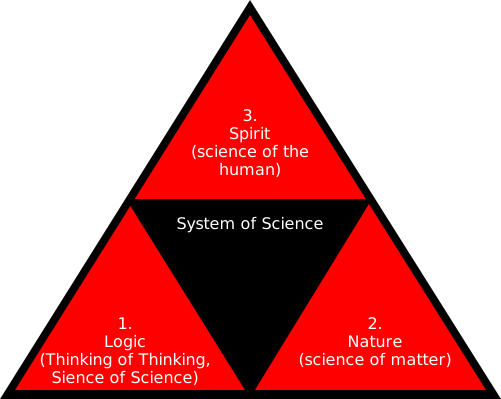
The comparison of the triads is especially instructive. Hegel himself has a trichotomy: Being - Essence - Concept. The “Concept” in Hegel has definite similarities to Lotze’s “validity”—it is the sphere of self-determination, of inner necessity, of “why must it be so?”
The difference lies not in the trichotomy itself, but:
- In Hegel, the three spheres are dialectically mediated: being passes over into essence, essence into the concept. The transition is necessary.
- In Lotze, the three spheres are strictly separated: no transition is possible. They are “unrelated worlds.”
By severing the mediation, Lotze leaves explanatory gaps: how do reality, process, and norm connect? Being becomes the merely given, without inner development; becoming, a process without goal; validity, a norm without power to realize itself.
11.4.8 What Is to Be Learned from Lotze
Despite the problems shown, Lotze’s position contains important insights that should be preserved:
The Legitimate Concern
-
The distinction between the act of thought and its content: there is a real difference between the psychic act of thinking and what is thought. This distinction is not to be given up—even though it must not become a separation.
-
Antipsychologism at its core: logical laws are not mere descriptions of factual thought processes. Logic has normative force. This must be defended against every naturalism.
-
The warning against genetic fallacies: the history of the origin of a belief does not explain whether it is true. This is an important methodological insight.
-
The irreducibility of values: values cannot be reduced to facts. Even though Lotze’s solution (strict separation) is problematic, the problem itself is real.
What Must Be Transformed
-
The strict separation must be transformed into a dialectical mediation: genesis and validity are distinguished, but not separated. Validity shows itself in genesis; genesis is oriented toward validity.
-
The static conception of validity must be transformed into a processual one: truth is not a dead “value” lying around somewhere, but shows itself in the exercise of cognition.
-
The gap between the spheres must be replaced by mediation: thought can reach truth because it is itself structured by truth. Genesis is the place where validity appears.
The Formulation of the Task
Lotze precisely formulated a problem: how can the objectivity of logic be secured without falling into psychologism or metaphysics?
His solution (strict separation) fails on its own contradictions. But the problem remains. An adequate solution would have to show:
- how validity and genesis are connected without being identical
- how thought can reach truth without creating it
- how norms can be binding without “existing” like things
This is the task Lotze bequeathed to subsequent philosophy—a task on which Frege, Husserl, Heidegger, and analytic philosophy have worked in various ways.
Lotze in the Context of the Displacement of Hegel
Köhnke summarizes Lotze’s role in a pithy formula: while Trendelenburg supplied the “logical wrecking ball” and Haym (see Chapter 11.5) took care of the political-historical demolition, Lotze built the new foundation—the distinction between being and validity, on which Neo-Kantianism could arise.[17]
An interesting finding of Köhnke’s: early Neo-Kantianism (around the 1860s) was actually a “Lotze-Kantianism.” The forgetting of Lotze set in only when scholars began to explain Neo-Kantianism purely from Kant himself.
Klaus Christian Köhnke, Entstehung und Aufstieg des Neukantianismus, Frankfurt/M. 1986. Köhnke analyzes Lotze’s role as a “replacement” for Hegel in academic teaching—a “more sober” philosophy on an empirical basis. ↩︎
Köhnke (1986) emphasizes Lotze’s function as “crisis manager” of the materialism dispute of the 1850s. His “teleomechanism” offered a philosophical mediation that accommodated natural scientists. ↩︎
Köhnke (1986) documents the broad impact of Mikrokosmos as a cultural phenomenon—the work replaced Hegel as the orientation text of the educated middle class. ↩︎
On Bolzano see Chapter 11.3. His attempt to distinguish “ideas in themselves” and “propositions in themselves” from psychic acts forms an important background for the antipsychologistic movement to which Lotze also belongs. ↩︎
Lotze, Kleine Schriften, Vol. III/1, Leipzig 1891, p. 367. Cf. also Beyer, Von Bolzano zu Husserl (1996), on the “Bolzano-Lotze thesis” regarding the priority of the concept of the proposition. ↩︎
Lotze, Logik (1874), Book Three, §§ 316-317. Cf. Internet Encyclopedia of Philosophy (IEP), article “Lotze.” ↩︎
Lotze, Logik (1874), § 317. ↩︎
Lotze, Logik (1874), quoted after De Santis, “Notes on Husserl’s Idealismus” (2016), p. 241. ↩︎
Cf. IEP, article “Lotze”: Lotze’s recourse to a “teleological world order” and the “continuing participation of God” in all natural processes. ↩︎
Cf. Gottfried Gabriel, “Objektivität: Logik und Erkenntnistheorie bei Lotze und Frege,” in: Apel/Apel (eds.), Frege’s Philosophy of Language, 1993. ↩︎
Husserl, Entwurf einer Vorrede zu den Logischen Untersuchungen (1913), Husserliana XX/1, p. 297. ↩︎
Frederick Beiser, Late German Idealism: Trendelenburg and Lotze, Oxford 2013. ↩︎
On Trendelenburg’s critique of Hegel, see Chapter 7.2. His objections shaped the image of Hegel held by an entire generation. ↩︎
On the “panlogism controversy,” cf. Terzi, “Wrestling with the Shadow: The Panlogism Controversy in Hegel’s French Reception (1897-1927),” 2018. ↩︎
For the systematic presentation of these points, see Froeb, Hegel’s Science of Logic (in preparation), Ch. 1, The Starting Point; Hegel’s Science of Logic (in preparation), Ch. 6, The Logic of Essence; and Hegel’s Science of Logic (in preparation), Ch. 23, The Three Basic Movements. This interpretation stands in agreement with modern Hegel scholarship, especially Stekeler-Weithofer, Pippin, and Brandom. ↩︎
Cf. Froeb, Hegel’s Science of Logic (in preparation), Ch. 23.4, Sublation - Productive Resolution of Contradiction: contradiction is the drive of thought, not its end. ↩︎
Köhnke (1986) summarizes the “division of labor” in the displacement of Hegel: Trendelenburg supplied the logical critique, Haym the political demolition, Lotze the new foundation. Cf. also his concept of “Hegel fatigue” for the intellectual climate of the 1850s. ↩︎