The Systematic Balance Sheet: Integration Instead of Polarization
This text is a preview of History of the Reception of Hegel, volume I, to be published in 2026 by Reflexivity Press.
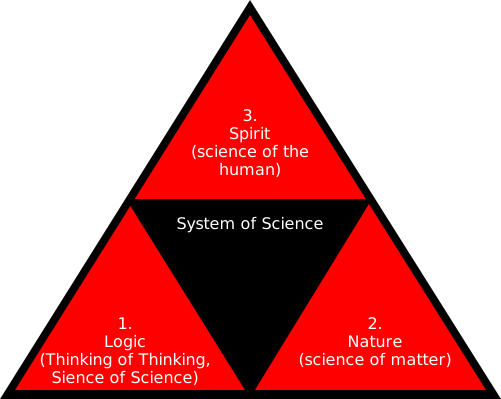
The four critics—Trendelenburg, Haym, the Neo-Kantians, the positivists—each formulate a legitimate intuition that any contemporary integration of Hegel must answer. Together they articulate the science challenge: how does speculative philosophy relate to the individual sciences?
Trendelenburg shows: the tension between purity and application is real. A logic must allow itself to be asked how it arrives at concrete reality. The covert appeal to intuition is a systematic problem, not a mere imprecision of presentation.
Haym shows: the categories are not abstract, but covertly refer to the concrete. Language, history, intuition are constitutive for logic, not external to it. This insight must be made explicit and systematically integrated.
The Neo-Kantians show: scientific methodology demands clarity about presuppositions and legitimation. The plurality of forms of reason—mathematical natural science, historical understanding, aesthetic experience—cannot be reduced to a single method. Symbolic mediation is constitutive for all cognition.
The positivists show: empirical verifiability is an important criterion of truth. Theories without observable consequences are empty. The sciences have rightly won their autonomy against philosophical tutelage.
All four, however, absolutize their insight into an anti-system. They polarize: either pure logic or intuition, either system or history, either transcendental philosophy or dialectic, either empiricism or speculation. These polarizations miss the task of integration. The question is not: logic or the individual sciences? But rather: how do both mediate with one another?
The interpretation of Hegel developed here offers approaches to integration. The performative method shows that logic and empiricism are not separated—they unite in the exercise of rational practice. The four basic operations (self-application, differentiation, sublation, recognition) are carried out not abstractly, but concretely in all forms of cognition.[1]
The “three circles”—performative, chronological, systematic—resolve Trendelenburg’s problem. Logic is not pure in the sense of a derivation from nothing, but the reflexive explication of what is already at work in the exercise of practice. Intuition is not covertly smuggled in, but recognized as a constitutive moment.
The “resistance of experience” integrates the insight of Haym and the positivists. The categories arise not from pure speculation, but from reflection on resistant practice. This resistance is no disturbance, but the condition of concreteness.
The “elephant principle” integrates Cassirer’s pluralism. The different symbolic forms—myth, art, science, philosophy—are different perspectives on the same systematic truth. They are not arbitrarily plural, but systematically structured by the common operations of rational thought.
The nine ethical criteria, which in our interpretation are developed out of the logic (but are not explicit in Hegel himself), show how systematic thought can do justice to plurality. The first criterion (self-relation) secures the autonomy of the sciences. The sixth criterion (graduated recognition) differentiates between instrumental, strategic, communicative, and metacommunicative relations. The ninth criterion (self-reflexivity) opens the system to revision and critique.[2]
The science challenge remains valid. It marks not a refutation of Hegel, but a task: the integration of speculative philosophy and empirical research, of systematic unity and methodological plurality, of logical form and resistant experience. This integration cannot succeed through mere repetition of Hegel, but only through his further development. The critics of the nineteenth century formulated the task—its solution is still outstanding.
Hegel’s Science of Logic (in preparation), Ch. 23.2, The Absolute Idea as Method - The Four Basic Operations Consciously Recognized. ↩︎
Hegel’s Science of Logic (in preparation), Ch. 22, The Nine Ethical Criteria. Once again as a reminder: this derivation is an achievement of our interpretation, not of Hegel himself. ↩︎