The Systematic Question
This text is a preview of History of the Reception of Hegel, volume I, to be published in 2026 by Reflexivity Press.
As the first generation of the Hegelian school conducted its debates, a fundamental transformation of the very concept of science was taking place. The individual sciences—mathematics, physics, chemistry, biology, and later psychology and sociology—emancipated themselves from philosophical tutelage and developed their own methods, their own criteria of success, their own standards of truth. What did this mean for a philosophy that claimed to explicate the basic structures of all rational thought?
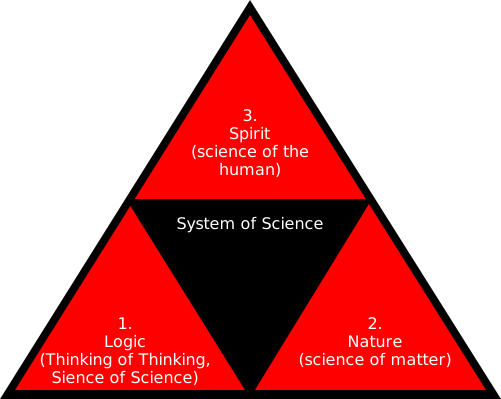
This question touches the systematic core of Hegel’s logic. Hegel had developed his Science of Logic as the explication of pure forms of thought—not as an empirical science about particular objects, but as reflection on the structures under which anything can be known as an object at all. Logic was meant to be neither natural science nor humanities, but their common methodological foundation.
But how does this foundation relate to the concrete sciences? Can philosophy prescribe to the natural sciences how they must proceed? Or must it content itself with the role of subsequent reflection on scientific results? Is speculative philosophy a rival to empirical research, or its necessary complement?
Four thinkers articulated this challenge, each in a different way: Trendelenburg raised the logical-methodological question of the rigor of dialectical transitions. Haym dissolved the system into its historical conditions. The Neo-Kantians demanded a return to the critical method against speculative arbitrariness. The positivists declared all metaphysics meaningless and demanded empirical verifiability as the sole criterion of truth.
All four directions grasped legitimate problems—but all of them absolutized their insight into a one-sided opposition to speculative philosophy.