The Three Points of Restoration: Systematic Fields of Conflict
This text is a preview of History of the Reception of Hegel, volume I, to be published in 2026 by Reflexivity Press.
Erdmann’s analysis of the three points of restoration offers the systematic key to understanding the school’s divisions. These points were not chosen arbitrarily, but marked the places where Hegel carried out a positive rehabilitation against the dominant tendencies of his age—the Enlightenment and critical philosophy.
The first point of restoration concerned the restitution of metaphysics. Kant, through his critique of pure reason, had disqualified traditional metaphysics as dogmatic and transgressive. Reason could think regulative ideas, but could gain no constitutive knowledge of the unconditioned. Against Kant, Hegel rehabilitated a systematic foundational science—logic as the presentation of the pure determinations of thought, which are at the same time the structures of being itself. This identity of thought and being was the scandalous claim of Hegelian logic.
At this point the first great conflict ignited: should this speculative unity be affirmatively developed further—or did one have to restore, precisely here, the critical limit that Kant had drawn? The Right understood logic as the completion of metaphysics and thereby justified theological dogmas. The Left understood logic as the critique of all metaphysics and dissolved the unity of thought and being into historical practice.
The second point of restoration concerned the positive relation to religion. The Enlightenment had criticized religion as superstition, priestly deception, or at best a moral surrogate for the uneducated. Against Enlightenment critique, Hegel rehabilitated the theoretical content of religious truth. Religion, he held, is a form in which absolute spirit becomes conscious of itself—still in the not-yet-adequate form of representation [Vorstellung], but with the same content as philosophy.
At this point the second great conflict ignited: was this rehabilitation meant seriously—or was it ironic critique? The Right understood it as a justification of Christian dogma, the Left as its sublation into anthropology. David Friedrich Strauss and Ludwig Feuerbach developed the anthropological turn: what religion presents as attributes of God are in truth attributes of humanity. Sublation turned into elimination.
The third point of restoration concerned the moral organism. The Enlightenment had conceived the social contract as a union of free individuals who protect their natural rights through rational agreement. Against atomistic individualism, Hegel rehabilitated the prior right of the whole. The state, he held, is not a contract but ethical substance—the reality of freedom, which realizes itself only in and through community.
At this point the third great conflict ignited: was this doctrine of the organism a justification of the existing order—or a critique of its irrationality? The Right understood it as legitimation of the Prussian monarchy, the Left as a demand for revolutionary transformation. The young Marx developed the insight that ethical substance is not realized in the state, but in the relations of social production and their contradictions.
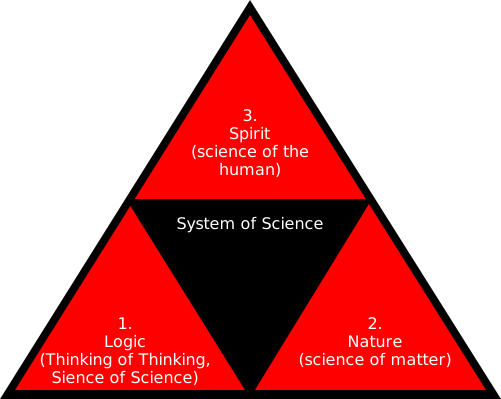
These three points of restoration were not isolated points of contention, but systematically connected. The question of metaphysics concerned the foundations of knowledge as such. The question of religion concerned the concrete shape of absolute knowledge. The question of the state concerned the practical realization of reason. Logic, religion, politics—the order of the conflicts mirrored the order of the Hegelian Encyclopedia.