Two Complementary Perspectives on the Same Development
This text is a preview of History of the Reception of Hegel, volume I, to be published in 2026 by Reflexivity Press.
For understanding this development, two outstanding sources are available to us, offering complementary perspectives whose integration alone allows for a complete picture.
Carl Ludwig Michelet wrote his History of the Development of the Most Recent German Philosophy in 1843, in the very midst of the movement.[1] As the left center of the school, he still saw the emerging divisions as productive tensions within a shared systematic foundation. His fundamental thesis was: “The Hegelian school forms the sample card of the entire history of philosophy, which repeats itself within it, but always assumes the form of systematic totality.”[2] The diversity of the school, he argued, results not from misunderstanding or external factors, but from the application of the same dialectical method to different aspects of reality. Michelet made this insight methodically explicit: “What is peculiar to Hegel is primarily the methodology; the content, however, can find justification only through the manner of dialectical progression. Since there is a correct and an incorrect application of the method, it follows that the diversity of content in the manifold directions of the school [follows from this].”[3]
This insight is systematically decisive: fragmentation is not interpreted as a symptom of degeneration, but as a necessary moment in the concretization of systematic totality. Michelet still saw the school as a living movement that might, through its inner differences, arrive at a higher unity.
Johann Eduard Erdmann wrote his Outline of the History of Philosophy in 1866, that is, after the school’s complete dissolution.[4] As a centrist with a tendency toward the right, he offered the most comprehensive collection of sources on the Hegelian school and saw the development as an inevitable disintegration. Erdmann identified three “points of restoration” at which Hegel’s philosophy set itself apart from the Enlightenment and Kantianism, and which became the school’s fault lines: the restitution of metaphysics against Kant, the positive relation to religion against Enlightenment critique, and the moral organism against atomistic individualism.[5] These three points formed the systematic fields of conflict along which the school split.
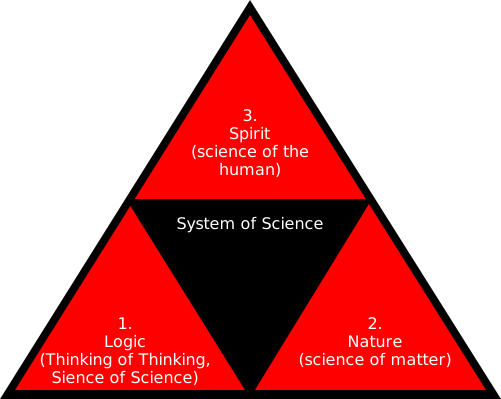
Erdmann’s observation was precise: the debates developed systematically—first around logical-metaphysical questions, then around questions in the philosophy of religion, and finally around ethical-political ones. This sequence mirrors the order of the Hegelian Encyclopedia: logic, nature, spirit. The fragmentation followed the inner structure of the system itself.
Both accounts are partisan—Michelet hopeful from within, Erdmann resigned from without. But their integration allows for a more complete picture of the inner logic of this movement, unique in the history of philosophy. Michelet grasps the productive energy of differentiation, Erdmann the systematic necessity of dissolution. Together they show: the fragmentation was neither accident nor decay, but the concrete shape that Hegel’s claim to totality had to assume under the historical conditions of the nineteenth century.
Carl Ludwig Michelet: Entwickelungsgeschichte der neuesten deutschen Philosophie mit besonderer Rücksicht auf den gegenwärtigen Kampf Schellings mit der Hegelschen Schule, Berlin: Duncker und Humblot, 1843. ↩︎
Michelet (1843), p. 12. ↩︎
Michelet (1843), p. 16. ↩︎
Johann Eduard Erdmann: Grundriss der Geschichte der Philosophie, vol. 3, Berlin 1866, 3rd ed. Berlin 1878. ↩︎
Erdmann (1866/1878), vol. 3, pp. 645–647. ↩︎