The Friends' Edition (1832–1845) — Collective Edition as the First Form of Reception
This text is a preview of History of the Reception of Hegel, volume I, to be published in 2026 by Reflexivity Press.
The edition of the “Works of the Friends of the Deceased” (1832–1845) was more than an editorial project. It was the first systematic form of Hegel reception—and at the same time its first distortion.
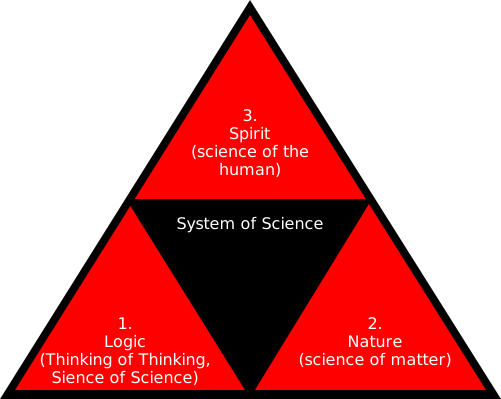
Collective work as an attempt at unification: All prominent Right- and Center-Hegelians (with the exception of Erdmann) worked together. This was remarkable at a time of growing division. The division of labor followed the parts of the system: each editor worked on one part of the Encyclopedia, trusting one another’s respective expertise. Trench warfare was avoided by concentrating on different areas. The organizational foundation for this undertaking had been laid by Eduard Gans (see Chapter 2.4).
Bruno Bauer as secret editor: The case of the philosophy of religion is especially interesting. Officially responsible was Marheineke, but the second edition was de facto edited by Bruno Bauer—at a time when the interpretation of the philosophy of religion was already contested. Bauer was still a Right-Hegelian at the time and possessed undisputed expertise. This personnel constellation shows that the Hegelians tried to bridge the emerging differences through collaborative work.
The naivety of smoothing over: The editors aimed to create a “living whole” out of the various lecture transcripts. They tried to resolve all differences into the “most mature, most complete form.” This corresponded to their experience with Hegel himself, who strove toward completion and sought the sublation of all differences. They were united in this ideal.
But this stance was naive. It smoothed over contradictions, swept developments under the rug, and made moments of learning disappear. What could have been recognized as a dynamic process across the various lectures now appeared as a static system. The tension between early and late versions, between experimental formulations and mature positions—all of this was lost.
Modern rediscovery: Only modern editorial philology has made these losses visible. Walter Jaeschke, in his editions of the lectures on the philosophy of religion, showed how much Hegel’s positions developed between different years. Annemarie Gethmann-Siefert demonstrated something similar for the lectures on aesthetics. The Friends’ Edition had flattened out this dynamic.
A sociological observation: The scholar of the Young Hegelians Wolfgang Eßbach aptly noted in his book on the Young Hegelians that, sociologically, the Left Hegelians were precisely those who did not obtain professorships (with the exception of Bruno Bauer, whose career ended promptly after his conversion to Left Hegelianism). This observation explains much about the dynamics of the school’s split. The Friends’ Edition was a project of the established, the academically successful.