The Center — The Great Universal Scholars of the Hegelian School
This text is a preview of History of the Reception of Hegel, volume I, to be published in 2026 by Reflexivity Press.
The reception of Hegel was shaped not only by “school splits,” but also by the extraordinary scholarly productivity of three universal scholars who had the good fortune to realize their comprehensive research programs as professors over the course of decades.
Johann Eduard Erdmann (1805–1892, 56 years as professor in Halle), Karl Rosenkranz (1805–1879, professor in Königsberg), and Carl Ludwig Michelet (1801–1893, teacher in Berlin) each developed complete systems of knowledge that extended far beyond Hegelian philosophy. Their more than 200 published works represent an attempt to realize the ideal of universal scholarship within German philosophy.
The Positioning: “Left,” “Center,” “Right” — Political-Religious, Not Philosophical
The designations “left center” (Michelet), “center of the center” (Rosenkranz), and “right center” (Erdmann) refer to political-religious orientation, not to philosophical fidelity to Hegel.
Paradoxically, it was precisely Rosenkranz, who politically and religiously stood in the “center,” who was philosophically furthest removed from Hegel—he was the only one who substantially reworked Hegelian logic (in a Kantianizing direction). Michelet, by contrast, politically furthest to the “left,” remained the most faithful to Hegelian systematics.
It is also important to note: “Right” in the context of the Hegelian school means something entirely different from what it means in later political usage. Erdmann, as “right center,” was a worldly, liberal, internationally networked scholar—he was simultaneously a follower of Bismarck and a personal friend of the French prime minister Thiers. Cosmopolitan education and an enlightened habitus were common to all three.
The Extended Center: Gans, Hotho, and the Institutional Base
The focus on three “universal scholars” is a dramaturgical simplification. The “left center” around Michelet also included Heinrich Gustav Hotho (to whom Michelet was related) and, above all, Eduard Gans (see Chapter 2.4). As organizer, Gans was at least as important as the three systematists—without him, the school would have had no institutional base.
Hotho is difficult to classify: editorially, he worked with the Right Hegelians on the Friends’ Edition, but he stood close to the left center. His edition of the lectures on aesthetics (1835–1838) became the standard version and decisively shaped the image of Hegelian aesthetics—though with the problem of “smoothing over” already discussed (see Chapter 2.2).
The institutional foundation: these philosophers benefited from the institutional stability of the German university system, which afforded them lifelong appointments, access to extensive libraries, and international networking. They were able to pursue major systematic projects over the course of decades—a privilege largely lost to philosophy after 1900.
Carl Ludwig Michelet (1801–1893) — The Visionary Program of Integration
Michelet occupies a unique position within the Hegelian school. As co-editor of Hegel’s works (especially the philosophy of nature) and an active member of the “Association of Friends of the Deceased,” he was institutionally central. Wolfgang Eßbach’s sociological analysis of the Young Hegelians as those Hegelians “who would no longer have obtained a professorship” makes Michelet’s position as “left center” with an actual teaching post sociologically plausible—he was systematically progressive but institutionally integrated.
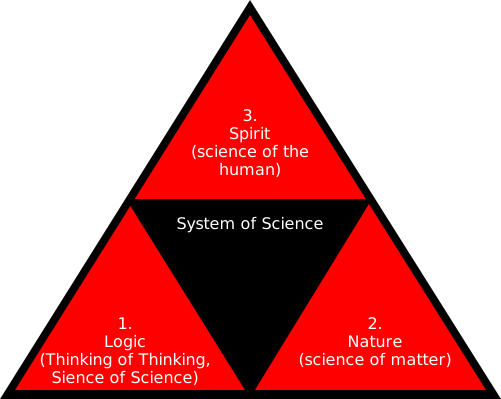
Michelet’s five-volume System of Philosophy as an Exact Science (1876–1881) was the most ambitious attempt to update Hegel’s approach for the second half of the nineteenth century. He retains the basic structure (logic -> nature -> spirit), but carries out decisive modifications.
In the philosophy of nature, he systematically integrates the “tremendous advances” of the empirical sciences. His treatment of Darwin shows his differentiated approach: he knows the theory of evolution precisely, but criticizes it as “thoroughly materialistic” and develops an idealist alternative—an “ideal sequence of stages” instead of “real descent.” With electricity and magnetism, he succeeds in integrating new discoveries (Oersted, Faraday) into the Hegelian conceptual framework.
In the philosophy of history, he carries out a structural innovation: world history, rather than philosophy, as the completion of the system. This shift means that philosophy does not merely contemplatively comprehend the past, but practically orients the future—“philosophy, too, is the cock’s crow of a newly dawning morning.”
The “Third Book: The Post-Historical Age” (pp. 642ff.) unfolds a remarkably visionary utopia. Michelet prophesies the technological overcoming of nature’s limits through “mechanics, technology, industry”—railways, steamships, and telegraphs as means for the “fraternization of nations.” He envisions an “Areopagus of Humanity” in Constantinople as a world court, to which five continental federations of states would send delegates—a vision anticipating the UN and the EU. Wars will cease, standing armies will be abolished, an “eternal peace” realized. Remarkably progressive, he advocates women’s suffrage: “In Victoria, women have the right to vote”—and this is correct, he argues, since laws are made concerning women, and they should therefore have a say “by virtue of the right of self-governance.”
This humanistic vision combines prophetic foresight with the Eurocentrism of its time—the “Caucasian race” is to “raise the others up to itself.” Michelet’s utopia shows both the emancipatory potential of Hegelianism and its limits.
The late attempt at a Hegelian renaissance: In the 1860s Michelet, together with August von Cieszkowski (the Polish Hegelian, see Chapter 12.3), undertook an attempt to revive the Hegelian tradition. They founded the journal Der Gedanke (1861–1884, see Chapter 2.3) and a “Philosophical Society” in Berlin. The attempt remained largely without effect, but documents Michelet’s unwavering conviction that Hegelian philosophy still had a future.
Further systematic works: Psychology, or the Science of Subjective Spirit (1837), Anthropology and Psychology (1840), Lectures on the Personality of God (1840–1841), The Epiphany of the Eternal Personality of Spirit (1844), Natural Right, or Philosophy of Right (1866), History of Humanity in Its Course of Development (1859–1860).
Karl Rosenkranz (1805–1879) — Ironic Mediation and Tragic Revision of the Logic
Karl Rosenkranz was the most creative mind among the Center Hegelians. As a student of Schleiermacher and then of Hegel, and holder of the Kant chair in Königsberg, he combined different philosophical traditions.
His scholarly works: Psychology, or the Science of Subjective Spirit (1837), the first Hegel biography (Georg Wilhelm Friedrich Hegel’s Life, 1844), and he edited Kant’s works.
His body of aesthetic work is remarkable: Aesthetics of the Ugly (1853) was a genuine speculative innovation—the ugly as a necessary moment of aesthetic totality. To this were added the Handbook of a General History of Poetry (1832–1833), Poetry and Its History (1855), Goethe and His Works, and a biography of Diderot. His Pedagogy as a System (1848) became an international standard work.
Rosenkranz’s Science of the Logical Idea (1858/59) was the didactically most valuable commentary on the logic of his time. He was the only Hegelian who undertook his own reworking of the logic (metaphysics, logic, theory of ideas), inspired by Hegel’s early drafts.
The tragedy: Rosenkranz’s fundamentally Kantian formation led to a re-Kantianization of Hegel. The intermingling of logical and ontological categories—Hegel’s post-Kantian innovation—was viewed as an error and the separation restored. This was a systematic regression, despite its didactic value.
Rosenkranz positioned himself deliberately, ironically, in the “center of speculation.” He “no longer wants to rescue the entire content of representation… over into philosophy”—a critical distance both from the Right and from the Left.
Johann Eduard Erdmann (1805–1892) — Historiographical Competence and Retrospective Analysis
Johann Eduard Erdmann was a universally learned historian of philosophy who read all relevant philosophers in their original languages (ancient Greek, Latin, English, French, German). He was professor in Halle for 56 years.
In the exploration of sources he did pioneering work: the first critical edition of Leibniz, recognition of the significance of Leibniz’s letters, work on medieval philosophy.
His major historiographical works—the Attempt at a Scientific Presentation of the History of Recent Philosophy (1834–1853) and the Outline of the History of Philosophy (1865)—were methodological innovations and international standard works.
Erdmann’s historiographical method regarded systematic philosophy as superseded, replaced by the history of philosophical system-building. He recognized a twofold necessity in the development of philosophy—world-historical and history-of-philosophy. His interpretation of the school’s split as a necessary consequence of Hegel’s own inner tensions was methodologically innovative: each direction develops legitimate moments, but none attains the totality.
In logic and psychology, he wrote the Outline of Logic and Metaphysics (1841), Outline of Psychology (1840), and Psychological Letters—clarifying in concept and influential.
The political turn: Erdmann became a follower of Bismarck, a “Prussian state philosopher” (Philosophical Lectures on the State, 1851). At the same time he was a personal friend of the French prime minister Adolphe Thiers—a remarkable constellation, showing how the cosmopolitan networking of the Hegelians spanned even the national antagonisms of the German-French conflict.[1]
The systematic limit: his retrospective view led to a deterministic interpretation and a one-sided image of Hegel as a “philosophy of restoration.”
The “Extended Elephant Principle” and the Systematic Necessity of the Center Position
Different perspectives each grasp one aspect of the truth. Each of the three Center Hegelians grasped different aspects of totality: Rosenkranz the aesthetic-cultural dimension, Erdmann the historical-developmental-logical dimension, Michelet the scientific-practical, future-oriented dimension.
The meta-role of philosophy requires the extended elephant principle: philosophy/logic, as the science of the sciences, as reflection on the foundations of all systematic truth-finding, must apply the elephant principle to itself. This means: it must be able to integrate not only different aspects of reality, but also different forms of thought, categories, and methods.
The failure of the Hegelian school lay in its restriction to integrating content within the Hegelian or Hegelian-Marxian systems of categories, without subjecting the category systems themselves to dialectical expansion and transformation. This shows the necessity of a methodical innovation that is only attempted in the twentieth century.
The limits without deeper methodical innovation: all three recognized the necessity of integrating different perspectives, but without a theory of reflection as their basis, they could not achieve a qualitative transformation of the principles of integration themselves.
The shared achievement: these three universal scholars accomplished the systematic exploration of all relevant fields of knowledge of their time on the basis of the dialectical method. They showed that a productive reception of Hegel was possible—one that neither rigidified into dogma nor abandoned systematic orientation.
Rather than as “epigones,” these three should be honored as the last representatives of the ideal of philosophical universal scholarship. Their “failure” lay not in a lack of innovative power, but in the historical impossibility of maintaining the ideal of totality under the conditions of modern scientific differentiation.
On Erdmann’s biography, see Hermann Glockner: Erdmanns Leben und Werke, introduction to: Johann Eduard Erdmann: Versuch einer wissenschaftlichen Darstellung der Geschichte der neuern Philosophie, 7 vols., Leipzig 1834–1853; reprint, 2nd ed., Stuttgart-Bad Cannstatt: Frommann-Holzboog, 1977, vol. 1. ↩︎