Donald Davidson — Truth and Interpretation (1967-1984)
This text is a preview of History of the Reception of Hegel, volume II, to be published in 2026 by Reflexivity Press.
Radical Interpretation and Conceptual Schemes
Donald Davidson (1917-2003) radicalized Quine’s holism into a theory of meaning. His question: how is understanding possible? How can we interpret the utterances of others (or of foreign cultures)?[1]
Radical interpretation: Davidson imagined a thought experiment: a linguist encounters a completely unknown language. He has no dictionaries, no interpreters, only the speakers’ utterances and their behavior. How can he understand the language?
Davidson’s answer: only through the “principle of charity.” The interpreter must assume that speakers largely hold true beliefs and largely act rationally. Without this assumption, interpretation is impossible — any utterance could mean anything.
The critique of conceptual schemes: In “On the Very Idea of a Conceptual Scheme” (1974), Davidson criticized the notion that different cultures or theories have “incommensurable” conceptual schemes that make mutual understanding impossible.[2]
The argument: if two schemes were truly incommensurable, we could not even say that they are “different” — for “difference” presupposes a common standard. Talk of “different conceptual schemes” is incoherent. There is no “the world” (schema-neutral) and “the schemes” (culturally relative), but only the one world, which we describe differently.
The Hegelian dimension: Here Davidson approaches Hegel’s critique of the “thing in itself.” Kant distinguished between appearance (how the world appears to us) and the thing in itself (how the world “really” is). Hegel’s critique: this distinction is incoherent — if the thing in itself is entirely unknowable, we cannot even say that it “exists” or is “different from” appearance. Davidson makes the same critique of the scheme-content distinction.[3]
Anomalous Monism and the Irreducibility of the Mental
Davidson’s philosophy of mind — “anomalous monism” — likewise has Hegelian features. He argues: the mental is not reducible to the physical (there are no “psychophysical laws”), but it is also not ontologically separate (dualism). Mental events are identical with physical events, but under mental descriptions they follow different rules than they do under physical descriptions.[4]
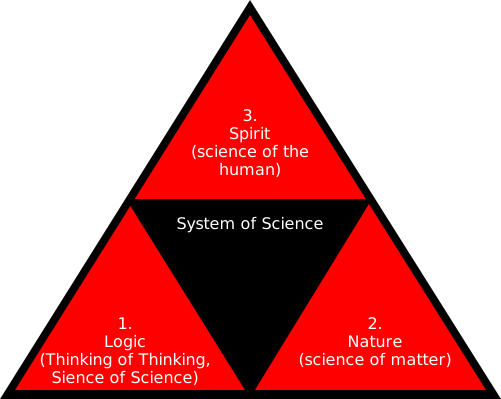
This means: the language of mind (beliefs, desires, intentions) has a rationality of its own that cannot be reduced to natural science. This is Hegel’s insight that “objective spirit” (right, morality, ethical life) has structures of its own that cannot be derived from nature — but are also not dualistically separate from it.
Donald Davidson: “Truth and Meaning” (1967), in: idem: Inquiries into Truth and Interpretation, Oxford: Clarendon Press, 1984. ↩︎
Donald Davidson: “On the Very Idea of a Conceptual Scheme” (1974), in: Inquiries into Truth and Interpretation, pp. 183-198. ↩︎
On the parallel between Davidson and Hegel, cf. John McDowell: “Gadamer and Davidson on Understanding and Relativism,” in: idem: The Engaged Intellect, Cambridge/MA: Harvard University Press, 2009, pp. 134-151. ↩︎
Donald Davidson: “Mental Events” (1970), in: idem: Essays on Actions and Events, Oxford: Clarendon Press, 1980. ↩︎