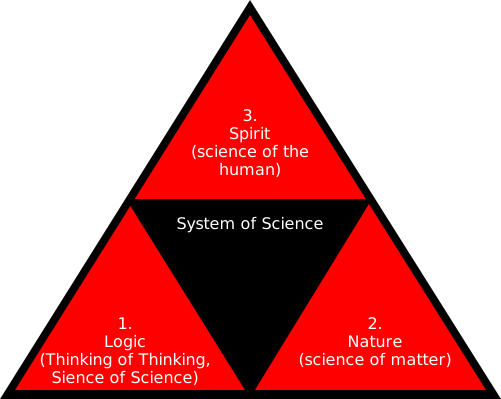
Systematic Balance: The Ironic Convergence
This text is a preview of History of the Reception of Hegel, volume II, to be published in 2026 by Reflexivity Press.
What Happened?
Between 1950 and 1989, analytic philosophy underwent a remarkable transformation:
1950: Hegel is considered finished. Analytic philosophy defines itself through the rejection of metaphysics, speculation, systematicity. Empiricism, logic, and linguistic analysis are the watchwords.
1989: The foundations of empiricism are shaken. Holism replaces atomism, contextuality replaces foundationalism, social practice replaces individual consciousness. Metaphysics has been rehabilitated (Kripke), the given is a myth (Sellars), conceptual schemes are incoherent (Davidson).
This development was not a return to Hegel — analysts continued not to read Hegel (with exceptions such as Findlay and Taylor). But it was a structural convergence. Analytic self-critique led to insights that Hegel’s Logic already contained:
- Holism: the true is the whole
- Mediation: no immediate knowledge
- Social constitution: spirit is objective, not merely subjective
- Conceptual necessity: not everything is empirically contingent
The Open Question
The ironic convergence raises a question: if analytic philosophy, through its own development, arrived at Hegelian structures — was the original rejection of Hegel a misunderstanding? Or did the analytic tradition discover something new, which Hegel had only seemed to anticipate?
The answer is complex: both are partly true. The rejection of Hegel was a misunderstanding (Russell, Ayer, and Popper did not understand Hegel). But the analytic reformulation is not mere repetition — it is transformation. Quine’s holism is not Hegel’s dialectic, Davidson’s radical interpretation is not Hegel’s phenomenology, Kripke’s essentialism is not Hegel’s logic of the concept.
The task for a contemporary philosophy of Hegel: to integrate the analytic insights without losing the dialectical depth. That is the program of the Pittsburgh School — and the subject of Volume III.