Commentary on Subjective Spirit, Chapter 39
The Formula of Division
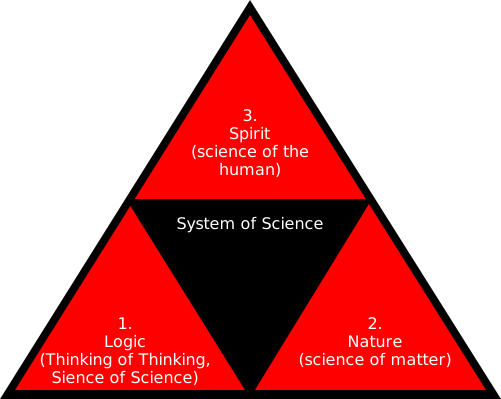
Drüe renders Hegel’s division of spirit in three sentences worth remembering:
“1. Subjective spirit always exists in the form of relation to itself. 2. Objective spirit exists in a form of reality that it itself produces. 3. Absolute spirit is the truly true spirit; it lives in the in-and-for-itself unity of the objectivity of spirit and its concept.”[1]
And he names the reason why subjective spirit is the least adequate: it is “least adequate to its telos: it is at the outset still bound up with the otherness of nature.”
Why this inadequacy drives things forward, Drüe formulates more precisely than Hegel himself: it contradicts spirit “because it is not truly immediate but posited only in itself. This contradiction prompts spirit to work off the shine of immediacy it has found.”
Shine of immediacy — this is the expression that was missing. What anthropology finds is not really immediate; it only appears to be. And that is precisely why it cannot remain as it is.
His Account of the History of Criticism
Drüe classifies the objections raised against subjective spirit by type — and the second type identifies an attitude still widespread today:
“Another type of criticism rejects Hegel’s systematics but wants to retain certain individual insights into human nature. In this critique, the theorist of subjectivity is attacked, while the so-called perceptive observer of human nature is acknowledged instead; such praise is certainly not in Hegel’s sense.”
This describes exactly the procedure this volume avoids — praising the individual observations while discarding the order that produced them.
Hermann Drüe, “Die Philosophie des Geistes,” in: Hegels „Enzyklopädie der philosophischen Wissenschaften“ (1830). Ein Kommentar zum Systemgrundriß, ed. by Herbert Schnädelbach, Frankfurt 2000, pp. 206 ff. ↩︎