12333
Interaction
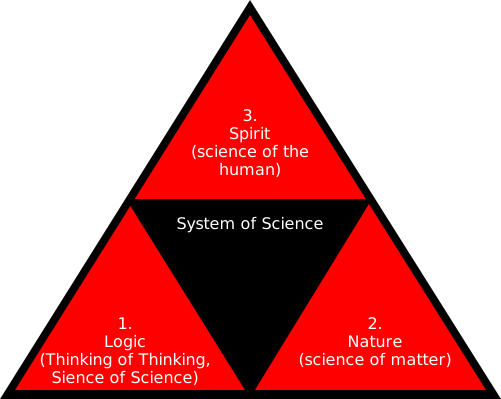
?- 0 Hegel's 'System of Science'
- 1 Logic (Thinking of Thinking, Science of Science)
- 2 Nature (science of matter)
- 3 Spirit/Mind (Science of humanities)
- 11 Being (immediateness, 'Ontology')
- 12 Essence (mediation, reflection, metaphysics)
- 13 Concept (Notion / Logos / Comprehension, 'Begriff')
- 121 Essence as Reflection Within Itself
- 122 Appearance (Erscheinung)
- 123 Actuality (Wirklichkeit)
- 1231 The Absolute
- 1232 Actuality as such
- 1233 Absolute Relation
- 12331 Substance - Accidents
- 12332 Causality
- 12333 Interaction
Reciprocal Action
To the glossary index · ↑ Top of page
Reciprocal action is completed mediation: A and B mutually constitute one another (A⇄B). Each is at once cause and effect. Examples: subject and object in cognition (subject structures the object, object resists the subject), teacher and student (both learn from one another), individual and society (socialization ⇄ innovation). Reciprocal action is the truth of causality: not one-sided determination, but mutual constitution. It leads to freedom: if I determine myself through my other, and this other is my own product, I am with myself - free.
Origin: Kant: reciprocal action as the third category of relation (alongside substance/accident and causality). Fichte: mutual determination of I and not-I. Hegel completes this: reciprocal action as the self-movement of the matter itself, no longer external reflection.
In Hegel: Enz. §155-157; Science of Logic, Vol. 2, Actuality
Cross-references: Causality, Substance, Relation, Freedom, Concept, Logic of Essence, Necessity