12332
Causality
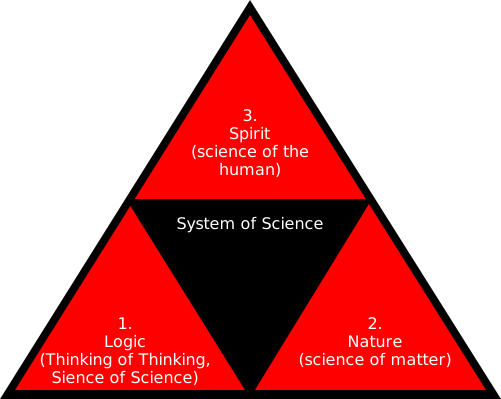
?- 0 Hegel's 'System of Science'
- 1 Logic (Thinking of Thinking, Science of Science)
- 2 Nature (science of matter)
- 3 Spirit/Mind (Science of humanities)
- 11 Being (immediateness, 'Ontology')
- 12 Essence (mediation, reflection, metaphysics)
- 13 Concept (Notion / Logos / Comprehension, 'Begriff')
- 121 Essence as Reflection Within Itself
- 122 Appearance (Erscheinung)
- 123 Actuality (Wirklichkeit)
- 1231 The Absolute
- 1232 Actuality as such
- 1233 Absolute Relation
- 12331 Substance - Accidents
- 12332 Causality
- 12333 Interaction
- 123321 Cause (formal cause, 'Ursache')
- 123322 Effect (determined cause, 'Wirkung')
- 123323 Counteraction
Causality
To the glossary index · ↑ Top of page
Causality is the activity of substance: cause effects effect. Hegel develops three stages: (1) formal causality --- abstract relation A→B, (Ch. 2) finite causality --- cause passes into effect and partly vanishes (match ignites candle), (3) infinite causality --- cause preserves itself in its effect (sun warms earth). The effect is not passive, but reacts to the cause (reaction). This leads to interaction. Hegel's answer to Hume's skepticism about causality: causality is not mere habit, but the structure of mediation of reality itself.
Origin: Aristotle: four causes (*causa materialis, formalis, efficiens, finalis*). Hume: causality is only habitual expectation. Kant: causality as a category of the understanding. Hegel: causality as an objective structure of self-mediating reality.
In Hegel: Enc. §153-154; SL Vol. 2, Actuality
Cross-references: Substance, Interaction, Necessity, Ground, Actuality, Logic of Essence