The First Generation: The Lyubomudry (1823-1830)
This text is a preview of History of the Reception of Hegel, volume I, to be published in 2026 by Reflexivity Press.
Historical Context: Between Enlightenment and Reaction
The 1820s were a time of the highest intellectual tension in Russia. The Napoleonic Wars had brought Russian officers into contact with the ideas of the Enlightenment and the French Revolution. The return of these officers to Russia led to the emergence of the Decembrist movement—a grouping, predominantly of noble officers, seeking a constitutional state.
In this climate, a small group of young nobles emerged who sought a different path: not political revolution, but the spiritual renewal of Russia through philosophy. They called themselves “Lyubomudry” (Любомудры)—Lovers of Wisdom, the Russian translation of “philosophers.”[1]
The choice of name was programmatic: they wanted to distinguish themselves from the “French philosophers”—Voltaire, Diderot, the materialist encyclopedists. The Russian Lovers of Wisdom oriented themselves toward German idealist philosophy, especially Schelling. Hegel’s influence was still slight in this early phase, though not entirely absent.[2]
Vladimir Odoevsky - The Pioneer of Russian Idealism
Vladimir Fyodorovich Odoevsky (Владимир Фёдорович Одоевский, 1804-1869) was the central figure of the Lyubomudry. As the son of a hero of the Patriotic War of 1812, he came from the highest nobility and enjoyed an excellent education. At age twelve he entered the “Благородный пансион” (Noble Boarding School) attached to Moscow University, where he found his first philosophy teachers: the professors Pavlov and Davydov.[3]
The Founding of the Society of Lyubomudry (1823)
“From the windows of the boarding school Odoevsky could already see the temple of the love of wisdom, in which among the gods Schelling too had his place.”[4] Philosophy and religion—these were the themes that occupied the young prince. Already in his graduation speech Odoevsky addressed the relationship between philosophy and religion, giving—characteristically for his entire later development—priority to religion: “May the whole ladder of human knowledge be illuminated by the inextinguishable light of religion—this one, true wisdom!”[5]
School had brought Odoevsky “to the threshold of the love of wisdom.” “The door was barely opened a crack.”[6] To open it fully—that would become the task of the Lyubomudry.
In 1823, Odoevsky, together with other young Moscow nobles, founded the “Общество любомудрия” (Society of the Lovers of Wisdom). The organization was systematically structured: Odoevsky became chairman, Dmitry Venevitinov (1805-1827) secretary. Among the members were the brothers Ivan (1806-1856) and Pyotr Kireevsky, Stepan Shevyrev (1806-1864), Mikhail Pogodin (1800-1875), and Alexander Koshelev (1806-1883).[7]
The age of the “philosophers” ranged between 17 and 20 years—and yet these young men set themselves a colossal task: “To open philosophy for Russia—and Russia for philosophy.” Well, youth loves grand plans.[8]
“Mnemosyne” - Russia’s First Philosophical Journal (1824-1825)
To spread their ideas, the Lyubomudry founded the journal “Мнемозина” (Mnemosyne) in 1824—in fact the first philosophical journal in Russian. In it, Odoevsky set out the program of the philosophical enlightenment of Russia:
“It must be admitted with regret that we Russians are not yet rich in philosophical writings… There is not a single complete course of philosophy, there is not even a single journal in which at least a few pages were devoted to philosophy…”[9]
The development of the sciences, he argued, was impossible without philosophy:
“There is no more laborious and useless work than the occupation with merely empirical knowledge, without any higher perspective on it. Hence it usually happens that people of excellent gifts, who devote themselves to all manner of sciences and strive in all directions—without order, without definite laws derived from unconditional principles—penetrate to no core that could serve as the root of a many-sided and infinite education.”[10]
Philosophy as the “Science of Sciences”
Odoevsky’s understanding of philosophy was radical: philosophy is the “science of sciences” (наука наук), the sun that illuminates the planets of the individual sciences. Without knowledge of philosophy, he held, genuine knowledge in the specialized sciences was impossible.[11]
Odoevsky defended this position against the empiricism of his former teacher Pavlov. When the latter proclaimed the primacy of the individual sciences, the young lover of wisdom sharply replied:
“The study of philosophy must precede the study of any particular science… Only in this way, once one has understood the position of one’s particular science within the system of knowledge as a whole, can any scholar grasp its spirit and ‘the manner in which one devotes oneself to it—not servilely, but freely embracing the whole in spirit.’”[12]
The young Odoevsky passed a harsh but fair judgment on Russian culture:
“The sole reason that to this day we are mere imitators in the arts and sciences is the contempt for the love of wisdom (презрение к любомудрию).”[13]
Odoevsky’s Philosophy: The Search for the “Bezuslov” (the Absolute)
The “Dictionary of the History of Philosophy”
The Lyubomudry’s program did not stop at mere proclamation. To fill the gap left by the absence of a “course of philosophy” in Russian, Odoevsky (calling on all capable persons to help) set about compiling a “Словарь истории философии” (Dictionary of the History of Philosophy). This work was, however, never completed—only one chapter of the planned course appeared in “Mnemosyne.”[14]
In another article, titled “Афоризмы из различных писателей по части современного германского любомудрия” (Aphorisms from Various Writers on Contemporary German Philosophy), Odoevsky set out his “idea of the sciences”:
“…a unified unconditional knowledge which, dividing itself into branches according to the various stages of the revealing ideal world, forms the immeasurable tree of knowledge.”[15]
As Sakulin rightly observes: “This ‘idea of the sciences’ is nothing other than Schelling’s philosophy of identity.”[16]
The Dialectic of the Material and the Abstract
Odoevsky formulated his understanding of Schelling’s teaching as follows:
“The material is equal to the abstract; the material and the abstract are one and the same, only in twofold form: in the abstract—in the form of the boundless, eternal, whole; the material is the same abstract, only broken into pieces, in the form of particular shapes; in the abstract—a boundless form; here—eternity, there—infinity. The idea of this perfect unity of the abstract with the material—is the Absolute. This idea is reflected in us—and our knowledge in its totality must be its imprint.”[17]
Odoevsky’s understanding of “dialectic,” then, follows rather Schelling’s doctrine of polarity—the unity of opposites in a higher third term. Hegel’s dialectic, by contrast, is processual: the opposites are not statically united but develop apart from and through one another. Unity is not presupposed but is first generated in the process of mediation.[18]
The Copernican Turn: From Object to Subject
Here Odoevsky accomplishes—without knowing Hegel at the time![19]—a revolution in Russian philosophy. He turns the vector of thought, of spirit, from the cognition of nature, from the philosophy of nature, onto itself:
“But everything that emerges directly from the Unconditioned is the unconditional reflection of the universe, and being, nature—is its second manifestation. In the realm of the material, finitude reigns; in the realm of the abstract—infinity. The first depends on necessity, the second on freedom. The human being, as a rational creature, is destined to be the completion of the world’s revelation; from its activity develops the completion of the totality of the manifestation of the All-perfect, for although nature reflects it, it does so only materially; the rational being, however, reflects the very essence of the Absolute, hence—abstractly.”[20]
Without being consciously aware of it at the time, Odoevsky followed objectively the Hegelian schema of the development of absolute spirit toward the cognition of the absolute idea:
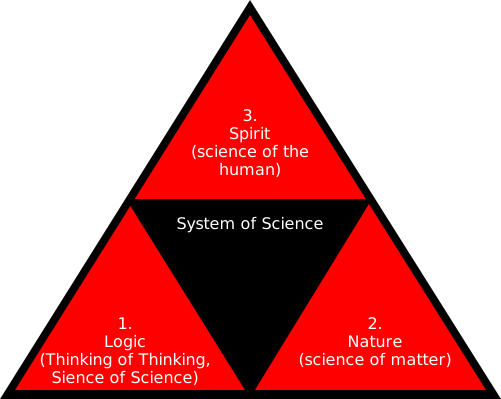
- First spirit directs itself toward the cognition of the idea (and of itself) in its otherness, in nature -> philosophy of nature
- Then cognition (which is the self-cognition of spirit) returns to itself -> philosophy of spirit
- Finally it reaches the absolute forms: art, religion, philosophy[21]
Odoevsky’s intellectual work vividly demonstrated this lawful transition from the philosophy of nature to the philosophy of spirit, although he himself was not yet fully aware of it.[22]
The “Bezuslov” - Odoevsky’s Concept of the Absolute
The proclamation of the Absolute, the propaganda for the necessity of grasping it, became Odoevsky’s main goal. In his missionary zeal, the lover of wisdom translated into Russian not only the ideas of German idealism but also the conceptual apparatus itself: he called the Absolute “Безуслов” (Bezuslov—the unconditioned, the unconditional).[23]
“There must, after all, be a thought that would be the foundation of all foundations, the condition of all conditions. Without it, all human knowledge is chaos.”[24]
This condition of all conditions, sought by philosophers of all ages, is precisely the “Bezuslov.” Even empiricists seek—contradicting themselves—a theoretical foundation for their experiments:
“Consequently, the existence of the Bezuslov is found in the reason of every individual, whether he wants it or not.”[25]
Philosophical assessment: Odoevsky’s “Bezuslov” follows Schelling’s absolute point of indifference—an Absolute directly graspable through intellectual intuition, PRIOR to all conceptual differentiation. This differs fundamentally from Hegel’s “absolute idea,” which is precisely NOT a starting point but a result—the insight into the method AFTER a development has been traversed. For Hegel, the Absolute is the method of conceptual thought that has become transparent to itself.[26] Odoevsky remained within the Schellingian paradigm and did not recognize Hegel’s methodical turn.
The Literary Work: Philosophy as a Form of Life
The “Strange Man” - A Philosophical Type
Odoevsky’s philosophical convictions found expression not only in theoretical articles but also in literary works. He created the type of the “странный человек” (strange man)—a character alien to ordinary society because he strives for the Absolute.
In his tale “Сегелиель, или Совершенный мудрец” (Segeliel, or The Perfect Sage), Odoevsky has his protagonist declare:
“The human soul cannot bear one thing—mediocrity; it always strives for the outermost limits—toward the Absolute Good or the Absolute Evil.”[27]
This philosophical type of the “strange man” was introduced by Odoevsky into Russian literature and had an enormous effect. Sakulin remarked on “an interesting coincidence of epithets and types”: in the 1820s, Odoevsky cast the type of the “strange man” into Russian literature and the consciousness of the reading public—in 1831 Lermontov’s drama “Странный человек” (A Strange Man) appeared, and in 1839-1840 Lermontov wrote “Герой нашего времени” (A Hero of Our Time), with the famous Pechorin—the incarnation of the “strange man.”[28]
“Russian Nights” - The Struggle Against Materialism
Odoevsky’s main work, “Русские ночи” (Russian Nights, 1844), is a philosophical novel in dialogue form that stages the confrontation between idealism and the emerging materialism.[29]
The work is a sharp critique of:
- Bourgeois economics and utilitarianism
- The greed for money of modern society
- Scientific one-sidedness without a philosophical foundation
In a famous comparison, Odoevsky calls the bourgeois economists “cesspool cleaners”—an allusion to the fact that they see only the low, material side of the human being, not the spiritual, the striving toward the Absolute.[30]
The book was Odoevsky’s attempt to defend the philosophical ideals of the Lyubomudry against the emerging positivism and materialism of the 1840s. It remained largely unnoticed—the times were no longer on its side.[31]
The Downfall of the Lyubomudry: The Decembrist Uprising (1825)
In December 1825 came the catastrophe. After the death of Tsar Alexander I, the Decembrist uprising occurred—a group of liberal officers attempted to force through a constitutional monarchy. The uprising was bloodily suppressed, its leaders executed or exiled to Siberia.
Although the Lyubomudry had no connection whatsoever to the Decembrists—they were, after all, pursuing the opposite path of purely spiritual renewal—they too came under suspicion. Any kind of organization of young nobles was now suspect. Political reaction under Nicholas I made philosophical circles dangerous.[32]
The lover of wisdom and later Slavophile Alexander Koshelev (А. И. Кошелев) recalled:
“After the 15th of December [the day of the uprising], a rumor spread through Moscow that the rebellious southern army was marching on the capital. […] The Lyubomudry unanimously decided to dissolve their society. Prince Odoevsky ceremonially burned the society’s statutes in his fireplace.”[33]
The End of an Era
In 1826, Odoevsky (like his friends Venevitinov and Koshelev) moved to St. Petersburg. There the philosopher-prince tried to continue his philosophical work, stayed in contact with old friends, and collaborated on the “Московский вестник” (Moscow Herald)—a journal meant to replace “Mnemosyne.”[34]
But two blows of fate ended this phase for good:
- The sudden death of Venevitinov in 1827 (at only 22 years of age!)
- The closure of the “Moscow Herald” in 1830
The Lyubomudr Melgunov wrote to Odoevsky in 1827:
“It is as if an evil spirit rules over our literary Russia.”[35]
The first generation of Russian Hegelians had failed—through external circumstances, not internal contradictions. But their work had not been in vain. They had laid the foundation on which a second generation could build.
Odoevsky’s Later Development: From Schelling to Schelling
After 1830, Odoevsky turned increasingly to literature and music theory. His philosophical interests did not lose intensity, but changed direction.
The Rejection of Hegel
When Odoevsky finally studied Hegel systematically in the 1840s, he rejected him. During a visit to Berlin in 1842 he met Schelling, who at the time was developing his “Philosophy of Revelation”—an explicitly anti-Hegelian position (cf. section 5.2). Odoevsky became an enthusiastic follower of the late Schelling.[36]
In a letter from Berlin, Odoevsky wrote, full of indignation, about Hegel:
“In his treatment of God, of ethics, indeed of everything, absolute negativity reigns in Hegel.”[37]
He was especially outraged by Hegel’s doctrine of the death of God in the philosophy of religion. Odoevsky was and remained a religious idealist—Hegel’s “panlogism” appeared to him as disguised atheism.[38]
This rejection of Hegel had philosophical grounds, but also biographical-psychological ones: Odoevsky had found his philosophical identity as a Schellingian. The late Schelling (like Schopenhauer later) offered the possibility of holding on to idealism without following Hegel—this was attractive to Odoevsky.[39]
Odoevsky’s rejection of Hegel followed consistently from his position: Hegel appeared to him as a “rationalist” who subjected the Absolute to conceptual thought. For Odoevsky, the Absolute remained accessible only religiously-mystically—through “faith” and “intuition,” not through discursive philosophy. From the perspective of the Hegel interpretation underlying this work, it becomes clear: Odoevsky missed Hegel’s methodological innovation. Hegel does NOT hypostatize conceptual thought but performatively explicates the structures of rational practice. For Hegel, “religion” remains an independent form of the Absolute—but philosophy can make these structures conceptually transparent WITHOUT eliminating them.[40]
Odoevsky’s Historical Significance
Despite his rejection of Hegel, Odoevsky remains a key figure in Russian intellectual history:
- He founded the philosophical tradition in Russia—for the first time in Russian
- He created the type of the philosophical human being in Russian literature
- He formed the first philosophical circle (the Lyubomudry)
- He prepared the ground for the second generation—the Stankevich Circle
Without Odoevsky and the Lyubomudry, Russian Hegelianism would not have been possible. They laid the foundation—even if they themselves did not complete the building.[41]
Philosophical Balance: Odoevsky and the Limits of Schellingianism
From the perspective of the Hegel interpretation underlying this work, it becomes clear: the Lyubomudry grasped important aspects of German idealist philosophy—the search for the Unconditioned, the overcoming of empiricism, the systematic unity of knowledge. But they did not grasp Hegel’s decisive innovation: the performative self-reflection of method.[42]
Odoevsky’s “Bezuslov” remained a presupposed Absolute—accessible through intuition or faith, not through conceptual development. Hegel’s “absolute idea,” by contrast, is the RESULT of the systematic self-unfolding of the concept—the method that grasps itself as method. The Absolute is not BEYOND mediation (as in Schelling) but the consciously accomplished mediation itself.
This philosophical difference explains why Odoevsky ultimately remained with Schelling: Hegel’s philosophy demands the renunciation of immediate certainty. It begins with doubt at the outset and traverses all mediations. For Odoevsky, for whom religious certainty was the foundation, this path remained closed.
The word “любомудрие” (lyubomudrie = love of wisdom) was already in use in the eighteenth century (e.g., by Radishchev) as a literal translation of the Greek “philosophia.” Mystics preferred this expression “because true wisdom is accessible to God alone” (Sakulin, quoted in Sarychev 2021, p. 48, n. 66). ↩︎
Sarychev 2021, pp. 47-50. The distancing from the French materialists was also politically motivated: after the Napoleonic Wars, “French ideas” were compromised. ↩︎
Sarychev 2021, p. 48. In detail on Odoevsky’s biography: P. N. Sakulin: Iz istorii russkogo idealizma. Knjaz’ V. F. Odoevskij, Moscow: Sabashnikov, 1913, Vol. 1, Part 1, pp. 80-103. ↩︎
Sarychev 2021, p. 48, quoting Sakulin 1913, Vol. 1, Part 1, p. 98. ↩︎
Sarychev 2021, p. 48, quoting Sakulin 1913, Vol. 1, Part 1, p. 89. ↩︎
Sarychev 2021, p. 48, quoting Sakulin 1913, Vol. 1, Part 1, p. 103. ↩︎
Sarychev 2021, pp. 48-49. These names are of great significance: from this small circle emerged later both leading Slavophiles (Kireevsky, Khomyakov) and Westernizers. ↩︎
Sarychev 2021, p. 49: “Возраст философов был от 17 до 20 лет – и тем не менее эти юноши ставили перед собой задачу колоссальную: открыть философию для России – и Россию для философии. Что ж, молодость любит грандиозные планы.” ↩︎
Mnemosyne, Part IV, pp. 160-161, quoted in Sarychev 2021, p. 49. ↩︎
Mnemosyne, Part II, p. 73, quoted in Sarychev 2021, p. 49. ↩︎
Sarychev 2021, p. 49: “Философия, любомудрие для Одоевского – это «наука наук», без знания которой невозможно никакое истинное знание.” ↩︎
Mnemosyne, Part II, p. 76, quoted in Sarychev 2021, p. 49. ↩︎
Sarychev 2021, p. 49, quoting Mnemosyne, Part IV, p. 161. ↩︎
Sarychev 2021, pp. 49-50. The published chapter bore the title “Секта идеалистико-элеатическая” (The Idealist-Eleatic Sect); see Mnemosyne, Part IV, pp. 160-192. ↩︎
Mnemosyne, Part II, p. 79, quoted in Sarychev 2021, p. 50. ↩︎
Sarychev 2021, p. 50, quoting Sakulin, Vol. 1, Part 1, p. 142. ↩︎
Sarychev 2021, p. 50, quoting Sakulin, Vol. 1, Part 1, p. 143. ↩︎
Froeb 2025, Chapters 21.1, 22.2, 22.3 (the four fundamental logical operations) ↩︎
Sarychev 2021, p. 50, note 77: “И даже позднее, познакомившись с его работами, любомудр не примет гегельянства, навсегда останется его критиком” (And even later, after becoming acquainted with his works, the lover of wisdom did not accept Hegelianism and remained his critic forever). ↩︎
Sarychev 2021, pp. 50-51, quoting Sakulin, Vol. 1, Part 1, pp. 143-144. ↩︎
Sarychev 2021, p. 51. Sarychev here explicates the full Hegelian system of objective and absolute spirit. ↩︎
Sarychev 2021, p. 51: “Сам того не сознавая, юный философ своей интеллектуальной работой наглядно демонстрировал это закономерное движение” (Without recognizing it himself, the young philosopher vividly demonstrated through his intellectual work this lawful movement). ↩︎
Sarychev 2021, p. 52. “Безуслов” is a neologism of Odoevsky’s, formed from the negation “без-” (without) and “услов” (condition). The word was meant to render the German “das Absolute” and Schelling’s “das Unbedingte.” ↩︎
Sarychev 2021, p. 52, quotation from Odoevsky’s writings (source not specified by Sarychev). ↩︎
Sarychev 2021, p. 52. ↩︎
Froeb 2025, ch. 22.1 (The Absolute Idea as Self-Knowledge—When Method Grasps Itself) ↩︎
Sarychev 2021, p. 52, quoting from Odoevsky’s “Segeliel.” ↩︎
Sarychev 2021, p. 53, referring to Sakulin, Vol. 1, Part 1, p. 294. ↩︎
V. F. Odoevsky: Russkie noči, Leningrad: Nauka, 1975. The work first appeared in 1844 and summed up Odoevsky’s philosophical and literary work of the 1820s-30s. ↩︎
Sarychev 2021, p. 54, quoting Odoevsky: Russkie noči, p. 73: “Господа экономисты-утилитарии, возясь в человеческих потребностях…” (The gentlemen economists-utilitarians, rummaging around in human needs…). ↩︎
Sarychev 2021, p. 54: “Mnemosyne” met with failure: “The broad public, which had no interest in philosophy, could not be satisfied by Mnemosyne.” But the seeds sown by the Lovers of Wisdom would sprout a decade later in the Stankevich Circle. ↩︎
Sarychev 2021, pp. 54-55. On the political situation after 1825, in detail: Walter Laqueur: Die Schwarze Hundert - Ursprünge des russischen Faschismus, Berlin: Ullstein, 1965, chs. 1-2. ↩︎
Sarychev 2021, p. 55, quoting from Koshelev’s memoirs (exact source not specified by Sarychev). ↩︎
Sarychev 2021, p. 55. On the “Moscow Herald,” see also: Derek Offord: Portraits of Early Russian Liberals, Cambridge: CUP, 1985, pp. 45-67. ↩︎
Sarychev 2021, p. 55, quoting from a letter of Melgunov to Odoevsky, 1827. ↩︎
Sarychev 2021, pp. 56-57. On the late Schelling and his influence: Walter Ehrhardt: F. W. J. Schelling: Philosophie der Offenbarung, Frankfurt a.M.: Klostermann, 1992. ↩︎
Sarychev 2021, p. 57, quoting from a letter of Odoevsky to Krajevsky from Berlin, 1842. ↩︎
Sarychev 2021, p. 57: Odoevsky accused Hegel of propagating atheism in his doctrine of the “death of God.” This was a fundamental misunderstanding of Hegel’s speculation on the “speculative Good Friday.” ↩︎
Sarychev 2021, p. 57. The irony: the late Schelling was just as dark and mystical as the young Schelling had been clear and systematic. Odoevsky followed Schelling into all his wrong turns. ↩︎
Cf. Froeb 2025, ch. 22.6 (Why Hegel speaks of ‘God’) ↩︎
Sarychev 2021, pp. 58-59. Sarychev’s overall judgment of Odoevsky is favorable: he sees him as a tragic figure who worked in the wrong place at the wrong time—too early for Russia, too late for German idealism. ↩︎
Froeb 2025, ch. 22.2-22.4 (The four fundamental operations: self-application, differentiation, sublation, recognition). The Lyubomudry practiced aspects of this (especially: the sublation of opposites), but did not grasp the systematic unity of all four operations as performative method. ↩︎