The First Russian Listener - Boris von Uexküll as a Solitary Figure (1821-1823)
This text is a preview of History of the Reception of Hegel, volume I, to be published in 2026 by Reflexivity Press.
Before the organized Russian reception of Hegel began with the Lyubomudry (1823), there was a single, isolated contact: Berend Johann Friedrich von Uexküll (1793-1870), called Boris, a Baltic-German nobleman and estate owner from Estonia (then part of the Russian Empire), who was the first person from the Russian Empire to attend Hegel’s lectures in Heidelberg and Berlin.[1]
The Personal Connection
The Heidelberg Encounter: Uexküll had already heard Hegel lecture in Heidelberg—presumably in 1816/17, before Hegel moved to Berlin in 1818.[2]
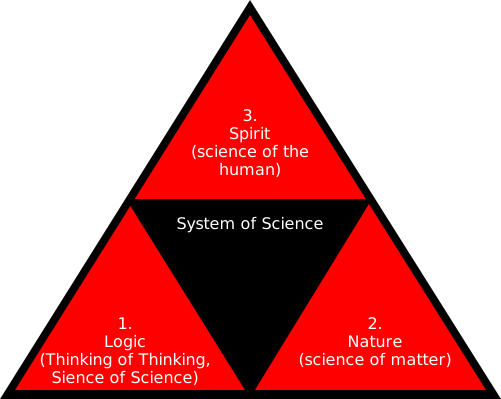
The Berlin Studies: In Berlin, Uexküll attended Hegel’s lectures on the philosophy of nature—documented for the semesters of 1821/22 and 1823/24. He had professional transcripts made of these lectures, which today count among the most important sources for Hegel’s oral teaching.[3]
The Correspondence: Uexküll conducted an “extensive correspondence” with Hegel—so Rosenkranz reports in his biography of Hegel.[4] This correspondence was entirely destroyed in 1905 in a fire at the ancestral castle in Estonia—an irreplaceable loss for Hegel scholarship.
Cultural Position: As a wealthy German-speaking Baltic nobleman, Uexküll belonged to that thin educated stratum that connected the Russian Empire with Western Europe. He did not belong to the Russian-speaking intelligentsia, but to the German upper class of the Baltic provinces—culturally closer to Berlin than to Moscow.
The Failed Visit to Russia - Franz von Baader (1823)
Uexküll attempted to bring important German thinkers to Russia. Franz von Baader (1765-1841) was meant to travel to Russia in 1823—Uexküll had also invited Hegel himself on this trip.[5]
Who was Baader? Franz von Baader was a philosopher, mining engineer, and a central figure in Munich’s cultural life. He developed an independent speculative philosophy that combined Christian mysticism (especially Meister Eckhart) with post-Kantian idealism. Hegel valued Baader and received him in Berlin; Baader had introduced Hegel to Meister Eckhart.[6]
The Failed Journey: Uexküll had met Baader in Munich in 1821 (through a recommendation from Rahel Varnhagen) and brought him to Estonia in 1823. Baader traveled in connection with his efforts toward reconciliation between the churches. But he did not succeed in reaching St. Petersburg—after waiting months for entry permission, he received a rejection and returned to Berlin in December 1823, where he stayed until early summer 1824, associating extensively with Hegel and Marheineke.[7]
Hegel’s Judgment: In a letter to Uexküll (November 28, 1821), Hegel commented on Baader:
“It is said that a prophet is not worth much in his own country; I would have thought that in Russia he would be esteemed. It does not yet seem so. You look right past him. Such a prophetic man can, perhaps precisely because he is held in low regard, be in some ways less suspect, in others more effective, than someone else who is clear about himself and his thoughts, as about people and circumstances, and is thereby, among other things, more honest toward himself and others.”[8]
This ambivalent statement shows that Hegel valued Baader but also recognized his limits—the “prophetic man” was not “clear” about himself and the circumstances, not “honest” in the philosophical sense.
Significance for Uexküll: The invitation extended to both Baader and Hegel to come to Russia demonstrates Uexküll’s active role as a mediator at the highest philosophical level. He was not merely a passive listener but attempted to bring the most significant German philosophers to Russia. The failure of both attempts (Hegel presumably declined, Baader was not permitted to enter St. Petersburg) is characteristic of the structural difficulties of such mediation in the early nineteenth century.
Historical Significance - A Solitary Figure Without Consequence
Why Uexküll founded no school:
-
Language barrier: Uexküll moved in German circles. The Russian-speaking intelligentsia had no access to him.
-
Geographic isolation: His estate lay in Estonia, far from Moscow and St. Petersburg, the centers of intellectual life.
-
Lack of publication: Uexküll published nothing on Hegel. His transcripts remained private. The letters were lost.
-
Social difference: The Baltic-German nobility and the Russian intelligentsia were two separate worlds—culturally, linguistically, socially.
-
Failed mediation: His attempts to bring German philosophers to Russia failed—partly due to political obstacles (Baader), partly presumably due to lack of interest (Hegel).
The Paradox: Precisely the wealthy, well-connected, philosophically ambitious Uexküll—the first person from the Russian Empire to hear Hegel and correspond intensively with him—remained without consequence for the Russian reception of Hegel. When the Lyubomudry began studying Schelling and Hegel in 1823, they presumably knew nothing of him. By the time the Stankevich Circle systematically read Hegel in the 1830s, Uexküll had long since been forgotten.
Symbolic Significance: Uexküll stands for the structural limits of philosophical transmission in the early nineteenth century. Personal contact, intensive correspondence, high-level invitations—none of this was sufficient. What was needed was publication, translation, school formation—and above all: connection to the Russian-speaking intelligentsia in Moscow and St. Petersburg.
The actual Russian reception of Hegel begins in 1823 with the Lyubomudry—independently of Uexküll, by other paths, in a different milieu.
On Uexküll’s biography, see Jürgen-Detlev von Uexküll (ed.): Armeen und Amouren. Ein Tagebuch aus napoleonischer Zeit, Reinbek: Rowohlt, 1965. ↩︎
Johannes Hoffmeister (ed.): Briefe von und an Hegel, Vol. 2, Hamburg: Meiner, 1953, p. 406 (note to Letter 406): Uexküll “had heard Hegel in Heidelberg.” ↩︎
Thomas Posch / Gilles Marmasse (eds.): G.W.F. Hegel, Vorlesung über Naturphilosophie Berlin 1821/22. Nachschrift von Boris von Uexküll, Frankfurt a.M.: Peter Lang, 2002 (Wiener Arbeiten zur Philosophie, Vol. 6). ↩︎
Karl Rosenkranz: Georg Wilhelm Friedrich Hegels Leben, Berlin: Duncker & Humblot, 1844, pp. 303-305. Quoted in Hoffmeister (ed.): Briefe, Vol. 2, p. 406: the “extensive correspondence” was “destroyed in 1905 in a fire at the ancestral castle.” See also Kuno Fischer: Hegels Leben, Werke und Lehre, 2nd ed., Heidelberg 1911, p. 121. ↩︎
Hoffmeister (ed.): Briefe, Vol. 4/2, Hamburg: Meiner, 1981, p. 177 (note to Letter 450a): Uexküll had “also invited Hegel on this trip” (referring to Letter 421). ↩︎
On Baader, see David Baumgardt: Franz von Baader und die philosophische Romantik, Halle: Niemeyer, 1927. On Baader’s transmission of Meister Eckhart to Hegel, see Cyril O’Regan: The Heterodox Hegel, Albany: SUNY Press, 1994, pp. 47-52. ↩︎
Hoffmeister (ed.): Briefe, Vol. 4/2, p. 177 (note to Letter 450a): “Franz v. Baader traveled to Russia in 1823, together with Boris v. Uexküll […]. He did not, however, succeed in reaching Petersburg; after waiting months for entry permission, he received a rejection and returned first to Berlin in December 1823, where he remained until early summer 1824.” See also Varnhagen von Ense: Blätter aus der preußischen Geschichte, ed. Ludmilla Assing, Vol. 2, Leipzig 1864, pp. 167f., 182f., 190, 452. ↩︎
Hegel to Uexküll, November 28, 1821. Quoted in Rosenkranz: Hegels Leben, pp. 304f.; reprinted in Hoffmeister (ed.): Briefe, Vol. 2, p. 406 (note to Letter 406). ↩︎