Giovanni Gentile (1875-1944) - Actualism and Fascist Entanglement
This text is a preview of History of the Reception of Hegel, volume I, to be published in 2026 by Reflexivity Press.
Giovanni Gentile was Croce’s student, collaborator, and eventually philosophical opponent. Both began with shared projects - the journal La Critica, editions of Italian philosophers.[1] But their paths diverged philosophically and politically. Croce became the liberal critic of fascism, Gentile its official philosopher.
“The Reform of Hegelian Dialectic” - The Foundational Position (1913)
”La riforma della dialettica hegeliana” (1913)[2] developed Gentile’s foundational position: the reform of Hegelian dialectic. Hegel was right about dialectic, but he applied it wrongly. He treated spirit as an object, as a finished system, as a completed development. Against this, Gentile posited the “actual act” - the present, living act of thinking.
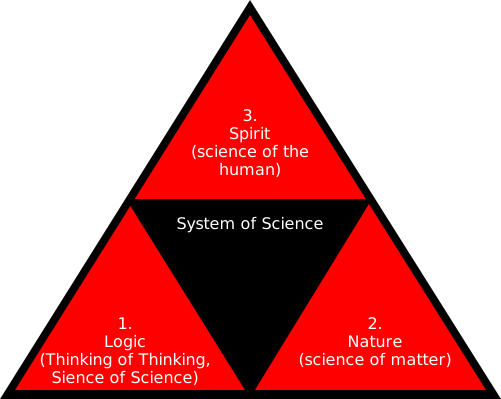
The central thesis of actualism: All being is atto puro - pure act of thought. Not the “thought-of,” not the result, but the “thinking of thinking” - the act of performance itself - is absolute reality. This thesis sounds like Aristotle’s noesis noeseos, but Gentile interpreted it in a radically subjectivist manner.[3]
The systematic insight: Gentile grasped an important aspect of Hegelian logic - processuality. For Hegel, the absolute idea is not a finished result but a “method that knows itself.”[4] It is the performance of thinking, not a thought content. In the terminology of our Logic interpretation: the Logic is performative - it explicates the structures that it itself carries out.[5]
The Radicalization - From Process to Arbitrariness
The consequence of Gentile’s thesis: the object does not exist independently of the thinking subject. It is constituted only in the act of thinking. The past does not exist “in itself” but only as thought-past in present consciousness. Nature does not exist independently but only as the correlate of the knowing spirit.
The critique of Hegel ran as follows: Hegel hypostatized spirit into an object. For Hegel, the “absolute idea” is a result, a finished structure, a system. But true spirit is never finished, never complete - it is continuous performance, pure actuality. Hegel’s error was to think the absolute as an “It,” not as an “I.”[6]
This critique contained an insight: Hegel’s system does indeed risk converting processuality into stasis. The absolute idea as “method that knows itself” could be misunderstood as a finished result. Gentile’s emphasis on actuality corrected this tendency.
The systematic problem: But Gentile’s radicalization went astray. By reducing everything to the present act of thinking, he lost all objectivity. The world becomes the product of my thinking - a solipsism unwilling to admit itself as such. The past becomes a mere construct of the present - a historicism without history.
In the terminology of our Logic interpretation: Gentile remained stuck in the subjective concept, without passing over to objectivity. The logic of the concept shows: the concept must objectify itself - in mechanism, chemism, teleology - in order to become truly concrete.[7] Gentile skipped this objectification and claimed that the pure act was already the absolute.
“Theory of Spirit as Pure Act” - The Consequences (1916)
”Teoria generale dello spirito come atto puro” (1916)[8] unfolded the consequences. Spirit constitutes itself in the act of thinking. This self-constitution is absolutely free - no nature, no law, no structure constrains it. Spirit is autoctisi - self-creation out of nothing.
This absolutization of freedom was philosophically untenable. If spirit constitutes itself entirely freely, why does it constitute itself in just this way and not another? Gentile’s answer pointed to the “will” - but with this he fell back behind Hegel into voluntaristic subjectivity.
The systematic diagnosis: Gentile repeated Fichte’s error - the reduction of dialectic to the I = I. Hegel had shown: the identity of the I is possible only through mediation with the not-I.[9] Self-consciousness constitutes itself in objectivity. Gentile ignored this insight and asserted an unmediated self-constitution.
In the terminology of our Logic interpretation: Gentile skipped over the logic of Essence. Mediation through the other, appearance, actuality, causality - all these structures are necessary for self-determination to be possible at all.[10] Without them, only empty assertion remains.
The Political Catastrophe - Fascism as Philosophy
The political consequence was fatal. If spirit is absolute self-creation, then the state too is an expression of this self-creation. The fascist state is not external power but the self-realization of the national spirit. Obedience to the state is obedience to oneself.
Gentile’s notorious formula: “tutto nello Stato, niente al di fuori dello Stato, nulla contro lo Stato” (everything within the state, nothing outside the state, nothing against the state).[11] The totalitarian state is reinterpreted as the realization of freedom.
Gentile became Minister of Education under Mussolini (1922-24). He reorganized the Italian education system along fascist lines. He wrote philosophical justifications of fascism. In 1943 he wrote the “Manifesto of Fascist Intellectuals”.[12] After 1943 he remained loyal to the Republic of Salò and was shot by anti-fascist partisans in 1944 - a tragic end to a philosophically misguided development.
The systematic question: Was this political instrumentalization accidental or systematically necessary?
Our answer: Systematically favored, but not necessary. Gentile’s philosophy of the pure deed, of spirit positing itself, could be read as a justification of the fascist leader-principle. The Duce as the realization of absolute spirit. If freedom is absolute self-creation, then the totalitarian state too can be interpreted as the realization of freedom.
But this interpretation was not compulsory. Actualism could equally have been interpreted democratically - as a philosophy of individual self-determination in each case. That Gentile chose the fascist variant also had biographical and political causes.[13]
The parallel to Germany: Gentile’s entanglement resembles that of some German followers of Hegel. In both cases, an affirmative theory of the state was instrumentalized. But there was one decisive difference: in Germany, racism was added into the mix - a dimension absent from Hegel and equally foreign to Gentile.[14]
Cf. Chapter 28: Fascism as a Philosophical Challenge - A Systematic Analysis
Systematic Assessment - Insight and Delusion
The achievement:
- Gentile’s actualism grasped the processuality of thinking.
- His critique of the hypostatization of spirit was justified.
- His emphasis on performance over result was important.
The limit:
- Reduction to subjectivity: Objectification was skipped.
- Arbitrary voluntarism: Without objective structures, only empty self-assertion remained.
- Political instrumentalization: Philosophy became a legitimation of totalitarianism.
From the standpoint of our Logic interpretation: Gentile grasped one aspect of the logic of the concept - the self-reference of the concept. But he skipped the necessary objectification. The Logic shows: the concept must pass through mechanism, chemism, teleology in order to comprehend itself.[15] Gentile wanted to leap directly to the absolute concept - and landed in emptiness.
On the collaboration and separation of Croce and Gentile, cf. Gennaro Sasso: Filosofia e idealismo, 3 vols., Naples: Bibliopolis, 1994-2000. ↩︎
Giovanni Gentile: La riforma della dialettica hegeliana, Messina: Principato, 1913. New edition Florence: Sansoni, 1954. ↩︎
Aristotle: Metaphysics XII, 9, 1074b33-35. Gentile’s subjectivist interpretation suppresses the objective dimension of noesis noeseos. ↩︎
G.W.F. Hegel: Science of Logic II, Werke vol. 6, p. 550: the absolute idea as “the thinking that thinks itself.” ↩︎
Hegel’s Science of Logic (in preparation), Ch. 1.5–1.6, performativity of the Logic: performative self-contradiction and its overcoming. ↩︎
Giovanni Gentile: Teoria generale dello spirito come atto puro, Pisa: Spoerri, 1916, pp. 45-78. ↩︎
Hegel’s Science of Logic (in preparation), Ch. 14–16, objectification of the concept: mechanism, chemism, teleology. ↩︎
Giovanni Gentile: Teoria generale dello spirito come atto puro, op. cit. ↩︎
G.W.F. Hegel: Phenomenology of Spirit, Werke vol. 3, pp. 145-155: self-consciousness constitutes itself through recognition. ↩︎
Hegel’s Science of Logic (in preparation), Ch. 4–8, the entire logic of Essence: necessary mediations for self-determination. ↩︎
Benito Mussolini (with Giovanni Gentile): La dottrina del fascismo, in: Enciclopedia Italiana, vol. 14, Rome: Treccani, 1932, pp. 847-851. ↩︎
The text is printed in: Renzo De Felice: Intellettuali di fronte al fascismo, Rome: Bonacci, 1985, pp. 141-147. ↩︎
On the biographical dimension, cf. Gabriele Turi: Giovanni Gentile. Una biografia, Florence: Giunti, 1995. ↩︎
On the German entanglement, see chapter 23, especially 15.4 on Theodor Haering. ↩︎
Hegel’s Science of Logic (in preparation), Ch. 14–16, the necessary objectification of the concept through mechanism, chemism, teleology. ↩︎