Benedetto Croce (1866-1952) - Liberal Historicism as a Transformation of Hegel
This text is a preview of History of the Reception of Hegel, volume I, to be published in 2026 by Reflexivity Press.
Benedetto Croce was the dominant figure of Italian philosophy in the first half of the twentieth century. Historian, aesthetician, literary critic, philosopher of culture, liberal politician - his influence extended far beyond academic philosophy. His reception of Hegel was selective, critical, and at the same time productive.
“What Is Living and What Is Dead” - The Programmatic Treatise (1906)
”What Is Living and What Is Dead in the Philosophy of Hegel” (1906)[1] was Croce’s programmatic treatise. The title signaled the approach: not to adopt or reject Hegel wholesale, but to distinguish between what is still alive and what is historically superseded. This critical appropriation was methodologically more demanding than mere defense or dismissal.
What is “living” in Hegel? Croce identified three central insights:
- Dialectic as the method of historical development: History is not a random sequence but an unfolding through contradictions. Every historical form generates problems that press toward its overcoming. This corresponds to what our interpretation of the Logic explicates as self-movement through immanent contradictions - though Croce applies this exclusively to history, not to logic itself.[2]
-
The unity of philosophy and history: Philosophical concepts are not timeless abstractions but develop historically. This thesis corresponds to the insight that the categories of logic have themselves become historical - but Croce draws from this the conclusion that there is only history, no supra-temporal structure.
-
The reconciliation of reason and actuality: History is not meaningless chaos but is rationally permeated. Croce adopts Hegel’s famous formula “What is rational is actual; and what is actual is rational”[3] - but interprets it historicistically: what prevails in history is thereby rational.
What is “dead” in Hegel? Croce rejected three aspects:
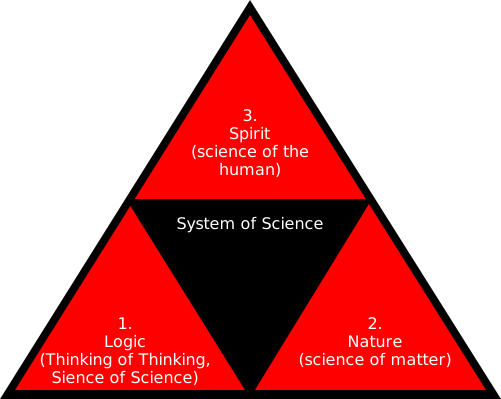
- The systematic logic: The Science of Logic is speculative construction without empirical content. The development of categories from Being through Essence to the Concept appeared to Croce as arbitrary metaphysics. This rejection overlooks that the Logic - as our interpretation shows - explicates precisely the structures of the cognitive process itself.[4]
-
The philosophy of nature: Hegel’s attempts to derive laws of nature from concepts were hopelessly misguided. Here Croce identified a genuine weakness of Hegelian philosophy.
-
The metaphysics of absolute spirit: The hypostatization of “spirit” into a supra-individual substance is mystical. Croce was right insofar as Hegel does occasionally treat spirit as a quasi-substance - but he overlooked that the Logic also allows spirit to be understood as the self-conscious structure of rationality.[5]
The Transformation: From Metaphysics to Method
This distinction was not arbitrary. Croce carried out a fundamental transformation: Hegel’s metaphysical philosophy of history became a methodological historiography. Dialectic is not a law of reality but the historian’s method of interpretation. Spirit is not a substantial power but the activity of historians seeking to understand the past.
The systematic problem: Croce resolved the dialectical tension between objectivity and historicity one-sidedly in favor of historicity. In the terminology of our Logic interpretation: he moved exclusively within becoming, without thematizing the structure of becoming itself. The Science of Logic explicates precisely how becoming is structured - which categories are necessary for anything to become at all.[6]
“All History Is Contemporary History” - The Radicalization of Historicism
”All history is contemporary history”[7] became Croce’s most famous thesis. The past does not exist in itself but only in its present significance. When we write history, we answer present-day questions posed to the past. The French Revolution “in itself” does not exist - there are only various interpretations of the Revolution arising from various presents.
This thesis was simultaneously Hegelian and anti-Hegelian:
- Hegelian: The recognition of the historicity of all knowledge.
- Anti-Hegelian: The rejection of an objective truth beyond perspectival interpretations.
Hegel had asserted the unity of objectivity and historicity - history develops according to immanent laws that the philosopher can recognize. Croce resolved this tension in favor of historicity: there is only the interpretation of the present moment, no supra-temporal truth.
The systematic consequence: Croce fell into a performative self-contradiction.[8] His thesis “all history is contemporary history” itself claims supra-temporal validity - it is meant to hold not merely for Croce’s present but for every era. It thereby undermines itself. In the terminology of our Logic: the content of the thesis (everything is time-bound) contradicts its performance (it claims supra-temporal validity).
Aesthetics - Croce’s Most Original Contribution
Aesthetics was Croce’s most original contribution. In Estetica come scienza dell’espressione e linguistica generale (1902)[9] he developed a theory of art as an autonomous form of cognition. Art is not a lower stage of conceptual cognition (as in Hegel) but an independent form of disclosing the world. Aesthetic intuition grasps the individual, the unique, the concrete - what the concept cannot grasp.
This elevation of art was a critique of Hegel’s hierarchy: art - religion - philosophy. Croce rejected the idea that philosophy is the higher form that “sublates” art. Different forms of world-disclosure are equal in standing, not hierarchically ordered.
The systematic significance: This pluralistic turn was important. It opened the way to a theory of multiple forms of rationality - an approach our interpretation of the Logic supports. The logic of the concept does not show the “highest” form of spirit but rather the structure of self-conscious rationality as such. Art, religion, philosophy are different ways in which this structure realizes itself.[10]
But Croce overstated the point: he separated the forms so radically that their systematic unity was lost. The question of how the different forms of rationality are connected remained unresolved.
Political Philosophy - Liberalism Against Fascism
Croce advocated his liberalism in numerous essays and as a senator. His liberalism was not laissez-faire economism but an emphasis on individual freedom, cultural diversity, and a critical public sphere. Against the rising tide of fascism, he defended the liberal order - unsuccessfully, but steadfastly.
In 1925 he wrote the “Manifesto of the Anti-Fascist Intellectuals” in response to Gentile’s fascist manifesto.[11] After 1943 he played a leading role in the reconstruction of Italian democracy.
The systematic connection: Croce’s liberal politics followed from his historicist philosophy. If there is no absolute truth, then political order must allow for plurality. Different interpretations of the world must be able to coexist. Totalitarian systems presuppose an absolute truth - precisely what Croce rejected.
Systematic Assessment - Achievement and Limit
The achievement:
- Croce’s historicization of philosophy grasped the historicity of all thought.
- His aesthetics honored art as an independent form of cognition.
- His liberalism combined Hegel’s insights with democratic values.
- His distinction between “living” and “dead” allowed selective appropriation instead of wholesale rejection.
The limit:
-
Reduction of dialectic: Dialectic was reduced from a universal logic to a mere historical method. The systematic dimension - the explication of the structures of cognition as such - was lost.
-
Dissolution of objectivity: The historicization of truth threatened to tip into relativism. If everything is merely contemporary history, there are no longer any supra-temporal standards. Croce had no answer to the question: how can we distinguish between better and worse interpretations?
-
Loss of systematic coherence: Selective appropriation led to the dissolution of systematic coherence. The historical dimension was separated from the logical - and thereby Hegel was reinterpreted as a historicist, which he was not.
From the standpoint of our Logic interpretation: Croce overlooked that the Science of Logic explicates precisely the structures of historicity itself. If everything is historical, then it must be clarified: what does “historical” mean? Which structures must a process have in order to count as “development”? The logic of Being (quality-quantity-measure) shows how qualitative leaps are possible within quantitative processes. The logic of Essence (reflection-appearance-actuality) shows how mediated determinations arise. The logic of the Concept shows how self-determination is possible.[12]
Croce separated history and logic - and thereby lost the possibility of understanding the logic of history.
Benedetto Croce: Ciò che è vivo e ciò che è morto della filosofia di Hegel, Bari: Laterza, 1906. German translation: Lebendiges und Totes in Hegels Philosophie, Heidelberg: Winter, 1909. ↩︎
Hegel’s Science of Logic (in preparation), Ch. 4–7, Logic of Essence: self-movement through immanent contradictions, especially chapters 11.9-7.8 (causality and reciprocity). ↩︎
G.W.F. Hegel: Elements of the Philosophy of Right, Preface, in: Werke vol. 7, Frankfurt/M.: Suhrkamp, 1970, p. 24. ↩︎
Hegel’s Science of Logic (in preparation), Ch. 1.3–1.6, Introduction: the Logic as explication of the structures of the process of truth. ↩︎
Hegel’s Science of Logic (in preparation), Ch. 9–18, logic of the Concept as the structure of self-conscious rationality, especially chapter 27 (the absolute idea). ↩︎
Hegel’s Science of Logic (in preparation), Ch. 1.6, becoming as the truth of being and nothing - the structure of becoming. ↩︎
Benedetto Croce: Teoria e storia della storiografia, Bari: Laterza, 1917, pp. 12-13. ↩︎
Hegel’s Science of Logic (in preparation), Ch. 1.5, the second failure - skepticism as a dead end: performative self-contradiction. ↩︎
Benedetto Croce: Estetica come scienza dell’espressione e linguistica generale, Milan: Sandron, 1902. German translation: Ästhetik als Wissenschaft vom Ausdruck und allgemeine Sprachwissenschaft, Tübingen: Mohr, 1930. ↩︎
Hegel’s Science of Logic (in preparation), Ch. 17, the differentiation of the idea into theoretical and practical idea: plurality of forms of rationality. ↩︎
The text is printed in: Benedetto Croce: Pagine sparse, vol. 2, Bari: Laterza, 1943, pp. 398-403. ↩︎
Hegel’s Science of Logic (in preparation): the entire system shows the structure of historicity — Hegel’s Science of Logic (in preparation), Ch. 3, measure: qualitative leaps; Hegel’s Science of Logic (in preparation), Ch. 4–7, logic of Essence: mediation; Hegel’s Science of Logic (in preparation), Ch. 9–18, logic of the Concept: self-determination. ↩︎