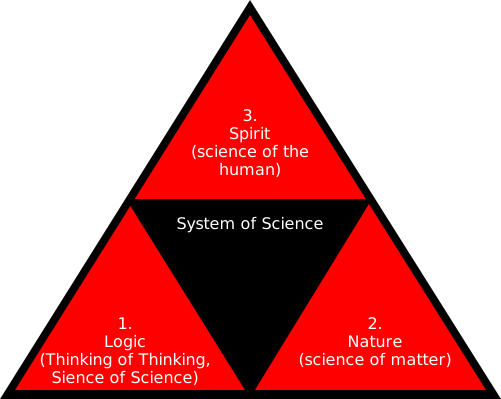
The Systematic Lesson: Contingency and Normativity
This text is a preview of History of the Reception of Hegel, volume I, to be published in 2026 by Reflexivity Press.
Darwin’s challenge remains current: if nature is contingent—how, then, do we ground norms? If the human being is a product of nature—whence its dignity? Three answers have been attempted:
1. Naturalistic reduction (Spencer, sociobiology): morality is evolutionary adaptation. Cooperation increases chances of survival, so we cooperate. Altruism is reciprocal—I help you so that you help me. Feelings of justice arise because free riders must be punished. All morality can be explained evolutionarily.
Problem: this explains the genesis of moral feelings, not their validity. That we feel pity (because it was evolutionarily advantageous) does not show that pity is right. The naturalistic fallacy remains: “ought” does not follow from “is.” Even if all human beings approved of slavery (because it was evolutionarily advantageous), slavery would not thereby be right.[22]
2. Dualistic separation (neo-Kantianism): nature is causality, spirit is freedom. The natural sciences describe facts, the humanities interpret meaning. Both domains are strictly separate. Evolution explains the body, but not reason. The human being is a citizen of two worlds—a natural being and a rational being.
Problem: how are the two connected? If spirit is entirely free of nature, how can it act within nature? How can freedom become a cause? Dualism generates insoluble riddles. And it is empirically untenable: neuroscience shows that consciousness depends on brain processes. The strict separation does not hold.[23]
3. Dialectical mediation (Hegel, updated): nature is contingent in its concrete forms, but not in its structure. The capacity for evolution, for self-organization, for the emergence of new complexity—that is not contingent. Nature necessarily brings forth structures that go beyond itself: self-referential systems (life), conscious systems (animals), self-conscious systems (humans). This emergence is not reducible.[24]
The human being is a product of nature—but a product of nature that transcends nature. Evolution has created the conditions for reason, freedom, morality—but these are not reducible to evolution. The human being can act against biological impulses (asceticism, sacrifice), can set purposes for itself (art, science), can know and shape nature (technology). This distinguishes it qualitatively from the animal—not gradually (more intelligent adaptation), but categorically (self-conscious teleology).
Normativity does not arise from nature, but from self-reflection. The human being can relate to its own drives, habits, traditions. It can ask: are these right? This question is itself not explicable evolutionarily—for it presupposes that there is a perspective beyond the factual. Reason is the capacity to transcend what exists. This is Hegel’s insight, updated for a post-Darwinian age.[25]